Who provides AC repair and replacement in Mesa?
The short answer: AZ Trusted Air repairs and replaces air conditioning across Mesa and the rest of the Phoenix metro under Arizona ROC license 317368. Diagnostics are $69.95 Monday through Friday 8am to 6pm, credited toward any repair, and the rate is the same at every Mesa address with no trip charge or zone pricing. A person answers the phone 24 hours a day, and typical non-emergency arrival is 12 to 24 hours.
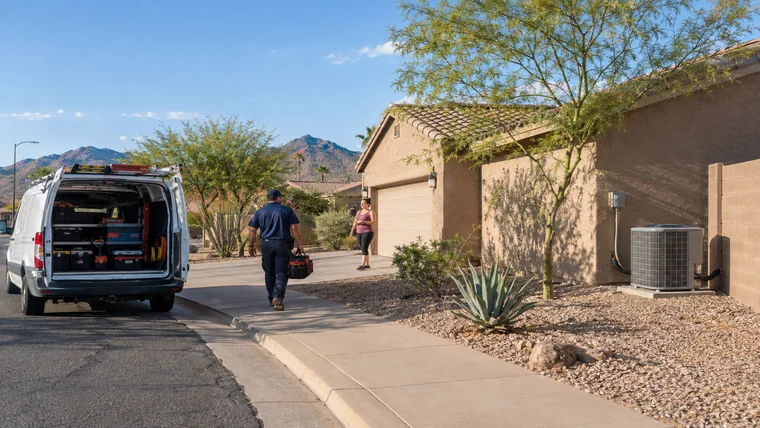
Mesa is not a new-build market and it is not an old one either. The housing runs from 1960s ranch stock near the downtown core out through the 1980s and 1990s subdivisions of central and west Mesa to the 2000s and newer product in the southeast, and the city's median construction year sits around 1989. That single fact shapes every air conditioning conversation we have here. There is no cohort wave in Mesa the way there is in a community where three thousand homes closed in the same eighteen months and their original equipment now fails in the same summer. What Mesa has instead is a long tail: a 1974 house with a rooftop package unit two streets from a 1998 house on its second split system, two streets from a 2016 house still under manufacturer warranty. Mesa is also one of the most heavily worked HVAC markets in the Valley, which means most homeowners here have already been sold something. Below is what we charge, what the rebate rules actually say, and how Mesa permitting differs from Phoenix.
- Mesa's housing runs 1960s through 2000s with a median construction year near 1989, so replacement demand here is a long tail rather than one cohort wave.
- Installed systems run $5,000–$7,000 at three tons, $6,000–$8,000 at four and $7,000–$10,000 at five; heat pumps carry no premium.
- Rooftop package units on older Mesa stock sit at the low end of the range, plus $400–$600 for the crane.
- Diagnostics are $69.95 weekdays 8am–6pm and $99.95 otherwise, credited toward repairs, at the same rate for every Mesa address — no trip charge.
- Coil cleaning ($150) and coil replacement ($2,200–$2,600) are different jobs; clarify any quote that just says “coil”.
- SRP Cool Cash pays $75/$150/$225 per ton by compressor type at SEER2 15.2+, needs both indoor and outdoor units replaced, and is filed within six months.
- Mesa's utility depends on your address: most of the city is SRP, but the City of Mesa's own electric utility serves about 18,000 customers near downtown.
- The federal 25C credit is repealed for anything placed in service after December 31, 2025, and APS ended residential equipment rebates on January 1, 2026.
What does a service call cost in Mesa, and how does scheduling work?
What that $69.95 buys is a measurement, not an opinion. On a Mesa service call our technician reads microfarads on the run capacitor, amp draw at the compressor and the condenser fan, suction and liquid pressures converted to superheat and subcool, and the temperature split across the evaporator — and writes those numbers where you can see them. That matters more in a market like this one than it sounds. In a place as thoroughly canvassed as central Mesa, homeowners who have owned the same house for twenty years consistently tell us they have already been handed a replacement quote by someone who never put a gauge on the system. Numbers on paper are the only thing that lets you check company two against company one.
Scheduling is the other half of the question. If your system quits at four in the afternoon in July, that hour is also the middle of SRP's summer on-peak window, which typically runs 2pm to 8pm on weekdays from May through October — SRP also offers a narrower three-hour plan, and the plan you are actually on is printed on your bill. So a Mesa failure at that hour is both a hot house and, once portable units and fans come out, an expensive one. We answer live at any hour and we dispatch overnight when a call genuinely warrants it. What we will not publish is a same-day guarantee, because in a Valley July no company can honour that for every caller who phones.
If you already have a diagnosis you do not trust, a second opinion is the same $69.95 or $99.95, credited toward work — and unlike a free inspection, the written report is yours whether you hire us or not. A quote review is free and needs no site visit at all. Ongoing care runs $25 per month per unit through our maintenance plan.
What does AC replacement cost for typical Mesa homes?
| System | Installed price in Mesa | What moves it within the range |
|---|---|---|
| 3-ton system | $5,000 – $7,000 | Efficiency tier; condition of line set and attic duct |
| 4-ton system | $6,000 – $8,000 | Efficiency tier; electrical work on older panels |
| 5-ton system | $7,000 – $10,000 | Efficiency tier; access and crane on rooftop units |
| Rooftop package unit | Low end, plus crane $400 – $600 | Curb condition and roof access |
| Mini-split, per head | $1,000 – $3,000 | Line-set routing, wall access |
Where a Mesa job lands in those ranges is usually decided by the decade the house was built rather than by the equipment brochure. On the older core stock we still find rooftop package units sitting on curbs cut when the house was framed, sometimes beside the capped shell of a long-dead evaporative cooler; that job needs a crane and a curb adapter, not just a new machine. Unlike a split system on a pad, where a bad day means a hot house, a package unit sits on a roof surface that runs far hotter than the shingle roof the same model would occupy in a moderate climate, and its cabinet and duct connections weather accordingly. In the 1990s and early-2000s subdivisions the outdoor unit is usually on a pad and the real cost driver is overhead: homeowners who open an attic hatch in August discover conditions in the 150-degree range, and flex duct that has been cooked at that temperature for twenty-five summers rarely survives a changeout intact. Newer southeast Mesa product around Eastmark and Cadence is a different conversation entirely, mostly still inside its manufacturer parts coverage.
Two rules bear on sizing and paperwork. Sizing here is a Manual J calculation against a design temperature near 115°F, not a guess copied off the old nameplate — and SRP's own rebate terms require the installing contractor to certify the load was estimated per ACCA Manual J and that installed capacity is within 15 percent or a half ton of that estimate. On permits, Mesa is its own jurisdiction: the City of Mesa issues mechanical permits through its Development Services department and its online portal, and the exemption Phoenix applies to most like-for-like outdoor swaps under five tons is a Phoenix rule, not a Mesa one. We confirm the requirement for your address and pull the permit when the work requires it.
What pushes a job above the typical range
These are the conditions that can push a job above the ranges above. We tell you before the work starts, not after — and they are worth checking on any contractor's quote, not just ours.
- Crane access on rooftop package units
- The existing line set cannot be reused with the new equipment
- Electrical panel lacks capacity or needs breaker work
- Ductwork is undersized, leaking, or hard to reach in the attic
- Code upgrades on an older home - grandfathering ends when equipment is replaced
- Refrigerant contamination, or an R-22 system needing conversion
Installed system price in Mesa — and where SRP's SEER2 15.2 rebate threshold falls
AZ Trusted Air published ranges. The split marks SEER2 15.2, the efficiency level SRP Cool Cash requires.
Cool Cash pays by the ton and by compressor type: $75 per ton single-stage, $150 multi-stage, $225 variable-capacity, reaching $1,125 on a 5-ton variable system. Confirm current SRP figures before relying on them, and note that municipal City of Mesa electric customers are not in SRP's program.
| Item | Range |
|---|---|
| 3-ton system | $5,000 – $7,000 |
| 4-ton system | $6,000 – $8,000 |
| 5-ton system | $7,000 – $10,000 |
What should Mesa homeowners check before approving a major AC repair?
Start by knowing what the repair should cost. Our published prices run $50 to $200 for a capacitor, $100 to $200 for a contactor, $600 to $1,200 for a condenser fan motor, $750 to $1,800 for a blower motor and $800 to $4,000 for a compressor, where the spread reflects whether the part is still warranty-covered. Duct replacement runs $1,000 to $3,000. Watch the coil line especially: cleaning a coil is $150 and replacing one is $2,200 to $2,600, and a quote that says only “coil” is a quote you should send back for clarification before signing. After a monsoon season of dust loading a condenser coil, a $150 cleaning is quite often the entire fix.
Then check the refrigerant, because in Mesa's build era this is a live question rather than a trivia one. Systems made through roughly 2010 may still be on R-22, whose production and import ended on January 1, 2020, leaving only reclaimed stock — so a leaking R-22 evaporator on a 2003 house is an economic decision, not a parts decision. Newer equipment is on R-410A, which manufacturers stopped producing for new residential split systems on January 1, 2025 under the EPA's AIM Act technology transitions rule; new systems now ship with lower-GWP A2L refrigerants such as R-454B. A 2026 EPA final rule allows pre-2025 R-410A units already in the supply chain to keep being installed until stock is depleted, which is why two honest Mesa quotes this year can name two different refrigerants. Our AC age checker and R-22 replacement pages walk through the nameplate.
Finally, verify the company, not the salesperson. Any Arizona homeowner can look up a license number and its complaint history at the Arizona Registrar of Contractors, and any technician handling refrigerant is required to be certified under EPA Section 608. In a saturated market like Mesa the marketing volume is high and the verification cost to you is about two minutes. If the numbers behind a big recommendation were never written down, that is the point to stop and use a repair-or-replace consultation.
A second opinion in Mesa is $69.95 during weekday hours and $99.95 outside them, credited toward any work you approve. The written report lists the measured values our technician took — capacitor microfarads against the nameplate rating, compressor and fan amp draw, superheat and subcool, and the supply-to-return temperature split — plus the equipment's model, serial, nameplate tonnage and refrigerant type, and whether the parts in question are still inside manufacturer coverage. Where we disagree with the first diagnosis, the report says which reading it disagrees with. Where we agree, it says that too. You keep the document either way, which is what makes it useful when you take it back to the first company.
Which rebates can Mesa residents claim on a replacement, and who handles the paperwork?
The SRP Cool Cash terms are worth reading closely, because three of them decide whether a Mesa rebate actually pays. First, equipment must be AHRI-listed at SEER2 15.2 or higher — above the federal regional minimum, so clearing code does not clear the rebate. Second, on a split system both the outdoor unit and the indoor air handler have to be replaced; a condenser-only swap does not qualify, which is the single most common reason a homeowner expecting a check does not get one. Third, the application is due within six months of installation, published program terms currently run installs through April 30, 2027, and SRP or its agent may inspect the installation. On a 5-ton variable-capacity system the $225-per-ton tier reaches $1,125. We file it, and SRP permits the rebate to be assigned to the contractor so it can come off the invoice instead of arriving by mail — see our rebate concierge page. Confirm current amounts with SRP before you rely on them; utilities change program cycles.
Mesa's utility map is genuinely unusual and this is where a generic page will mislead you. Most of the city is SRP, but the City of Mesa runs its own municipal electric utility serving roughly 18,000 customers inside about 5.5 square miles centred on downtown, and portions of the far east and southeast of the city fall to other providers. Mesa also sells natural gas across a much wider footprint than its electric territory, reaching well past the city limits. We cannot tell you from a community page which of those serves your house — it varies by address, your bill names your provider, and municipal-electric customers need to ask the City of Mesa's Energy Resources department directly what it offers, because SRP's program is not open to them.
Two things to disregard from older advice. APS discontinued its residential AC and heat pump rebates effective January 1, 2026 after its efficiency budget was cut, leaving only a smart-thermostat demand-response credit, and we are not an APS Qualified Technology Installer in any case. And the federal 25C Energy Efficient Home Improvement Credit was repealed: the IRS lists it as unavailable for any property placed in service after December 31, 2025, so no 2026 Mesa installation earns it. Any quote still adding it to your savings math is wrong by up to $2,000.
Sources and further reading
The figures and requirements on this page draw on the following public sources. We link them so you can check anything here yourself.
- SRP — current Cool Cash amounts, the SEER2 15.2 threshold and application deadlines
- Arizona Registrar of Contractors — verify a license number and its complaint history before approving major work
- U.S. Environmental Protection Agency — Section 608 — refrigerant handling certification, the R-410A phase-down and A2L transition
- ACCA (Air Conditioning Contractors of America) — Manual J load calculation, which SRP's rebate terms require the installer to certify
- AHRI Directory — confirm a quoted indoor and outdoor unit are a certified matched system at SEER2 15.2+
- U.S. Department of Energy — regional minimum efficiency standards and cooling system guidance
Send it however suits you — text a photo, email it, whatever is easiest. No site visit, no obligation, and nobody will call to ask when a salesperson can stop by. One flat rate at every Mesa address and across the surrounding communities, at any distance.