Who offers an honest repair-or-replace assessment in Phoenix?
The short answer: AZ Trusted Air runs repair-or-replace assessments across the Phoenix metro for $69.95 Monday to Friday, credited toward any work we perform. Our technician measures the system, prices the repair against a replacement, checks refrigerant type and SRP rebate eligibility, and hands you a written report you keep either way — including when the honest answer is repair it.
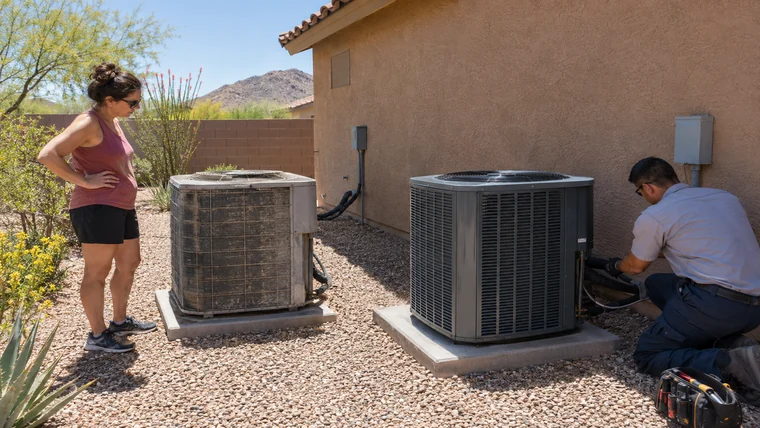
The repair-or-replace question is the one place in this trade where the person answering it has the most to gain from answering it wrong. A capacitor is a couple of hundred dollars. A four-ton changeout is six to eight thousand. Nobody needs a diagram to see where the incentive points.
So the useful thing is not a promise of honesty — anyone can type that — but a method you can check. Four inputs, each of them a number, each written down: what the repair costs, how old the system is against a Valley cooling season that starts in April and does not really let go until October, what the machine does with a dollar of electricity, and which refrigerant it holds. That last one has changed more in the past two years than in the previous fifteen, and it is now the input that decides most borderline systems in Phoenix.
- Four inputs decide it: repair cost, nameplate age, rated efficiency and refrigerant type — and all four belong in writing before anyone recommends anything.
- Arizona service life commonly runs 8 to 12 years against national tables of 15 to 20, because a Valley cooling season runs April into October rather than three months.
- No new R-22 has been produced or imported in the United States since January 1, 2020, and reclaimed supply now bills out at roughly $100 to $250 per pound installed — which is what usually ends the argument on a leaking R-22 system.
- R-410A is not banned: the AIM Act stopped manufacture and import of new R-410A residential equipment from January 1, 2025, but existing systems remain legal to run, service and recharge.
- SRP Cool Cash pays $75 per ton single-stage, $150 multi-stage and $225 variable-capacity, up to $1,125 on a five-ton, requires SEER2 15.2, and on split systems will not pay for a condenser-only swap.
- The IRS states the section 25C credit is not allowed for property placed in service after December 31, 2025, so any 2026 Phoenix quote showing a federal HVAC credit is quoting a repealed provision.
- The assessment is $69.95 Monday to Friday 8am to 6pm and $99.95 outside those hours, credited toward any repair, with no trip fee anywhere in the service area.
How does AZ Trusted run the math (repair cost, age, efficiency, refrigerant status)?
Here is the whole method, with nothing held back for the kitchen-table conversation. Four inputs, each of them checkable by you, and the report we leave behind fills in every cell.
| Input | What we measure | What tips it toward replacement |
|---|---|---|
| Repair cost | The failed part, priced at our published range | Repair approaching a third or more of installed replacement cost |
| Age | Nameplate manufacture date, not the date you moved in | Past 10 years with a major component failing |
| Efficiency | Rated SEER2 versus what a new matched system would deliver | Equipment predating the 2023 SEER2 rules, running an 8-month season |
| Refrigerant status | Nameplate charge type: R-22, R-410A, R-454B or R-32 | R-22 with a leak, or a large R-410A charge loss |
There is an old rule of thumb in this trade — multiply the repair price by the age of the unit and replace if the product clears five thousand. It is not useless, but it was written for a national market, and national lifespan tables mislead Valley homeowners badly. Sources across the Arizona market put local service life in the range of 8 to 12 years in extreme-heat zones, well under the national figure, and the U.S. Department of Energy's general guidance of roughly fifteen to twenty years simply describes a machine that gets six months off every year. Ours does not. A Phoenix condenser that runs April into October has done in eight seasons what a Portland condenser does in twenty.
Refrigerant status is the input that changed
What we find on 1990s and early-2000s Phoenix rooftops is still a surprising amount of R-22 equipment, quietly working. Nothing about that is illegal. No new R-22 has been manufactured or imported into the United States since January 1, 2020; existing equipment can still be used and serviced from reclaimed or previously produced supply, and the EPA does not require a homeowner to replace a working R-22 system. The problem is arithmetic, not law: R-22 typically runs $100–$250 per pound installed in 2026 because every pound now comes from reclaimed or stockpiled supply. On a leaking three-ton system that is a four-figure recharge that buys you nothing structural. That is the single most common case where we tell a homeowner the repair is not worth doing — and it is why we keep a separate page on R-22 system replacement.
R-410A is a milder version of the same story, and it is worth understanding before someone uses it to frighten you. R-410A is not banned: the AIM Act prohibited manufacture and import of new R-410A residential AC equipment from January 1, 2025, but service refrigerant remains legal and you can recharge an existing system without issue. R-410A has a global warming potential around 2,088, and new residential equipment has shifted to R-454B or R-32. Homeowners who are told their R-410A system is now “illegal” are being sold something. What is true is that the phase-down is tightening supply and the price is drifting up, which matters if your system is losing a substantial charge every season rather than needing a one-time top-off. If you are replacing now, you are almost certainly getting an A2L machine — see R-454B installation for what that changes about the install.
Where the rebate changes the arithmetic
The efficiency input is not abstract in SRP territory, because SRP pays by the ton and by compressor type. Cool Cash pays $75 per ton on single-stage systems, $150 per ton on multi-stage and $225 per ton on variable-capacity systems and inverter-driven mini-splits, up to $1,125 on a 5-ton; equipment must be SEER2 15.2 or better, installed by an Arizona-licensed contractor, with the application filed within six months. Two conditions catch people: on split systems both the condenser and the air handler must be replaced, so a condenser-only swap does not qualify, and a Manual J load calculation is required for single-stage systems, though not for multi-stage or variable-capacity ones. That last requirement is doing real work in a market where oversizing has been the default habit for decades. We handle the paperwork side through our rebate concierge.
Two things we will not pretend about. APS: we are not enrolled as an APS Qualified Technology Installer, so we will not quote an APS equipment rebate. Verify current APS residential program terms with APS directly before making a replacement decision that depends on one. Federal credits: the IRS states the section 25C energy efficient home improvement credit will not be allowed for any property placed in service after December 31, 2025. Any 2026 Phoenix quote still showing a $2,000 federal heat pump credit is quoting a repealed provision. Check your own bill for your utility — it names it — and treat anything else you are told about incentives as something to verify.
Where the repair sits against the replacement
AZ Trusted Air published ranges, Phoenix metro. The decision is only hard where the bars overlap.
A capacitor or a fan motor is never a replacement argument. A compressor at the top of its range on an older R-22 system usually is. SRP Cool Cash requires SEER2 15.2 and pays $75 to $225 per ton by compressor type, up to $1,125 on a five-ton — confirm current terms with SRP before relying on them.
| Item | Range |
|---|---|
| Capacitor | $50 – $200 |
| Condenser fan motor | $600 – $1,200 |
| Coil replacement | $2,200 – $2,600 |
| Compressor | $800 – $4,000 |
| 3-ton replacement | $5,000 – $7,000 |
| 5-ton replacement | $7,000 – $10,000 |
What does the consultation cost, and is it credited toward work performed?
| What you are buying | Price | Notes |
|---|---|---|
| Repair-or-replace assessment (diagnostic visit) | $69.95 | Mon–Fri, 8am–6pm; credited toward any repair we perform |
| Same, outside those hours | $99.95 | After 6pm any day; 6pm Friday to 8am Monday |
| Second opinion on another company's diagnosis | $69.95 / $99.95 | Credited; the written report is yours either way |
| Quote review — no site visit | Free | Send the quote any way that suits you |
| Travel, trip or zone charge | None | Anywhere in our service area |
The credit is the part that decides whether an assessment is advice or a sales call. If the answer is a $50–$200 capacitor, the $69.95 comes off that invoice and you have paid two hundred dollars or less to have the question settled. If the answer is a system, it comes off that too. The only scenario where the fee stays spent is the one where you take the report and do nothing with us, which is a legitimate outcome and the reason the report is written to be readable by a competitor.
On timing: we answer the phone 24 hours a day, seven days a week, and it is a person rather than voicemail. We dispatch overnight when a call genuinely warrants it — a house at 95 degrees with an infant or an elderly resident in it does warrant it. Typical non-emergency arrival is 12 to 24 hours. We do not publish a same-day guarantee, because in a Phoenix July that is a promise the whole market makes and very little of the market keeps. If your system is down right now, start at emergency AC repair instead of here.
What pushes a job above the typical range
These are the conditions that can push a job above the ranges above. We tell you before the work starts, not after — and they are worth checking on any contractor's quote, not just ours.
- Crane access on rooftop package units
- The existing line set cannot be reused with the new equipment
- Electrical panel lacks capacity or needs breaker work
- Ductwork is undersized, leaking, or hard to reach in the attic
- Code upgrades on an older home - grandfathering ends when equipment is replaced
- Refrigerant contamination, or an R-22 system needing conversion
Will AZ Trusted recommend a repair even when a replacement would earn more?
The cases that come back as “repair it” are not exotic. Homeowners who look at their condenser after a monsoon haboob consistently find a coil packed with a felt of fine dust and cottonwood fluff, and a machine that is struggling to reject heat at 115 degrees because it cannot breathe. That is a $150 coil cleaning, not a system. Unlike a coastal climate where a condenser coil silts up slowly over years, a Valley coil can lose serious capacity across a single dust event — which is exactly why the symptom (weak cooling, long run times, high bill) mimics a failing compressor closely enough to be sold as one.
Capacitors are the other one. They fail constantly here because they sit in an outdoor cabinet that spends the afternoon well past its rating, and they are the cheapest part on the machine. A capacitor presented as evidence that a system is finished is the single most common thing our second opinion overturns. So is a “coil” line item that never says whether it means cleaning at $150 or replacement at $2,200–$2,600. Those two words are separated by about two thousand dollars, and blurring them is not an accident.
When we do say replace, here is what the report has to show
Replacement earns its recommendation when the numbers converge, not when one of them looks bad. An R-22 system past ten years with a compressor failure is the clearest case in this market: the compressor alone runs $800–$4,000, the recharge is at reclaimed-supply prices, and the machine remains a machine with a finite and shrinking refrigerant supply behind it. On rooftop package units — which dominate large stretches of Phoenix, Glendale and the older West Valley tract housing in a way they simply do not in most of the country — add crane service at $400–$600 and the calculus shifts again, because the labour to get a dying unit off the roof gets spent either way. Our rooftop package unit page covers that job specifically.
And sometimes the honest answer is neither. What we find on Phoenix rooftops in July is equipment being blamed for a duct system that is dumping cooled air into a 165-degree attic. Phoenix attics can easily reach 165+ degrees, and that heat degrades ductwork over time until seals break and cold air leaks into the attic instead of the house. Replacing the condenser does nothing about that. Duct sealing and repair at $1,000–$3,000 for a full replacement is often the better dollar, and SRP's separate duct program covers 75% of duct testing and qualified sealing costs up to $400 for a single-family detached home, when the work is done by a BPI-certified contractor and submitted within six months.
Permits, and why “we always pull one” is the wrong answer
You will see contractors claim a permit is always required in Phoenix. The City of Phoenix Planning & Development permit-exemption guidance says otherwise for one specific case: repair or replacement in kind of refrigeration units not over 5 tons of refrigeration capacity in one or two-family dwellings, when located outdoors. The city also runs a counter vetting procedure for exempt status, and if any of its questions gets a yes — including whether the replacement sits in a different location — a permit is required. Replacement of refrigeration systems located inside a building requires a permit. We pull permits when the work requires it, and we tell you which side of that line your job falls on before it starts. Outside city limits, the issuing jurisdiction and the answer can differ — verify with whoever issues your permits, not with a contractor's blanket claim.
Blank report template. Every field below is completed during the assessment before a repair-or-replace recommendation is made.
| System identity | Model / serial / manufacture date / tonnage / refrigerant |
|---|---|
| Measured readings | Capacitance / amp draws / pressures / temperature split |
| Diagnosis | Failed component and supporting readings |
| Repair path | Repair price and expected remaining service life |
| Replacement path | Installed price by tonnage, plus crane, duct or electrical findings where applicable |
| Rebate and permit status | SEER2 15.2 eligibility, SRP tier and permit applicability |
| Technician recommendation | Repair / replace / further diagnosis |
What written deliverable do I get to make the decision with?
A verbal recommendation is not a deliverable. It cannot be compared, cannot be shown to a spouse who was at work, and cannot be handed to a second contractor without being reduced to “the guy said…”. Here is what is on the page instead.
| Section of the report | What it contains | Why it matters later |
|---|---|---|
| System identity | Nameplate model, serial, manufacture date, tonnage, refrigerant type | Establishes real age and refrigerant status — not a guess from the install sticker |
| Measured readings | Capacitor microfarads against rating, amp draws, pressures, temperature split | Turns a diagnosis into something another technician can check |
| Repair path | Named part, our published price, expected remaining service life | Lets you weigh the repair on its own terms |
| Replacement path | Installed price by tonnage, crane if rooftop, duct and electrical findings | No “starting at” numbers that grow at signing |
| Rebate and permit status | SEER2 15.2 eligibility, SRP Cool Cash tier, whether a permit applies | The two items most often left off a quote entirely |
The report is yours whether you hire us, hire someone else, or do nothing for a year. That is deliberate. Unlike a proposal designed to expire at midnight, a document that survives the visit is the only version of this advice that is worth anything to you — and it is also what lets you verify us. Our licence is ROC 317368 and the Arizona Registrar of Contractors publishes licence status and complaint history on every contractor in the state, including ours. Check it before you spend seven thousand dollars with anybody.
If you already have a quote in hand and no equipment failure to diagnose, you do not need this visit at all. Send it to us and the quote review is free, with no site visit and no salesperson calling to ask when they can stop by. If you are just trying to work out how much life is left in what you have, start with the AC age checker, and see published pricing for every number quoted on this page.
Sources and further reading
The figures and requirements on this page draw on the following public sources. We link them so you can check anything here yourself.
- SRP — current Cool Cash per-ton amounts, the SEER2 15.2 threshold and the six-month filing window
- U.S. Environmental Protection Agency — refrigerant handling rules, the R-22 phase-out and the AIM Act R-410A phase-down
- City of Phoenix Planning & Development — work exempt from permit, and the counter vetting questions for exempt AC replacement
- Arizona Registrar of Contractors — licence verification and complaint history — check any contractor before a five-figure decision
- U.S. Department of Energy — general service-life and efficiency guidance, and why national figures run long for desert climates
- AHRI Directory — confirm the quoted indoor and outdoor units are a certified match at the rated SEER2
- ACCA (Air Conditioning Contractors of America) — Manual J load calculation, required by SRP on single-stage rebate applications
No site visit, no obligation, and nobody calls to book a salesperson. If you would rather have the system looked at, the assessment is $69.95 Monday to Friday and credited toward the work — one flat rate across the Phoenix metro. Call (623) 252-6403; a person answers, 24 hours a day.