Who Offers 24/7 Emergency AC Repair in Phoenix — and What Actually Happens When You Call at 2am
The short answer: AZ Trusted Air answers the phone 24 hours a day, seven days a week across the Phoenix metro — a live person, not voicemail, and not a service that leaves a message for morning. When a call genuinely warrants it, we dispatch overnight. Most non-emergency calls are handled within 12 to 24 hours. Arizona ROC 317368.
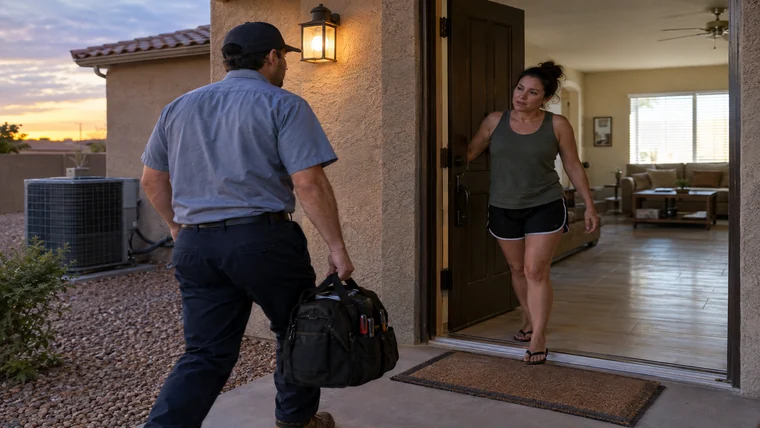
An air conditioner failing in a Phoenix August is not an inconvenience the way it is in Denver or Atlanta. Maricopa County's own death review makes that unusually explicit: among indoor heat-related deaths in 2025, an air conditioning unit was present in 94 percent of cases, and in 72 percent of those the unit was not working. The equipment was there. It had simply stopped. So this page is written for the person reading it at eleven at night with a house at 92 degrees, and it tries to answer four things in order — who actually picks up, what it costs before anyone knocks, how the queue really works in July, and what to do for the hours in between. The prices and the availability below are ours. The heat-safety part applies whoever you call.
- Among Maricopa County indoor heat-related deaths in 2025, an air conditioner was present in 94 percent of cases and was not working in 72 percent of those — a broken AC here is a safety issue, not a comfort issue.
- AZ Trusted Air answers live 24 hours a day, dispatches overnight when a call warrants it, and quotes typical non-emergency arrival at 12 to 24 hours. No same-day or fixed-hour guarantee is published, because in July none can be kept.
- Diagnostics are $69.95 Monday to Friday 8am–6pm and $99.95 outside those hours, credited toward the repair. There is no emergency surcharge and no trip or zone fee at any distance in the Phoenix metro or Pinal corridor.
- Most after-hours no-cooling calls end in a small part: a capacitor at $50–$200 or a contactor at $100–$200, not a replacement.
- If the indoor coil has iced, set the thermostat to OFF and the fan to ON. Running a compressor against an iced coil can turn a small repair into a $800–$4,000 one.
- Maricopa County's Heat Relief Network runs May 1 to September 30 with 200-plus mapped cooling, respite and hydration sites, and 211 Arizona takes live calls 9am to 7pm daily.
- Renters: under A.R.S. § 33-1364, cooling where installed and offered is an essential service, and remedies begin only once written notice is given to the landlord.
- The ACC summer disconnection moratorium runs June 1 to October 15 for APS, TEP and UNS Electric; SRP is not ACC-regulated and sets its own policy, so your bill tells you which rules apply.
What are AZ Trusted Air's after-hours rates — published, not surprise?
| Visit | Price | When it applies |
|---|---|---|
| Diagnostic / service call | $69.95 | Monday–Friday, 8am–6pm |
| After-hours service call | $99.95 | After 6pm any day, weekends, holidays |
| Credit against repair | Full fee | Either rate, credited toward work we perform |
| Emergency or holiday surcharge | None | The $99.95 is the whole after-hours difference |
| Travel / trip / zone fee | None | Same price in Arcadia as in Casa Grande |
The reason to publish this is that the after-hours call is the single easiest moment in this trade to take advantage of somebody. You are hot, you are tired, the house is not cooling and it is dark outside. A number invented on your doorstep at that moment is a number almost nobody argues with. Ours is written down here before you dial, and the difference between the daytime and the night rate is thirty dollars, not a multiplier.
What we find on Phoenix rooftops at one in the morning is that the emergency itself is usually cheap. The failures that take a system down in the heat are, more often than not, a capacitor at $50–$200 or a contactor at $100–$200 — a part the size of a soup can, cooked by 115-degree ambient air and by a condenser coil packed with monsoon dust. Unlike a mechanical failure in a mild climate, where a struggling capacitor may limp along for two more seasons, a weak capacitor in a Valley July gets found within days because the equipment never gets a low-load night to hide behind.
Two things we will not do at 2am. We will not quote a system replacement in the dark on a rooftop, because you cannot properly assess ducting, static pressure or electrical capacity by flashlight, and a replacement decision made at that hour is a decision made under duress. And we do not change the price of a job because it is financed — financing is third-party and credit-dependent, and the number on the invoice is identical either way. If the honest answer at 3am is a temporary repair to get you through to daylight, that is what you will be told.
What actually fails on a Phoenix emergency call — published repair ranges
AZ Trusted Air published repair prices. The same price at 2am as at 2pm; only the diagnostic fee differs.
Coil cleaning ($150) and coil replacement ($2,200–$2,600) are separate jobs and are not shown here. The compressor spread reflects whether the part is still under manufacturer warranty.
| Item | Range |
|---|---|
| Capacitor | $50 – $200 |
| Contactor | $100 – $200 |
| Condenser fan motor | $600 – $1,200 |
| Blower motor | $750 – $1,800 |
| Compressor | $800 – $4,000 |
When can I expect a technician during a Phoenix summer breakdown?
Here is the arithmetic nobody advertising a two-hour response wants to spell out. Phoenix routinely records more than 100 days above 100°F in a single cooling season — a load profile unlike almost anywhere else in the country. On extreme-heat days every HVAC company in the Valley is running the same finite number of trucks against a call volume that can triple overnight. A company promising every caller a same-day arrival on a 116-degree Tuesday is promising something the physics of scheduling will not allow, and the homeowner who was promised it is simply the one who finds out last.
So we triage instead. A house with no cooling at all and an 88-year-old occupant moves ahead of a house with one warm bedroom. Overnight dispatch happens when the call warrants it, which in practice means total failure, a safety issue, or a vulnerable occupant. Homeowners who have sat through a Phoenix breakdown consistently report that the worst part was not the wait itself but not knowing its length — so we would rather tell you honestly that you are third in line than tell you two hours and arrive at seven.
What makes your call faster once you are on the list
| Have ready | Why it matters |
|---|---|
| Thermostat reading and set point | A 10-degree gap and a 25-degree gap are different problems |
| Whether the outdoor unit is running, humming or silent | Separates a control fault from a locked compressor before the truck rolls |
| Whether a breaker has tripped, and how many times | Repeated tripping is an electrical fault, not a nuisance |
| Rooftop or ground-level equipment | Rooftop package units need ladder access and, after dark, lighting |
| Gate, guard-gate or HOA access details | Master-planned communities across the north Valley and Pinal corridor gate after hours |
| Age of the system, roughly | Pre-2010 equipment may be R-22, which changes the repair conversation entirely |
That last row does real work in this market. R-22 equipment is still running in plenty of 1990s and 2000s Valley housing stock, and the EPA's Section 608 rules govern how that refrigerant is recovered and handled — production ended years ago, so a large R-22 leak at midnight is a replacement conversation, not a top-up. If that is your situation, the R-22 replacement page covers it properly in daylight.
One piece of good news on timing: the City of Phoenix exempts most like-for-like outdoor equipment swaps under five tons from permitting, so a straight changeout the next morning is not usually held up waiting on paperwork. Work that touches ductwork, electrical or a change in equipment type more often does require a permit, and we pull it when it is required.
What pushes a job above the typical range
These are the conditions that can push a job above the ranges above. We tell you before the work starts, not after — and they are worth checking on any contractor's quote, not just ours.
- Crane access on rooftop package units
- The existing line set cannot be reused with the new equipment
- Electrical panel lacks capacity or needs breaker work
- Ductwork is undersized, leaking, or hard to reach in the attic
- Code upgrades on an older home - grandfathering ends when equipment is replaced
- Refrigerant contamination, or an R-22 system needing conversion
What should I do while waiting for an emergency technician in extreme heat?
The Heat Relief Network is the specific local resource worth knowing by name. Run jointly by the Maricopa County Department of Public Health and the Maricopa Association of Governments, it opens each year on May 1 and runs through September 30, with an interactive map of more than 200 cooling centers, respite sites and hydration stations — searchable by hours, services and whether the site takes pets. 211 Arizona staffs live bilingual operators from 9am to 7pm daily, and they can point to utility help and emergency A/C repair assistance as well as a cool room.
The hours before we arrive
| Do this | Why |
|---|---|
| Shut the system off at the thermostat if the outdoor unit is silent but the indoor fan runs | Circulating attic-temperature air through leaky ducts can make the house hotter, not cooler |
| If the indoor coil has iced, set the thermostat to OFF and the fan to ON | Thaws the coil; running the compressor on ice can destroy it and turn a $50 night into a $800+ one |
| Pull the outdoor disconnect if you smell burning | Removes power at the unit rather than trusting a breaker that already failed to trip |
| Close blinds on south and west glass; open the house up only after outside drops below inside | On the worst nights that crossover may never come — Phoenix has run 16 consecutive nights without dropping below 90 |
| Move to one room and cool that room | A portable or window unit cools 200 square feet far better than it cools 2,000 |
| Check on the neighbours who live alone | Indoor heat deaths in this county are disproportionately found on welfare checks |
Renters have statutory footing here that many do not know about. Under A.R.S. § 33-1364, air conditioning where installed and offered is an essential service, and a tenant who gives the landlord notice has defined remedies — procuring reasonable cooling and deducting the reasonable cost from rent, claiming diminished rental value, or obtaining substitute housing. The Arizona courts publish a fill-in notice form for exactly this. The rights do not arise until notice is given, which is why the written notice matters more than the phone call.
And on power: if your outage is a disconnection rather than a breakdown, the Arizona Corporation Commission's summer moratorium runs June 1 through October 15, and APS, TEP and UNS Electric have opted into it, with APS additionally agreeing not to disconnect on days above 95 degrees. SRP is not ACC-regulated and sets its own policy, so your bill tells you which set of rules you are under. That is a utility call, not an HVAC call, and making it first will save you a diagnostic fee.
Last thing, and the most important on this page: public health guidance is consistent that confusion, hot dry skin, a body temperature above 103 degrees, or someone who has stopped sweating are signs of heat stroke. At that point this stops being an air conditioning problem. Call 911, then call us.
Maricopa County Department of Public Health, 2025 heat-related deaths report: an air conditioning unit was present in 94 percent of indoor heat-related deaths, and among those, the unit was not functioning in 72 percent of cases. Public data, not a company claim.
Which situations count as true emergencies and get priority?
| True emergency — call now | Can safely wait for daylight |
|---|---|
| No cooling at all with an extreme heat warning in effect | One room warmer than the rest of the house |
| Infant, elderly, disabled or medically fragile occupant | System cooling, but cycling more than usual |
| Burning smell, smoke, or scorch marks at the disconnect | Outdoor unit louder than it used to be |
| Breaker tripping repeatedly on reset | Blank thermostat with the system otherwise running — often batteries |
| Water staining or dripping through a ceiling below the air handler | Condensate dripping normally from the primary line outdoors |
| Total failure in a home with no second cooled room | A high summer bill on an otherwise working system |
The ceiling row deserves an explanation, because it is a Valley-specific trap. Most Phoenix homes with split systems carry the air handler in the attic, and the drain pan under it has a float switch that is supposed to shut the system down before the pan overflows. When a Phoenix attic is sitting at 150 to 170 degrees in July, the condensate load is enormous and a clogged primary line finds that pan quickly. Homeowners who open an attic hatch in August consistently discover what we are talking about within about ninety seconds. Unlike a basement furnace in a temperate climate, where a slow leak sits harmlessly on a concrete floor, this one is directly above your drywall.
The breaker row matters for a different reason. Resetting a breaker once is reasonable. Resetting it three times is asking a piece of safety equipment to keep overlooking a fault it has already detected — commonly a failing compressor drawing locked-rotor current, or a shorted condenser fan motor at $600–$1,200. That one is worth an after-hours call even if the house is still tolerable.
Rooftop package units get their own note. They dominate whole neighborhoods of Phoenix housing stock and are almost unknown in most of the country, and they fail differently: everything — compressor, coil, blower, heat section — sits in one cabinet baking in full sun on a surface that can run well above ambient all afternoon. At night, diagnosing one means a ladder, proper lighting and safe roof access, which is why we ask on the phone whether your equipment is on the roof. If yours is nearing the end, the rooftop package unit replacement page explains crane needs and what the changeout involves — crane service runs $400–$600 and is billed separately.
One more honest point about emergencies: the cheapest emergency is the one that happened in April instead of July. A great many of the capacitor, contactor and coil failures we attend on the worst nights of the year were visible as a measurement drift months earlier. That is the whole argument for an annual tune-up in a climate with a cooling season running April into October — national maintenance advice built around a four-month season quietly understates what a Valley system is asked to do.
Sources and further reading
The figures and requirements on this page draw on the following public sources. We link them so you can check anything here yourself.
- Maricopa County Department of Public Health — Extreme Heat — annual heat-related death reports and the Heat Relief Network dates and map
- Arizona Corporation Commission — summer utility disconnection moratorium, June 1 to October 15, and bill assistance programmes
- Arizona Revised Statutes § 33-1364 — tenant remedies when a landlord fails to supply air conditioning or cooling
- Arizona Registrar of Contractors — verify any contractor's licence before authorising after-hours work
- City of Phoenix Planning & Development — when a mechanical permit is required for a residential equipment change-out
- U.S. Environmental Protection Agency — Section 608 — refrigerant handling rules affecting legacy R-22 systems still in Valley housing stock
- U.S. Department of Energy — cooling system operation and efficiency guidance
A person answers at any hour, every day of the year. $69.95 diagnostic Monday to Friday 8am–6pm, $99.95 outside those hours, credited toward the repair. One flat rate across the Phoenix metro and the Pinal corridor — no trip fee, no zone pricing, at any distance.