Who Replaces Rooftop Package Units in Phoenix?
The short answer: AZ Trusted Air replaces residential rooftop package units across the Phoenix metro, from Sun City and Youngtown to Ahwatukee, Maricopa and Casa Grande. We handle the crane, the curb or adapter curb, the roof penetration and the duct transition. Package units sit at the low end of our published ranges, $5,000 to $10,000 installed, with crane service $400 to $600.
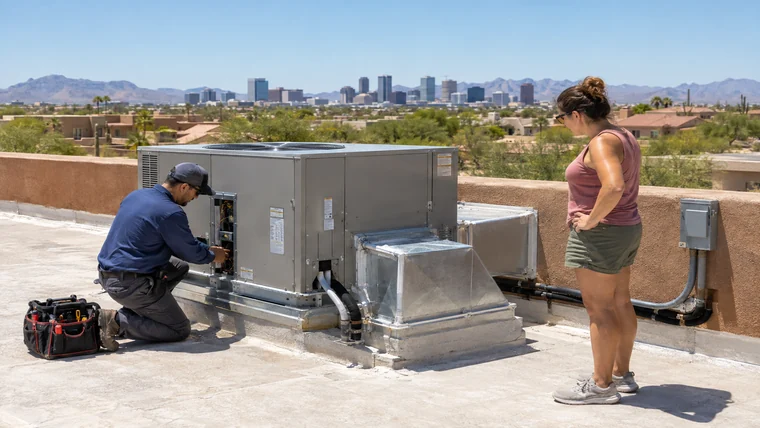
Large parts of the Valley’s housing stock never got a split system. Drive Sun City, Youngtown, Sunnyslope, older Glendale and Mesa, and much of the 1970s and 1980s tract building, and the air conditioner is a single steel box sitting on the roof over a ceiling plenum — compressor, coils, blower and, on a gas pack, the furnace, all in one cabinet in direct sun. It is a design that barely exists in most of the country and is completely ordinary here. Replacing one is not the same job as swapping a condenser in a side yard: there is a curb, a roof penetration, a duct transition, a lift, and in many cases a gas line. This page covers what that work actually involves in the Phoenix metro, what we charge for it, and the two or three places homeowners most often get a quote wrong.
- Rooftop package units concentrate in specific Valley housing stock — 1960s to 1980s homes, low-slope roofs, age-restricted communities and homes converted from evaporative cooling — and barely exist in most of the country.
- Installed ranges are $5,000–$7,000 for three tons, $6,000–$8,000 for four and $7,000–$10,000 for five, with package equipment typically in the lower half of each range.
- Crane service is $400–$600 and should appear as its own line; some single-story jobs with good access do not need a crane at all.
- SRP Cool Cash pays $75 per ton single-stage, $150 multi-stage and $225 variable-capacity on AHRI-listed SEER2 15.2+ equipment, so a five-ton single-stage package unit earns roughly $375, not the $1,125 headline figure.
- SRP requires an ACCA Manual J load calculation with single-stage applications and filing within six months of installation.
- APS discontinued its residential AC rebate effective January 1, 2026, and the federal 25C credit is repealed for equipment placed in service in 2026 — neither belongs in a 2026 quote.
- Phoenix exempts like-for-like outdoor replacements not over five tons in one- and two-family dwellings, but changing location, footprint or refrigerant type can pull the job back into permit territory.
- A package-to-split conversion is possible but usually costs more than replacing in kind, because the ductwork, return path and indoor equipment location all have to be created.
- Most changeouts are a single day on the roof once equipment and crane are confirmed; a built-to-order adapter curb is the usual reason a timeline stretches.
How does AZ Trusted Air handle crane scheduling, and what does the crane cost?
The crane is the part of a rooftop job that punishes poor planning. It arrives for a window, not a day. Two units come off and on in that window if the sequencing is right, and none do if the curb adapter is wrong or the disconnect has not been pulled. So the site check happens first: where the truck sets up, what it has to reach over, and whether there is a block wall, a mature tree, power lines or a narrow cul-de-sac between the truck and the roof.
Unlike a wide-lot property where the truck parks on the driveway and reaches straight up, tight age-restricted street layouts and alley-loaded lots in older Phoenix neighborhoods often force a longer reach from further back, which is the single most common reason a lift gets re-planned. Homeowners in gated and master-planned communities also run into something split-system owners never think about: gate access wide enough for a boom truck, and in some HOAs a scheduled window for heavy equipment. We ask about both at booking rather than finding out at 7am.
What the crane line covers — and what it does not
| Item | Price | Notes |
|---|---|---|
| Crane service, rooftop lift | $400 – $600 | Set-up, removal of old unit, placement of new unit |
| Travel to your address | None | No trip charge or zone pricing anywhere we serve |
| Curb adapter, if required | Quoted before the job | Fabricated to the old curb and new cabinet dimensions |
| Duct transition below the roof opening | Quoted before the job | Priced with the duct work, not with the lift |
Some changeouts do not need a crane at all. A single-story home with a low parapet and good ground access can sometimes be done with a boom or a properly rated lift, and where that is genuinely safe we say so and the crane line comes off the quote. Nobody should be paying for a crane that never showed up, and a rooftop quote that folds an unnamed “equipment charge” into the system price is worth a question before you sign. Our free quote review exists for exactly that sort of line.
What do package unit replacements cost (published ranges)?
Package equipment generally sits at the lower half of each range, because you are buying one cabinet rather than a matched condenser and air handler. The crane, the curb work and any duct transition are what bring a rooftop job back up toward the middle. That is the honest arithmetic, and it is why we itemise rather than quoting one number.
| Line | Price | What moves it |
|---|---|---|
| 3-ton package system, installed | $5,000 – $7,000 | Efficiency tier; condition of curb and roof deck |
| 4-ton package system, installed | $6,000 – $8,000 | Efficiency tier; electrical or gas work required |
| 5-ton package system, installed | $7,000 – $10,000 | Efficiency tier; access and reach for the lift |
| Package heat pump | Same by tonnage | No premium over straight-cool |
| Crane service | $400 – $600 | Reach required and staging space |
| Duct replacement, if the plenum runs are done | $1,000 – $3,000 | Extent, access and material |
| Diagnostic before any of it | $69.95 / $99.95 | Credited toward the work |
The rebate arithmetic is different on a package unit
This is where rooftop owners get told something inaccurate more often than anyone else in the Valley. SRP’s Cool Cash rebate pays by ton and by compressor type: $75 per ton on single-stage equipment, $150 per ton on multi-stage and $225 per ton on variable-capacity systems, on AHRI-listed equipment rated SEER2 15.2 or better. Most residential rooftop package equipment is single-stage, so a five-ton package changeout realistically earns around $375 — not the $1,125 figure that gets quoted from the variable-capacity column, which applies to a five-ton variable-speed system. SRP also requires an ACCA Manual J load calculation with single-stage applications and will not process the rebate without one, and the application has to be filed within six months of installation. Rebate amounts and program dates change between cycles, so confirm the current figure with SRP directly or let our rebate concierge pull it before you sign.
Two things you should not be promised. APS discontinued its residential AC and heat pump rebate effective January 1, 2026 following an Arizona Corporation Commission decision, so any 2026 quote sheet showing an APS AC rebate is out of date — and separately, we are not an APS Qualified Technology Installer, so we will never build an APS rebate into your numbers. The federal 25C tax credit is likewise repealed for equipment placed in service in 2026; it is not a discount available to you this year. If your bill says SRP or ED3, there is real money on the table. If it says APS, the honest answer is that the rebate landscape changed under everyone’s feet.
What pushes a job above the typical range
These are the conditions that can push a job above the ranges above. We tell you before the work starts, not after — and they are worth checking on any contractor's quote, not just ours.
- Crane access on rooftop package units
- The existing line set cannot be reused with the new equipment
- Electrical panel lacks capacity or needs breaker work
- Ductwork is undersized, leaking, or hard to reach in the attic
- Code upgrades on an older home - grandfathering ends when equipment is replaced
- Refrigerant contamination, or an R-22 system needing conversion
Installed package system price by tonnage, and where the SRP rebate threshold falls
AZ Trusted Air published ranges, Phoenix metro. Crane service is a separate $400–$600 line.
Package equipment usually lands in the lower half of each range; the crane at $400–$600 and any curb adapter are itemised on top. SRP Cool Cash pays $75 per ton on single-stage equipment at SEER2 15.2 or better, which is what most residential rooftop units are. Confirm current SRP amounts before relying on them.
| Item | Range |
|---|---|
| 3-ton package | $5,000 – $7,000 |
| 4-ton package | $6,000 – $8,000 |
| 5-ton package | $7,000 – $10,000 |
Can a rooftop package unit be converted to a split system, and when is it worth it?
The reason the conversion looks attractive on paper is real: getting the machine off a roof that hits punishing surface temperatures, and off a ladder for service, extends practical service life and makes maintenance easier. The reason it usually loses on paper is also real. A home built around a rooftop package unit has its ductwork arranged for down-flow supply through a ceiling plenum. There is frequently no closet, no attic platform and no return path sized for an indoor air handler, and creating one means framing, duct rework and drywall in addition to the equipment.
Unlike a like-for-like rooftop swap, which Phoenix often treats as permit-exempt, a conversion changes equipment type and location and involves ductwork and electrical — that is squarely permit territory, with inspection to follow. That is not a reason to avoid it; it is a reason to budget the real scope rather than the equipment price.
When we think a conversion genuinely earns its cost
- The roof structure or deck around the curb has deteriorated to the point that the opening should be closed rather than re-flashed.
- There is already a usable interior mechanical space — a converted swamp-cooler chase, a hall closet, a garage wall — so the air handler is not a construction project.
- The home is being re-ducted anyway, which is when duct geometry is on the table for free.
- You want capacity in specific rooms rather than the whole plenum, in which case ductless mini-splits at $1,000–$3,000 per head may beat both options.
- The house came off evaporative cooling and the ducting was never right for refrigerated air — see swamp cooler conversion.
Where none of those apply, we say so. Homeowners who ask us this question are usually surprised that the contractor talks them out of the bigger job, but the alternative is selling a $12,000 remodel to avoid a $600 crane. If you are still weighing the underlying question of whether to fix or replace at all, the repair-or-replace consultation and the AC age checker are better starting points than either quote.
Representative example. Illustrative layout, not a specific customer’s job: equipment by tonnage at the published range, crane at $400–$600 on its own line, curb adapter priced separately, and the duct transition below the roof opening shown as its own item. A rooftop quote that shows one number hides which of these you are actually buying.
How long does a rooftop replacement take from approval to inspection?
The realistic sequence looks like this. Approval and equipment confirmation; curb measurement and, if the new cabinet footprint differs, an adapter curb ordered to the old curb and new unit dimensions; the crane window booked; one working day on site for removal, set, seal, electrical, gas if fitted, duct transition and startup; then inspection where the work required a permit.
The variable that stretches timelines is almost never the labour. It is a built-to-order adapter curb, which is fabricated for the specific cabinet, or a gate or street access constraint that pushes the lift to a particular day. We tell you which one applies to your address before you approve anything, because a contractor who says “we can do it tomorrow” without having measured your curb is guessing.
Permits on a Phoenix rooftop swap — the part that gets stated wrongly
Phoenix’s own work-exempt-from-permit guidance exempts repair or replacement in kind of refrigeration units not over five tons of capacity in one- and two-family dwellings when located outdoors, and the city’s counter guideline for AC replacements screens the exemption with specific questions: is the unit going in a different location, does it keep the same footprint, and does a change of refrigerant type trigger different code requirements. Answer yes to the wrong question and a permit is required. So we do not claim we always pull permits, and we do not claim rooftop swaps never need one. We check your scope against the jurisdiction — and the Valley has a lot of jurisdictions, so a Scottsdale, Mesa or Maricopa County address is verified against that authority, not against Phoenix’s rules.
One more timing note that is specific to this market. We answer the phone 24 hours a day, seven days a week — a person, not voicemail — and we dispatch overnight when a call genuinely warrants it. Typical non-emergency arrival is 12 to 24 hours. We will not publish a same-day guarantee on a rooftop job, because a crane and a fabricated curb are not things any honest company can promise inside a few hours in July. If the house is unlivable now, emergency AC repair is the faster path to cooling while the replacement is scheduled properly.
Sources and further reading
The figures and requirements on this page draw on the following public sources. We link them so you can check anything here yourself.
- SRP — Cool Cash rebate amounts per ton, the SEER2 15.2 threshold and the six-month filing window
- City of Phoenix Planning & Development — work exempt from permit, and the AC replacement counter questions that screen the exemption
- Arizona Registrar of Contractors — verify a licence and complaint history before anyone puts a crane on your street
- ACCA (Air Conditioning Contractors of America) — Manual J load calculation, which SRP requires with single-stage rebate applications
- AHRI Directory — confirm the listed SEER2 rating of the packaged unit you are being quoted
- U.S. Environmental Protection Agency — Section 608 — refrigerant handling rules and the HFC phase-down affecting R-410A and R-22 equipment
Send it however suits you — a photo, an email, whatever is easiest. We will tell you whether the crane, curb and duct transition are priced or assumed. No obligation, no site visit, and one flat rate across the Phoenix metro and surrounding communities, including Casa Grande, Florence and Maricopa, at any distance. Call (623) 252-6403 — a person answers, 24 hours a day.