Who handles utility rebate paperwork for AC upgrades in Phoenix?
The short answer: In the Phoenix metro the installing contractor is the one who can file. AZ Trusted Air prepares the SRP Cool Cash application on our own installs — AHRI reference number, paid-in-full invoice, signed contractor terms, and the Manual J load calculation when SRP requires one — and handles ED3 paperwork for customers in Maricopa and Casa Grande. You sign it; we submit it inside SRP’s six-month window.
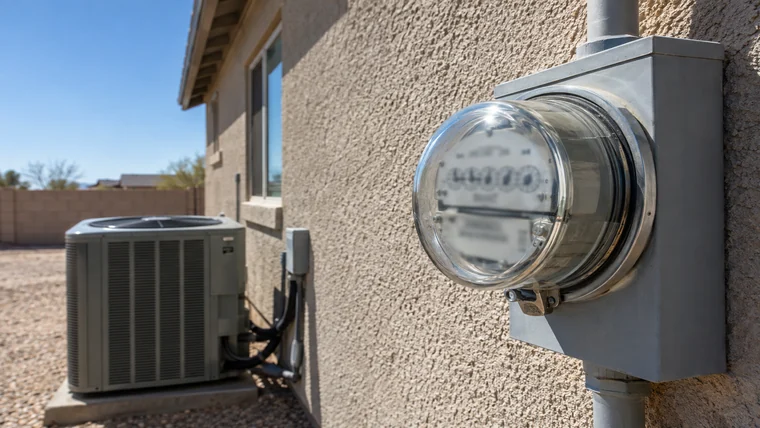
Rebate money in the Valley is smaller than it was two years ago and the rules are stricter, which is exactly why it gets misrepresented. APS closed its residential equipment rebates on January 1, 2026. The federal 25C tax credit is gone for anything placed in service this year. What is left is SRP Cool Cash, a handful of SRP and ED3 add-on rebates, and an income-qualified state programme we do not administer. Every one of them turns on decisions made before your system is ordered — efficiency tier, compressor type, whether the indoor coil gets replaced, whether a Manual J was done. Nothing on this page can be retrofitted onto a finished installation. So this is the whole picture as we file it: the per-ton amounts, the conditions that disqualify people, how the money actually arrives, and the rebates we cannot claim for you. If your quote from someone else cites a rebate you cannot find here, that is worth a phone call before you sign.
- SRP Cool Cash pays $75 per ton single-stage, $150 multi-stage and $225 variable-capacity or inverter mini-split, capped at $1,125 on a five-ton.
- Equipment must be AHRI-listed at SEER2 15.2 or better — the floor rose to 15.2 on November 11, 2024.
- On a split system both the condenser and the coil or air handler must be replaced; a condenser-only swap earns nothing.
- Single-stage installs require a Manual J, with installed capacity certified within 15% or a half-ton of the calculated load.
- SRP pays by check within a six-month filing deadline; ED3 pays as a bill credit, typically within one to two billing cycles.
- ED3 requires the unit purchased and installed inside the same calendar year — a late-December changeout has almost no runway.
- APS ended residential equipment rebates on January 1, 2026; only the Cool Rewards thermostat credit remains, and we are not an APS Qualified Technology Installer.
- The federal 25C credit is not allowed for property placed in service after December 31, 2025, so it cannot reduce a 2026 install.
Which Phoenix utility rebates can AZ Trusted Air file for me?
Start with what is actually live, because the Valley’s rebate landscape shrank in 2026 and a great many pages still read like it is 2024. APS discontinued its residential AC and heat pump rebates effective January 1, 2026, after the Arizona Corporation Commission cut the utility’s efficiency-program budget in a late-2025 decision. What survives at APS is Cool Rewards — a one-time enrollment credit of about $50 per enrolled smart thermostat plus roughly $35 per season for a device that participates in summer conservation events. That is a demand-response credit, not a rebate on buying equipment. Separately and independently: we are not an APS Qualified Technology Installer, and we will not imply otherwise to close a job.
SRP Cool Cash is the one Arizona utility rebate still paying meaningful money on a replacement, and it pays by compressor type rather than as a flat amount. Single-stage equipment earns $75 per ton, multi-stage $150 per ton, and variable-capacity systems and inverter-driven mini-splits $225 per ton — which caps out at $1,125 on a five-ton variable-capacity system. Everything must be listed in the AHRI Directory at SEER2 15.2 or better and installed by an Arizona-licensed contractor, the application is due within six months of installation, and there is a limit of five rebates per customer. SRP raised that SEER2 floor to 15.2 on November 11, 2024; quotes still citing 15.0 or an old SEER number are working from stale paperwork.
| Programme | What it pays | The condition that disqualifies people |
|---|---|---|
| SRP Cool Cash — single-stage | $75 per ton | SEER2 15.2+, AHRI-listed; Manual J required on single-stage |
| SRP Cool Cash — multi-stage | $150 per ton | Both indoor and outdoor units replaced on a split system |
| SRP Cool Cash — variable-capacity / inverter mini-split | $225 per ton, up to $1,125 | Tier is set by the equipment ordered — not changeable later |
| SRP Duct Test & Repair | 75% of cost, up to $400 | Requires a BPI-certified contractor; $300 cap on attached homes, condos and mobile homes |
| SRP smart thermostat | $50 per device, up to two | Plus $25 per device after each May–October season you stay enrolled |
| ED3 HVAC installation | Set by ENERGY STAR SEER2 rating | Unit must be purchased and installed within the same calendar year |
| ED3 smart thermostat | $50 each, up to $100 | Limit two per ED3 residential account |
| ED3 home insulation | 50% of the bill, up to $300 | Paid as a bill credit, not a check |
| APS equipment rebate | None since Jan 1, 2026 | Cool Rewards thermostat credit is all that remains |
| Federal 25C tax credit | Repealed | Not allowed for property placed in service after December 31, 2025 |
ED3 territory is the part almost no Phoenix HVAC website handles properly. Electrical District No. 3 serves Maricopa and stretches of the Pinal corridor, and its residential rebate list is genuinely different in shape from SRP’s: an HVAC installation rebate whose amount is keyed to the ENERGY STAR SEER2 rating, a heat pump water heater rebate of $250, insulation at half the invoice up to $300, an air duct repair rebate that requires a detailed paid-in-full receipt itemising the work completed, and a Peak Rewards thermostat programme on top. ED3 also states plainly that its rebate programme depends on available funding and can change without notice — which is why we check current terms at ed3online.org on the day we write your quote rather than quoting from memory.
Homeowners in Maricopa who call us in late December consistently get caught by the same clause, and it is not in SRP’s rules at all: ED3 requires the unit to be purchased and installed within the current calendar year. Unlike SRP’s rolling six-month filing window, a December 28 changeout in ED3 territory has almost no runway. If your bill says Electrical District No. 3 and it is the back half of December, the calendar is the constraint, not the paperwork.
Two honest exclusions. The SRP Duct Test & Repair rebate requires the work be done by a BPI-certified contractor, so do not assume every duct sealing and repair job qualifies for it — ask, before the rebate becomes part of your budget. And the income-qualified state route, Efficiency Arizona’s HEAR programme, has been reported to offer up to $8,000 per heat pump for households at or below 150% of area median income. We do not administer that programme and cannot promise its funding or your eligibility; if your household may fall under the limit, verify it with the state programme directly before it changes your decision.
How much do rebates typically knock off a replacement?
Run the arithmetic per ton and the picture stops being vague. Single-stage pays $225 on a three-ton, $300 on a four-ton, $375 on a five-ton. Multi-stage pays $450, $600 and $750. Variable-capacity pays $675, $900 and $1,125. Set that against our published installed ranges — $5,000–$7,000 for three tons, $6,000–$8,000 for four and $7,000–$10,000 for five — and a single-stage rebate lands in the region of three to five percent of the job, while a variable-capacity rebate on a five-ton can reach roughly eleven to sixteen percent depending where in the range your install falls.
The trap sits in the gap between tiers. Moving a four-ton job from single-stage to variable-capacity improves the rebate by $600, from $300 to $900. In our experience the equipment and labour difference between those two tiers is normally larger than $600, so the rebate does not pay for the upgrade — it softens it. Anyone telling you a variable-capacity system is effectively free after rebates is doing different arithmetic than SRP is.
The argument for the better machine in the Valley is run hours, not rebate dollars, and this is where national comparisons mislead. A homeowner in a moderate climate runs cooling perhaps three months; our cooling season opens in April and does not close until October, and a modulating compressor spends that stretch holding a low, steady load instead of slamming on and off in 115-degree afternoons. That is a real operating-cost and equipment-life argument. It is also an argument we would rather you weigh on its own merits than on a $600 swing.
Where the smaller rebates punch above their weight is on the parts of your system that are not the box outside. SRP’s Duct Test & Repair rebate covers 75% of testing and qualifying repair costs up to $400 on a single-family detached home, and duct leakage is the most expensive invisible defect in Phoenix housing: our technicians measure attic temperatures of 150 to 170 degrees in July, so every cubic foot of cooled air leaking from a supply run up there is replaced by air drawn out of an oven. Unlike a leaky duct in a vented crawlspace in a mild climate, a Phoenix attic leak is a heat-gain problem and an airflow problem at the same time. Pair that with SRP’s thermostat rebate — $50 per device for up to two, plus $25 per device at the end of each May-to-October season you remain enrolled — and a smart thermostat set up to pre-cool ahead of an on-peak window on a time-of-use plan can move more money annually than the one-time equipment rebate did.
Two things to keep out of your budget entirely. The federal 25C Energy Efficient Home Improvement Credit is repealed: the IRS termination table states the credit is not allowed for any property placed in service after December 31, 2025. Nothing installed in 2026 earns it, and any quote still showing a federal credit line is wrong. And APS equipment rebate money does not exist for a 2026 replacement, no matter which contractor is holding the pen.
Practical framing for your own planning: budget the full installed price, treat the rebate as money that arrives later, and make the equipment decision on sizing and build quality. Our price is the same whether you finance it through the third-party lender we work with or pay directly, and it is the same in Casa Grande as in Arcadia — one flat rate, no trip charge, no zone pricing. If you want the numbers checked against someone else’s proposal first, the quote review is free and does not require a site visit.
What pushes a job above the typical range
These are the conditions that can push a job above the ranges above. We tell you before the work starts, not after — and they are worth checking on any contractor's quote, not just ours.
- Crane access on rooftop package units
- The existing line set cannot be reused with the new equipment
- Electrical panel lacks capacity or needs breaker work
- Ductwork is undersized, leaking, or hard to reach in the attic
- Code upgrades on an older home - grandfathering ends when equipment is replaced
- Refrigerant contamination, or an R-22 system needing conversion
SRP Cool Cash by compressor type — three tons to five tons
Per-ton amounts on AHRI-listed equipment at SEER2 15.2 or higher. Each bar runs from a 3-ton system to a 5-ton system.
Per-ton amounts are set by SRP and change between programme cycles; equipment must be AHRI-listed at SEER2 15.2 or better, installed by an Arizona-licensed contractor, with the application filed within six months. Confirm current figures with SRP before relying on them.
| Item | Range |
|---|---|
| Single-stage — $75/ton | $225 – $375 |
| Multi-stage — $150/ton | $450 – $750 |
| Variable-capacity — $225/ton | $675 – $1,125 |
When does the rebate money arrive and in what form?
The two utilities behave differently enough that homeowners routinely expect the wrong thing. SRP Cool Cash is paid by check rather than posted against your account, so nothing shows up on your SRP bill and there is nothing to watch for there. ED3 approvals are the opposite: the credit appears on the bill, generally within one to two billing cycles of approval, and ED3 emails applicants to tell them where the application stands. If you are an ED3 customer waiting for an envelope, you may already have been paid.
What the SRP file has to contain is not mysterious, and it is worth knowing even if you never file one yourself: the signed contractor terms and conditions agreement, a dated paid-in-full invoice, the AHRI reference number for the matched system, the model numbers for condenser, coil and air handler or furnace, and a copy of the Manual J load calculation when single-stage equipment is installed. On that form the installing contractor certifies that the cooling load was estimated consistent with ACCA Manual J or an equivalent procedure and that the installed capacity is within 15% or a half-ton of that estimate. SRP also reserves the right to inspect the installation to verify compliance.
Read that certification twice, because it is the most consequential sentence in the rebate programme and almost nobody in the Valley discusses it. A contractor who habitually rounds a Phoenix house up to five tons because the last guy put in five tons is signing a document he cannot support. Our technicians still find equipment sized off a rule of thumb rather than a load calculation at our 115-degree design temperature, in houses whose windows, insulation and shading were never entered into anything. The rebate paperwork and correct sizing are the same problem wearing different hats.
Timing, honestly stated. Because the application requires an invoice marked paid in full, we file after the job is closed out rather than on installation day. SRP’s deadline is six months from installation and SRP's current programme has a published end date for qualifying installs — we confirm the live terms before your quote is written, because program windows and amounts are set by SRP and do change between cycles. What we will not do is publish a turnaround time for a check we do not mail. SRP processes rebates on its own schedule, and it is heaviest in the same summer weeks the whole Valley is replacing equipment.
Some Phoenix contractors offer to take the rebate assignment and discount it on the invoice up front, using a signed release. That mechanism is described in SRP’s programme documentation, and if it matters to your cash flow you should ask for it in writing and read what you are signing — you are handing over your claim, so the contractor’s filing discipline becomes your problem. Homeowners who ask us about it generally find the ordinary route simpler: we file, SRP mails you the check, and nobody has assigned anything to anybody.
The failure points on a rebate file are mundane rather than dramatic: a missing AHRI reference, model numbers that do not match the certified pair, no Manual J behind single-stage equipment, an invoice that is not marked paid, or a filing that slips past the six-month mark. None of those are judgment calls. That is precisely why the paperwork belongs with the people who ordered the equipment, and why our labour warranty — two years on new equipment, one year on repairs — sits alongside it in the same file as your warranty documentation.
A complete SRP Cool Cash submission contains the signed contractor terms and conditions agreement, a dated invoice marked paid in full, the AHRI reference number for the certified matched system, model numbers for the outdoor unit and the indoor coil or air handler, and the Manual J load calculation when single-stage equipment was installed. On that form the installing contractor certifies the load was estimated consistent with ACCA Manual J or an equivalent procedure, and that installed capacity is within 15% or a half-ton of the estimate. SRP may inspect the installation to verify compliance. Filing is due within six months of the installation date, and the rebate is paid to the customer by check. For ED3 customers the packet is different — the amount is keyed to the ENERGY STAR SEER2 rating, the unit must be purchased and installed inside the same calendar year, and approved rebates post as a credit on the ED3 bill.
What equipment tiers must be chosen up front to qualify?
The efficiency floor first. SRP requires the equipment to be listed in the AHRI Directory at SEER2 15.2 or better, which sits above the federal minimum efficiency standard that took effect in January 2023 — Arizona utility thresholds are deliberately set above the DOE floor, so “it meets code” and “it earns a rebate” are two different statements. Watch the units, too. SEER and SEER2 are different tests, and a machine marketed for years as 16 SEER converts to roughly 15.2 SEER2 in ducted systems. A quote quoting legacy SEER numbers has not been checked against the directory.
Second, the compressor decision, which is the single largest lever on the amount. Single-stage, multi-stage and variable-capacity pay $75, $150 and $225 per ton respectively, and that choice is locked the moment equipment is ordered. Single-stage installs also carry the Manual J requirement; load calculations are not required for multi-stage or variable-capacity systems under the programme rules. So the tier you pick changes both your rebate and your paperwork burden.
Third, and the one that costs Phoenix homeowners the most rebate money: on a split system, both the condenser and the air handler or coil must be replaced. A condenser-only swap does not qualify. What our installers find when they pull an indoor coil in a late-1990s Ahwatukee or Deer Valley house is a coil matched to equipment two generations old, and leaving it in place saves a little money on install day while disqualifying the whole rebate and defeating the rated efficiency of the new outdoor unit. The AHRI listing is for a pair; half a pair rates nothing.
Rooftop package units deserve their own note, because they cover a large share of Valley housing stock and barely exist in most of the country. Packaged equipment is rated separately from split systems and often carries lower published numbers, so a package unit has to be checked against the directory on its own terms rather than assumed to clear 15.2 because a similar split system does. Plan the crane into the budget as its own line — ours runs $400–$600 — and see rooftop package unit replacement for how that job actually sequences on a July roof.
Three more tier questions that come up constantly in our quotes. Inverter-driven mini-splits at SEER2 15.2 or better sit in the $225-per-ton band, which makes a mini-split one of the better rebate-per-dollar propositions on a casita or a converted garage. Heat pumps earn the same per-ton amounts as straight-cool air conditioners, and we charge no premium for a heat pump over a comparable cooling-only system, so the rebate maths does not penalise the choice. And the 2025 refrigerant transition matters here in a purely clerical way: model numbers changed as the industry moved to R-454B, so the AHRI certificate has to match the exact pair going into your house, not last year’s catalogue. Our R-454B installation page covers what changed on the equipment side.
One last Phoenix-specific wrinkle. The City of Phoenix exempts most like-for-like outdoor equipment swaps under five tons from a mechanical permit, so many Valley changeouts proceed without one, and we pull permits when the work requires it rather than as a blanket claim. Utility programmes, though, can ask for inspection or documentation of their own — SRP reserves the right to inspect the installed unit. The two systems are not the same system, and a contractor who conflates them is guessing at one of them.
Sources and further reading
The figures and requirements on this page draw on the following public sources. We link them so you can check anything here yourself.
- SRP — Cool Cash per-ton amounts, the SEER2 15.2 threshold, filing deadlines and duct and thermostat rebates
- AHRI Directory — confirm the exact indoor and outdoor pair is a certified matched system at the rated SEER2
- ACCA (Air Conditioning Contractors of America) — Manual J load calculation, which SRP requires behind single-stage equipment
- APS — current programme status after residential equipment rebates ended January 1, 2026
- ENERGY STAR — certification criteria referenced by ED3's residential HVAC rebate and the status of federal credits
- U.S. Department of Energy — federal minimum efficiency standards that utility thresholds are set above
- City of Phoenix Planning & Development — when a mechanical permit is required for a residential changeout
No site visit, no obligation. If a proposal in front of you cites an APS equipment rebate, a federal tax credit, or a per-ton amount that does not match SRP’s current tiers, we will tell you plainly. Same flat rate across the Phoenix metro and the Pinal corridor — no travel fee at any distance. Call (623) 252-6403 and a person answers, 24 hours a day.