Who installs heat pumps in the Phoenix metro?
The short answer: AZ Trusted Air installs heat pumps across the entire Phoenix metro and the Pinal corridor, licensed under Arizona ROC 317368. Installed pricing matches our straight-cool ranges — $5,000 to $7,000 for three tons, $6,000 to $8,000 for four, $7,000 to $10,000 for five — with no heat pump premium. Sizing is by Manual J load calculation, which SRP's rebate requires on single-stage equipment.
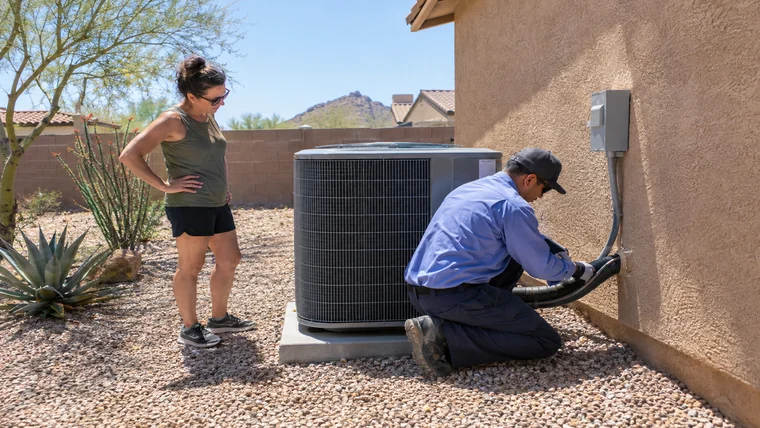
A heat pump in the Phoenix metro is not a heating decision with a cooling side effect. It is an air conditioner that can also run in reverse, and in a climate where the cooling season starts in April and does not reliably let go until October, that is the right way round to think about it. The heating half matters on maybe thirty or forty mornings a year. The cooling half runs while your attic is sitting at 150 degrees. That difference drives everything below: which equipment tier is worth paying for, why the sizing calculation carries more weight here than in a mild climate, and how much of the cost SRP will actually hand back. We install these systems across the whole metro and out through the Pinal corridor at one flat rate, and we publish the numbers rather than saving them for a living-room conversation.
- Heat pumps cost the same as straight-cool equipment of the same capacity at AZ Trusted Air: $5,000–$7,000 for three tons, $6,000–$8,000 for four and $7,000–$10,000 for five, installed across the Phoenix metro at one flat rate.
- SRP's Cool Cash rebate pays $75 per ton on single-stage, $150 per ton on multi-stage and $225 per ton on variable-capacity systems, to a maximum of $1,125, on AHRI-listed equipment at SEER2 15.2 or better.
- SRP will not pay on a condenser-only swap — both the indoor and outdoor units must be replaced — and the application must be filed within six months of installation.
- APS discontinued its residential AC and heat pump rebates effective 1 January 2026, and AZ Trusted Air is not an APS Qualified Technology Installer, so we never quote an APS equipment rebate.
- The federal 25C tax credit does not apply to equipment placed in service in 2026; a quote still showing a $2,000 heat pump credit is out of date.
- New systems use A2L refrigerant, in practice R-454B at a global warming potential near 466 against R-410A's 2,088, and an R-454B outdoor unit cannot be paired with an existing R-410A indoor coil.
- Sizing is by ACCA Manual J against Phoenix design conditions around 108 to 110 degrees, not by matching the old nameplate; SRP requires a Manual J on single-stage rebate claims.
- Attic duct leakage changes the tonnage the calculation returns, because Valley attic air commonly sits at 150 to 170 degrees against the outside of the duct in August.
- Phoenix exempts most like-for-like outdoor swaps under five tons from permit, but a straight-cool to heat pump conversion involving electrical or equipment-type changes more often requires one.
Which heat pump systems does AZ Trusted Air recommend for extreme heat, and why?
Start with what the machine is being asked to do. Unlike a heat pump in Minneapolis, where the whole selection argument turns on how much heating capacity survives at 5 degrees, a Phoenix heat pump is judged on the other end of the curve entirely: how it behaves at a 110-plus degree outdoor ambient, with high head pressure, after eleven hours of continuous run time. Manufacturer capacity tables all derate as outdoor temperature climbs. What we find on Phoenix rooftops and side yards in July is equipment producing meaningfully less than its nameplate tonnage precisely when the house needs all of it, which is why the efficiency tier and the compressor's ability to modulate matter more here than the number stamped on the label.
That is the case for staged or variable capacity rather than single-stage. A single-stage compressor has two states, all and nothing. A variable-capacity machine spends a Phoenix April, May, and October running long and slow at part load, which is both where the efficiency is and where the dehumidification happens during monsoon weeks. It is also the tier SRP rewards most heavily, at $225 per ton against $75 per ton for single-stage — a gap that frequently pays for a good part of the upgrade.
| Equipment tier | Where it fits in the Valley | SRP Cool Cash rate |
|---|---|---|
| Single-stage, SEER2 15.2+ | Budget-driven replacements, rentals, smaller homes with simple duct layouts | $75 per ton |
| Two-stage / multi-stage | Most Valley single-family homes; better part-load behaviour through shoulder seasons | $150 per ton |
| Variable-capacity | Long-run-hour homes, two-story plans, west-facing glass, comfort-sensitive households | $225 per ton |
| Ductless / inverter mini-split heat pump | Casitas, Arizona rooms, garages, additions the main system was never sized for | $225 per ton on qualifying inverter units |
Rebate rates above are SRP's published Cool Cash tiers as we verified them; confirm the current figures at srpnet.com before you rely on them, because SRP resets program terms between cycles.
The refrigerant question, which is no longer optional
Every new heat pump we install now uses an A2L refrigerant, in practice R-454B. Under the EPA's AIM Act technology transitions rule, manufacturing of new R-410A residential systems stopped on 1 January 2025 and the installation window for pre-2025 R-410A stock closed on 1 January 2026. R-454B carries a global warming potential of roughly 466 against R-410A's 2,088, and it is classified mildly flammable, which brings real service-side changes: A2L-rated recovery equipment, A2L leak detection, and equipment built to the current UL 60335-2-40 requirements.
The practical consequence for a homeowner is blunt, and it is the one thing on this page most likely to save you from a bad quote: you cannot hang a new R-454B outdoor unit on an existing R-410A indoor coil and call it a system. The safety architecture is designed as a matched pair, and the AHRI Directory is where a matched, certified combination can be verified. Homeowners who were sold a condenser-only swap in 2024 consistently discover the same thing now that the indoor half has failed — that the cheap half of the job has quietly become the expensive half. More on that in our R-454B installation notes.
Legacy R-22 equipment is its own conversation. There is still a real amount of 1990s and early-2000s R-22 gear running in the Valley, and on those systems a heat pump changeout is usually the honest answer rather than another repair — see R-22 replacement.
What does heat pump installation cost in Phoenix after the SRP rebate?
There is no heat pump premium in our pricing, and that is worth saying plainly because it is often presented as an upcharge elsewhere. The outdoor unit gains a reversing valve and the indoor side gains a different control sequence. That is not a $2,000 difference in materials, and we do not bill it as one.
| System | Installed price | SRP rebate at variable capacity | Approximate net |
|---|---|---|---|
| 3-ton heat pump | $5,000 – $7,000 | $675 | $4,325 – $6,325 |
| 4-ton heat pump | $6,000 – $8,000 | $900 | $5,100 – $7,100 |
| 5-ton heat pump | $7,000 – $10,000 | $1,125 | $5,875 – $8,875 |
| Rooftop package heat pump | Low end of range | Same per-ton tiers | Crane billed separately, $400 – $600 |
| Ductless head | $1,000 – $3,000 per head | Per-ton on qualifying inverter units | Varies by head count |
Net figures assume variable-capacity equipment, an SRP account, and a complete indoor-and-outdoor replacement, because SRP will not pay on a condenser-only swap. A single-stage machine earns a third of that. The reason the efficiency step is worth walking through rather than glossing over is that the rebate can invert the usual logic: moving up within one of our ranges sometimes lands you a better machine for less net money than sitting at the bottom of it. Our five-tons-for-six-thousand explainer works through where that math holds and where it does not.
Rooftop package units deserve their own line. A large share of Valley housing stock — 1970s and 1980s tract homes especially — carries a single package unit on the roof rather than a split system, an arrangement that barely exists in most of the country. Replacing one is a crane job at $400 to $600, and the curb and roof penetration have to be dealt with as part of the work. Unlike a shingle roof in a moderate climate, a Phoenix roof deck bakes at ambient-plus for months, so the curb gasket and the duct connections below it are the first things our technicians check on any rooftop changeout. Details on rooftop package unit replacement.
The rest of the commercial terms, so nothing arrives as a surprise: diagnostics are $69.95 Monday to Friday 8am–6pm and $99.95 outside those hours, credited toward any repair we perform. Labour warranty is two years on new equipment and one year on repairs. Financing is available through a third-party lender, subject to credit, and choosing it does not change the price of the job by a dollar. We answer the phone 24 hours a day, seven days a week — a person, not voicemail — and typical non-emergency arrival is 12 to 24 hours. Full ranges for everything we do are on the pricing page.
What pushes a job above the typical range
These are the conditions that can push a job above the ranges above. We tell you before the work starts, not after — and they are worth checking on any contractor's quote, not just ours.
- Crane access on rooftop package units
- The existing line set cannot be reused with the new equipment
- Electrical panel lacks capacity or needs breaker work
- Ductwork is undersized, leaking, or hard to reach in the attic
- Code upgrades on an older home - grandfathering ends when equipment is replaced
- Refrigerant contamination, or an R-22 system needing conversion
Installed heat pump price by tonnage — and where the SRP rebate threshold falls
AZ Trusted Air published ranges, Phoenix metro. The split marks SEER2 15.2, the efficiency level SRP's Cool Cash rebate requires.
Heat pumps carry no premium over straight-cool equipment of the same capacity in our pricing. SRP pays per ton and by system type — $75 single-stage, $150 multi-stage, $225 variable-capacity, to a maximum of $1,125 on a five-ton variable system — on AHRI-listed equipment at SEER2 15.2 or better. Confirm current amounts and the install-by date with SRP before relying on them.
| Item | Range |
|---|---|
| 3-ton heat pump | $5,000 – $7,000 |
| 4-ton heat pump | $6,000 – $8,000 |
| 5-ton heat pump | $7,000 – $10,000 |
Which utility rebates apply to a heat pump in Phoenix, and does AZ Trusted Air file the paperwork?
Your bill names your utility, and in this metro that single fact is worth several hundred dollars. Neighbouring streets can sit in different territories, so check before you assume.
| Utility | Heat pump rebate status | Key conditions |
|---|---|---|
| SRP | Active — Cool Cash, $75/$150/$225 per ton by system type | AHRI-listed SEER2 15.2 or better; Arizona-licensed installer; indoor and outdoor units both replaced; application within six months of install; Manual J required on single-stage |
| APS | Residential AC and heat pump rebates discontinued effective 1 January 2026 | Followed an Arizona Corporation Commission decision cutting the efficiency-program budget. The surviving Cool Rewards thermostat credit is a demand-response program, not an equipment rebate |
| ED3 (Electrical District No. 3) | Active HVAC replacement rebate | Amount is set by ENERGY STAR SEER2 rating; equipment must be purchased and installed within the current calendar year. ED3 also lists up to $100 for smart thermostats and 50% up to $300 on home insulation |
| Federal 25C tax credit | Not available for 2026 installations | Section 25C no longer applies to equipment placed in service in 2026. Any quote sheet still showing a $2,000 heat pump credit is out of date |
Two honest caveats, because papering over them would cost you money. First, SRP's program has carried a published install-by date that has moved between cycles — sources we checked show qualifying installs running through April 2027 while older pages still print April 2026 — so we confirm the live date against SRP before anyone signs anything. Second, ED3 sets its HVAC rebate amount by SEER2 tier rather than publishing one flat number, and the tier table is the part to read; we pull the current version for Maricopa, Rancho El Dorado and Casa Grande customers rather than quoting from memory.
On paperwork: we assemble and file it. SRP wants the itemised paid invoice, model and coil numbers, the AHRI reference, and a Manual J on single-stage equipment, and it allows a customer to assign the rebate to the contractor with a signed release so the amount can come off the invoice instead of arriving as a cheque months later. That is what our rebate concierge exists to handle. What we will not do is pre-promise an approval; SRP or its agent may inspect the installation, and the rebate is theirs to grant.
Homeowners comparing quotes this year consistently find at least one that still lists an APS rebate and a federal credit as line items reducing the price. Unlike a stale price, a stale incentive does not just misprice the job — it shifts money that never existed onto your side of the ledger. If you have a quote in hand, our quote review is free, needs no site visit, and will tell you which of the incentives on it are still real.
One. The utility on the bill, because SRP pays $75 to $225 per ton and APS ended its residential heat pump rebate on 1 January 2026. Two. A Manual J load calculation against Phoenix design conditions, including duct location and leakage, rather than the tonnage on the failed unit. Three. The AHRI certified matched-system reference for the exact indoor and outdoor model numbers quoted, which also establishes whether the equipment clears SEER2 15.2 for the rebate.
Four. Whether the job is a like-for-like outdoor swap under five tons, which Phoenix generally exempts from permit, or a conversion with electrical and equipment-type changes, which more often is not exempt. Five. Physical placement — crane access and curb condition on a rooftop package unit, and any HOA design guideline governing where a condenser is allowed to sit. Nothing in this list requires trusting us; all five are verifiable by you.
How is sizing determined for a cooling-dominated climate?
Manual J is ACCA's load calculation procedure, and it runs off published design conditions rather than record highs. For Phoenix Sky Harbor those summer design dry-bulb values sit around the 108 to 110 degree range at the 1% and 0.4% levels in the ASHRAE tables, against an indoor target of 75. Two things follow. The first is that design temperature is deliberately not the worst day of the year — equipment sized to shrug off 118 degrees would be oversized for the several thousand hours either side of it. The second is that the exact value in use should be a number your contractor can name, and the current ASHRAE tables are where it can be checked.
Oversizing is the failure mode we see most, and it comes from nameplate matching: the old unit said four tons, so the new one does too, regardless of the windows someone replaced in 2016 or the insulation blown in since. An oversized compressor satisfies the thermostat quickly, shuts off, and never runs long enough to pull moisture out of the air — which is fine in dry May heat and genuinely unpleasant during a monsoon stretch, when Valley dew points climb into the 50s and 60s. Short cycling also punishes the compressor's start windings, and in a climate with an April-to-October cooling season those start cycles accumulate fast.
The other half of the calculation is the part most quotes ignore. Roughly speaking, the majority of Valley homes route supply ductwork through an unconditioned attic, and homeowners who open an attic hatch in August consistently find air in the 150 to 170 degree range sitting directly against the outside of that duct. Manual J accounts for duct location, duct insulation value and leakage as load, which means a leaking attic duct system does not just waste capacity, it changes the tonnage the calculation returns. Unlike a basement-ducted house in a moderate climate, where a leaky duct leaks into semi-conditioned space, a leaking attic duct here is dumping cold air into a 160 degree oven and pulling that air back into the house through the return side. If the ducts are bad, we would rather fix them and size the smaller machine — see duct sealing and repair, which SRP also rebates separately for duct testing and qualified sealing.
Two Phoenix-specific constraints on where the unit goes
Master-planned communities across the Valley — the Verrado, DC Ranch and Eastmark style of development — publish design guidelines that govern equipment screening and where a condenser may physically sit relative to a side yard or a view fence. That is not a code question and the city will not resolve it; it is an HOA architectural-committee question, and it occasionally decides the layout of the whole installation. We ask about it before we quote a relocation.
Permits are the other one, and the answer is genuinely conditional. The City of Phoenix exempts most like-for-like outdoor equipment swaps under five tons, which is why a blanket claim that a contractor always pulls a permit is not accurate here. Converting a straight-cool system to a heat pump is frequently not like-for-like, though — it can involve electrical work, a different indoor unit, and a change in equipment type — and those cases more often do require one. We pull them when the work requires it, and requirements vary between Phoenix, Mesa, Scottsdale, Maricopa and the county, so we confirm with the jurisdiction rather than guessing.
Sources and further reading
The figures and requirements on this page draw on the following public sources. We link them so you can check anything here yourself.
- SRP — Cool Cash rebate tiers, the SEER2 15.2 requirement, the six-month filing window and the current install-by date
- APS — confirm the status of residential AC and heat pump rebates and the surviving thermostat program
- ACCA (Air Conditioning Contractors of America) — Manual J load calculation, the correct basis for sizing a heat pump in a cooling-dominated climate
- AHRI Directory — verify that a quoted indoor and outdoor unit are a certified matched system and clear SEER2 15.2
- U.S. Environmental Protection Agency — Section 608 — refrigerant handling rules, the R-410A phase-down and the A2L transition
- City of Phoenix Planning & Development — when a mechanical permit is required for a residential equipment change-out or conversion
- Arizona Registrar of Contractors — licence verification for ROC 317368 and the homeowner complaint process
Send it however suits you — a photo, an email, a PDF. No site visit, no obligation, and no salesperson will call asking when they can stop by. We will tell you whether the sizing, the matched-system reference and the rebates on it are real. One flat rate across the Phoenix metro and the Pinal corridor, at any distance, with no travel or trip fee.