Who Installs Mini-Splits in the Phoenix Metro?
The short answer: AZ Trusted Air installs ductless and ducted mini-splits across the entire Phoenix metro and the Pinal corridor, Casa Grande, Florence and Maricopa included, at one flat rate with no trip charge at any distance. We hold Arizona ROC 317368, work with no manufacturer alignment, and publish the price: $1,000 to $3,000 per indoor head, installed.
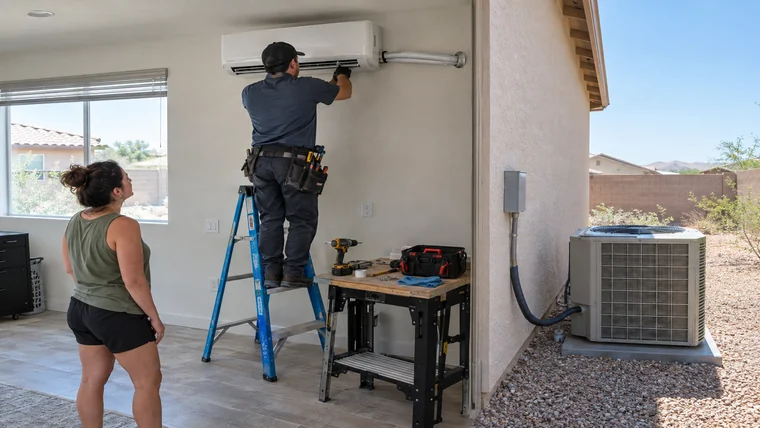
Mini-splits get sold in the Valley as a gadget. They are not. In Phoenix they are the correct answer to a specific and very common problem: a room the central system was never designed to cool — a casita, a converted garage, an Arizona room, a west-facing upstairs bedroom, a 1930s house that never had ducts and has no soffit space to add them. The wrong answer to that problem is a bigger central unit, which is how a lot of Valley homeowners end up with an oversized system that short-cycles for eight months a year. Below is what we install, how we size it for a 115-degree design day, what it costs per indoor head, and the two federal rules that changed what can legally go on your wall in 2026.
- Mini-splits are priced per indoor head at AZ Trusted Air: $1,000 to $3,000 installed, the same anywhere in the Phoenix metro with no trip fee.
- A mini-split carries energy in refrigerant lines rather than through a Phoenix attic that routinely exceeds 150 degrees in July, which is the core reason the technology suits this market.
- Sizing should follow an ACCA Manual J room-by-room load calculation; SRP warns that an oversized unit short-cycles, driving up bills and wearing the equipment out.
- Since 1 January 2026 new residential split systems must use a refrigerant with a global warming potential below 700, which is why new equipment uses R-454B or R-32.
- SRP's Cool Cash rebate covers mini-splits, ducted or ductless, and pays by the ton in tiers — reported at $75 single-stage, $150 multi-stage and $225 variable-capacity — on AHRI-listed equipment. Confirm the current figure with SRP before relying on it.
- The federal 25C credit is repealed for equipment placed in service in 2026; any quote still showing a 30 percent federal credit this year is showing money that no longer exists.
- EPA rules require Section 608 certification to add or remove refrigerant during a mini-split installation or to connect and disconnect pre-charged lines.
- Two separate warranties apply: the manufacturer covers parts and compressor subject to registration and licensed installation, while our labour warranty runs two years on new equipment and one year on repairs.
How does AZ Trusted Air choose mini-split equipment for Phoenix heat?
Sizing is where most mini-split disappointment starts, and the failure mode here is the opposite of what people expect. Almost nobody undersizes in Arizona. The instinct is to go big, and SRP says it plainly in its own rebate guidance: a unit too large for the space leads to expensive bills and short cycling, where the system cools quickly instead of gradually and cycles itself to death rather than running steadily. On a 12,000 BTU head in a 250-square-foot casita, that is a real and common mistake.
What our technicians find in Valley garages specifically is that the load is rarely about floor area. It is about an uninsulated slab that has been soaking up heat since April, a metal door facing west, and often a water heater sitting in the corner. Two garages of identical square footage in the same Surprise subdivision can differ by a full ton of load depending on orientation. That is the argument for a calculation rather than a rule of thumb, and ACCA publishes the Manual J standard that calculation follows.
What we specify, and why
| Specification | Why it matters in the Valley |
|---|---|
| Inverter / variable-capacity compressor | Modulates instead of cycling; also the tier SRP pays the most for |
| AHRI-listed matched system | SRP requires equipment listed in the AHRI Verified Directory as meeting the efficiency minimums |
| Heat pump rather than cooling-only | Covers the January mornings; no price premium on our published ranges |
| Low-GWP refrigerant (R-454B or R-32) | Since 1 January 2026 new residential split systems must use refrigerant under 700 GWP |
| Condenser placement | Airflow clearance, shade where achievable, and whatever your community design guidelines allow |
The refrigerant point is not a detail. Under the EPA's Technology Transitions rule made under the AIM Act, new residential split systems installed from the start of 2026 must use a refrigerant with a global warming potential below 700, which is why the market moved to R-454B and R-32. The transition window that allowed installation of earlier higher-GWP stock closed at the end of 2025. If someone is offering you a brand-new R-410A mini-split in the Phoenix metro this year, ask where it came from and when it was manufactured before you sign. We cover the practical side of the changeover on our R-454B installation page.
Placement is the other Phoenix-specific decision. In master-planned communities across the north Valley and the southeast Valley, design guidelines frequently dictate where a condensing unit may physically sit and how it must be screened from the street. Unlike a suburban lot elsewhere where you put the outdoor unit wherever the line set is shortest, here the approved location can be on the opposite side of the house — and line-set length affects both cost and capacity. We would rather establish that before ordering equipment than after.
One more thing the brochure will not tell you. Monsoon season loads outdoor coils with fine dust in a way a coastal or midwestern installation never sees, and a mini-split condenser sitting at grade in a gravel yard collects more of it than a rooftop unit does. The coil still needs cleaning, the indoor head's filters and blower wheel still need attention, and a mini-split that nobody has touched in four Phoenix summers will be quietly running at a fraction of its rated capacity. Coil cleaning is a $150 service on our price list; our maintenance plan is $25 per month per unit.
What do single-zone and multi-zone installs cost (published ranges)?
Pricing per head is the honest unit, because that is how the work actually scales. A second head is not double the labour — the outdoor unit, the electrical and the mobilisation are already there — but it is a second line-set run, a second condensate path and a second wall penetration, and in a two-story Gilbert house that second run may travel three times as far as the first.
| Configuration | Installed range | What moves it within the range |
|---|---|---|
| Single zone, one head | $1,000 – $3,000 | Capacity, line-set length, electrical availability |
| Two zones, two heads | $2,000 – $6,000 | Second run length; whether both heads are on the same wall plane |
| Three zones, three heads | $3,000 – $9,000 | Panel capacity; routing through finished ceilings |
| Diagnostic / service call | $69.95 / $99.95 | Mon–Fri 8am–6pm; credited toward any repair |
| Duct replacement, if you go ducted instead | $1,000 – $3,000 | Comparison point, not part of a ductless job |
The comparison people actually need. A complete central system replacement runs $5,000 to $10,000 on our published ranges, depending on tonnage. If the whole house is failing, that is the conversation. If one room is failing, a mini-split at a fraction of that is usually the right money. Where homeowners lose is in the middle — replacing a working three-ton system with a five-ton system to fix one hot bedroom, which is a solution we see quoted in this market with some regularity and which is addressed properly on our hot upstairs page.
Rebates: what is real in 2026 and what is not
SRP's Cool Cash rebate does cover mini-splits, ducted or ductless, and it pays by the ton at tiered rates — reported at $75 per ton for single-stage, $150 for multi-stage and $225 for variable-capacity equipment, with all qualifying equipment required to appear in the AHRI Verified Directory. An inverter-driven mini-split sits in the top tier. Program amounts and deadlines are set by SRP and change between cycles, so we confirm the current figure against SRP's own published terms before it goes on your quote rather than after.
Two things we will not tell you. APS operates its own program on its own terms and we are not currently an APS Qualified Technology Installer, so we never promise an APS rebate on a job — if an APS-territory quote shows one, ask the contractor to show you the current program document. And the federal 25C tax credit is repealed for equipment placed in service in 2026; it was eliminated for property placed in service after 31 December 2025. Any Phoenix quote still showing a 30 percent federal credit on a mini-split this year is showing you money that no longer exists. Our rebate concierge page tracks what is actually live.
Financing is available through a third-party lender and is credit-dependent. Choosing it does not change the price of the job by a dollar. We do not price match.
What pushes a job above the typical range
These are the conditions that can push a job above the ranges above. We tell you before the work starts, not after — and they are worth checking on any contractor's quote, not just ours.
- The existing line set cannot be reused with the new equipment
- Electrical panel lacks capacity or needs breaker work
- Ductwork is undersized, leaking, or hard to reach in the attic
- Code upgrades on an older home - grandfathering ends when equipment is replaced
- Refrigerant contamination, or an R-22 system needing conversion
Mini-split installed cost by number of indoor heads
AZ Trusted Air published ranges, Phoenix metro. Priced per indoor head at $1,000–$3,000, installed.
Multi-zone ranges are the per-head range multiplied by the number of indoor heads. The outdoor unit and mobilisation are shared, but each additional head adds a line-set run, a condensate path and a wall penetration.
| Item | Range |
|---|---|
| Single zone, 1 head | $1,000 – $3,000 |
| Two zones, 2 heads | $2,000 – $6,000 |
| Three zones, 3 heads | $3,000 – $9,000 |
Will AZ Trusted Air install a unit I purchased myself?
This is the most common call we get on mini-splits, so here is the full reasoning rather than a policy line.
First, the federal rule. The EPA is explicit that adding or removing refrigerant from a mini-split as part of installation, and connecting or disconnecting pre-charged lines, requires Section 608 technician certification. That covers attaching gauges, cutting a refrigerant line, and adding or removing components. The pre-charged DIY kits get around it only so long as the sealed circuit is never opened — and the moment there is a leak, a low charge or a flare that needs redoing, a certified technician has to be involved anyway.
Second, the warranty arithmetic. Manufacturers commonly condition their parts and compressor coverage on professional installation and on registration within a set window, frequently 90 days. Homeowners who buy online consistently find this out at the wrong moment — not at purchase, but two summers later when a compressor fails and the manufacturer asks for the installing contractor's licence number. Unlike a washing machine, where the box is the whole product, a mini-split's reliability is largely a function of evacuation, charge and flare technique. That is why the manufacturer cares who touched it.
Third, the part that affects us. If we install hardware we did not supply and the compressor fails in month fourteen, there is no manufacturer standing behind the part. You are then relying entirely on our labour warranty for a failure that was not a labour failure. That is a bad deal for you and an unmanageable one for us.
What we will do: look at what you have already bought, free, and tell you where it stands. Our quote review is free with no site visit and no obligation, and if you want a second set of eyes on an existing diagnosis, a second opinion is $69.95 Monday to Friday, credited toward any work — and the written report is yours either way, whether you hire us or not.
Representative example. Illustrative of the document set we leave with a completed install — the load calculation the sizing was based on, the AHRI reference number the SRP rebate application requires, both model and serial numbers, and confirmation the equipment was registered. Example document; not a specific customer's file.
What warranty applies to a professionally installed mini-split?
Homeowners routinely assume these are one document. They are not, and knowing the difference is what stops a warranty claim turning into an argument.
| Covered by | What it covers | What it does not |
|---|---|---|
| Manufacturer | Parts and compressor, for the registered term | Labour to diagnose, remove and refit the part |
| AZ Trusted Air labour warranty | Two years on new equipment installs, one year on repairs | The part itself, if it is a manufacturer defect under their coverage |
| Neither | — | Neglected maintenance, damage, or work done by someone else after us |
Register the equipment. It is the single cheapest thing you will ever do for a mini-split, and missing the registration window is the most common reason a Valley homeowner discovers they have the base term rather than the extended one. Keep the paid invoice, the model and serial numbers of both the indoor head and the outdoor unit, and the AHRI reference number — that same reference is what an SRP rebate application asks for, so the paperwork does double duty.
Ductless systems carry one warranty risk that central systems mostly do not: nobody services them. A condenser in the side yard gets noticed when it stops. A mini-split head in a guest casita that is occupied six weeks a year can run filthy for years without anyone opening it, and manufacturers do exclude failures traceable to neglected maintenance. Annual service is not an upsell here, it is the condition on which the coverage rests. If you are unsure what you currently have, our warranty help page walks through how to find out, and we answer the phone 24 hours a day, seven days a week — a person, not voicemail.
On response: typical arrival is 12–24 hours in most cases. We do not publish a same-day guarantee, because in a Phoenix July that is a promise many companies make and fewer keep.
Sources and further reading
The figures and requirements on this page draw on the following public sources. We link them so you can check anything here yourself.
- U.S. Environmental Protection Agency — Section 608 — technician certification required to install a mini-split and connect pre-charged lines
- SRP — Cool Cash rebate terms for mini-splits, AHRI listing requirement and sizing guidance
- ACCA (Air Conditioning Contractors of America) — Manual J load calculation, the correct basis for sizing each zone
- AHRI Directory — verify the quoted system is a certified matched system and get the reference number a rebate needs
- City of Phoenix Planning & Development — mechanical and electrical permit requirements for new equipment installations
- Arizona Registrar of Contractors — licence verification and complaint history before anyone touches your house
Text a photo, email it, whatever is easiest — no site visit, no obligation, and nobody will call to ask when a salesperson can stop by. One flat rate across the Phoenix metro and surrounding communities including Casa Grande, Florence and Maricopa, at any distance.