Who adds cooling to casitas and Arizona rooms in Phoenix?
The short answer: AZ Trusted Air does — we cool casitas, guest houses, converted garages and enclosed Arizona rooms across the Phoenix metro and the Pinal corridor, under Arizona ROC 317368. Most of these spaces get a ductless mini-split at $1,000 to $3,000 per head, because the existing system in a Valley home rarely has capacity to spare on a 110-degree afternoon.
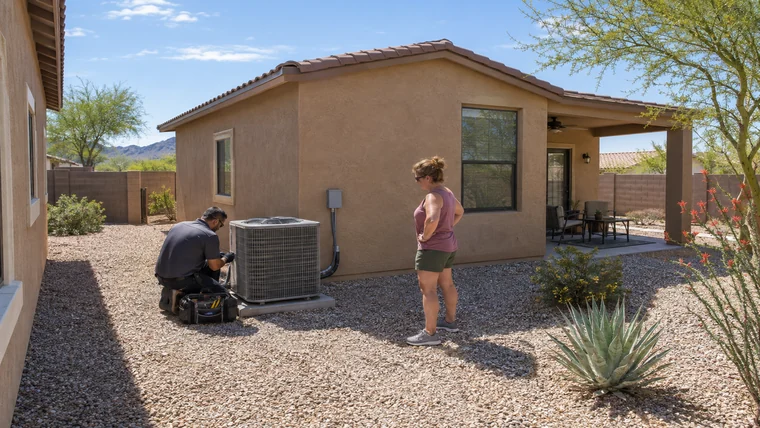
Two very different jobs arrive under the same phone call. One is a casita — a detached guest house, a garage conversion, or a new backyard unit built under Arizona's HB 2720, the 2024 “Casita Bill” that since January 2025 has required cities over 75,000 people to allow accessory dwellings on single-family lots. The other is an Arizona room: a covered patio someone enclosed, permitted as a patio enclosure, and then found unusable from May to October. The cooling answer is not the same for both, and the permit answer is genuinely different. What they share is that neither space was in the original load calculation. The equipment was sized for the house. Adding 300 square feet of mostly glass, or a 600-square-foot building forty feet from the back door, is not a rounding error in a climate with a design temperature near 110 degrees and a cooling season that runs April into October. Below is how we decide, what we charge, and what the city will want to see first.
- Casitas and Arizona rooms were never in the original load calculation, so tonnage is decided by ACCA Manual J against a Valley design temperature near 108 to 110 degrees — not by a proportional rule of thumb.
- Patio enclosures permitted as Category I or II sunrooms under IRC Appendix H are non-habitable and unconditioned, and local handouts state they cannot be heated or cooled by fixed mechanical equipment.
- Phoenix exempts only same-type, same-rating replacements in the same location, so a new head, pad or circuit normally needs a mechanical permit and inspection.
- Duct runs added through a 150-to-160-degree Phoenix attic lose delivered capacity to leakage faster than to R-value, which is why sealing existing runs often beats adding new ones.
- Published prices: $1,000–$3,000 per mini-split head, $1,000–$3,000 for duct extension or replacement, $5,000–$7,000 for a dedicated three-ton system.
- SRP Cool Cash pays by nominal ton and compressor type on AHRI-listed SEER2 15.2+ equipment, and resets amounts each program year, so the figure gets verified before it reaches a quote.
- The federal 25C credit is repealed for equipment placed in service after 31 December 2025; anyone quoting it on a 2026 casita install is quoting something that no longer exists.
- Detached casitas almost always get their own equipment, because nothing in a correctly sized Phoenix system is held in reserve on a 110-degree afternoon.
Extend the ducts or add a mini-split — how does AZ Trusted decide?
Two houses can look identical from the street and need opposite answers, so we do not start from a preference. We start with a load calculation. ACCA's Manual J is the method, and the outdoor design temperature it runs against in the Valley is roughly 108 to 110 degrees depending on which weather station and data set the software pulls — Sky Harbor's ASHRAE summer design dry bulb is commonly published at 110, and some tools use 108. Either way it is nowhere near the 95 a national online calculator defaults to, and it is not the 118 on your car's dashboard either. That single number decides everything downstream.
Test one is whether the existing system has anything left to give. What we find on Phoenix rooftops in July is equipment already running a full duty cycle at four in the afternoon just to hold the house it was sized for. A 1980s or 1990s home with one rooftop package unit and a fixed set of duct drops is the clearest case: tapping a new supply off that plenum to feed an Arizona room does not create capacity, it redistributes it, and the two back bedrooms pay for the patio. Unlike a Midwest bonus room, where a contractor can often lean on an air handler that spends most of the year loafing, nothing in a correctly sized Phoenix system is loafing between June and September.
Test two is the path the air would have to take. Duct runs in Valley attics sit in 150 to 160 degree air through the summer, which puts a differential of more than 90 degrees across the wall of a duct carrying 55 to 60 degree supply air. That is why Phoenix amends the energy code upward for ducts in unconditioned attics rather than accepting the R-6 the IECC allows in Climate Zone 2B — and why leakage matters even more than R-value here. A well-insulated duct losing air into a 155-degree attic delivers less than a lesser-insulated duct that is genuinely sealed. A forty-foot flex run added to reach a back-corner casita is a long time for air to be losing that argument.
Test three is glass. An Arizona room exists because of a code definition: to be permitted as a patio enclosure rather than an addition, the longest wall and one additional wall generally have to stay at least 65 percent open or glazed below six feet eight inches, and Peoria's published guideline is explicit that you cannot use three walls to reach that number. The result is a room that is mostly window. It does not load like a bedroom of the same floor area, which is why the proportional rule of thumb — 2,000 square feet on four tons, so a 300-foot room needs half a ton — is wrong in the direction that leaves you hot. Climate Zone 2B also wants new fenestration at a solar heat gain coefficient of 0.25 or lower, worth knowing before you choose the glass, because the windows set the load the equipment carries for the next twenty years.
Homeowners who have already tried a portable unit or a window shaker in an Arizona room describe the same pattern to us: comfortable at ten in the morning, losing the room by two in the afternoon, because the machine was sized for a bedroom and the space behaves like a greenhouse. A ductless head sized off a real load, with an inverter compressor that modulates instead of cycling, is usually the fix — and variable-capacity equipment sits in SRP's top Cool Cash tier, which pays by the ton.
Ducts do sometimes win. An attached casita or converted den off an interior wall, on a system young enough to have measured spare capacity and with a return path that can carry the extra air, is a reasonable duct extension — often paired with sealing the existing runs, because recovering leaked capacity is cheaper than buying new capacity. Detached casitas, and any space occupied on a different schedule from the main house, get their own mini-split almost every time.
What does casita or Arizona room cooling cost (published ranges)?
| Scope | Published price | What moves it within the range |
|---|---|---|
| Ductless mini-split, per indoor head | $1,000 – $3,000 | Head capacity, line-set length and routing, wall construction, electrical |
| Duct extension or replacement | $1,000 – $3,000 | Number of runs, attic access, return path, insulation level required |
| Dedicated 3-ton system for a larger casita | $5,000 – $7,000 | Efficiency tier, pad or rooftop placement, new duct versus existing |
| Dedicated 4-ton system | $6,000 – $8,000 | Efficiency tier, electrical and code work if required |
| Crane, rooftop package unit | $400 – $600 | Billed separately, only when the unit is going up or coming down |
| Diagnostic / service call | $69.95 / $99.95 | Weekdays 8am–6pm / outside those hours. Credited toward any repair |
| Maintenance plan | $25/month per unit | A casita mini-split is a second unit, so it is a second enrolment |
The things that push a mini-split toward the top of its range are almost all visible before we start, and they are the same five every time in this market: line-set length when the only acceptable condenser location is around a corner, coring a block or stucco-over-block wall rather than a framed one, panel capacity in an older home that has no spare breaker space, condensate routing that has to reach somewhere legal, and a multi-zone head count that pushes the outdoor unit up a size. In master-planned communities the condenser location is frequently decided by the architectural guidelines rather than by us — several Valley HOAs require the unit screened, set back from a view fence, or off a side yard entirely, and that constraint can add twenty feet of line set before anyone has looked at a spec sheet.
On rebates, be specific or say nothing. SRP's Cool Cash program pays by nominal ton and by compressor type. SRP resets the per-ton amounts and eligibility thresholds each program year, which does not align with the calendar year. That is why we verify the current figure before it goes on a quote, and why SRP wants the AHRI reference number for the matched outdoor-and-indoor combination on the application. A two-ton inverter mini-split is a modest rebate, not a transformative one; the tonnage on a casita is small, so the dollars are small.
Two things we will not tell you are available. The federal 25C credit that once paid up to $2,000 on a ductless heat pump was repealed for equipment placed in service after 31 December 2025 — if a salesperson quotes it to you on a 2026 install, that is not a rounding error, it is wrong. And we are not currently an APS Qualified Technology Installer, so we never promise an APS rebate; separately, APS is reported to have ended its residential AC and heat pump rebate effective 1 January 2026, leaving its thermostat program in place. Rebates follow the meter, not the street: SRP and APS lines interleave mid-block in parts of Scottsdale, Glendale, Tempe and Avondale, and much of the Pinal corridor is Electrical District No. 3 territory. Your bill names your utility, and our rebate concierge works from that.
Labour warranty is two years on new equipment and one year on repairs. Financing is third party and credit-dependent, and choosing it does not change the price of the job by a dollar. We do not price match. If you already have a quote for a casita or patio-room system, the quote review is free with no site visit, and a second opinion costs $69.95, credited — and the written report is yours either way. Our full published pricing covers the rest.
What pushes a job above the typical range
These are the conditions that can push a job above the ranges above. We tell you before the work starts, not after — and they are worth checking on any contractor's quote, not just ours.
- Crane access on rooftop package units
- The existing line set cannot be reused with the new equipment
- Electrical panel lacks capacity or needs breaker work
- Ductwork is undersized, leaking, or hard to reach in the attic
- Code upgrades on an older home - grandfathering ends when equipment is replaced
- Refrigerant contamination, or an R-22 system needing conversion
What cooling a casita or Arizona room costs — published ranges
AZ Trusted Air published prices, Phoenix metro and the Pinal corridor. Same price at any distance; no trip fee.
Crane service on a rooftop package unit is billed separately at $400 to $600. Diagnostics are $69.95 weekdays 8am–6pm and $99.95 outside those hours, credited toward any repair.
| Item | Range |
|---|---|
| Mini-split, per indoor head | $1,000 – $3,000 |
| Duct extension or replacement | $1,000 – $3,000 |
| Dedicated 3-ton system | $5,000 – $7,000 |
| Dedicated 4-ton system | $6,000 – $8,000 |
What do metro permits require for converted and added spaces?
This is the section most homeowners have never been told, and it is the one that can cost real money. Patio enclosures in the Valley are routinely permitted as thermally isolated sunrooms under Appendix H of the International Residential Code. Category I and Category II sunrooms are, by definition, non-habitable and unconditioned — Casa Grande's own Arizona Rooms handout states plainly that those spaces cannot be heated or cooled by fixed mechanical equipment, and that they are intended for recreational and outdoor-living use rather than for living, sleeping or eating. Maricopa County's sunroom directive puts the other half of it: an enclosed patio or Arizona room opened directly to adjoining habitable space is treated as habitable space and has to meet those requirements.
Read together, those two rules explain why a permanently mounted head in a Category II sunroom is not simply a mechanical question. Bolting fixed cooling to a space the city recorded as unconditioned either needs the space converted properly — insulation, glazing performance, structural review, energy-code compliance — or it is work that will not pass inspection and will surface later in a title or appraisal search. So we ask, before quoting: what was this room permitted as? If the answer is a habitable addition, the mechanical scope is straightforward. If it is a patio enclosure, the conversation changes, and the honest version of that conversation is worth more to you than a fast install.
On the structural side, an aluminium patio cover is an engineered, listed structure designed for the loads it had when it was built. Adding walls or glazing was not in that design, which is why Valley jurisdictions require engineering review of the existing framing against current wind loading — 115 mph, Exposure C is the figure that appears in local handouts. That review is a general contractor's and engineer's scope, not ours. We will tell you when you need it rather than quote around it.
For the mechanical work itself, the City of Phoenix Planning & Development published exemption list is narrow: repair or replacement of fixed approved appliances of the same type and rating in the same location. A new condenser on a new pad, a new head on a wall that never had one, or a new circuit is none of those things. The same document adds a detail worth knowing in 2026 — altering a refrigeration system to use a different class of refrigerant requires a permit and compliance with the code for the new refrigerant. That matters because under the EPA's Technology Transitions rule the door closed on 1 January 2026 for new residential split systems using refrigerants with a global warming potential of 700 or more, which is why current equipment ships on R-454B or R-32. Phoenix also publishes that residential permits are required for porch enclosures, garage conversions and additions, which is exactly the population of spaces on this page.
If the casita is new construction, the zoning side is more permissive than most homeowners expect. Phoenix now allows two accessory dwelling units on a single-family detached lot, and a third on lots of at least an acre where one unit is deed-restricted affordable, with a size cap of 1,000 square feet on lots up to 10,000 square feet or 75 percent of the main house, whichever is less, setbacks as tight as five feet, and no additional parking required. HB 2928 extended substantially similar requirements to counties from 1 January 2026. A building permit is still required, utilities are addressed unit by unit, and your HOA's architectural review runs independently of the city — a city permit exemption has never overridden a covenant. We pull the mechanical permits our work requires, and we do not claim we always pull one, because in this city that would be inaccurate.
Ask your jurisdiction's records desk what permit exists for the room. Three possible answers, three different jobs. Permitted as a habitable addition: the mechanical scope is normal. Permitted as a patio cover or Category I/II sunroom: fixed heating and cooling is not contemplated for that space, and converting it is a general contractor and engineering scope before it is ours. No permit on file at all: that is worth resolving before you add equipment to it.
Can one system serve both the casita and the main house?
The physical answer and the practical answer diverge here, so take them in order. Physically, an attached casita or an Arizona room off an interior wall can be served by the house system if three things are true at once: the load calculation shows spare capacity at design conditions, the trunk and return can carry the air without starving the rooms they already serve, and the space is not going to be operated on its own schedule. Zone dampers can split that airflow, but they are not free — close a damper and the blower has to have somewhere for that air to go, and a single-stage system that was already sized generously will short-cycle when you shrink its zone.
Detached is a different animal. Unlike a mild coastal climate, where one condenser quietly serving a house plus a garage apartment is unremarkable, every ton in a Phoenix system is committed on a 110-degree afternoon, and there is nothing in reserve to lend the guest house. Refrigerant line length is limited by the manufacturer's data, underground or exterior runs across a yard are a poor bet in this soil and sun, and Phoenix ADU guidance contemplates a unit with its own utility connections. The tidy answer is usually the correct one: leave the main house load intact and give the casita its own equipment on its own circuit.
Where one outdoor unit genuinely can serve two spaces is a multi-zone ductless system — one condenser, several heads, each with its own setpoint. It works well for a casita plus an Arizona room, or a casita with a bedroom and a living area. Two cautions from practice. A multi-zone unit modulates to the smallest connected load, so when only one small head is calling on a mild evening the compressor can hunt; and every heat pump loses capacity as outdoor temperature climbs, which is why the rated number on the box is not the number at 115 degrees. We size off the derated capacity, not the headline. Mixing in a garage head is a common request, and we treat that as its own garage cooling calculation rather than a bonus zone.
Separate equipment also solves the billing and scheduling problem that homeowners raise after the fact. If the casita is rented long term, sub-metering is not something an HVAC contractor can conjure, but independent equipment with its own thermostat at least makes usage attributable and lets the tenant run their own hours. If you are on a time-of-use rate, separate control is what makes pre-cooling worth doing — dropping the setpoint before the on-peak window and letting the building coast through it. The on-peak hours differ by utility and by plan, and your bill names both, which is the only honest way to state it.
One more contrast worth drawing. In older Valley homes we still find casitas and back rooms that were cooled by an evaporative unit, and homeowners who grew up with one consistently expect the replacement to behave the same way — wide open in dry June, useless in a humid August monsoon week. Refrigerated cooling in that space behaves the opposite way round, holding steady through humidity but demanding a sealed envelope to do it. The conversion path for those spaces is its own job, and a mini-split head is frequently the cleanest version of it. For a two-story house where the upper floor is the real complaint, the fix is usually different again — see hot upstairs solutions.
Sources and further reading
The figures and requirements on this page draw on the following public sources. We link them so you can check anything here yourself.
- City of Phoenix Planning & Development — residential permit requirements for porch enclosures, conversions and additions, and the published list of work exempt from permit
- ACCA (Air Conditioning Contractors of America) — Manual J load calculation, the correct basis for sizing a casita or patio-room system
- SRP — current Cool Cash rebate amounts, per-ton tiers and the SEER2 threshold they require
- U.S. Environmental Protection Agency — Section 608 — refrigerant handling rules and the phase-down driving R-454B and R-32 equipment
- Arizona Registrar of Contractors — licence verification and complaint history before anyone works on your property
- AHRI Directory — verify the matched indoor and outdoor combination and pull the reference number a rebate application needs
No site visit, no obligation — send it however suits you. We answer the phone 24 hours a day, seven days a week, with a person rather than voicemail, at (623) 252-6403. One flat rate across the entire Phoenix metro and surrounding communities including Casa Grande, Florence and Maricopa, at any distance.