Who installs garage mini-splits in the Phoenix metro?
The short answer: AZ Trusted Air installs garage mini-splits across the entire Phoenix metro and the Pinal corridor, including Casa Grande, Florence and Maricopa, at one flat rate with no trip charge. We hold Arizona ROC 317368, we size the space from a load calculation rather than a square-foot rule, and installed heads run $1,000 to $3,000 each.
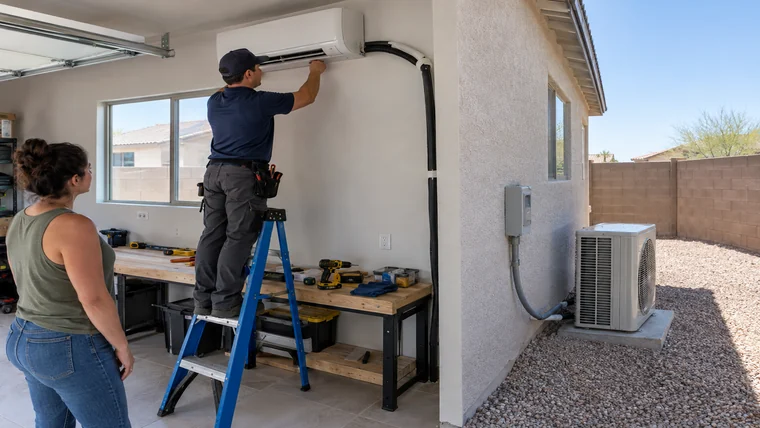
A Phoenix garage is the hottest room attached to the house and the only one the builder never intended anyone to stand in. It sits outside the insulated envelope by design: the common wall into the house is insulated, the ceiling under living space is insulated, and the sixteen-foot steel door facing the street is not. By mid-afternoon in July the attic above it is running 150 to 170 degrees and that door has been in full sun for hours.
People use the space anyway — as a gym, a workshop, a home for the second refrigerator, a place to get into the car without the seatbelt buckle burning. A ductless mini-split is the normal fix, because there is no duct run out there and the residential code does not permit the house duct system to open into a garage; ducts that pass through must be sealed sheet metal with no register on the garage side. This page covers what size actually works here, what a head costs installed, whether insulation should come first, and what controls the calendar.
- Most Phoenix 2-car garages land at 18,000–24,000 BTU and 3-car garages at 24,000–36,000, frequently across two heads.
- Hot-climate garage guidance runs 30–45 BTU per square foot against roughly 20 for living space, with 30–50 percent added for a bare shell.
- The garage sits outside the building thermal envelope, so the ceiling is rarely insulated — and the attic above it runs 150 to 170 degrees in July.
- Weatherizing — insulated door, ceiling insulation, sealed perimeter — commonly drops a 2-car garage from 24,000 BTU to 18,000.
- Installed heads run $1,000–$3,000; electrical work and permit fees are priced separately and shown in writing first.
- Phoenix's exempt-work list requires a permit for indoor residential refrigeration installations regardless of size, so the under-five-ton outdoor swap exemption does not cover a garage head.
- SRP Cool Cash may cover a new garage mini-split on qualifying equipment; eligibility and the current per-ton amount are confirmed against the live programme before the quote.
- APS ended its residential AC and heat pump rebate, and the federal 25C credit is unavailable for 2026 installations.
What size unit does AZ Trusted Air recommend for 2- and 3-car garages here?
The chart that says 400 square feet needs 12,000 BTU was written for a bedroom. A bedroom has conditioned space on most of its surfaces, blown-in insulation over the ceiling, and no sixteen-foot opening to the outdoors. Published garage sizing guidance for hot climates starts at 30 to 45 BTU per square foot instead of the roughly 20 a living space gets, and a bare-shell garage — no wall batts, uninsulated overhead door, a bottom seal that stopped sealing years ago — commonly takes another 30 to 50 percent on top of that before sun exposure or ceiling height is counted at all.
What we find above Phoenix garage ceilings is usually nothing. The energy code defines the building thermal envelope as the boundary between conditioned and unconditioned space, and an attached garage sits outside it, so the builder insulated the common wall and the ceiling under living space and stopped there. Unlike a bedroom ceiling with R-38 sitting on top of it, a garage lid in a 1990s tract home is often half an inch of drywall with a July attic on the other side. Homeowners who open a garage attic hatch in August consistently find 150 to 170 degrees pressing down on the largest surface in the room.
The second thing that changes the answer is the number you want to see on the thermostat. ACCA's Manual J is built around design conditions for occupied space; a garage has no code-required temperature, so the setpoint is your choice and it moves the equipment tier. Holding 85 degrees in a west-facing bare garage while the outdoor design condition sits at 110 and above is a different load from holding 78 in the same room. We ask that question before sizing anything, because a homeowner who wants a usable workshop and a homeowner who wants a gym at 74 are not buying the same machine.
On three-car garages the layout matters as much as the capacity. Homeowners who mount a single head above the man door consistently discover that the third bay — the deep one behind the workbench — never catches up, because air throw from a high-wall head falls off long before it reaches a back corner forty feet away. Two smaller heads on one outdoor unit usually beat one oversized head, and they let you shut down the half of the garage you are not using.
Bigger is not automatically safer. SRP's own guidance warns that an oversized system short cycles, cooling in bursts and wearing itself out. An inverter-driven mini-split modulates, unlike a single-stage condenser that only knows on and off, so a modest step up is far less punishing here than it would be on a whole-house changeout — but a 36,000 BTU head in a 400-square-foot garage will still swing temperature and never settle.
| Garage | Typical floor area | What we usually specify |
|---|---|---|
| 2-car, bare shell | 380–480 sq ft | 18,000–24,000 BTU, one head |
| 2-car, weatherized | 380–480 sq ft | 12,000–18,000 BTU, one head |
| 3-car, bare shell | 600–750 sq ft | 24,000–36,000 BTU, usually two heads |
| 3-car, weatherized | 600–750 sq ft | 18,000–24,000 BTU, one or two heads |
Those are starting points, not quotes. The load calculation is what we build from, and it is the document worth asking any contractor for. A garage sized off a wall chart in this climate is the most common reason a mini-split runs all afternoon and never satisfies. The same arithmetic applies to any unducted room; our mini-split installation page covers the whole-house version.
Floor area and ceiling height, including bonus height in RV bays. Orientation of the overhead door and its shade at 4pm. Door construction and R-value, or bare steel. Wall assembly: block, or frame with or without batts. Ceiling condition: drywall with attic above, open trusses, or insulated. Perimeter and bottom-seal condition. Heat-producing equipment kept out there, from a second refrigerator to a welder. And the number you want held on the thermostat, because that single answer can move the specified capacity a full tier.
Cooling load we see in Phoenix garages, by garage type
Manual J results in BTU per hour. Weatherized means R-13 walls, an insulated overhead door and sealed perimeter.
Ranges reflect load calculations, not equipment quotes. Setpoint changes the answer: holding 78 degrees rather than 85 in a west-facing garage pushes toward the top of each band.
| Item | Range |
|---|---|
| 2-car, bare shell | 18,000 – 24,000 BTU/hr |
| 2-car, weatherized | 12,000 – 18,000 BTU/hr |
| 3-car, bare shell | 24,000 – 36,000 BTU/hr |
| 3-car, weatherized | 18,000 – 24,000 BTU/hr |
What does a garage mini-split cost installed (published range)?
That band is per indoor head. It covers the equipment, the outdoor unit, the line set, the condensate arrangement, mounting, vacuum and commissioning, and our two-year labour warranty on new equipment. A 3-car garage taking two heads is two heads' worth of head price on one outdoor unit, not two complete systems, which is why the second zone costs less than the first.
Inside the band, four things move the number. Line-set length and routing is the first: a condenser set beside the garage on the same wall as the head is a short run, while a condenser pushed around to a side yard for architectural reasons can double the pipe. Wall construction is the second — a stucco-over-frame wall in a 2005 Surprise house takes minutes to penetrate, while the CMU block walls common in older Phoenix and Sunnyslope construction need a core bit and a much slower afternoon. Condensate is the third, because a garage has no floor drain and rarely has convenient exterior grade, so some jobs gravity-drain outside and some need a pump. Access and ceiling height are the fourth.
Electrical is quoted separately because it genuinely varies. A garage head needs its own circuit and a disconnect at the outdoor unit, and the honest answer on a good many 1970s to 1990s panels in this market is that there is no spare double-pole space left. Our technician checks the panel on the survey visit and prices any work in writing before the install is scheduled. We will not guess at that number over the phone, and neither should anyone else.
The City of Phoenix Planning and Development Department sets the permit requirement and the fee, and that fee is the city's rather than ours. Outside Phoenix, Mesa, Chandler, Peoria, Surprise and the Pinal corridor jurisdictions each run their own schedule; your address decides which one applies, and we tell you before the quote is final.
On rebates, SRP's Cool Cash programme covers mini-splits, ducted or ductless, and requires the equipment to appear in the AHRI Verified Directory at or above the efficiency minimum. The rebate is paid per ton and scaled by compressor type — widely reported at $75 per ton single-stage, $150 multi-stage and $225 variable-capacity, which is how a five-ton system reaches $1,125. At $225 a ton, an inverter-driven two-ton garage head pencils out near $450. Two cautions, both real: SRP resets the amounts and the qualifying window each programme cycle, and adding cooling to a space that never had it is not the same transaction as replacing equipment, so eligibility gets confirmed against the live programme rather than assumed. If your meter belongs to Electrical District No. 3 in the Pinal corridor, the terms are that district's and we check them the same way. Our rebate concierge handles the filing.
Two things are not coming. APS ended its residential air conditioning and heat pump rebate after the Arizona Corporation Commission cut the efficiency-programme budget, leaving Cool Rewards, a thermostat credit rather than an equipment rebate — and we are not an APS Qualified Technology Installer, so APS money never appears on our quotes. The federal 25C credit expired at the end of 2025 under the One Big Beautiful Bill Act and is not available for anything placed in service in 2026. A garage quote showing either one is worth questioning, and our quote review is free if you want a second set of eyes on it.
What pushes a job above the typical range
These are the conditions that can push a job above the ranges above. We tell you before the work starts, not after — and they are worth checking on any contractor's quote, not just ours.
- The existing line set cannot be reused with the new equipment
- Electrical panel lacks capacity or needs breaker work
- Code upgrades on an older home - grandfathering ends when equipment is replaced
- Refrigerant contamination, or an R-22 system needing conversion
Does the garage need insulation work first, and does AZ Trusted Air coordinate it?
Order of operations matters more here than it does on a house. On a whole-home changeout the envelope is already whatever it is; on a garage, the envelope is usually the cheapest lever in the room. We look at four things in this order: the ceiling, the overhead door, the perimeter seals, and the door into the house.
The ceiling comes first because of where the heat is. A Phoenix attic at 150 to 170 degrees in July sits directly on the largest uninsulated surface in the garage, and until something is between the two, the mini-split spends its afternoon fighting a radiant panel the size of the floor. Where the garage has a finished drywall lid with attic above it, blown-in insulation on that plane is straightforward work. Where the trusses are open to the roof deck, the conversation is a different one, and it belongs with an insulation contractor rather than with us.
The overhead door is the second lever and the one homeowners feel fastest. The step from an uninsulated door to roughly R-9 blocks the large majority of the heat flow through the panels; going from R-9 to R-18 helps again, but noticeably less. Arizona door specialists put the summer peak reduction inside the garage at 10 to 20 degrees for an insulated door. Unlike a north-facing door in a moderate climate, a west-facing steel door in Goodyear or Surprise takes full sun at five in the afternoon in July — the precise hour most people walk into the garage.
Then the gaps. Garage slabs are poured with drainage slope and are rarely flat, so the bottom seal on an older door often touches in the middle and daylights at both corners. Jamb weatherstripping, a replaced bottom seal and a properly sealed man door are inexpensive next to a larger machine. Sealing the house-side wall matters for a second reason: a cooled garage against an unsealed common wall is partly cooling a stud cavity.
What all of that buys is a size tier. Weatherizing — R-13 in the walls, an insulated door, sealed perimeter — commonly moves a 2-car garage from 24,000 BTU to 18,000, and a 1-car from 18,000 to 12,000. Smaller equipment, less runtime, and a machine that is not pinned at full capacity every afternoon. It is equally fair to say when it is not worth it: if you want 85 degrees in a workshop you use on weekends, a correctly sized unit in a bare garage will get there. It will simply run near capacity to do it, and you will see that on your SRP or APS bill.
We do not sell insulation, which is exactly why we are comfortable telling you to buy it. What we do is run the load calculation both ways so you can see the equipment you would need before and after, then sequence our crew behind the insulation crew so the line set and the head land in a finished space. If the plan is to convert the garage into living space rather than simply cool it, that is a different path — a building permit with envelope, egress and light requirements — and the City of Phoenix Planning and Development Department is the authority on which one you are in. Cooling an enclosed patio or guest space follows the same logic, and that is covered on our casita and Arizona room cooling page.
What determines how soon a garage mini-split can be installed?
Start with the permit, because a garage head is not the job most people assume it is. Phoenix exempts a great many like-for-like outdoor condenser swaps under five tons, which is why a straight changeout can be booked and finished quickly. The city's published exempt-work list takes the opposite position on indoor work: it requires a permit for indoor residential refrigeration installations regardless of size. A wall head inside your garage is an indoor installation. That is the most common surprise on this job, and a contractor who tells you a garage mini-split never needs a permit in Phoenix is describing a different job.
A permit brings inspections, and inspections run on the jurisdiction's calendar rather than ours. Mechanical work in Phoenix takes a rough-in inspection once the refrigerant lines are in but before anything is concealed, then a final that confirms operation, clearances and condensate disposal. Suction-line insulation on a split system is inspected as part of that, per the residential code. In practice, the physical install can be a day while the paperwork runs longer, and we would rather say so than let you discover it.
Second, panel capacity. If the survey finds no spare double-pole space, that electrical work has to be priced and completed before equipment goes on the wall. Finding it out on the survey visit costs you nothing. Finding it out on install morning costs you a day.
Third, architectural review. In master-planned communities the design guidelines decide where a condenser may physically sit and whether it has to be screened; homeowners in Verrado, Eastmark, DC Ranch and Vistancia routinely find that equipment visible from the street needs committee approval first, and committees meet on their own schedule rather than a July one. Unlike a replacement condenser dropping onto an existing pad, a garage mini-split puts a new box on a wall that never had one — precisely the situation those guidelines were written for. We can supply the equipment dimensions and placement details a committee asks for; the submittal timeline belongs to them.
Fourth, the season and the queue. AZ Trusted Air answers the phone around the clock. A garage comfort project sits behind the no-cool list in July, and we would rather tell you plainly than promise a date we would end up moving.
Fifth, equipment. New residential systems are moving onto lower-GWP refrigerants under the EPA's technology transition rules, and the availability of specific capacities and head styles shifts with that changeover. We confirm the exact model and its AHRI listing before you sign, which matters twice over if an SRP rebate is part of the plan.
What we will commit to in writing: the sized equipment, the electrical scope, whether a permit is required at your address, and one flat price across the Phoenix metro and the Pinal corridor with no trip charge at any distance. What we will not do is publish a guaranteed arrival window in the middle of a Phoenix summer.
Sources and further reading
The figures and requirements on this page draw on the following public sources. We link them so you can check anything here yourself.
- City of Phoenix Planning & Development — permit requirements, the exempt-work list, and mechanical rough-in and final inspections
- ACCA (Air Conditioning Contractors of America) — Manual J load calculation, the correct basis for sizing a garage unit
- SRP — Cool Cash rebate terms for mini-splits and the AHRI listing requirement
- AHRI Directory — verify the exact model and rating a rebate application will be filed against
- U.S. Environmental Protection Agency — Section 608 — refrigerant handling rules and the transition to lower-GWP refrigerants
- Arizona Registrar of Contractors — licence verification and complaint history before you hire anyone
Send it however suits you — text a photo, email it, whatever is easiest. No obligation and no site visit. One flat rate across the Phoenix metro, the Pinal corridor and surrounding communities, at any distance.