Who repairs and seals attic ductwork in Phoenix?
The short answer: AZ Trusted Air repairs, seals and replaces attic ductwork across the Phoenix metro and the Pinal corridor, under Arizona ROC #317368. Our technicians work the parts homeowners never see: crushed flex runs, separated boots, unsealed plenum seams and returns pulling 150-degree attic air. Diagnosis is $69.95 Monday to Friday, credited toward the repair.
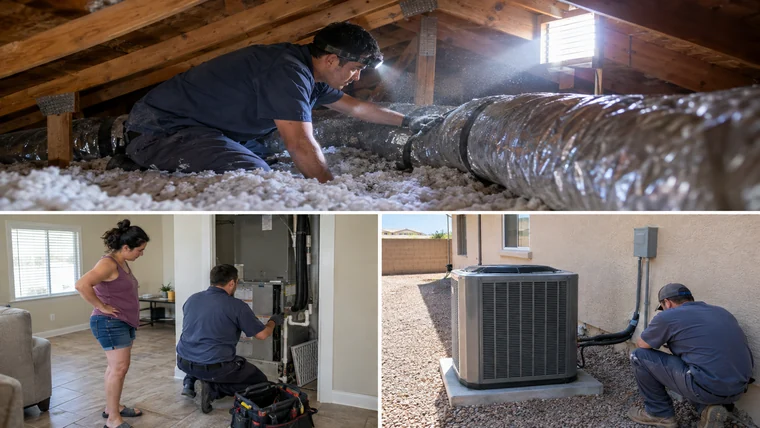
Almost every duct problem we are called about in the Phoenix metro lives in a place the homeowner has never looked. The ducts run through a vented attic, above the insulation, in air that sits far hotter than the outdoor temperature through the whole April-to-October cooling season. Homeowners who open an attic hatch in August consistently discover the same thing: the space their conditioned air travels through is the most hostile part of the house. The U.S. Department of Energy puts typical duct losses at 20 to 30 percent of the air moving through the system, and the National Renewable Energy Laboratory puts attic and crawlspace duct systems higher still, at 25 to 40 percent of the heating or cooling energy that passes through them. In a house where that duct run is stapled to the underside of a roof deck in July, those are not abstract percentages. This page covers how the leakage is found, what the fix costs, what SRP will pay toward it, and when it is worth doing at the same time as an equipment change.
- The U.S. Department of Energy puts typical duct losses at 20 to 30 percent of the air moving through the system; NREL puts attic and crawlspace duct systems at 25 to 40 percent.
- Return-side leakage matters most in Arizona: pulling 10 percent of return air from a hot attic can cut system efficiency and capacity by as much as 30 percent.
- Duct leakage is measured as CFM25 at 25 pascals; leakage to outside is the meaningful number when ducts run through a vented Phoenix attic.
- The 4 CFM25 per 100 square feet figure is a new-construction code threshold, not a pass-fail verdict on an existing 1990s Valley home.
- SRP's Duct Test and Repair Rebate covers 75% of repair costs or up to $400, with up to $300 for mobile homes, apartments, condominiums and townhouses, and excludes new construction and evaporative coolers.
- SRP's rebate requires work to be performed through a participating contractor; verify current credential and enrollment requirements on SRP's rebate page before booking.
- Duct replacement is published at $1,000 to $3,000 across the Phoenix metro and the Pinal corridor, one flat rate with no trip charge; sealing scope is priced after an attic inspection.
- The federal 25C credit does not apply to work placed in service in 2026, and AZ Trusted Air is not an APS Qualified Technology Installer — plan around SRP or ED3 programs instead.
How does AZ Trusted Air test duct leakage, and what does the test cost?
There are two honest levels of duct diagnosis, and they answer different questions. The first is the one we perform on a standard service visit: a technician in the attic with a light and a camera, checking every take-off, boot, plenum seam and return connection, and reading static pressure at the air handler so the airflow story matches the visual one. What we find on Phoenix jobs is rarely subtle. Separated flex at a take-off, a boot that has pulled away from the ceiling drywall, an air handler cabinet whose panel gasket disintegrated years ago — those are found by eye, not by instrument, and they are the leaks that move the meter.
The second level is a measured test. A calibrated duct-blaster fan pressurises the sealed duct system to 25 pascals and reports leakage as CFM25 — the airflow the fan must supply to hold that pressure. Total leakage counts everything; leakage to outside runs a blower door at the same pressure so that only the air escaping the building envelope is counted. In a Phoenix house with ducts in a vented attic, leakage to outside is the number that matters, because that is the air that never comes back.
| Measurement | What it tells you | Reference threshold |
|---|---|---|
| Total duct leakage (CFM25) | Everything leaking from the sealed system, inside and out | 4 CFM25 per 100 sq ft of conditioned floor area under IECC 2021 for new construction |
| Leakage to outside (CFM25) | Only the air leaving the building envelope — into the attic | ENERGY STAR rater checklists use the greater of 4 CFM25 per 100 sq ft or 40 CFM25 |
| Static pressure at the air handler | Restriction: crushed flex, undersized returns, blocked coil | Compared against the equipment's rated external static |
| Visual attic inspection | Where the leak physically is, and whether it is repairable or terminal | No numeric threshold — this is the part that gets photographed |
An important honesty note about those thresholds. The 4 CFM25 per 100 square feet figure is a new-construction code number. Your 1996 Maricopa County tract house was never held to it and will almost never meet it. It is a useful yardstick, not a pass-fail verdict on an existing home — and any contractor who tells you your house “failed code” because an existing duct system tested above a new-build threshold is using a number to sell you something.
The rebate-qualifying test is a specific credential
SRP's Duct Test and Repair Rebate is not a reimbursement you claim on your own. SRP publishes its current contractor terms, including any BPI certification requirement, on its participating contractor page; verify those requirements before booking. The rebate is paid on work done through a participating Duct Test and Repair contractor. SRP's own published guidance says testing for a typical home can run $100 to $450 and repairs often land between $300 and $1,500.
So the practical question to ask any Valley company before booking a duct test is simply: are you on SRP's participating contractor list for this program? If a $400 rebate is central to your decision, verify that first — with the company and with SRP — rather than after the invoice is paid. We would rather send you to that list than have you assume something about us that costs you four hundred dollars. Our rebate concierge page walks through which Phoenix-area programs are live and which quote sheets are still quoting dead ones.
What do duct sealing and duct replacement cost (published ranges)?
| Work | Price | Notes |
|---|---|---|
| Diagnostic visit, Mon–Fri 8am–6pm | $69.95 | Credited toward any repair we perform |
| Diagnostic visit, outside those hours | $99.95 | Credited the same way |
| Duct replacement | $1,000 – $3,000 | Driven by run count, attic access and whether the plenums are rebuilt |
| Duct sealing and partial repair | Priced after inspection | Scope is not knowable from the driveway — see below |
| Travel / trip fee | None | Same price in Sunnyslope as in Casa Grande, Florence or Maricopa |
Duct work is the one category where a phone quote is close to meaningless, and the reason is structural rather than evasive: duct jobs get priced on several different bases — per linear foot, per supply or return run, per register, time and materials, or a fixed job price — and which basis fits cannot be chosen until someone has been in the attic and counted. That gives you a fast question for any duct quote you receive in this market: which basis is this priced on? A quote that cannot answer was guessed at. Our free quote review exists for exactly that comparison, and no one visits your house to do it.
What pushes a Phoenix duct job toward the top of its range
- Run count, not square footage. A 2,000 square foot single-story home with fourteen supply runs is a bigger duct job than a 2,400 square foot home with nine.
- Attic access. A low-pitch roof with 24-inch clearance over the run is slow, hot work; a walkable attic is not.
- Plenum condition. Rebuilding supply and return plenums and sealing them to the air handler is the difference between a repair and a rebuild.
- Return sizing. Undersized returns are common in older Valley tract housing, and adding return capacity is added scope, not a sealing task.
- Insulation value. Supply ducts in unconditioned attic space are held to R-8 in Climate Zone 2 for new work — older R-4.2 flex in an attic is thermally outclassed before it leaks a single cubic foot.
The two rebates that apply to duct work here
SRP's Duct Test and Repair Rebate covers 75 percent of repair costs or up to $400 of duct testing and qualified repairs. Single-family detached homes qualify for up to $400; mobile homes, manufactured homes, apartments, condominiums and townhouses qualify for up to $300. New construction homes and evaporative coolers are not eligible. The paid-in-full itemised invoice must carry the contractor's name, address and Arizona ROC licence number, the application must be submitted within six months of the repairs. SRP publishes a current program window on its residential rebates page — confirm the deadline there before you schedule the work.
Representative example. Illustrative format, not a specific customer’s diagnosis: return static pressure recorded at 0.62 in. w.c.; photograph DS-01 identifies a separated return-plenum connection in the attic; written finding: seal and mechanically secure the connection, then verify the repair. The report records the observed condition and reading before any repair recommendation.
If your meter is ED3 rather than SRP — which is the case for a good share of Maricopa and the surrounding Pinal corridor — ED3 lists an Air Duct Repair rebate of its own on its residential rebates page, and requires a detailed paid-in-full receipt from the repair company listing the work completed. ED3 publishes the current amount and terms on that program page; check it there rather than taking a contractor's word for the figure, because these programs change. APS is a different situation again: we are not an APS Qualified Technology Installer, so never plan an APS incentive around work we perform.
And one thing that is not available, no matter who tells you otherwise: the federal 25C energy efficiency home improvement credit does not apply to work placed in service in 2026. If a quote you are holding adds a federal tax credit line to a duct job this year, that quote is out of date.
What pushes a job above the typical range
These are the conditions that can push a job above the ranges above. We tell you before the work starts, not after — and they are worth checking on any contractor's quote, not just ours.
- Crane access on rooftop package units
- The existing line set cannot be reused with the new equipment
- Electrical panel lacks capacity or needs breaker work
- Ductwork is undersized, leaking, or hard to reach in the attic
- Code upgrades on an older home - grandfathering ends when equipment is replaced
- Refrigerant contamination, or an R-22 system needing conversion
What duct work actually costs in the Phoenix metro
AZ Trusted Air published prices alongside SRP's own published typical figures for duct testing and qualified repairs.
SRP's Duct Test and Repair Rebate covers 75% of repair costs or up to $400 for single-family detached homes, and up to $300 for mobile and manufactured homes, apartments, condominiums and townhouses. Figures per SRP's published program terms — confirm current amounts and participating-contractor requirements before you rely on them.
| Item | Range |
|---|---|
| Diagnostic visit (Mon–Fri / after hours) | $70 – $100 |
| Duct testing — SRP typical | $100 – $450 |
| Qualified duct repairs — SRP typical | $300 – $1,500 |
| Full duct replacement | $1,000 – $3,000 |
Should ducts be fixed at the same time as an AC replacement?
Here is the sequence that costs Valley homeowners money. A system is replaced in July. The house is better, but not as much better as the efficiency rating promised. Two summers later somebody finally goes into the attic and finds the return plenum was never properly sealed to the new air handler, and a supply take-off has been drawing on nothing but attic air since the day it was installed. The equipment was never the limiting factor.
Unlike a boiler swap in a Midwestern basement, where the distribution system is inside the heated envelope and a leak simply warms the room next door, a Phoenix attic duct leak is a total loss. The air goes into 150-degree attic space and does not come back. That is why we treat duct evaluation as part of a replacement conversation rather than an upsell bolted to the end of one — and why our repair-or-replace consultation looks at the duct system before it recommends a machine.
Three things that change when duct work is in scope
| Item | Equipment-only change-out | Change-out with duct work |
|---|---|---|
| Permit | Phoenix exempts most like-for-like outdoor swaps under five tons | Duct replacement or re-routing is the kind of alteration that commonly requires a mechanical permit — confirm with City of Phoenix Planning & Development for your address |
| Inspection | Where a permit applies, a straight change-out with no new ductwork often draws a single final inspection | New duct work is inspected before it is covered or concealed, which affects scheduling |
| Sizing | Same-capacity replacement generally reuses the existing load assumption | Capacity changes beyond a narrow tolerance call for a fresh ACCA Manual J calculation against the 115-degree design condition |
Rooftop package units are their own case, and they dominate certain Phoenix neighborhoods in a way they simply do not in most of the country. The cabinet sits on a roof curb with the supply and return dropping straight through the roof deck, so the vulnerable joints are the curb transition and the first few feet of duct — not a 60-foot attic run. Unlike a split system, there is no attic air handler to work around, which changes both access and price. We cover that equipment separately on the rooftop package unit page.
One genuine caution: SRP's duct rebate excludes new construction and evaporative cooler systems, and each SRP program carries its own application and terms. If you intend to pursue both an equipment rebate and the duct rebate on the same project, confirm the stacking rules with SRP before you rely on both figures. We will not tell you they stack when the program terms are the authority on that.
What efficiency gain can sealed ducts deliver in an Arizona attic?
The single most useful number we know of on this subject comes from duct-testing work rather than from marketing: if 10 percent of the return air for an air conditioning system is pulled from a hot attic, system efficiency and capacity are often reduced by as much as 30 percent. Read that again with a Phoenix attic in mind. The return is not drawing neutral outdoor air — it is drawing air that has been sitting under a roof deck since sunrise.
Losses also compound rather than add. Research by Iain Walker at Lawrence Berkeley National Laboratory, widely cited in the building-science field, found that a system with 10 percent supply leakage and 10 percent return leakage does not lose 20 percent; the real hit is closer to 30 percent. The same work indicates that bringing leakage down to roughly 5 percent on each side raises duct system efficiency by about 10 percent. SRP, for its part, tells its own customers that about 20 percent of the air moving through a duct system is lost because of improper installation.
What that means in a Valley house, stated carefully: sealing a genuinely leaky attic duct system is one of the few retrofits where the physics supports a double-digit improvement in delivered capacity. What we will not do is attach a dollar figure to your bill. Your savings depend on your leakage rate, your duct length and insulation, your rate plan and how you run the thermostat — and your utility bill names your provider, whether that is SRP, APS or ED3. Anyone quoting you a guaranteed monthly saving before testing your ducts is reciting a sales script.
What leaky ducts feel like before they show up on a bill
- The far bedroom never catches up. A run that has separated at the take-off delivers a fraction of its design airflow, and no thermostat setting fixes it. That is the core of what we cover on hot upstairs and hot-room problems.
- Dust that returns days after cleaning. Return-side leaks draw attic dust, insulation fibre and whatever the monsoon pushed through the soffit vents directly into the air stream, upstream of your filter. That is an air quality issue before it is an energy one.
- Long run times at moderate outdoor temperatures. A system that cannot satisfy the thermostat on a 98-degree October afternoon has a distribution problem, not a refrigerant one.
- A closet or hallway that feels pressurised. Imbalance between supply and return leakage pushes the house positive or negative, which drives outside air through every other gap in the building.
One contrast worth holding onto. In a moderate climate, a duct that loses 25 percent of its air into a 78-degree crawlspace has wasted energy but not much capacity. In an Arizona attic in July, the same duct is losing air into a space more than 60 degrees hotter than the house — and the conduction loss through the duct wall is running alongside the leakage the whole time. Identical leakage, very different consequence. That is the part national duct-sealing advice consistently understates for Valley homeowners, and it is why we look at ducts before we look at equipment on almost every second opinion we write.
Sources and further reading
The figures and requirements on this page draw on the following public sources. We link them so you can check anything here yourself.
- SRP — Duct Test and Repair Rebate terms, typical test and repair costs, and participating-contractor requirements
- U.S. Department of Energy — typical duct loss figures and guidance on sealing ducts in unconditioned space
- City of Phoenix Planning & Development — when duct alteration or replacement requires a mechanical permit and inspection
- ENERGY STAR — duct leakage test protocols and the CFM25 per 100 square feet thresholds
- ACCA (Air Conditioning Contractors of America) — Manual J load calculation and Manual D duct design standards
- Arizona Registrar of Contractors — licence verification and complaint history — SRP rebate paperwork requires the ROC number
Send it however suits you — text a photo, email it, whatever is easiest. No obligation and no site visit. One flat rate across the Phoenix metro and surrounding communities, including the Pinal corridor, at any distance. Call (623) 252-6403 any hour; a person answers.