Who performs genuine AC tune-ups in Phoenix (not sales visits)?
The short answer: A genuine tune-up ends in numbers. AZ Trusted Air technicians document capacitor microfarads, superheat or subcooling against the manufacturer's target, temperature split and amp draws on every Phoenix metro visit, and hand you the readings. A sales visit ends in a replacement quote instead. Our diagnostic is $69.95 weekdays, and the written report is yours either way.
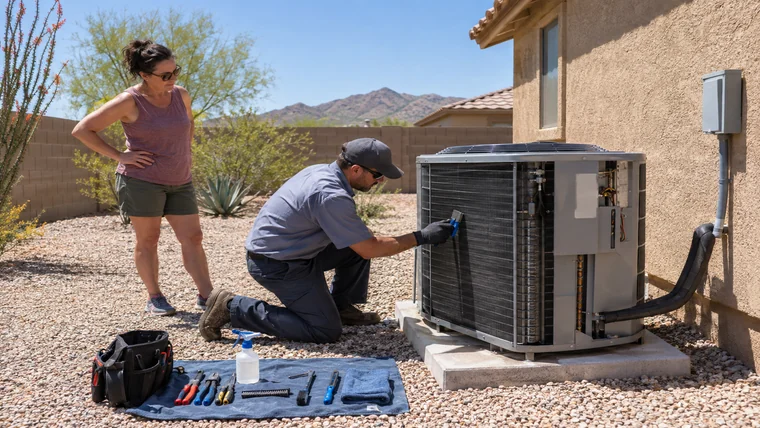
Every spring we get the same question in different words: is a tune-up real maintenance, or is it a way to get a technician standing in front of you in March so somebody can sell you a system in June? Both products exist in this market, and they are easy to tell apart. A real tune-up produces numbers — capacitance in microfarads, superheat or subcooling against the manufacturer's target, a temperature split, amp draws — written down where you can compare them against next year's. A sales visit produces a proposal. Below is what ours measures, what it costs, and when to book it.
- A genuine tune-up ends in recorded figures: microfarads against the nameplate, superheat or subcooling against the manufacturer's target, temperature split and amp draws. Checkmarks are not readings.
- ENERGY STAR's HVAC quality-installation checklist allows subcooling deviation within ±3°F of the OEM goal or superheat within ±5°F, with electrical readings compared against nameplate values.
- At a ±5% tolerance, a 40 µF capacitor should measure 38–42 µF; capacitors commonly test acceptable in spring and fail under sustained July load, which is why the spring number matters.
- A one-off tune-up is billed as a service call at $69.95 Monday to Friday 8am–6pm and $99.95 outside those hours, credited toward any repair. The maintenance plan is $25 a month per unit.
- Coil cleaning ($150) and coil replacement ($2,200–$2,600) are different jobs; a quote saying only “coil” should be clarified before signing.
- SRP covers duct testing and qualified sealing at 75% of cost, up to $400 for a single-family detached home and $300 for attached homes, condos and mobile homes, filed within six months and performed by a BPI-certified contractor.
- Phoenix's average first 100-degree day is May 2, though the Valley has recorded 100°F as early as mid-March — book maintenance in February or March.
- The federal 25C tax credit is repealed for equipment placed in service in 2026, and APS ended its residential equipment rebates on January 1, 2026; SRP's Cool Cash remains for qualifying replacements.
What does AZ Trusted Air's tune-up include, item by item, with documented readings?
The standard we work to is the one ENERGY STAR's HVAC quality-installation checklist sets out: subcooling deviation within ±3°F of the manufacturer's goal, or superheat within ±5°F, with amps, volts and watts recorded on the blower, the condenser fan and the compressor and compared against the nameplate. Those are the measurements that tell you whether a system is genuinely charged and moving air, as opposed to merely blowing something cool at a register.
| Item | What gets measured | Why it matters in the Valley |
|---|---|---|
| Condenser coil | Cleaned and rinsed; fin condition noted | Monsoon dust loads Phoenix coils in a way no moderate climate does |
| Capacitor | Capacitance in microfarads against the nameplate | At ±5% tolerance a 40 µF capacitor should read 38–42 µF; a reading in the high 20s is failing, not “fine” |
| Refrigerant charge | Superheat or subcooling against the OEM target | Checked by measurement, never by frost on a line or a gauge glance |
| Airflow | Supply-and-return temperature split; filter and blower wheel condition | Dust that slips past a loaded filter cakes the blower wheel and quietly costs capacity |
| Electrical | Amps, volts and watts on compressor, condenser fan and blower | Rising amp draw is the earliest warning a compressor gives before a 115°F afternoon |
| Contactor | Pitting, scorching, engagement | Pitted contacts add resistance and heat at the highest-voltage connection in the box |
| Condensate drain | Cleared, flow-tested, safety switch verified | An overflowing attic pan finds your ceiling drywall before it finds you |
| Controls | Thermostat calibration, staging and schedule reviewed against your rate plan | On a time-of-use plan the schedule is worth nearly as much as the hardware |
Two Phoenix-specific notes. Attic temperatures here run 150–170°F in July, so the evaporator, the blower and the ducting live in an oven for half the year — which is why we look at duct condition and connections during maintenance rather than waiting for a complaint about one hot bedroom. And on a rooftop package unit, the entire machine is up there taking direct sun, so panel gaskets, curb seals and the drain pan matter in a way they simply do not on a ground-mounted split system.
On refrigerant, EPA Section 608 governs handling, certification and venting, and a tune-up is not a licence to top a system off. If a system is low, it is leaking, and the honest next step is a leak search and a repair decision, not another pound of gas each spring.
What pushes a job above the typical range
These are the conditions that can push a job above the ranges above. We tell you before the work starts, not after — and they are worth checking on any contractor's quote, not just ours.
- Crane access on rooftop package units
- The existing line set cannot be reused with the new equipment
- Electrical panel lacks capacity or needs breaker work
- Ductwork is undersized, leaking, or hard to reach in the attic
- Code upgrades on an older home - grandfathering ends when equipment is replaced
- Refrigerant contamination, or an R-22 system needing conversion
What does the tune-up cost and what does the maintenance plan include?
| Service | Price |
|---|---|
| Tune-up / service call, Mon–Fri 8am–6pm | $69.95 |
| Outside those hours | $99.95 |
| Maintenance plan | $25/month per unit |
| Coil cleaning (service, not replacement) | $150 |
| Coil replacement | $2,200 – $2,600 |
| Capacitor | $50 – $200 |
| Contactor | $100 – $200 |
| Condenser fan motor | $600 – $1,200 |
| Blower motor | $750 – $1,800 |
| Duct replacement | $1,000 – $3,000 |
| Travel / trip fee | None, at any distance we serve |
Coil cleaning at $150 and coil replacement at $2,200–$2,600 are separate jobs roughly two thousand dollars apart, and a quote that says only “coil” should be clarified before it is signed. Repairs carry a one-year labour warranty; full pricing for everything else sits on our published pricing page.
Maintenance also intersects with real rebate money, which is why the paperwork side matters. SRP's programme covers duct testing and qualified sealing at 75% of cost, up to $400 for a single-family detached home and $300 for attached homes, condos and mobile homes, with the work performed by a BPI-certified contractor and the claim filed within six months — confirm current terms with SRP before you count on a figure. SRP also credits enrolled smart thermostats, and APS runs Cool Rewards, a demand-response programme that credits enrolled customers for reducing load during on-peak events — confirm current terms with APS directly. We are not an APS Qualified Technology Installer and will never promise you an APS equipment rebate; our rebate concierge page sets out what each territory actually pays.
What a $69.95 tune-up is measured against — published repair costs it can catch early
AZ Trusted Air published prices, Phoenix metro. Same prices at any distance, no trip fee.
A tune-up does not prevent every failure. What it does is put a measured number beside each component before the season that breaks them, so a weak part is replaced at capacitor prices rather than discovered at compressor prices.
| Item | Range |
|---|---|
| Tune-up / service call | $70 – $100 |
| Coil cleaning | $150 – $150 |
| Capacitor | $50 – $200 |
| Condenser fan motor | $600 – $1,200 |
| Blower motor | $750 – $1,800 |
| Coil replacement | $2,200 – $2,600 |
| Compressor | $800 – $4,000 |
Does AZ Trusted Air's tune-up ever come with sales pressure — what is the no-upsell policy?
The upsell pattern in this market is predictable enough to describe. A cheap or free pre-season inspection is booked, the technician spends twenty minutes at the unit, and the visit ends with a replacement proposal and a discount that expires. The tell is always the same: the proposal arrives without the readings that would justify it. A capacitor is condemned with no microfarad figure, a system is called “low on freon” with no superheat or subcooling number, or a compressor is written off with no amp draw recorded.
Our position is simply that the reading comes first and the recommendation second, and that you keep the reading either way. If somebody else has already handed you a proposal, a second opinion costs the same $69.95 and is credited toward any work, with the written report yours regardless — and a quote review is free with no site visit at all. Unlike a replacement decision made in July with the house at 88 degrees, a repair-or-replace conversation in March is one you can take a week to think about.
Each report carries the same fields, filled in with figures: capacitor rated value and measured microfarads; superheat or subcooling measured against the manufacturer's target; supply and return air temperatures and the resulting split; compressor, condenser fan and blower amp draw against nameplate; contactor condition; condensate drain and safety switch verified; filter size and condition; and any recommendation with the specific reading that supports it. Where a reading is out of range, the report says by how much. Where nothing is wrong, the report says that too, and no quote is attached.
When should spring maintenance be scheduled to beat the summer rush?
The case for booking early is not scheduling convenience, it is diagnostic quality. Capacitors degrade gradually and frequently test acceptable in spring, then fail under sustained July load, so the March number matters precisely because it gives us something to compare the next reading against. A cooling season running April into October also means national maintenance advice built around one annual visit understates what equipment here goes through; a heat pump, in particular, benefits from a shoulder-season check because it works in both directions. Our heat pump page covers that side.
While a technician is there in spring, the rate plan is worth ten minutes. SRP and APS both sell time-of-use plans where on-peak energy is priced far above off-peak, and your bill names your plan and its hours — which is what makes pre-cooling the house before the on-peak window a real saving rather than a theory. A smart thermostat makes that schedule automatic. Also worth saying plainly: the federal 25C tax credit is repealed for equipment placed in service in 2026, so any contractor still folding it into a spring “act now” pitch is quoting a credit that no longer exists. If cooling does fail mid-season, emergency repair is answered by a person 24 hours a day — typical arrival is 12 to 24 hours in most cases.
Sources and further reading
The figures and requirements on this page draw on the following public sources. We link them so you can check anything here yourself.
- ENERGY STAR — HVAC quality-installation checklist: subcooling and superheat deviation limits and required electrical measurements
- SRP — current duct test and repair rebate terms, thermostat credits and Cool Cash requirements
- U.S. Environmental Protection Agency — Section 608 — refrigerant handling and certification rules that govern charging during service
- U.S. Department of Energy — maintenance, airflow and charge guidance for central cooling systems
- Arizona Registrar of Contractors — verify licence status and complaint history before any technician works on your system
Send it however suits you — text a photo, email it, whatever is easiest. No obligation and no site visit. One flat rate across the Phoenix metro and surrounding communities including Casa Grande, Florence and Maricopa, at any distance. Call (623) 252-6403 any hour.