Where Can I Get a Second Opinion on an AC Replacement Recommendation in Phoenix?
The short answer: Before approving any AC replacement in the Phoenix metro, get the diagnosis verified. AZ Trusted Air provides $69.95 second opinions at one flat price anywhere we serve, with no travel fee (after-hours or emergency $99.95): a licensed technician re-tests the disputed components, documents the readings and photos in a written report you keep, and gives you a straight repair-or-replace verdict.
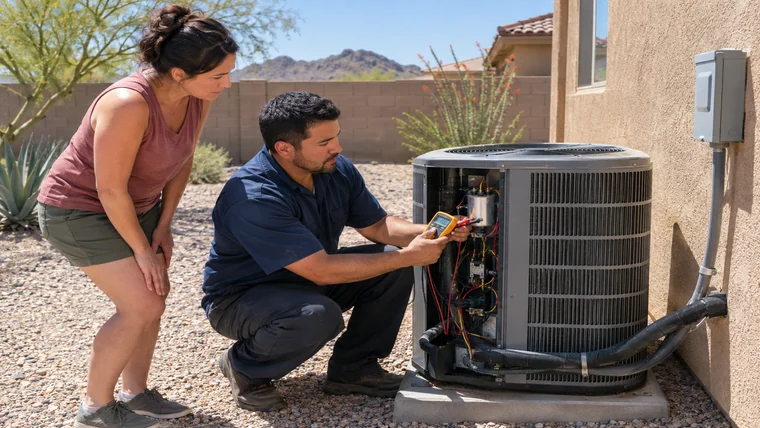
You've just been told your air conditioner is finished. The quote in your hand has five digits, the house is warming up, and the comfort advisor is asking which financing option works best. Here's what we've learned across the Valley: a meaningful share of those replacement recommendations don't survive a second set of instruments. Not always — sometimes the first diagnosis is exactly right, and we'll tell you so. But on a $5,000–$10,000 decision, a $69.95 verification that's credited back anyway isn't caution. It's arithmetic.
- A second opinion on an air conditioning replacement costs $69.95 in the Phoenix metro and is credited toward any repair performed, so verifying a four-figure recommendation is close to free.
- The failures most often presented to Phoenix homeowners as system-ending — capacitors, contactors and condenser fan motors — are repairs in the $50 to $1,200 range, not replacements.
- A written report with measured readings (capacitance, refrigerant pressures, amp draws, temperature splits) is evidence; a verbal opinion is one voice against another.
- Arizona homeowners can check any contractor's licence and complaint history free at the Arizona Registrar of Contractors before letting them on the property.
- Free second opinions are usually sales visits — the visit costs nothing because the replacement quote at the end pays for it.
- A correct first diagnosis confirmed in writing is still worth the visit: it converts a pressured decision into a normal purchase with two comparable quotes.
- Phoenix systems age faster than national averages, so age alone is never a diagnosis — the instruments decide, not the install date.
What does AZ Trusted Air's second-opinion visit cost and exactly what does it include?
The fee exists for one reason: it keeps the opinion honest. Free second opinions are usually sales calls wearing a costume — the visit is free because the replacement quote at the end pays for it. Charging a flat rate and crediting it back means our technician's only job on your property is to find out what's true. What we test depends on what the first company claimed: a "failed compressor" call gets winding resistance and amp-draw measurements; a "coil leak, not worth fixing" call gets electronic leak detection and pressure readings; a "system's too old to repair" call gets a component-by-component condition assessment against our repair-or-replace framework.
What we find on Phoenix rooftops in July is that the diagnosis and the sales pitch often arrive together, from the same person, in the same visit. Technicians touring a failed system in 115-degree heat are working a homeowner who wants the house cool tonight, and that urgency is doing a lot of the selling. Charging a flat $69.95 and crediting it back is how we take that pressure out of the room: the only thing our technician is paid to do on your property is find out what is true.
Will the technician put the diagnosis in writing with photos and readings?
This is the part that changes the conversation. A verbal opinion is one voice against another; documented readings are evidence. Capacitance is a number. Refrigerant pressure is a number. Either the measurements support the recommendation you were given or they don't — and you'll hold the paper either way. Homeowners have used our reports to cancel unnecessary replacements, to negotiate fair pricing on necessary ones, and in a few cases to support complaints to the Arizona Registrar of Contractors.
The readings are also what make a complaint stick if one is ever needed. According to the Arizona Registrar of Contractors, a homeowner filing against a licensed contractor is expected to document what was claimed and what was found — and a dated report with instrument readings and photographs is exactly that. Homeowners have used our reports to cancel unnecessary replacements, to negotiate fair pricing on necessary ones, and in a few cases to support an ROC filing.
Our written reports have helped Phoenix homeowners cancel unnecessary replacements, negotiate fair pricing on confirmed repairs, and — in documented cases — support complaints to the Arizona Registrar of Contractors.
What happens if the first company's recommendation was right?
Roughly speaking, that's the second-best outcome a second opinion can buy. You stop wondering whether you're being played, and the decision becomes a normal purchasing decision: same verified problem, two quotes, your choice. If you'd like our number for that comparison, we'll quote the confirmed scope — and per our published pricing, you'll know before we arrive roughly where that number will land. No today-only discounts, no expiring prices. If the other company's price is fair, we'll say that too.
One check worth running yourself before either company touches the equipment: if you were quoted a complete system, confirm the indoor and outdoor units are a certified matched pair in the AHRI Directory. Mismatched equipment is a genuine problem in the Phoenix market — it costs efficiency, it can void a manufacturer warranty, and it is invisible on a quote that lists only model numbers.
How often do second opinions overturn a replacement recommendation?
Why does it happen here so much? Two Phoenix-specific pressures. First, commission structures: many large operations pay technicians on what they sell, and a replacement pays a multiple of a capacitor swap. Second, the desert itself provides cover — capacitors genuinely do fail constantly in extreme heat, so "your system is dying" lands plausibly even when the cure is a modestly priced part. The pattern to watch for: a dramatic diagnosis, urgency, financing paperwork, and reluctance to show you the actual readings. When you see all four, that's the moment this service exists for.
There is a structural pressure worth naming too. Sealed-system repairs on older R-410A equipment now sit inside an industry-wide refrigerant phase-down administered by the U.S. Environmental Protection Agency under Section 608, which genuinely does push the economics of a large repair on an aging unit toward replacement. That is a real argument. It is also a convenient one, which is why it deserves to be checked against the actual condition of your equipment rather than accepted on its own.
What the common failures actually cost — against the replacement being recommended
AZ Trusted Air published repair prices, Phoenix metro, compared with a complete system replacement.
The three failures most often presented to Phoenix homeowners as system-ending — capacitor, contactor and fan motor — sit at the top of this chart. A second opinion costs $69.95 and is credited toward whatever the repair turns out to be.
| Item | Range |
|---|---|
| Capacitor | $50 – $200 |
| Contactor | $100 – $200 |
| Condenser fan motor | $600 – $1,200 |
| Blower motor | $750 – $1,800 |
| Full replacement | $5,000 – $10,000 |
Sources and further reading
The figures and requirements on this page draw on the following public sources. We link them so you can check anything here yourself.
- Arizona Registrar of Contractors — licence verification and complaint history for any Arizona contractor, free to search
- U.S. Environmental Protection Agency — Section 608 — refrigerant handling requirements and the R-410A phase-down affecting older system repairs
- ACCA (Air Conditioning Contractors of America) — Manual J load calculation and professional diagnostic standards
- AHRI Directory — verify that a quoted indoor and outdoor unit are a certified matched system
- U.S. Department of Energy — efficiency standards and cooling system guidance
One flat price across the Phoenix metro — Phoenix, Scottsdale, Glendale, Peoria, Surprise, Goodyear, Buckeye, Mesa, Gilbert, Chandler, Queen Creek, San Tan Valley, Apache Junction, Maricopa, Sun City, Fountain Hills, Cave Creek and the communities in between. No travel fee, no zone pricing.