Who installs and configures smart thermostats in Phoenix?
The short answer: AZ Trusted Air installs and configures smart thermostats across the Phoenix metro and the Pinal corridor, under Arizona ROC 317368. The install itself is the easy part: what matters here is wiring a common conductor, configuring heat-pump reversing-valve and auxiliary-heat staging correctly, then programming the schedule around your actual utility plan — APS, SRP or ED3 — because each one prices afternoons differently.
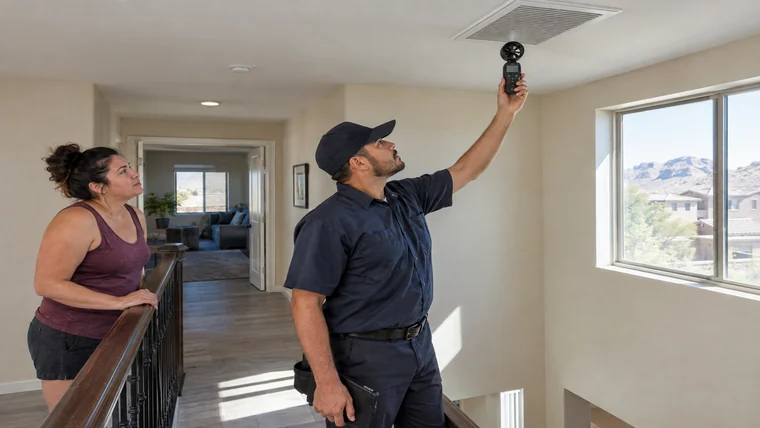
A smart thermostat is the cheapest piece of equipment in a Phoenix cooling system and the one most often left half-configured. The device goes on the wall in twenty minutes. What actually decides whether it saves you anything is the hour of the afternoon your utility charges the most for electricity — and in the Valley that hour is not the same from one street to the next. APS runs its current time-of-use plans with a three-hour on-peak window of 4pm to 7pm weekdays. SRP's Manage Demand plan runs 5pm to 10pm; its Conserve plan runs 6pm to 9pm. Out in the Pinal corridor, ED3's peak window starts earlier in the afternoon than either. A schedule built for one of those is wrong for the other two. So the first thing our technicians ask for is not the thermostat box, it is the electric bill, because the plan name printed on it dictates every setpoint we enter afterward.
- The plan name on your bill decides the whole configuration: APS current time-of-use plans peak 4pm–7pm weekdays, the frozen Saver Choice Plus plan peaks 3pm–8pm.
- SRP Manage Demand 5-10 p.m. and Save peaks 5pm–10pm with super off-peak energy 8am–3pm daily; Conserve 6-9 p.m. and Save peaks 6pm–9pm year round.
- On an APS demand plan the charge is set by your single highest hour inside the on-peak window, so one badly timed afternoon prices the whole month.
- APS itself recommends switching geofencing and occupancy sensing off on demand plans and pre-cooling on a schedule instead.
- SRP's Bring Your Own Thermostat program pays $50 per eligible thermostat on enrollment plus $25 per season; ED3 rebates up to $50 per device, two per account.
- APS Cool Rewards pays $50 per thermostat on enrollment and $35 a year; AZ Trusted Air is not an APS Qualified Technology Installer and promises no APS equipment rebate.
- SRP's published pre-cool method is three degrees below setpoint about three hours before peak, then three degrees above once peak begins.
- Remote sensors are not zoning, and the 25C federal credit is repealed for anything placed in service in 2026.
How does AZ Trusted program thermostats for APS/SRP time-of-use and demand plans?
APS now runs its current residential time-of-use plans on a three-hour on-peak window, 4pm to 7pm weekdays, after the Arizona Corporation Commission voted to shorten the on-peak period from five hours to three. Customers still sitting on the frozen Saver Choice Plus plan keep on-peak hours of 3pm to 8pm, because retired plans did not move. Those are two different schedules in the same subdivision, and we have programmed both on the same street in the same week.
SRP is its own world. Manage Demand 5-10 p.m. and Save prices on-peak from 5pm to 10pm weekdays and puts its cheapest energy, super off-peak, between 8am and 3pm every day. Conserve 6-9 p.m. and Save narrows on-peak to 6pm through 9pm weekdays, year round. Older SRP plans are still in service — Time-of-Use and EZ-3 are closed to new enrollment and SRP has said they will be discontinued by the November 2029 billing cycle, so a schedule written around an EZ-3 window has an expiry date on it. SRP also lowered prices temporarily by $0.0038 per kWh for the May through October 2026 billing cycles, which shifts the arithmetic slightly without changing the strategy.
| Plan | On-peak window | What we program |
|---|---|---|
| APS Time-of-Use 4pm–7pm Weekdays | 4pm–7pm weekdays | Pre-cool finishing by 4pm, setback through 7pm |
| APS Saver Choice Plus (frozen) | 3pm–8pm weekdays | Earlier pre-cool, longer coast |
| SRP Manage Demand 5-10 p.m. and Save | 5pm–10pm weekdays | Heavy use in super off-peak 8am–3pm; staged recovery |
| SRP Conserve 6-9 p.m. and Save (E-28) | 6pm–9pm weekdays | Run the afternoon, coast after dinner |
Demand plans are where a badly configured thermostat costs real money, and it is the part national thermostat advice gets wrong for Arizona. On the APS Time-of-Use 4pm-7pm with Demand Charge plan, the demand charge is set by your single highest hour of use inside that window each billing month — one badly timed afternoon prices the whole month. APS publishes a demand limiter that can be applied once during the May-to-October summer months and up to three times in a calendar year, plus a demand charge credit available once in a rolling twelve months. Those are safety nets, not a plan. APS's own Cool Rewards guidance goes further and recommends switching geofencing and occupancy sensing off if you are on a plan with a demand charge, because a thermostat that notices you pulling into the driveway at 4:30pm will start a five-ton compressor at precisely the wrong minute. We turn it off and put a schedule in its place.
At commissioning we confirm there is a common conductor for continuous power, verify the staging the thermostat believes it is driving, and on heat pumps configure the reversing-valve output and lock out electric auxiliary heat so it cannot fire on a 45-degree Phoenix morning. Then we write the schedule down and leave it with the homeowner. Homeowners who install their own consistently discover the defaults are a generic wake-and-sleep pattern designed for a heating climate, with no relationship to a 4pm-to-7pm window.
When your on-peak window actually falls — and when pre-cooling has to start
Published on-peak windows by plan, Phoenix metro and Pinal corridor. Hours shown on a 24-hour clock.
Pre-cooling generally needs to be finished before the bar starts, which is why an ED3 schedule looks nothing like an SRP Conserve schedule. APS and SRP windows are from the utilities' own plan pages; the ED3 window is from third-party rate tracking, so confirm yours against your bill.
| Plan | On-peak window |
|---|---|
| ED3 time-of-use (Pinal corridor) | 2pm – 9pm |
| APS Saver Choice Plus (frozen plan) | 3pm – 8pm |
| APS Time-of-Use 4pm–7pm Weekdays | 4pm – 7pm |
| SRP Manage Demand 5-10 p.m. and Save | 5pm – 10pm |
| SRP Conserve 6-9 p.m. and Save (E-28) | 6pm – 9pm |
What does professional installation and TOU configuration cost?
Two numbers make up your total and they move independently. The device is the smaller one: ED3's own homeowner guidance puts smart thermostat retail prices at roughly $50 to $300 and up depending on features, and the utility credits described in the next section cover $50 to $100 of that. Labour is the variable, and what varies is behind the wall plate rather than on it.
Three things drive it in Valley houses. First, the common wire. ED3 notes that smart thermostats work with most forced-air systems installed after 1975 but that you need to check your wiring and whether a C-wire exists for constant power — in plenty of 1980s and 1990s Phoenix homes it does not, and the fix is either an adapter at the air handler or new low-voltage cable pulled. Second, rooftop package units: the thermostat cable runs up through the roof curb, so tracing a control fault is a roof trip in 115-degree ambient, not a hall-closet trip like it would be on a split system with the air handler in the garage. Third, heat pumps, which add terminals, reversing-valve logic and auxiliary heat that has to be configured rather than left on the factory default.
Our fees are the same whatever we find. A diagnostic or service visit is $69.95 Monday to Friday between 8am and 6pm and $99.95 outside those hours, credited toward any repair we perform, and it is the same price in Arcadia as in Casa Grande, Florence or Maricopa — no trip charge, no zone pricing, at any distance. Our maintenance plan is $25 a month per unit. Labour warranty runs two years on new equipment and one year on repairs. Financing is available through a third-party lender and does not change the price of the job by a dollar. We do not price match, and a quote review is free with no site visit if you want another company's thermostat or zoning proposal checked before you sign it.
Two things we will not do. We will not sell a thermostat as the cure for a load problem: if the upstairs runs eight degrees warmer than the hallway, the constraint is duct capacity or building load, and the honest fixes are duct work at $1,000 to $3,000 for a replacement, or a ductless head at $1,000 to $3,000 through mini-split installation. And we will not put a federal tax credit on your estimate. The 25C energy efficient home improvement credit is repealed for anything placed in service in 2026, so a 2026 quote that shows one is quoting money that no longer exists. Our full published pricing covers the rest of the catalogue.
What pushes a job above the typical range
These are the conditions that can push a job above the ranges above. We tell you before the work starts, not after — and they are worth checking on any contractor's quote, not just ours.
- Crane access on rooftop package units
- The existing line set cannot be reused with the new equipment
- Electrical panel lacks capacity or needs breaker work
- Ductwork is undersized, leaking, or hard to reach in the attic
- Code upgrades on an older home - grandfathering ends when equipment is replaced
- Refrigerant contamination, or an R-22 system needing conversion
Which thermostats qualify for utility rebates, and is the paperwork handled?
SRP's Bring Your Own Thermostat program pays a $50 bill credit per eligible thermostat once your enrollment is accepted, then $25 per thermostat at the end of each participating season you stay in. SRP caps the enrollment side at $100 and the seasonal side at $50 for homes with more than one qualifying thermostat, and describes the headline offer as up to $100 off your bill. In exchange, SRP nudges your setpoint up a few degrees during conservation events, which it says usually last no longer than three hours, and you can opt out of any single event from the app, a browser or the thermostat itself. Buying through SRP Marketplace applies instant rebates at checkout instead. Eligibility is by model, and SRP publishes the participating manufacturers — that list, not a contractor's word, is the authority.
In the Pinal corridor the programme is different. Electrical District No. 3 rebates up to $50 per qualifying smart thermostat, limited to two per residential account, with the device purchased within the current calendar year. Its Peak Rewards demand-response program adds a $25 one-time enrollment incentive and a $25 yearly participation incentive, with opt-out at any event. That is separate paperwork from SRP's, and which set applies is decided by the meter, not the mailing address — something worth checking if you are in Maricopa or on the edge of a district boundary.
APS runs Cool Rewards: a one-time $50 enrollment bill credit per thermostat, up to five thermostats per home, plus a $35 participation credit per thermostat each year. Events fall between June 1 and September 30, are capped at 20 per summer, last up to three hours and raise the setpoint by a few degrees. Enrollment is a homeowner account action — no contractor is needed, and we will tell you that rather than bill you for it. What we will not do is promise APS equipment money. AZ Trusted Air is not an APS Qualified Technology Installer. APS's current residential rebate landscape changed in 2026; confirm what is currently available at aps.com before counting on any equipment-side incentive.
We handle what a contractor can legitimately handle: documenting installed model and serial numbers, confirming AHRI listings when the thermostat is part of a system replacement, completing and submitting the rebate forms that require a contractor signature, and getting the device onto Wi-Fi and into a manufacturer account so the enrollment actually validates. Utility amounts change between program cycles, so we verify the current figure before it goes on your paperwork. If a replacement is in the picture too, SRP's equipment rebate is the larger prize — up to $1,125 on qualifying high-efficiency equipment — and our rebate concierge page covers how those stack.
Every thermostat we configure leaves with a written one-page record: the utility and exact plan name from your bill, the on-peak window that plan uses, the pre-cool start time and setpoint, the on-peak setpoint, whether geofencing or occupancy sensing was disabled and why, the heat pump or package unit settings entered (reversing valve orientation, auxiliary heat lockout, staging, cycles per hour), and whether a C-wire was present or an adapter was fitted. If a rebate applies, the model and serial numbers and the programme the paperwork went to are on the same sheet. It is the customer's copy to keep, which matters the day a utility plan changes or another contractor touches the system.
Can a pre-cooling schedule be set up as part of the install?
SRP publishes the recipe plainly: about three hours before on-peak begins, set the thermostat three degrees below your preferred temperature, and when on-peak starts, set it three degrees above so the compressor is not running through the expensive hours. That is the skeleton we program on install day. The depth and the lead time then get adjusted to the building, because three degrees over three hours is a starting point, not a property of physics.
Your pre-cool start time is decided by when your peak begins, and the earliest peak in our service area belongs to ED3 territory, where rate trackers put the weekday window at 2pm to 9pm. ED3 publishes its own schedule and that is the one that governs, so confirm it against your bill — but if it is a 2pm start, the pre-cool has to be finished before noon, in a house that is still gaining heat. An APS 4pm peak means starting around 1pm. SRP's 6pm-to-9pm plan is the gentlest of the three: you can run the equipment through the hottest part of the afternoon and only coast after dinner, which in July is a very different ask.
Pre-cooling only pays if the house holds what you bought. Our technicians routinely measure Phoenix attic temperatures of 150 to 170 degrees in July, so every leaking or poorly insulated attic duct dumps the cool air you paid for during off-peak hours into the hottest space in the building. Unlike a moderate climate where an attic is merely warm and leakage is a slow loss, here the temperature difference across the duct wall is enormous and the loss is fast. Homeowners who open the attic hatch in August consistently understand the problem within about ten seconds. This is why we assess duct condition before promising anything from a schedule, and the U.S. Department of Energy's cooling guidance makes the same point about distribution losses.
Two cautions. On a demand plan, letting the house drift five degrees and then recovering at 7:01pm can create the very peak hour you were avoiding — recovery gets staged, not dumped. And remote room sensors are not zoning; they average or prioritise a room, they do not send more air to it. Real zoning means dampers, a zone panel and duct capacity per zone, sized against an ACCA Manual J load calculation at a 115-degree design temperature, which is also how you find out a west-facing two-story has two loads one thermostat cannot serve. Replacing a thermostat is not permit work; cutting dampers into ducts can be, and City of Phoenix Planning & Development publishes the requirements, which differ by jurisdiction. If the symptom is a temperature split between floors, start at hot upstairs solutions, not at the wall plate.
Sources and further reading
The figures and requirements on this page draw on the following public sources. We link them so you can check anything here yourself.
- SRP — residential price plan windows, Bring Your Own Thermostat credits and the published pre-cooling method
- APS — time-of-use and demand plan on-peak hours, demand limiter rules and Cool Rewards terms
- City of Phoenix Planning & Development — when duct or mechanical modification for zoning requires a permit
- U.S. Department of Energy — cooling system and distribution loss guidance behind pre-cooling strategy
- ACCA (Air Conditioning Contractors of America) — Manual J load calculation, the correct basis for sizing zones
- Arizona Registrar of Contractors — licence verification and homeowner complaint process
Send it however suits you — text a photo, email it, whatever is easiest. No obligation and no site visit. You can leave a message any time at (623) 252-6403, and there is one flat rate across the Phoenix metro and surrounding communities, at any distance.