Who provides AC repair and replacement in Maricopa?
The short answer: AZ Trusted Air handles AC repair and replacement throughout Maricopa and the wider Pinal corridor, licensed under Arizona ROC 317368. Diagnostics are $69.95 weekdays from 8am to 6pm and $99.95 outside those hours, credited toward the repair. Maricopa is billed at the same flat rate as any Phoenix metro address — no travel fee, trip charge or zone pricing at any distance.
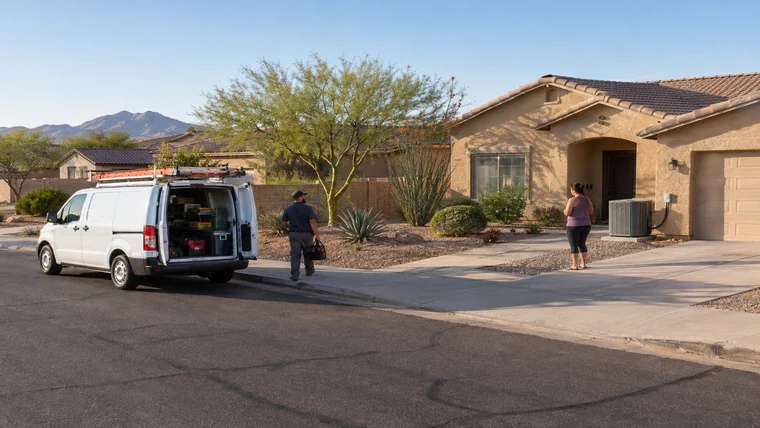
Maricopa is a young city with an ageing air-conditioning problem. The core of the housing stock went up in one compressed wave between 2004 and 2008, which means the original equipment in thousands of these homes was installed within a few seasons of each other and is now reaching the end of a Valley service life at roughly the same time. That build wave is the single most useful thing to know about HVAC here. It tells you what is likely failing, what it will cost, and why a second opinion is worth more in Maricopa than in most of the metro — the house three streets over is often the same floor plan with the same duct layout and the same tonnage, and somebody in it has already been quoted. What follows is what we charge in Maricopa, what the ED3 rebate rules actually say, what the City of Maricopa requires on a permit, and the questions worth asking before you approve anything expensive.
- Maricopa's core housing stock went up in one 2004–2008 wave, so original systems are reaching end of life together — the replacement window is now.
- Diagnostics are $69.95 weekdays 8am–6pm and $99.95 outside those hours, credited — the same flat rate in Maricopa as anywhere in the Phoenix metro, with no trip fee.
- Installed: 3-ton $5,000–$7,000, 4-ton $6,000–$8,000, 5-ton $7,000–$10,000; heat pumps no premium; crane $400–$600 on rooftop units.
- Maricopa addresses are typically ED3, not SRP or APS, so SRP's Cool Cash SEER2 15.2 rebate does not apply here — your bill names your utility.
- ED3's residential HVAC rebate is sized on ENERGY STAR SEER2 rating, requires purchase and installation in the same calendar year, and pays as a bill credit.
- The federal 25C credit is terminated: the IRS allows no credit for property placed in service after 31 December 2025.
- The City of Maricopa runs its own building department and treats HVAC replacement as permit work; Phoenix's like-for-like exemption is not the rule here.
- Coil cleaning ($150) and coil replacement ($2,200–$2,600) are different jobs, and on a 2004–2008 original the refrigerant on the data plate decides the whole repair-or-replace question.
What does a service call cost in Maricopa, and how does scheduling work?
Maricopa is a drive, and that is where most pricing games start. For most of our routes the only practical way in is State Route 347 south through the Gila River Indian Community, and plenty of Valley companies quietly price that drive into the job as a trip charge, a zone fee or a higher minimum. We do not. The diagnostic is the same number in Rancho El Dorado as it is in Arcadia, and the same number again in Casa Grande further down the corridor.
The phone is answered by a person 24 hours a day, and when a call genuinely warrants it we dispatch overnight. What we will not publish is a same-day promise. By late June every competent company in this market is committed by mid-morning, and a guaranteed arrival window in that week is a marketing sentence rather than a schedule. Typical non-emergency arrival is 12 to 24 hours. If the house is climbing past 90 degrees with an infant or an older adult inside, say so on the call, because that changes where you sit in the queue. Genuine no-cooling failures route to emergency AC repair.
There is a local billing reason not to let a 4pm problem become a 9pm problem. ED3's time-of-use peak runs 2pm to 9pm on weekdays, and an independent 2026 guide built from ED3's published rate schedule puts the super-summer on-peak energy charge at $0.2482 per kWh, roughly four times the off-peak rate. Unlike an APS or SRP customer in the metro, a Maricopa homeowner buys power from a political subdivision whose rates are set by its own elected board rather than by the Arizona Corporation Commission — so rate advice written for Phoenix does not transfer. Most ED3 homes sit on the standard tiered rate by default and the TOU plan is opt-in, so check your bill before you assume you are pre-cooling for a reason.
Maintenance is $25 a month per unit. A second opinion costs the same $69.95, is credited if we do the work, and the written report is yours either way. A quote review is free and needs no site visit at all.
What does AC replacement cost for typical Maricopa homes?
The homogeneous build wave cuts both ways. It makes tonnage easy to guess and dangerous to assume. The nameplate on the outdoor unit records what a production builder bought in 2005 for a plan that was being repeated down the whole street; it is not a load calculation for your house, with your window film, your added shade and your converted-garage office. ACCA's Manual J is the correct basis, and it is run against a July afternoon rather than an average day. If a Maricopa quote arrived without anyone measuring or asking, it was matched to a sticker. Our AC age checker is a quick way to place your equipment in that wave before you start.
What moves a job inside its range here is mostly hidden. Homeowners who open an attic hatch in August discover conditions national duct guidance simply does not contemplate — Valley attics routinely run 150 to 170 degrees, and flex duct that has baked through twenty cooling seasons leaks the cooling you paid for into that oven. Duct replacement runs $1,000–$3,000. Where the equipment sits also matters: a rooftop package unit needs a crane at $400–$600, a ground-set split system does not.
Refrigerant is the other 2026 variable. Under EPA's Technology Transitions rule, new residential systems must use refrigerant below 700 GWP, which is why R-454B (GWP 466) replaced R-410A (GWP 2,088), and why new systems carry integrated leak detection. Manufacture of residential R-410A equipment stopped on 1 January 2025, but EPA's final rule effective 27 July 2026 removed the installation deadline for pre-2025 inventory, so that stock may still be installed until it runs out.
Permits are not a Phoenix question here. Maricopa is a Pinal County city running its own building department, and its published guidance on the adopted 2024 International Mechanical Code treats installation, replacement or relocation of HVAC equipment as permit work — including an amended IMC 309.1 requirement that a dwelling maintain both heating and cooling capability. That is a different rule from the City of Phoenix, which exempts many like-for-like outdoor swaps under five tons. We confirm with the city on each job rather than assuming either way.
What pushes a job above the typical range
These are the conditions that can push a job above the ranges above. We tell you before the work starts, not after — and they are worth checking on any contractor's quote, not just ours.
- Crane access on rooftop package units
- The existing line set cannot be reused with the new equipment
- Electrical panel lacks capacity or needs breaker work
- Ductwork is undersized, leaking, or hard to reach in the attic
- Code upgrades on an older home - grandfathering ends when equipment is replaced
- Refrigerant contamination, or an R-22 system needing conversion
Installed system price by tonnage — Maricopa homes
AZ Trusted Air published ranges, identical in Maricopa to anywhere in the Phoenix metro. The split marks where equipment moves from standard efficiency into the ENERGY STAR-rated tier ED3 sizes its residential HVAC rebate on.
Crane service on a rooftop package unit adds $400–$600 and is billed separately. ED3 states its residential HVAC rebate amount is based on the ENERGY STAR SEER2 rating and that the programme is subject to funding availability and change without notice — we confirm the current figure with ED3 before you sign.
| Item | Range |
|---|---|
| 3-ton system | $5,000 – $7,000 |
| 4-ton system | $6,000 – $8,000 |
| 5-ton system | $7,000 – $10,000 |
What should Maricopa homeowners check before approving a major AC repair?
Start with numbers, not adjectives. A failed capacitor has a measured microfarad reading against a printed nameplate rating; a failing compressor has amp draws and resistance values. What we find on Maricopa service calls is that the honest repairs are the cheap ones — capacitors run $50–$200 and contactors $100–$200 at our published prices. Unlike a five-figure replacement decision, those are decisions you can make on the spot, which is exactly why a capacitor presented as a reason to replace an entire system deserves a second set of eyes.
Then check warranty status, and check it specifically for this build wave. Equipment original to a 2005 house is long past any parts coverage. But a great many Maricopa systems were already replaced once in the 2010s, and those may still be inside a ten-year parts warranty if the original owner registered them — registration transfers vary by manufacturer, so the answer sits in your paperwork, not in a general rule. That single question is most of the reason compressor work spans $800–$4,000.
Read the word “coil” carefully. Coil cleaning is $150. Coil replacement is $2,200–$2,600. They are different jobs about two thousand dollars apart, and in a monsoon summer — when dust and blown organic debris load an outdoor coil until head pressure climbs and the unit starts short-cycling — the cheap one is often the correct one. Ask which is being quoted before you sign anything.
Finally, check the refrigerant on the data plate. Systems original to the 2004–2008 wave were commonly built for R-22, whose production and import ended in 2020, leaving only reclaimed and stockpiled supply for service. Putting $1,500 into a charge-losing R-22 system is usually a poor trade, and our R-22 replacement and repair-or-replace pages set that arithmetic out. Whoever you use, verify the licence at the Arizona Registrar of Contractors and confirm it covers residential air conditioning work.
One: a tonnage supported by a Manual J, not copied from the 2005 nameplate. Two: the refrigerant, stated as R-454B or pre-2025 R-410A stock. Three: the AHRI certified match of outdoor unit and indoor coil, not just a condenser model. Four: whether a City of Maricopa mechanical permit is included. Five: whether ductwork is repaired, replaced or left untouched. A quote missing three of the five was estimated from a driveway.
Which rebates can Maricopa residents claim on a replacement, and who handles the paperwork?
ED3 — Electrical District No. 3 of Pinal County, formed in 1926 as a special district — is not a version of SRP with a different logo. It sets its own rates and its own programmes through an elected board, and it states plainly that its rebate programme depends on available funding and can change without notice. Its residential HVAC rebate requires the unit to be purchased and installed within the current calendar year, and the rebate amount is based on the ENERGY STAR SEER2 rating of what you install. Approved rebates are applied as a bill credit, generally within one to two billing cycles.
We will not publish a residential dollar figure we have not confirmed for the current programme year, because that number moves and a wrong one costs you real money. What is verifiable today: ED3's non-residential HVAC rebate runs $350–$1,000 with a 16-SEER minimum and AHRI Directory listing, its smart thermostat rebate pays up to $50 each for up to two per household, home insulation pays 50 percent of the billed amount up to $300, and a qualifying heat pump water heater pays $250. We confirm the current residential HVAC figure and threshold with ED3 before you sign, not after.
Two things people expect here do not apply. SRP's Cool Cash, which requires SEER2 15.2 or higher listed in the AHRI Directory, belongs to SRP customers — a Maricopa home on ED3 cannot claim it. And if your bill happens to read APS, tell us before you buy: APS requires its rebates be installed by a Qualified Technology Installer, and we are not currently one.
The federal credit is gone. The IRS lists section 25C as terminated — no credit for property placed in service after 31 December 2025 — and 25D with it. Any 2026 quote still showing a $2,000 heat pump credit is padded with money that does not exist. Paperwork we handle through the rebate concierge: itemised paid invoice, model and serial numbers, AHRI certification reference and the signed forms, with the account name matched to the ED3 bill.
Sources and further reading
The figures and requirements on this page draw on the following public sources. We link them so you can check anything here yourself.
- ED3 (Electrical District No. 3) — Residential Rebates — current residential HVAC, thermostat, insulation and water heater rebate terms for Maricopa customers
- Arizona Registrar of Contractors — verify a contractor's licence, classification and complaint history before approving work
- U.S. Environmental Protection Agency — Section 608 — refrigerant handling rules, the R-410A phase-down and the move to R-454B
- AHRI Directory — confirm the quoted outdoor unit and indoor coil are a certified matched system before filing a rebate
- ACCA (Air Conditioning Contractors of America) — Manual J load calculation, the correct basis for sizing a replacement in a tract-built home
- City of Phoenix Planning & Development — the Phoenix permit rules that do not apply in Pinal County — useful for comparison
- SRP — Cool Cash rebate terms and the SEER2 15.2 threshold, for homes actually in SRP territory
Send it however suits you — text a photo, email it, read it out over the phone on (623) 252-6403. No obligation and no site visit. Maricopa and the Pinal corridor are billed at the same flat rate as anywhere in the Phoenix metro, with no travel fee, trip charge or zone pricing at any distance.