Who provides AC repair and replacement in Province / 55+?
The short answer: AZ Trusted Air handles AC repair and replacement in Province and across Maricopa, licensed under Arizona ROC 317368. Diagnostics are $69.95 weekdays 8am to 6pm and $99.95 outside those hours, credited toward the repair. Replacement runs $5,000 to $10,000 installed depending on tonnage. A person answers our phone 24 hours a day, seven days a week.
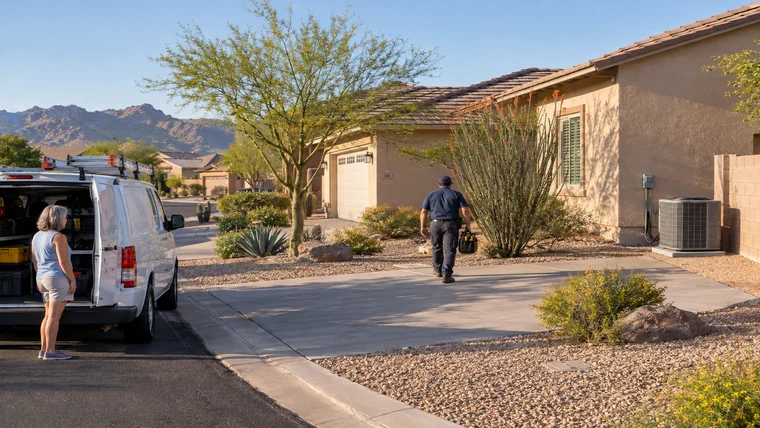
Province started going up in 2004 and has kept building since, and that spread of build dates matters more than it sounds. The first air conditioners installed there are now twenty-two years old; the newest are barely broken in. Twelve to twenty-two years is the window where a Valley system stops being a maintenance item and becomes a decision, and a large share of this community sits inside that window right now. What we find in homes of this era around Maricopa is original equipment that has run eight-month cooling seasons since the day it was commissioned — April into October, every year, which is why national lifespan tables written for a four-month season read as optimistic here. This page covers what a service call costs in Province, what a replacement actually runs, what to verify before you approve a large repair, and how the rebate paperwork works in ED3 territory. Every price below is the same one we quote at any Phoenix metro address.
- Province homes date from 2004 onward, so the oldest systems there are now twenty-two years old and much of the community sits inside the 12-to-22-year replacement window.
- AZ Trusted Air charges $69.95 for a diagnostic weekdays 8am to 6pm and $99.95 outside those hours, credited toward the repair, at the same price as any Phoenix metro address.
- Installed replacement runs $5,000–$7,000 at three tons, $6,000–$8,000 at four and $7,000–$10,000 at five; heat pumps carry no premium and a package-unit crane is $400–$600.
- The City of Maricopa requires a mechanical permit for HVAC replacement under its adopted 2024 IMC; Phoenix's under-five-ton like-for-like exemption is a Phoenix rule and does not apply in Province.
- Coil cleaning at $150 and coil replacement at $2,200–$2,600 are different jobs, and a quote saying only “coil” should be clarified before signing.
- Province is typically ED3 territory, but territory varies by address and your bill names it; ED3 sets its own rates and rebates and is not ACC-regulated, so APS and SRP terms do not transfer.
- The federal 25C tax credit is repealed for systems placed in service in 2026 — any quote still showing it was built on last year's assumptions.
- A second opinion is $69.95, credited, and the written report is yours regardless; a quote review is free and needs no site visit.
What does a service call cost in Province / 55+, and how does scheduling work?
Our pricing does not change by address. A diagnostic in Province is the same $69.95 it is in Phoenix or Casa Grande, and $99.95 evenings and weekends. There is no trip charge, no zone pricing and no surcharge of any kind at any address we serve. The fee is credited toward any repair we perform, so on most calls it simply disappears into the invoice.
Scheduling in a 55-plus community has one practical wrinkle worth raising while you are still on the phone: controlled entry. If your community uses a guard gate, a call-box directory or a visitor pass, tell us at booking how a technician gets through and what name the truck should be listed under. A van parked outside a gate at two in the afternoon in July is the most avoidable delay in this trade, and it is one we can eliminate in thirty seconds of conversation.
We do not publish a same-day guarantee. In a Maricopa August, every company that makes one has broken it by mid-afternoon, and a homeowner sitting in a hot house would rather have a realistic window than a promise. Unlike a failed furnace in a moderate climate, where the homeowner has a day or two of slack, a failed compressor here on a 112-degree afternoon is a genuine health question for an older resident — which is exactly the kind of call that earns overnight dispatch rather than a slot on tomorrow's board.
Two visits cost less than people expect. A second opinion is the same $69.95 or $99.95, credited if we do the work, and the written report is yours whether you hire us or not. A quote review costs nothing and needs no site visit at all: send us the estimate however suits you and we will tell you what we make of the scope and the number.
What pushes a job above the typical range
These are the conditions that can push a job above the ranges above. We tell you before the work starts, not after — and they are worth checking on any contractor's quote, not just ours.
- Crane access on rooftop package units
- The existing line set cannot be reused with the new equipment
- Electrical panel lacks capacity or needs breaker work
- Ductwork is undersized, leaking, or hard to reach in the attic
- Code upgrades on an older home - grandfathering ends when equipment is replaced
- Refrigerant contamination, or an R-22 system needing conversion
What does AC replacement cost for typical Province / 55+ homes?
| System | Installed price | What moves it within the range |
|---|---|---|
| 3-ton split system | $5,000 – $7,000 | Efficiency tier; attic duct and line-set condition |
| 4-ton split system | $6,000 – $8,000 | Efficiency tier; electrical or code work if required |
| 5-ton split system | $7,000 – $10,000 | Efficiency tier; access and equipment placement |
| Heat pump | Same by tonnage | No premium over straight-cool |
| Rooftop package unit | Crane $400 – $600 | Billed separately from the system price |
| Mini-split | $1,000 – $3,000 per head | Line-set routing; casita, garage or added room |
What decides where a Province home lands in that spread is load and access, not badge. Homes of this build era in the Pinal corridor are commonly single-story with the air handler and the entire duct trunk sitting in the attic, so the changeout is a two-piece job and the attic portion is the part that varies. ACCA's Manual J is the correct basis for sizing it, run in this climate against a design temperature near 110 to 115 degrees. Oversizing is the cheap shortcut: a system a half-ton too large short-cycles, never runs long enough to pull moisture out during monsoon weeks, and leaves the far bedroom warm anyway.
Permitting is where Province differs from most of our Phoenix work, and it surprises people. The City of Phoenix exempts many like-for-like outdoor swaps under five tons — but that is a Phoenix rule and it does not travel to Pinal County. The City of Maricopa requires a mechanical permit for the installation, replacement or relocation of HVAC equipment under the 2024 International Mechanical Code as it has adopted it, with its own portal and inspection; the city's published fee schedule lists a $56 residential minor mechanical fee effective October 2025, which is worth confirming with the city before you rely on it. We pull the permit where the jurisdiction requires one.
One more thing to check on any 2026 quote: the refrigerant. New residential equipment has moved to R-454B under the EPA's phase-down of high-GWP HFCs, and the indoor and outdoor units must be a certified match. Ask for the AHRI reference number and look it up yourself in the AHRI Directory. Our labour warranty is two years on new equipment and one year on repairs, and financing, if you use it, is third-party and does not change the price of the job by a dollar.
Installed system price by capacity — Province and the Maricopa area
AZ Trusted Air published ranges. The split marks the step from standard-efficiency equipment to the higher-efficiency, AHRI-listed tier utility rebate programs generally require.
Crane service on a rooftop package unit is billed separately at $400 to $600. Heat pumps carry no premium over straight-cool equipment of the same capacity. Rebate thresholds and amounts are set by ED3 and revised periodically — confirm the current terms before you rely on them.
| Item | Range |
|---|---|
| 3-ton system | $5,000 – $7,000 |
| 4-ton system | $6,000 – $8,000 |
| 5-ton system | $7,000 – $10,000 |
What should Province / 55+ homeowners check before approving a major AC repair?
Age first, because it reframes everything else. A Province home finished in 2005 on original equipment is at twenty-one years; a 2016 home is at ten. The same $2,400 coil quote is a reasonable repair on the second house and a poor investment on the first. If you are not certain of the install date, the data plate on the outdoor unit carries a manufacture date in the serial, and our AC age checker walks you through reading it.
Then the paperwork. Ten-year registered parts warranties are common on equipment of this vintage, and a compressor still covered on parts turns a $4,000 conversation into a labour-only one. That is the whole reason our compressor range runs from $800 to $4,000 — the bottom of it is a covered part, the top of it is an out-of-warranty replacement on older refrigerant. Ask any contractor to check registration before they quote; the manufacturer look-up takes minutes.
Read the part names literally. Coil cleaning is $150. Coil replacement is $2,200 to $2,600. A quote that says only “coil” is a quote worth a question. The smaller items are equally worth knowing: a capacitor is $50 to $200, a contactor $100 to $200, a condenser fan motor $600 to $1,200 and a blower motor $750 to $1,800. Any of those presented as a reason to replace an entire system deserves a second set of eyes.
Finally, look up. Homeowners who open an attic hatch in August consistently discover an environment nothing in the house prepares them for — 150 to 170 degrees, with every duct joint and every foot of flex sitting in it. Unlike a duct run in a conditioned basement, where a loose collar costs you a little air, a failed connection up there is dumping cooled air into an oven while pulling that same heat back into the return. Before you approve a large repair, it is worth asking whether the fault is the equipment or the delivery. If the system is on R-22, add refrigerant cost to the arithmetic: production ceased in 2020 under EPA Section 608 rules and reclaimed supply prices accordingly.
Install date read from the outdoor unit data plate, against the 12-to-22-year window. Manufacturer parts-warranty registration status, looked up before any compressor or coil is quoted. Refrigerant type, because an R-22 system changes the arithmetic. Manual J load run against a 110-115 degree design temperature rather than a match to whatever tonnage the builder fitted in 2006. Attic duct condition and static pressure, measured rather than assumed. AHRI matched-system reference number for the equipment proposed. City of Maricopa mechanical permit scope. ED3 rebate eligibility confirmed in writing against the district's current published terms.
Which rebates can Province / 55+ residents claim on a replacement, and who handles the paperwork?
Start by confirming who bills you. Electrical District No. 3 is a political subdivision of Arizona formed in 1926 under Pinal County, with rates set by its own elected board rather than the Arizona Corporation Commission. The practical consequence is that almost every national article about “Arizona utility rebates” describes APS or SRP terms that simply do not apply at a Province address. Territory can also vary block to block on the edges of any district, so check the utility name printed on your bill rather than assuming.
ED3 runs separate commercial and residential rebate schedules. The residential terms for homeowners are what apply at a Province address, and we will not quote a figure that may be stale — confirm the current residential schedule on ED3's energy services page, or let us do it in writing before you sign.
Two honest limits. We are not currently an APS Qualified Technology Installer, so if your address turns out to be APS we will tell you plainly rather than promise a rebate we cannot deliver. And the federal 25C credit is repealed for systems placed in service in 2026 — any quote still showing a $2,000 federal credit line was built from last year's assumptions.
On paperwork, we do the part that requires a contractor: model and serial numbers, the AHRI certificate for the matched system, the itemised invoice and the install date. You remain the account holder, so your signature and submission close it out. While you are in ED3's program list, the rate side is worth a look too — ED3's time-of-use peak begins at 2pm on weekdays, earlier than APS, and a household that is home all afternoon has more to gain from pre-cooling than a working couple does.
Sources and further reading
The figures and requirements on this page draw on the following public sources. We link them so you can check anything here yourself.
- Arizona Registrar of Contractors — verify ROC 317368, licence classification and complaint history before hiring
- AHRI Directory — confirm the quoted indoor and outdoor units are a certified matched system
- U.S. Environmental Protection Agency — Section 608 — refrigerant handling rules, the R-22 phase-out and the move to lower-GWP refrigerants
- ACCA (Air Conditioning Contractors of America) — Manual J load calculation, the correct basis for sizing a Pinal corridor replacement
- City of Phoenix Planning & Development — the Phoenix like-for-like exemption, for comparison with City of Maricopa requirements
- U.S. Department of Energy — efficiency standards, SEER2 ratings and cooling system guidance
Send it however suits you — text a photo, email it, read it to us over the phone. No obligation, no site visit, and nobody will call to ask when a salesperson can stop by. Same flat pricing at every address we serve, including Province and the wider Pinal corridor.