Who provides AC repair and replacement in Rancho El Dorado?
The short answer: AZ Trusted Air covers Rancho El Dorado and the rest of the Pinal corridor — Maricopa, Casa Grande, Florence — at the same flat rate we charge in central Phoenix, with no travel fee, trip charge or zone pricing at any distance. We hold Arizona ROC 317368, answer the phone with a live person twenty-four hours a day, and dispatch overnight when a call genuinely warrants it.
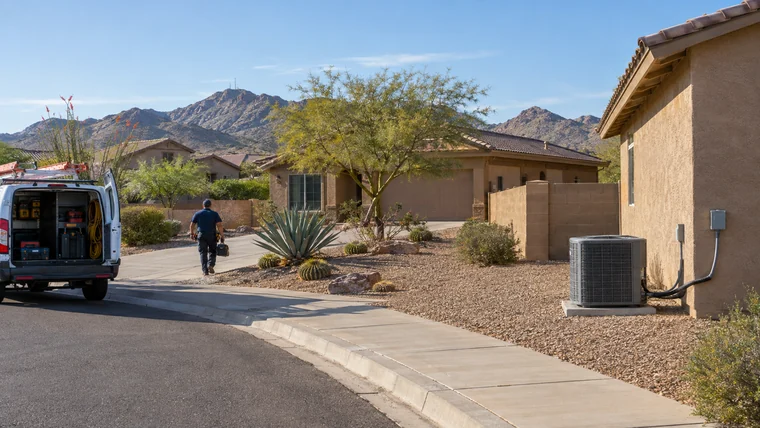
Rancho El Dorado homes went up between 2002 and 2008. If the condenser outside yours is original, it has now run eighteen to twenty-four Phoenix-area cooling seasons — and a cooling season in Maricopa runs from April into October, which is why the fifteen-to-twenty-year lifespan tables written for the rest of the country read optimistically here. Some of the original equipment in this neighborhood is R-22, because manufacturers were permitted to build new R-22 systems until January 2010. Other houses have already been changed out once, which means a second-generation R-410A system is itself ten to fifteen years old. Both situations sit in front of us regularly in this part of the Pinal corridor, and they lead to very different conversations. What follows is what we charge, how scheduling actually works from a Maricopa address, what ED3's rebate program does and does not cover, and the checks worth running before you approve a repair bill north of a thousand dollars. The prices are published below rather than held back for a living room.
- Rancho El Dorado was built 2002–2008, so original equipment is now eighteen to twenty-four cooling seasons old — and a Maricopa cooling season runs April into October.
- Manufacturers could build new R-22 equipment until January 2010, so R-22 is plausible on original units here; R-22 production and import ended in 2020 under the EPA phase-out.
- Installed replacement runs $5,000–$7,000 for three tons, $6,000–$8,000 for four and $7,000–$10,000 for five, with heat pumps at no premium.
- Diagnostics are $69.95 Monday to Friday 8am–6pm and $99.95 outside those hours, credited toward any repair, with no trip charge to Maricopa at any distance.
- Coil cleaning is $150 and coil replacement is $2,200–$2,600 — different jobs, and a quote saying only “coil” should be clarified before signing.
- Phoenix exempts many like-for-like outdoor swaps under five tons; the City of Maricopa is listed as requiring a mechanical permit for HVAC replacement, so confirm with the city permit centre.
- ED3 sets its HVAC rebate by the equipment's ENERGY STAR SEER2 rating, pays it as a bill credit within one or two cycles, and requires purchase and installation in the same calendar year.
- The federal 25C credit is not allowed for property placed in service after December 31, 2025, so it is not available on a 2026 install.
What does a service call cost in Rancho El Dorado, and how does scheduling work?
The flat rate is the part worth understanding from out here. Rancho El Dorado sits roughly thirty-five miles from central Phoenix, and the practical route in and out is State Route 347. Plenty of Valley companies price that drive one way or another — a zone fee, a mileage add-on, or a quiet decision to send the truck tomorrow rather than tonight. We do not. The $69.95 diagnostic is the same number we bill in Ahwatukee, and there is no trip charge at any distance.
What we tell homeowners here plainly is that the 347 is one road. Unlike a Gilbert call, where three arterials reach the same subdivision, a Maricopa call has a single realistic approach, and a closure on that road moves arrival times for everyone. That is why we publish a twelve-to-twenty-four-hour typical window for non-emergency work and will not advertise a same-day guarantee. A person answers the phone here at two in the morning, and when a call genuinely warrants it — no cooling at all, an infant or an elderly resident in the house in July — we dispatch overnight.
Three things cost nothing or close to it, and homeowners in this neighborhood under-use all three. A quote review is free: send the estimate however suits you, no site visit and nobody calling back to book a salesperson. A second opinion is $69.95, or $99.95 after hours, credited toward work, and the written report is yours whether you hire us or not. And the maintenance plan is $25 a month per unit, which on a street where the condensers are all the same age mostly buys you the chance to find the failing part in March instead of the second week of July.
What does AC replacement cost for typical Rancho El Dorado homes?
Homes of this era were built to production plans, and the tonnage that came with the house is not automatically the tonnage the house needs. ACCA's Manual J is the calculation that settles it — room by room, against Valley summer design conditions rather than a square-foot rule of thumb. Two variables move the answer here: whether the attic insulation is still at its original depth after twenty-odd years of trades working up there, and whether the duct system still holds air. Oversizing by a ton is the most common error we correct on a changeout, and it costs comfort as well as money, because a system that short-cycles never runs long enough to pull humidity out of the house during a monsoon week.
The refrigerant question is now unavoidable. New residential equipment is built around R-454B and similar low-GWP refrigerants under the EPA's phase-down, so a 2026 changeout on a 2004 R-22 system is not a like-for-like swap: outdoor unit, indoor coil and usually the line-set treatment all move together. Ask for the AHRI certificate covering the matched pair. Unmatched indoor and outdoor equipment does not deliver the rating printed on the sticker, and a utility rebate application can be refused on exactly that point.
Permits are where Maricopa differs from the city pages you may have already read. Phoenix exempts many like-for-like outdoor swaps under five tons; published permit references list the City of Maricopa as requiring a mechanical permit for the installation, replacement or relocation of HVAC equipment under the 2024 International Mechanical Code as locally adopted. We pull the permit when the work requires one, and the authority for your address is the City of Maricopa permit centre, not a contractor's assurance either way. The same honesty applies to equipment placement: what your HOA's design guidelines allow for a relocated pad or a screen wall varies, and we check rather than guess.
What pushes a job above the typical range
These are the conditions that can push a job above the ranges above. We tell you before the work starts, not after — and they are worth checking on any contractor's quote, not just ours.
- Crane access on rooftop package units
- The existing line set cannot be reused with the new equipment
- Electrical panel lacks capacity or needs breaker work
- Ductwork is undersized, leaking, or hard to reach in the attic
- Code upgrades on an older home - grandfathering ends when equipment is replaced
- Refrigerant contamination, or an R-22 system needing conversion
Installed replacement price by capacity — Rancho El Dorado and the Pinal corridor
AZ Trusted Air published ranges. Same price as a central Phoenix address; no trip charge to Maricopa.
Heat pumps are priced the same as straight-cool equipment at equal capacity. Crane service, where a rooftop unit is involved, is $400–$600 billed separately. ED3 rebate amounts are tied to the equipment's ENERGY STAR SEER2 rating and are subject to program funding — confirm current terms before relying on them.
| Item | Range |
|---|---|
| 3-ton system | $5,000 – $7,000 |
| 4-ton system | $6,000 – $8,000 |
| 5-ton system | $7,000 – $10,000 |
| Mini-split, per head | $1,000 – $3,000 |
What should Rancho El Dorado homeowners check before approving a major AC repair?
Our published repair prices: capacitor $50–$200, contactor $100–$200, condenser fan motor $600–$1,200, blower motor $750–$1,800, compressor $800–$4,000, coil cleaning $150, coil replacement $2,200–$2,600, duct replacement $1,000–$3,000. Two of those get deliberately blurred in quotes. Coil cleaning and coil replacement are separate jobs about two thousand dollars apart, so if a quote says only “coil”, ask which. And the compressor spread is not vagueness: a warranty-covered compressor where you pay labour sits at the bottom, an out-of-warranty R-22 machine at the top.
Four checks, in order. First, the refrigerant: R-22 production and import ended in 2020 under the EPA's phase-out, so what remains is reclaimed or stockpiled and priced accordingly — a large R-22 charge on a twenty-year-old system is usually money spent on a machine that needs replacing anyway. Second, age against the build date, which in Rancho El Dorado means eighteen to twenty-four years for anything original. Third, warranty: several manufacturers require registration within sixty to ninety days of installation, so a second-generation system installed around 2014 may or may not still carry parts coverage, and the model and serial numbers will tell us. Fourth, licence — ours is ROC 317368, and any Arizona contractor's licence status and complaint history can be checked free at the Registrar of Contractors before you sign anything.
Homeowners here consistently report the same thing after a failure: the neighbours started replacing too. That clustering is real on a street whose houses went up inside eighteen months of each other, and it is also what makes this neighborhood a soft target for the replace-it-all pitch. Unlike a mixed-age street in central Phoenix, where a sales story has to be built house by house, a 2004 subdivision lets someone argue from the calendar alone. A $200 capacitor is still a $200 capacitor.
Federal rules allowed manufacturers to build new R-22 equipment until January 2010, and R-22 production and import ended entirely in 2020 under the EPA's phase-out. A Rancho El Dorado house built in 2004 with original equipment therefore sits in the window where R-22 is plausible, the system is eighteen to twenty-four cooling seasons old, and manufacturer parts coverage has long since expired — three facts that point the same direction. A house built in 2007 and changed out around 2014 is a different case: R-410A, ten to fifteen years old, and possibly still under parts warranty if the original installer registered it. We read the data plate before recommending anything, because the model and serial numbers answer all three questions in about ninety seconds.
Which rebates can Rancho El Dorado residents claim on a replacement, and who handles the paperwork?
Start by confirming who bills you, because the Pinal corridor is not uniform. Your monthly statement names the provider, and that one line decides which program you are eligible for. SRP's and APS's residential rebates do not apply to an ED3-metered home — and separately, we are not currently an APS Qualified Technology Installer, so we never promise an APS rebate to anybody.
ED3's published residential program ties the HVAC rebate amount to the equipment's ENERGY STAR SEER2 rating rather than a single flat figure, and requires the unit to be purchased and installed within the same calendar year. Approved rebates arrive as a bill credit, generally within one or two billing cycles of approval, and the program is subject to available funding and can change without notice — which is why we confirm current terms at the time of quoting instead of printing a number that goes stale.
Two adjacent rebates matter in a neighborhood this age. ED3 has offered rebates for home insulation and air duct repair — confirm current amounts and eligibility directly with ED3, as program terms and funding change without notice. Both are aimed at exactly the leakage that costs a Maricopa homeowner most, because it happens in an attic that runs past 150 degrees in July where nobody looks.
The federal side is simpler than it was. The IRS termination schedule lists the 25C Energy Efficient Home Improvement Credit as not allowed for any property placed in service after December 31, 2025. Anyone quoting you a federal credit on a 2026 install in Maricopa is quoting last year's rules. We fill out and hand over the utility paperwork complete — invoice, model and serial numbers, AHRI certificate — and the credit lands on your ED3 bill, not ours.
Sources and further reading
The figures and requirements on this page draw on the following public sources. We link them so you can check anything here yourself.
- U.S. Environmental Protection Agency — Section 608 — refrigerant handling rules, the R-22 phase-out and the current R-410A phase-down
- Arizona Registrar of Contractors — verify any contractor's licence status and complaint history before signing
- ACCA (Air Conditioning Contractors of America) — Manual J load calculation, the correct basis for sizing a replacement in this climate
- AHRI Directory — confirm the quoted indoor and outdoor units are a certified matched system
- ENERGY STAR — SEER2 certification levels that ED3 rebate tiers are based on
- U.S. Department of Energy — efficiency standards and cooling system guidance
Send it however suits you — text a photo, email it, whatever is easiest. No obligation and no site visit. One flat rate across the Phoenix metro and the Pinal corridor, at any distance, with no trip charge to Maricopa.