Who handles R-22 (Freon) system replacement in Phoenix?
The short answer: AZ Trusted Air retires R-22 systems across the Phoenix metro, from 1990s split systems in Deer Valley to rooftop package units on Sun City rooflines. Our technicians hold EPA Section 608 certification, we are licensed under Arizona ROC #317368, and the diagnostic is $69.95 on weekdays, credited toward the work. Since the EPA banned new R-22 production on January 1, 2020, every Valley repair now runs on reclaimed refrigerant.
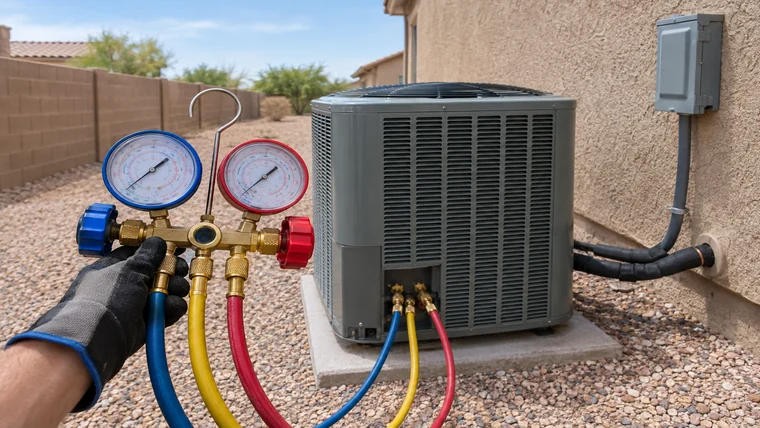
If the nameplate on the outdoor unit says R-22, you are looking at equipment that could not legally be built with a factory charge after January 1, 2010, and a refrigerant that has not been produced or imported into the United States since January 1, 2020. That means two things in a Phoenix driveway. First, the machine is at minimum in its sixteenth summer, and Valley summers are not the ones national lifespan tables were written for — our cooling season runs April into October, and the unit has spent every one of those Julys rejecting heat into 110-degree air. Second, any refrigerant that goes back into it is reclaimed, priced by whatever the supply house has left, and finite. Nobody is required to replace a working R-22 system. But the arithmetic of feeding one has changed, and this page lays out where the real numbers sit before anyone asks you for a decision.
- New R-22 has not been produced or imported in the United States since January 1, 2020; only recovered, recycled and reclaimed supply remains, and factory-charged R-22 residential equipment could not be built after January 1, 2010 — so any R-22 system in the Valley is at least sixteen summers old.
- EPA phased out production, not use. There is no law requiring a Phoenix homeowner to replace a working R-22 system.
- EPA Section 608 requires certified technicians and prohibits venting; recovered refrigerant cannot be sold to a new owner unless an EPA-certified reclaimer processes it first.
- Complete replacement runs $5,000–$7,000 at three tons, $6,000–$8,000 at four and $7,000–$10,000 at five, installed, plus $400–$600 crane on rooftop package units.
- Most R-22 equipment was built to a 10 SEER minimum; the Southwest floor is now SEER2 14.3 and SRP's rebate needs SEER2 15.2, which is roughly a 37% reduction in electricity for the same cooling on nameplate arithmetic alone.
- R-454B (GWP 466) and R-32 (GWP 675) replaced R-410A (GWP 2,088) in new residential equipment from January 1, 2025; none of them are drop-in substitutes for R-22.
- SRP Cool Cash pays $75 per ton single-stage, $150 multi-stage and $225 variable capacity, up to $1,125 on a five-ton; APS ended residential equipment rebates on January 1, 2026.
- The federal 25C credit is not allowed for property placed in service after December 31, 2025, so it does not apply to a 2026 installation.
How does AZ Trusted Air recover and dispose of old refrigerant (EPA-compliant)?
The refrigerant step is the part of a changeout no homeowner watches, which is exactly why it gets skipped. EPA's Section 608 rules under the Clean Air Act make two things plain: only certified technicians may handle the refrigerant, and knowingly venting it during service, maintenance or disposal is prohibited. So the first thing that happens on an R-22 retirement is not a wrench on a line set — it is a recovery machine, a scale and a cylinder marked for R-22 only.
What we find on Phoenix rooftops in July is that this step is where corners get cut, because it is slow and it is hot. Unlike a ground-level condenser in a moderate climate, a rooftop package unit hands you the whole charge sitting on a deck radiating heat back at the technician, and recovery into a cylinder in high ambient temperatures takes longer than it does in a shaded side yard in March. That time is the whole reason someone is tempted to crack a fitting and let it go. Homeowners who watch a changeout start to finish consistently notice the recovery is the least glamorous hour of the day and the only hour with a federal rule attached to it.
Where the recovered R-22 goes afterward matters too, and the rule is narrower than most people assume. EPA is explicit that recovered refrigerant cannot be sold to a new owner for use as a refrigerant unless it has first been reclaimed by an EPA-certified reclaimer. Recovered, recycled and reclaimed are three different words with three different legal meanings. Our cylinders go back through the supply chain for reclamation — which is, incidentally, the only place any R-22 on the market now comes from, since production and import both stopped in 2020.
What we document on an R-22 recovery
| Step | What gets recorded |
|---|---|
| Nameplate capture | Refrigerant type, factory charge weight, model and serial — the serial dates the equipment |
| Recovery | Charge pulled into R-22-labelled cylinders, weighed against the nameplate figure |
| Leak evidence | Whether the recovered weight came up short, and by how much — the tell on a slow leak |
| Equipment removal | Old condenser and coil hauled out; nothing left in a side yard or on a roof deck |
That short-charge number is worth more to you than it sounds. If a five-pound-per-ton system gives back noticeably less than its nameplate, you have just been handed documented proof that it was leaking, which is the single most useful fact in a repair-or-replace conversation. Our technicians write it down whether it helps the sale or hurts it, and the report is yours either way.
The other half of compliance is what goes in. Under EPA's Technology Transitions rule, new residential air conditioners and heat pumps had to move to refrigerants below 700 GWP as of January 1, 2025, which is why the equipment replacing your R-22 system will almost certainly be charged with R-454B (GWP 466) or R-32 (GWP 675) rather than R-410A (GWP 2,088). None of these are drop-in substitutes for R-22 — the pressures and the compressor oil are different — so a genuine retirement means new outdoor unit, new matched indoor coil, and either a flushed or replaced line set. Anyone offering to just top your R-22 system up with something modern is describing a job that does not exist. We cover the A2L side of that in more detail on our R-454B installation page.
What does replacing an R-22-era system cost, and what efficiency jump is typical?
Start with the published ranges, because the retirement of an R-22 system is not priced differently from any other changeout at the same tonnage. What differs is how many of the surrounding line items come into play, and on a twenty-year-old Valley install it is usually more of them than on a 2015 house.
| Line item | Price | Why it shows up on an R-22 job |
|---|---|---|
| 3-ton system, installed | $5,000 – $7,000 | Common on 1990s single-story stock |
| 4-ton system, installed | $6,000 – $8,000 | Typical mid-2000s two-story |
| 5-ton system, installed | $7,000 – $10,000 | Larger homes and most rooftop package units |
| Crane, rooftop units | $400 – $600 | Old unit down, new unit up, in one lift |
| Duct replacement | $1,000 – $3,000 | Flex duct that has spent 20 summers at attic temperature |
| Mini-split, per head | $1,000 – $3,000 | Where a room was never on the original duct plan |
Heat pumps carry no premium over straight-cool at the same capacity, which surprises people whose R-22 system was paired with an electric furnace or strip heat. If your old system was straight-cool plus resistance heat, the heat pump conversation is worth having at no extra equipment cost — we walk through it on the heat pump installation page.
Now the efficiency jump, stated carefully. The federal minimum for split-system air conditioners was 10 SEER through the 1990s and into 2005, rose to 13 SEER in 2006, and today sits at a regional Southwest minimum of SEER2 14.3 for systems under 45,000 Btu/h. SRP's rebate threshold is higher still at SEER2 15.2, which corresponds to roughly 16 SEER on the old scale. Purely as arithmetic: delivering the same cooling at 16 SEER instead of 10 SEER takes about 37% less electricity. That is the nameplate-to-nameplate comparison, and it is the honest version of the number.
The real-world gap is usually wider than that, for reasons that have nothing to do with the brochure. A twenty-year-old condenser in the Valley has been through fifteen or more monsoon seasons of dust loading its coil, and what our technicians find on pre-monsoon service calls is fin packs holding a felt of fine dust that no garden hose ever reached. A coil that cannot reject heat does not match its nameplate rating any more. Add the charge that slowly walked out of a leaking system and you have equipment performing below the 10 SEER it was sold as.
What we will not do is put a dollar figure on your monthly bill. It depends on which utility bills your meter, which rate plan you are on, your setpoint, your duct leakage and your shade — and on an SRP time-of-use plan, pre-cooling the house before the on-peak window starts changes the answer again. Your bill names your utility and your plan; that is the correct starting point, not a contractor's estimate. What we can say is that the leakage costing a Valley homeowner most is the leakage they cannot see: Phoenix attics routinely run 150 to 170 degrees in July, and duct losses up there are charged against every cooling hour of a season that starts in April. Replacing the box while ignoring the ducts is how a new system disappoints its owner. See duct sealing and repair for how we test that side of it.
On permits, be wary of absolutes in either direction. The City of Phoenix publishes a work-exempt-from-permit list, and a like-for-like replacement that does not increase capacity and does not change location is treated as exempt, while changes to ductwork, electrical or equipment location put you back inside the permit and inspection process. Some private permit guides flatly claim every changeout needs one. The authority that decides is Phoenix Planning & Development or your own city — Mesa, Chandler, Surprise and unincorporated Maricopa County each issue their own — and we confirm scope with them and pull a permit when the work requires it.
What pushes a job above the typical range
These are the conditions that can push a job above the ranges above. We tell you before the work starts, not after — and they are worth checking on any contractor's quote, not just ours.
- Crane access on rooftop package units
- The existing line set cannot be reused with the new equipment
- Electrical panel lacks capacity or needs breaker work
- Ductwork is undersized, leaking, or hard to reach in the attic
- Code upgrades on an older home - grandfathering ends when equipment is replaced
- Refrigerant contamination, or an R-22 system needing conversion
Installed replacement price by tonnage — and where the SEER2 15.2 rebate threshold falls
AZ Trusted Air published ranges, Phoenix metro. The split marks SEER2 15.2, the efficiency level SRP's Cool Cash rebate requires.
Rooftop package units add $400–$600 for crane service. SRP Cool Cash pays $75 per ton single-stage, $150 multi-stage and $225 variable capacity on SEER2 15.2+ equipment, up to $1,125 on a five-ton. Amounts and programme deadlines are set by SRP and change between cycles — confirm the current figure before relying on it.
| Item | Range |
|---|---|
| 3-ton system | $5,000 – $7,000 |
| 4-ton system | $6,000 – $8,000 |
| 5-ton system | $7,000 – $10,000 |
Can an R-22 system limp another season safely, and when is that reasonable?
EPA's own homeowner guidance on the HCFC phaseout says it about as plainly as a federal agency ever says anything: the production of R-22 is being phased out, not the use of it, and you are not required to stop using an R-22 air conditioner or to replace existing equipment. Any contractor telling a Valley homeowner that their system is now illegal is either confused or selling. What has changed is not legality — it is supply, and therefore price, of a refrigerant that only exists now as reclaimed stock.
So the question is not whether you may keep it. It is whether the next repair buys you enough season to be worth its price. That is arithmetic, and it turns on where the failure is.
| What failed | Our price | Usually reasonable on an R-22 system? |
|---|---|---|
| Capacitor | $50 – $200 | Yes — cheap, fast, and no refrigerant involved |
| Contactor | $100 – $200 | Yes — same reasoning |
| Coil cleaning (service) | $150 | Yes — often recovers real capacity after monsoon season |
| Condenser fan motor | $600 – $1,200 | Often — depends how many summers are left in the compressor |
| Coil replacement | $2,200 – $2,600 | Rarely — a new coil plus a full reclaimed R-22 charge on old equipment |
| Compressor | $800 – $4,000 | Almost never out of warranty — this is the replacement conversation |
Note that coil cleaning at $150 and coil replacement at $2,200–$2,600 are separate jobs roughly two thousand dollars apart. On R-22 equipment that distinction gets blurred more often than on any other system we look at, because a dirty coil and a leaking coil can present with similar symptoms on a 112-degree afternoon. If a quote says only “coil,” ask which one. That single question is one of the most common things our second opinion resolves, and the $69.95 is credited if we do the work.
The condition that ends the limping argument is a leak. A system that needed refrigerant last May and needs it again this May is not holding a charge, and every top-off is reclaimed R-22 at whatever the supply houses are charging that week. We do not publish a per-pound figure because it genuinely moves with supply and varies between distributors — anyone quoting you a fixed national price for reclaimed R-22 is guessing. What we will do is tell you the weight we put in and what it cost us, so you can compare it against the ranges above.
Timing is the part Valley homeowners have the most control over and use the least. Unlike a Midwest furnace that fails on a cold night and gets replaced in a week, a Phoenix cooling failure in July competes with every other cooling failure in the metro for crews and equipment. Homeowners who plan a changeout for March or October consistently get a calmer process than those who make the decision in a hot house in August. We answer the phone 24 hours a day with a person rather than voicemail, and we dispatch overnight when a call genuinely warrants it — but a planned retirement is a better job than an emergency one every time. Typical non-emergency arrival is 12 to 24 hours, and emergency repair exists for the nights it cannot wait.
If you are deciding this year, two things help: find the serial on the nameplate and date the equipment with our AC age checker, then keep the thing serviced while you decide. Our maintenance plan is $25/month per unit, and on legacy equipment it earns its keep mostly by catching the slow leak and the failing capacitor before a 115-degree design day finds them for you.
On an R-22 system our technician records six things before recommending anything: the nameplate refrigerant type and factory charge weight, the serial-dated age of the equipment, the weight of refrigerant actually recovered or measured against that nameplate figure, capacitor microfarad readings against rating, compressor amp draw, and the location of any leak found. The gap between nameplate charge and actual charge is the item that settles most repair-or-replace arguments, because it is the difference between a system that is merely old and a system that is losing refrigerant that is no longer manufactured. That report goes to you as a document at the $69.95 diagnostic price — $99.95 outside Monday to Friday, 8am to 6pm — credited toward any repair we perform, anywhere in the Phoenix metro at one flat rate.
What rebates apply when retiring a system this old?
Retiring an R-22 system is the one moment when a rebate can meaningfully change the shape of a decision, so it is worth getting the current picture right rather than the picture from two years ago.
| Programme | What it pays | Condition |
|---|---|---|
| SRP Cool Cash — single-stage | $75 per ton | SEER2 15.2+, AHRI-listed; Manual J required on single-stage |
| SRP Cool Cash — multi-stage | $150 per ton | SEER2 15.2+, AHRI-listed |
| SRP Cool Cash — variable capacity | $225 per ton | Up to $1,125 on a 5-ton; inverter mini-splits qualify at this tier |
| APS residential equipment rebate | Discontinued | Ended January 1, 2026 — do not let it appear on a quote |
| ED3 residential rebates | Varies by measure | HVAC replacement, duct repair and insulation are on ED3's own list |
| Federal 25C tax credit | Not available | Not allowed for property placed in service after December 31, 2025 |
SRP is the programme that still moves real money on an air conditioning replacement, and the structure rewards the two things an R-22 retirement is already pushing you toward: efficiency and compressor quality. The tier is set by the compressor, not by the brand. On a four-ton changeout that is $300 single-stage, $600 multi-stage or $900 variable-capacity — which is frequently enough to close most of the gap between the bottom and the middle of a published price range. The requirements are specific: equipment must be at SEER2 15.2 or better as listed in the AHRI Directory, installed by an Arizona-licensed contractor, with the application filed within six months of installation. SRP requires an ACCA Manual J load calculation with single-stage applications, and its own terms ask the installer to certify that installed capacity is within 15% or a half-ton of that calculation, airflow within 10% of rated blower capacity and charge within 5% of manufacturer specification.
That certification language is the most useful thing on the SRP application, and almost nobody reads it. It means the rebate paperwork is also a sizing audit. It matters here because R-22 systems in the Valley were very often oversized on a rule of thumb, and the replacement quote that simply copies the old nameplate inherits that mistake for another twenty years. Phoenix design conditions sit near 110 to 115 degrees, which is exactly the condition a Manual J is built to size for — and an oversized system in a dry climate short-cycles, dehumidifies poorly during monsoon humidity, and wears its compressor out early. Our rebate concierge page covers the filing side in more detail.
Two honest cautions. First, programme years and deadlines move: current programme material has referenced install deadlines of April 30, 2026 and April 30, 2027 in different places, and amounts are set by SRP between cycles. Verify the live figure against SRP's own page or ask us to confirm it in writing before you sign anything. Second, territory follows the meter, not the address. SRP and APS lines interleave street by street in parts of Scottsdale, Glendale, Tempe, Chandler and Avondale, so two neighbours can have different answers. Your bill names your utility; that is the check that takes ten seconds and prevents a phantom rebate on a quote.
On APS specifically: its residential AC and heat pump rebate programme was discontinued effective January 1, 2026 following an Arizona Corporation Commission decision cutting the efficiency-programme budget, leaving Cool Rewards — a smart-thermostat demand-response credit — as what remains, and that is not an equipment purchase rebate. Separately, and regardless of programme status, AZ Trusted Air is not currently an APS Qualified Technology Installer, so we will never put an APS equipment rebate on your quote. ED3 customers in the Pinal corridor around Maricopa and Casa Grande should check ED3's residential rebate page directly, since its list runs to duct repair, insulation and smart thermostats as well as HVAC replacement and the terms are set per measure.
The federal picture is simpler and less pleasant. Under the legislation enacted in July 2025, the Section 25C Energy Efficient Home Improvement Credit is not allowed for any property placed in service after December 31, 2025. If your R-22 retirement happens in 2026, there is no 25C credit on it. Any contractor still showing a $600 or $2,000 federal credit on a 2026 proposal is working from stale material, and that is worth noticing about the rest of the proposal too.
Sources and further reading
The figures and requirements on this page draw on the following public sources. We link them so you can check anything here yourself.
- U.S. Environmental Protection Agency — Section 608 — technician certification, the venting prohibition, and the rule that recovered refrigerant must be reclaimed before resale
- SRP — Cool Cash per-ton amounts, the SEER2 15.2 threshold, Manual J requirement and current programme deadlines
- City of Phoenix Planning & Development — the work-exempt-from-permit list and when a mechanical permit is required for a change-out
- AHRI Directory — confirm the quoted outdoor unit and indoor coil are a certified matched system at the rated SEER2
- ACCA (Air Conditioning Contractors of America) — Manual J load calculation — the correct basis for sizing a replacement rather than copying the old nameplate
- U.S. Department of Energy — efficiency standards history and regional minimums for cooling equipment
- Arizona Registrar of Contractors — licence verification and complaint history — check any contractor before a changeout
Send it however suits you — text a photo, email it, whatever is easiest. No site visit, no obligation, and nobody will ring to ask when a salesperson can stop by. Or call (623) 252-6403 and speak to a person, 24 hours a day. One flat rate across the Phoenix metro and surrounding communities, including the Pinal corridor, at any distance.