Who converts swamp coolers to refrigerated AC in Phoenix?
The short answer: AZ Trusted Air converts evaporative coolers to refrigerated air conditioning across the Phoenix metro under Arizona ROC 317368. In practice a conversion is four jobs at once: a Manual J load calculation, a duct and return-air design, a 240-volt circuit, and a roof opening closed up and flashed properly. Any contractor you consider should be verifiable at the Arizona Registrar of Contractors before work starts.
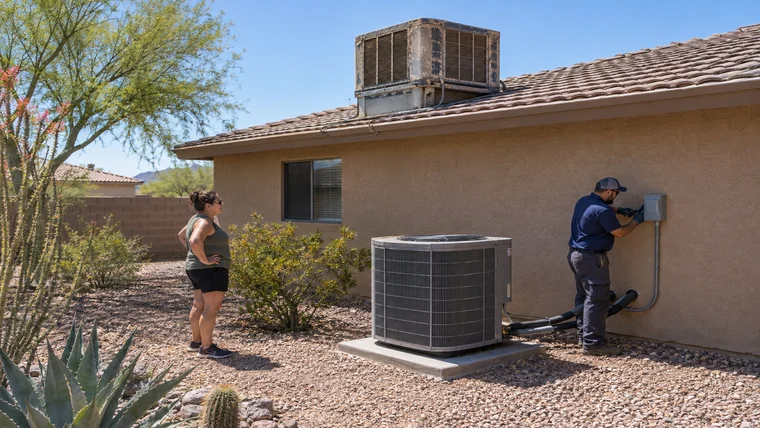
A swamp cooler and a refrigerated system are not two versions of the same machine. One pulls outdoor air across wet pads, drops it maybe twenty degrees, pushes it into the house at low pressure and relies on you cracking a window so it has somewhere to go. The other is a closed loop that has to pull back every cubic foot it delivers, through insulated duct, at a pressure the blower was designed for. That difference is the whole job. It is why a conversion touches the roof, the ducts, the electrical panel and the thermostat wiring, and why a quote that reads like a straight equipment swap is usually a quote that has not looked in the attic yet. This page sets out what the work actually involves in Valley homes, what we publish for prices, how the decision about reusing your existing ducting gets made, and which permit applies in Phoenix.
- A conversion is not a like-for-like swap, so a City of Phoenix mechanical permit applies — equipment type, roof framing, ducting and electrical all change at once.
- Phoenix exempts in-kind evaporative replacement rated up to 6,500 CFM, and the City's own commentary says in-kind assumes roof framing, ductwork and electrical are not modified.
- Evaporative duct moves several thousand CFM at near-zero static pressure; refrigerated air needs roughly 400 CFM per ton through insulated duct with a sealed return.
- Return air is the most common omission in a cheap conversion quote: no return path means high static, weak airflow and an icing coil.
- A University of Arizona study for the City of Phoenix measured average evaporative cooler use at about 66 gallons a day, roughly 14,000 gallons over a 212-day season.
- Published ranges: $5,000–$10,000 installed by tonnage, duct replacement $1,000–$3,000, crane $400–$600, mini-split heads $1,000–$3,000 each.
- SRP Cool Cash pays $75, $150 or $225 per ton on SEER2 15.2+ equipment; APS ended residential equipment rebates on January 1, 2026, and federal 25C is repealed for 2026 installs.
- The old 120-volt cooler circuit cannot serve a condenser: a dedicated 240-volt circuit, a disconnect in sight of the unit and new low-voltage thermostat wiring are part of the job.
What does AZ Trusted Air's conversion include (roof work, ducts, electrical)?
What we find on Phoenix rooftops is a cooler that was never designed to be removed politely: a sheet-metal cabinet sitting over a framed opening, a quarter-inch copper water line run across the roof deck, and a 120-volt feed coming from a two-speed switch in a hallway. The hole, the water and the power are the three connections that have to be undone properly, and underneath all three sits a duct system built for a completely different kind of air.
Roof work
The cooler comes off, the opening is framed and decked, and the patch is tied into whatever the roof actually is — tile on a good deal of the East Valley, built-up or foam on the flat and low-slope roofs common in the central historic districts, composition shingle elsewhere. Unlike a roof penetration in a moderate climate, a Phoenix patch spends April to October under direct sun on a surface far hotter than the air around it, then gets one monsoon season to prove the flashing was done right. If the replacement is a rooftop package unit, it sits on a curb or stand with its own supply and return openings, which is one reason package units are so common in this market and so rare in most others. Crane service, where the set requires it, runs $400–$600.
The water line, and what it was costing
The supply valve gets shut and capped inside, the line abandoned, the bleed line pulled. This is not a trivial line item on the bill, it is a real change in household consumption: the University of Arizona's Office of Arid Lands Studies monitored evaporative coolers in Phoenix homes at the request of the City and found average use of about 66 gallons a day, roughly 14,000 gallons across a 212-day cooling season, and around 15.8 percent of total household water use across the homes studied. Homeowners who convert consistently tell us the summer water bill was the change they had not thought to expect.
Ducts and return air
This is the part most often left out. Evaporative cooling is an open loop — air in, air out through a cracked window or a ceiling relief shutter. Refrigerated cooling has to bring air back. A converted house with no proper return path gives you a starved blower, high static pressure, weak airflow at the far registers and a coil that ices rather than cools. So the scope usually includes sealing or removing the old relief shutters, cutting and building a central return, and setting supply registers where they wash the exterior walls and glass instead of dumping into the middle of a room the way an evaporative drop does.
Electrical and controls
A cooler runs happily on a 120-volt circuit and a wall switch. A condenser needs a dedicated 240-volt branch circuit sized to the equipment's nameplate minimum circuit ampacity, with a disconnecting means within sight of the unit, plus a circuit for the indoor air handler or furnace. In older panels — and we still open plenty of them in Sunnyslope and the older central neighborhoods — there is either no spare capacity or no room, and that gets priced and shown to you before anyone starts. Controls change too: there is no 24-volt thermostat in an evaporative house, so low-voltage cable gets run from the equipment to a thermostat location, which is the natural moment to fit a programmable or smart thermostat for pre-cooling on a time-of-use rate.
One last piece worth raising early: many pre-1980 Valley homes cooled by evaporation were heated by a gas wall or floor furnace, with no ducted heat at all. If that is your house, a heat pump gives you ducted heating and cooling from the same box, and we charge no premium over straight-cool equipment of the same capacity.
What does a full conversion cost (published ranges)?
A conversion prices in three stacks, and separating them is the only way to compare two quotes honestly. Equipment and its installation is one. Distribution — duct, registers, return — is two. The trades around it, meaning roof closure, electrical and thermostat wiring, are three. A single number covering all three cannot be checked against anything, and a homeowner holding two such numbers has no way of knowing whether the cheaper one simply left out the return.
| Element | Published range | Notes |
|---|---|---|
| 3-ton system, installed | $5,000 – $7,000 | Efficiency tier and access move it within the range |
| 4-ton system, installed | $6,000 – $8,000 | Most common size on converted Valley homes |
| 5-ton system, installed | $7,000 – $10,000 | Sized from a load calculation, not from square footage |
| Heat pump | Same by tonnage | No premium — and it replaces a wall or floor furnace |
| Duct replacement | $1,000 – $3,000 | Priced after the attic inspection, not before |
| Mini-split, per indoor head | $1,000 – $3,000 | Where ducting a room would mean destroying plaster |
| Crane, rooftop set | $400 – $600 | Only when the equipment goes back on the roof |
| Diagnostic / consultation visit | $69.95 / $99.95 | Mon–Fri 8am–6pm / outside those hours, credited |
Why a conversion sits above a plain changeout is straightforward: a changeout inherits its distribution and its electrical, and a conversion frequently inherits neither. The lower half of each equipment range is standard-efficiency gear; the upper half clears SEER2 15.2, which matters because that is the threshold SRP's Cool Cash programme requires.
Rebates, stated accurately
SRP's current published Cool Cash terms pay by capacity and compressor type — $75 per ton on single-stage, $150 per ton on multi-stage and $225 per ton on variable-capacity and inverter-driven equipment, which tops out around $1,125 on a five-ton variable-capacity system. Equipment must be AHRI-listed at SEER2 15.2 or better, installed by an Arizona-licensed contractor, with the application filed within six months; single-stage applications require a Manual J load calculation. One caveat specific to this page, and we would rather say it plainly than sell around it: SRP's programme language is written around replacing or supplementing existing central air conditioning or heat pump equipment, so a home that has only ever had evaporative cooling should have eligibility confirmed with SRP directly before anyone counts a rebate into a price. We do not deduct a rebate we have not confirmed. Our rebate concierge page tracks the current terms.
Two things not to let into a quote. APS discontinued its residential AC and heat pump equipment rebates effective January 1, 2026 after the Arizona Corporation Commission cut the efficiency-programme budget, and we are not an APS Qualified Technology Installer in any case — so we never promise one. And the federal 25C energy-efficient home improvement credit is repealed for equipment placed in service in 2026; if a quote you are holding still shows it as a deduction, that is a number that will not arrive. Homes in the Pinal corridor around Maricopa and Casa Grande may sit in ED3 territory rather than SRP or APS — programme terms differ by utility and your bill names yours.
Labour warranty is two years on new equipment and one year on repairs. If you already have a conversion quote in hand, the quote review is free, needs no site visit, and will tell you which of the three stacks above your quote actually covers.
What pushes a job above the typical range
These are the conditions that can push a job above the ranges above. We tell you before the work starts, not after — and they are worth checking on any contractor's quote, not just ours.
- Crane access on rooftop package units
- The existing line set cannot be reused with the new equipment
- Electrical panel lacks capacity or needs breaker work
- Ductwork is undersized, leaking, or hard to reach in the attic
- Code upgrades on an older home - grandfathering ends when equipment is replaced
- Refrigerant contamination, or an R-22 system needing conversion
What the pieces of a Phoenix swamp cooler conversion cost
AZ Trusted Air published ranges. Equipment bars are split at SEER2 15.2, the efficiency level SRP's Cool Cash rebate requires.
Roof closure, electrical and thermostat wiring are quoted from what the attic and panel actually contain, so they are not shown as a range here. SRP Cool Cash pays $75, $150 or $225 per ton by compressor type on AHRI-listed SEER2 15.2+ equipment — confirm current terms and eligibility with SRP before relying on them.
| Item | Range |
|---|---|
| 3-ton system, installed | $5,000 – $7,000 |
| 4-ton system, installed | $6,000 – $8,000 |
| 5-ton system, installed | $7,000 – $10,000 |
| Duct replacement | $1,000 – $3,000 |
| Crane, rooftop set | $400 – $600 |
Can existing swamp cooler ducting be reused, and how is that decided?
Start with the numbers, because they settle most of the argument. A residential evaporative cooler typically discharges through an 18-by-18 or 20-by-20 inch opening because it is moving several thousand CFM of barely pressurised air. A three-ton refrigerated system wants roughly 1,200 CFM — about 400 CFM per ton — delivered at a design static pressure the blower is rated for, through duct that is insulated so the air arriving at the register is still the temperature it was when it left the coil. Those are different design problems, not different sizes of the same problem.
Then there is where that duct lives. Homeowners who open an attic hatch in August consistently discover an environment nothing like the one national duct advice assumes: Phoenix attics run well past 150 degrees on a July afternoon, and bare or barely-wrapped evaporative duct in that space is a heat exchanger working against you. Unlike a duct run through a conditioned basement in the Midwest, every foot of uninsulated Valley attic duct is a tax on capacity you already paid for.
What we actually measure
Four things decide it. Sizing: measured duct cross-sections and branch counts compared against the room-by-room load from an ACCA Manual J calculation, not against square footage or the old cooler's rating. Condition: insulation R-value and whether the jacket has gone brittle, which is common on flex installed in the 1970s and 80s and cycled through thirty Phoenix summers. Leakage: whether the existing system is worth sealing or worth replacing. And return capacity, which is where evaporative-era houses usually fail, because they were never built to bring air back at all.
The two house types we see
The first is evaporative-only: one big drop or a short trunk, large ceiling grilles in the middle of rooms, ceiling relief shutters, no return grille anywhere. Very little of that distribution survives as-is, though a straight trunk run in sound condition can sometimes be adapted rather than binned. The second is the dual-system house — a ducted gas furnace for winter plus a separate roof cooler for summer. Those homes frequently already have a usable supply trunk and a return, and the conversion becomes a matter of sizing, sealing and adding capacity rather than starting over. Which one you own is visible from your ceilings before anyone opens a hatch.
Where existing duct is sound but leaky, sealing is often the better spend. SRP's published Duct Test and Repair terms cover 75 percent of testing and qualified sealing costs up to $400 for a single-family detached home, with lower caps for attached homes, condos and mobile homes; the programme requires a BPI-certified contractor and submission within six months, so confirm the certification requirement with SRP for any contractor you are considering, ourselves included. Our duct sealing and repair page covers how the test is run.
The honest position on reuse: it cannot be decided from the driveway, from a phone call, or from a photograph of your roof. Anyone who tells you over the phone that your evaporative ducting is fine has told you something they do not know.
Stack one, equipment: tonnage from a Manual J calculation, AHRI-listed model numbers, efficiency rating, and whether it is a split or package unit. Stack two, distribution: which duct runs are reused, which are replaced, how many supply registers, and where the return is being built. Stack three, the surrounding trades: roof opening framed and closed, water line capped and abandoned, dedicated 240-volt circuit with a disconnect in sight of the unit, low-voltage thermostat cable, crane if required. Add the permit line and the labour warranty term. Every one of those items is knowable before work starts, and a quote that names all of them is a quote that has actually been in your attic.
How long does a conversion take and what permits are pulled?
A straightforward conversion into a house that already has usable ducting and panel capacity is commonly a one to two day job. Add full duct replacement, a new central return, panel work, or a rooftop set needing a crane, and it stretches to three days or beyond. We will not publish a guaranteed completion time, because the honest answer depends on what the attic and the panel turn out to hold. What we will commit to is that the house is not left without cooling overnight in July without that being discussed with you first.
The permit question, specifically
Phoenix's published work-exempt-from-permit guidance is narrower than people assume. It exempts repair or replacement in kind of evaporative cooling equipment rated not more than 6,500 CFM, and the City's commentary states plainly that in-kind replacement assumes existing infrastructure — roof framing, ductwork, electrical connections — will not require modification. Separately, outdoor refrigeration equipment under five tons is treated differently from indoor work, with permits required for residential indoor installations regardless of size. A conversion fails the in-kind test on every count: the equipment type changes, the roof framing is modified, the ducting is modified and new electrical is installed. So a mechanical permit is pulled and the work is inspected. Verify any of this yourself at City of Phoenix Planning and Development rather than taking a contractor's word, including ours.
This matters more than it sounds. On a like-for-like outdoor condenser swap under five tons, we tell homeowners honestly that Phoenix often does not require a permit — which is why we never claim we always pull one. A conversion is the opposite case, and a contractor offering to skip it as a saving is offering you an unpermitted mechanical alteration on your own property record.
Jurisdiction governs, and the Phoenix rules are not the Mesa, Chandler, Scottsdale, Glendale or Maricopa County rules. Unincorporated county addresses and the Pinal corridor communities follow their own building departments. We confirm which authority has jurisdiction over your address before applying, because applying to the wrong one costs days.
Two local wrinkles worth knowing. Phoenix City Code section 39-5 sets minimum cooling standards for rental housing — habitable rooms capable of being held at no more than 86 degrees where cooled by evaporative cooling and 82 degrees where cooled by air conditioning — and it restricts removing an existing ducted cooling system except for immediate repair or replacement. Landlords converting a rental should read that section before scheduling anything. Second, in master-planned communities from Verrado to the north Valley, design guidelines often dictate where a condenser may physically sit, how visible it can be from the street, and whether a screen wall is required. That is a submittal to your association, not to the city, and it is the single most common reason a conversion start date moves.
On scheduling: we answer the phone 24 hours a day, seven days a week — a person, not voicemail. Typical non-emergency arrival is 12 to 24 hours in most cases. Conversions themselves are planned work, and the calmest time to do one in the Valley is the shoulder season either side of the summer peak.
Sources and further reading
The figures and requirements on this page draw on the following public sources. We link them so you can check anything here yourself.
- City of Phoenix Planning & Development — work exempt from permit, including the 6,500 CFM in-kind evaporative provision, and residential mechanical permit requirements
- SRP — current Cool Cash per-ton amounts, the SEER2 15.2 threshold, and Duct Test and Repair programme terms
- ACCA (Air Conditioning Contractors of America) — Manual J load calculation, the correct basis for sizing equipment in a converted home
- Arizona Registrar of Contractors — licence verification and complaint history before you hire anyone for a conversion
- AHRI Directory — confirm the quoted indoor and outdoor units are a certified match at the rated efficiency
- U.S. Department of Energy — how evaporative and refrigerated cooling differ in operation and efficiency standards
No site visit, no obligation — send it whichever way suits you and we will tell you what it covers and what it leaves out. One flat rate across the entire Phoenix metro and surrounding communities including the Pinal corridor, with no travel fee or trip charge at any distance. Call (623) 252-6403 any hour; a person answers.