Who provides AC repair and replacement in Sunnyslope?
The short answer: AZ Trusted Air handles AC repair, replacement and maintenance throughout Sunnyslope and the rest of the Phoenix metro under Arizona ROC 317368. We answer the phone live 24 hours a day, charge $69.95 for a weekday diagnostic and $99.95 outside those hours, and credit it toward any repair. One flat rate applies here and at any distance we serve, with no trip charge.
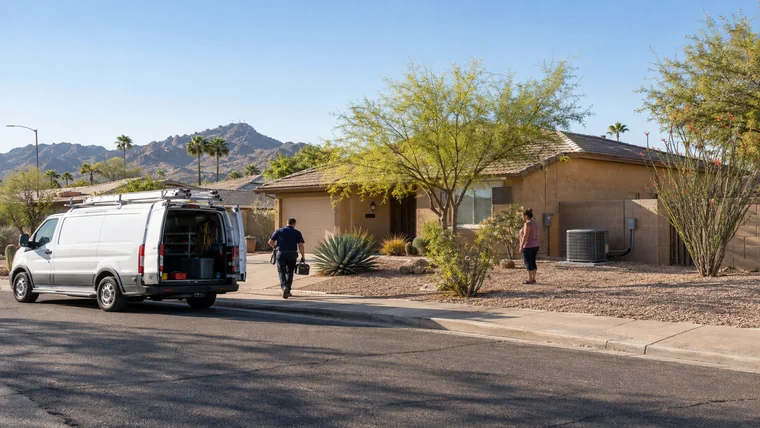
Sunnyslope is older than most of the Phoenix metro, and that one fact drives almost every cooling decision made here. The housing stock runs from the 1940s through the 1980s, which means we work on homes built before refrigerated air was standard equipment, homes converted off evaporative cooling somewhere along the way, and homes on their third or fourth condenser since the slab was poured. None of that is exotic, but it changes the questions worth asking. Whether a Phoenix permit is required turns on whether the new unit sits exactly where the old one sat. Whether a rebate exists turns on which utility reads your meter — and in 2026 that answer changed. Whether a large repair is worth approving turns partly on which refrigerant the system holds. Below is what we charge, what replacement costs in homes of this age, what to check before signing off on a major repair, and the honest 2026 rebate picture for an address that is typically served by APS.
- Sunnyslope housing stock runs from the 1940s to the 1980s, so evaporative cooler conversions, relocated equipment and legacy refrigerants drive more of the cost conversation here than in newer parts of the Valley.
- Diagnostics are $69.95 Monday to Friday 8am–6pm and $99.95 outside those hours, credited toward the repair, at the same flat rate as anywhere else we serve — no trip charge.
- Installed replacement runs $5,000–$7,000 for three tons, $6,000–$8,000 for four and $7,000–$10,000 for five; heat pumps carry no premium and a rooftop crane is $400–$600.
- Phoenix exempts like-for-like outdoor refrigeration swaps not over 5 tons at one- and two-family dwellings when the replacement is identical in weight; moving the unit or converting from evaporative cooling is not like-for-like.
- APS ended residential AC and heat pump rebates on January 1, 2026. SRP Cool Cash still pays $75, $150 or $225 per ton by compressor type on AHRI-listed SEER2 15.2+ equipment.
- The federal 25C tax credit was terminated for property placed in service after December 31, 2025, so 2026 installs do not qualify.
- Coil cleaning is $150 and coil replacement is $2,200–$2,600 — different jobs, and a quote that says only “coil” should be clarified before signing.
What does a service call cost in Sunnyslope, and how does scheduling work?
The fee covers the visit and the diagnosis, and it comes off the invoice if you approve a repair. The same number applies in Sunnyslope as it does in Casa Grande sixty-odd miles south — one flat rate, no trip charge, no zone pricing, no distance surcharge anywhere we work.
Scheduling works like this. Someone answers our phone at two in the morning, and it is a person rather than a recording. When a call genuinely warrants it, we dispatch overnight. Most non-emergency calls here are handled within 12 to 24 hours. We do not publish a same-day guarantee, because in a Phoenix July that is a promise the whole market makes and very few companies keep.
What changes on older Sunnyslope equipment is not the price of the visit, it is the parts conversation. Unlike a newer tract home where a failed capacitor or contactor is truck stock and the repair closes in the same hour, a system installed in the late 1980s can need a blower motor matched by specification rather than by part number. That is why our technicians photograph the data plate and the nameplate amperage on the first visit rather than the second.
Homeowners who call us in August consistently describe the same sequence: the system runs all day, cools less each afternoon, then quits. On equipment past fifteen years that pattern usually points to a capacitor, a condenser fan motor, or a condenser coil packed with dust after a run of monsoon storms — a $150 cleaning, not a replacement. A second opinion costs the same $69.95, is credited if we do the work, and the written report is yours either way. Our maintenance plan is $25 a month per unit.
What does AC replacement cost for typical Sunnyslope homes?
| Work | Installed price |
|---|---|
| 3-ton system | $5,000 – $7,000 |
| 4-ton system | $6,000 – $8,000 |
| 5-ton system | $7,000 – $10,000 |
| Heat pump | Same by tonnage, no premium |
| Mini-split | $1,000 – $3,000 per head |
| Crane, rooftop package units | $400 – $600 |
| Duct replacement | $1,000 – $3,000 |
Floor plans of this era are small by Valley standards, and square footage alone does not set the tonnage — orientation, glazing, insulation depth and how badly the attic ducting leaks all move the number. We size on an ACCA Manual J load calculation. So does the utility: SRP's Cool Cash application requires installed capacity to sit within 15 percent or half a ton of that calculation, and requires the Manual J worksheet itself on single-stage equipment.
Permits turn on a rule you can read yourself. City of Phoenix Planning & Development exempts repair or replacement in kind of outdoor refrigeration units not over 5 tons at one- and two-family dwellings, with the replacement identical in weight to what it replaced. The counter guidance the city uses is a short list of yes-or-no questions — is the unit moving, is the footprint different — and a single yes puts the job back into permit territory. Equipment located inside the building is not covered by that exemption at all.
That matters more here than in newer neighborhoods. A house that started life on an evaporative cooler is not a like-for-like swap under any reading: the equipment moves, the roof opening has to be closed and flashed properly, the duct system was sized for a large volume of low-pressure outside air, and the return path often has to be rebuilt before refrigerated equipment will hold temperature on a 110-degree afternoon. Unlike a 2005 tract home where the pad, the return and the circuit were sized for refrigerated air on day one, an evaporative cooler conversion in a 1950s house is three jobs wearing one name.
City of Phoenix Planning & Development lists repair or replacement in kind of outdoor refrigeration units not over 5 tons at one- and two-family dwellings as exempt from permit, provided the replacement is identical in weight to the equipment it replaces. The city's counter guidance screens exemption requests with yes-or-no questions about whether the unit is changing location or footprint, and any yes means a permit is required. Refrigeration equipment located inside the building falls outside the exemption. For a straight outdoor changeout in a Sunnyslope home under five tons, that usually means no permit; for an evaporative cooler conversion or a relocated condenser, it usually means one. We pull permits when the work requires them, and we do not claim to pull them when the code says otherwise.
What pushes a job above the typical range
These are the conditions that can push a job above the ranges above. We tell you before the work starts, not after — and they are worth checking on any contractor's quote, not just ours.
- Crane access on rooftop package units
- The existing line set cannot be reused with the new equipment
- Electrical panel lacks capacity or needs breaker work
- Ductwork is undersized, leaking, or hard to reach in the attic
- Code upgrades on an older home - grandfathering ends when equipment is replaced
- Refrigerant contamination, or an R-22 system needing conversion
Installed system price by tonnage — and where the SEER2 15.2 line falls
AZ Trusted Air published ranges, same in Sunnyslope as anywhere in the Phoenix metro. The split marks SEER2 15.2, the level SRP's Cool Cash rebate requires if your meter reads SRP.
Most Sunnyslope addresses are APS, and APS discontinued residential equipment rebates on January 1, 2026 — so for those homes the higher-efficiency step buys lower running costs rather than a rebate. Confirm your utility on your bill.
| Item | Range |
|---|---|
| 3-ton system | $5,000 – $7,000 |
| 4-ton system | $6,000 – $8,000 |
| 5-ton system | $7,000 – $10,000 |
What should Sunnyslope homeowners check before approving a major AC repair?
| Repair | Price |
|---|---|
| Capacitor | $50 – $200 |
| Contactor | $100 – $200 |
| Condenser fan motor | $600 – $1,200 |
| Blower motor | $750 – $1,800 |
| Compressor | $800 – $4,000 |
| Coil cleaning | $150 |
| Coil replacement | $2,200 – $2,600 |
First, the refrigerant. A 1990s or early-2000s system in this neighborhood may still hold R-22, while anything sold new today runs an A2L such as R-454B. Under the EPA's AIM Act rules, manufacturers stopped building R-410A residential systems on January 1, 2025, and a 2026 EPA final rule effective July 27, 2026 allows installation of pre-2025 R-410A equipment until that inventory is depleted. Servicing an existing R-410A or R-22 system remains legal — but the new refrigerants cannot be poured into old equipment, and topping off a leaking R-22 unit gets more expensive every season.
Second, warranty status. The serial number dates the equipment, and many compressors and coils carry a manufacturer parts warranty of up to ten years — the difference between a compressor job near the bottom of that range and one near the top. Unlike a newer system where the parts coverage usually survives the first failure, a twenty-year-old unit gives up parts and labour coverage at the same moment, which is exactly when the repair-or-replace question genuinely tips. Our own labour warranty runs two years on new equipment and one year on repairs.
Third, the readings. A written diagnosis with microfarad values, amp draw and operating pressures is checkable; “the compressor is going out” is not. Coil cleaning at $150 and coil replacement at $2,200 to $2,600 are different jobs, so if a quote says only “coil”, ask which. You can verify any contractor's licence and complaint history at the Arizona Registrar of Contractors, and our quote review is free with no site visit.
Which rebates can Sunnyslope residents claim on a replacement, and who handles the paperwork?
The 2026 answer changed, and plenty of quote sheets have not caught up. APS discontinued its residential AC and heat pump rebates effective January 1, 2026, after Arizona Corporation Commission decisions cut utility efficiency-program budgets. If your address is billed by APS — as most in this part of north Phoenix are — there is currently no equipment rebate to claim, and any contractor showing an APS rebate line on a 2026 quote should be asked to produce it in writing from aps.com.
Which utility bills you is not something anyone can read off a map. APS and SRP service lines interleave street by street across this metro, and a rebate follows the meter rather than the address. Your bill settles it in five seconds, and we check it before anything rebate-related appears on a quote. We should also say plainly that we are not currently on the APS Qualified Technology Installer list.
If your meter does read SRP, Cool Cash is still funded and still real money. It pays by the ton of installed capacity according to compressor type: $75 per ton on single-stage equipment, $150 per ton on multi-stage and $225 per ton on variable-capacity systems and inverter-driven mini-splits, which works out to $1,125 on a five-ton variable system. Equipment must be listed in the AHRI Directory at SEER2 15.2 or higher — a threshold SRP raised on November 11, 2024, and meaningfully above the 14.3 SEER2 federal minimum for the Southwest region. Applications are due within six months of installation, and SRP sets an install-by date each program cycle that has moved more than once, so confirm the current cycle at srpnet.com before you count on it.
We complete the contractor side, pull the AHRI certificate, attach the Manual J and submit it through our rebate concierge. On the federal side there is nothing to add: the 25C Energy Efficient Home Improvement Credit was terminated for property placed in service after December 31, 2025, so a 2026 install does not qualify no matter what older articles still say. APS does list smart thermostat rebates of up to $85 per device through its marketplace, plus credits for enrolling a thermostat in its demand-response programme; those amounts change, and aps.com is the place to confirm them.
Sources and further reading
The figures and requirements on this page draw on the following public sources. We link them so you can check anything here yourself.
- City of Phoenix Planning & Development — permit-exempt work list and the AC replacement vetting questions
- SRP — Cool Cash per-ton amounts, the SEER2 15.2 threshold and current program cycle dates
- APS — current residential program status and thermostat rebate terms
- AHRI Directory — verify a quoted system's SEER2 rating and matched-system certification
- U.S. Environmental Protection Agency — Section 608 — refrigerant handling rules, the R-410A phase-down and A2L transition
- ACCA (Air Conditioning Contractors of America) — Manual J load calculation, the correct basis for sizing in a converted older home
- Arizona Registrar of Contractors — licence verification and complaint history before you sign anything
Send it however suits you — a photo, an email, whatever is easiest. No obligation and no site visit. One flat rate across the Phoenix metro and surrounding communities, at any distance, with no travel or trip fee. Call (623) 252-6403 any hour and a person answers.