Who installs AC in historic Phoenix homes without ductwork?
The short answer: AZ Trusted Air installs cooling in Phoenix historic-district homes with no ductwork, working under Arizona ROC 317368. In Willo, Coronado, Encanto-Palmcroft and the rest of central Phoenix we use ductless multi-zone heat pumps, small-duct high-velocity systems, or conventional ducting where a usable chase exists — permitted through Planning and Development and, when the exterior shows from the street, cleared with the Historic Preservation Office first.
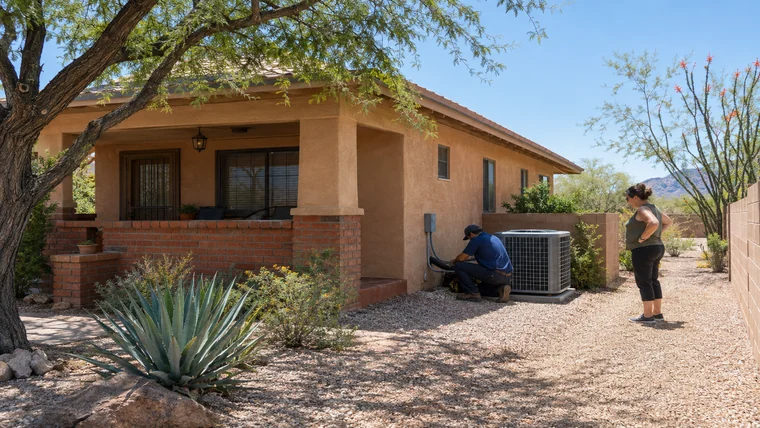
A 1928 bungalow in Willo was built to get through a Phoenix summer without a compressor: plaster on wood lath, deep porches, high ceilings, transoms over the bedroom doors, and eventually a roof-mounted evaporative cooler when the sleeping porch stopped being enough. What it was not built with is a duct chase. There is no room above the ceiling for an eight-inch trunk line, the exterior walls are barely four inches deep, and the joist bays run the wrong direction for the rooms you actually want cooled. So the retrofit question in central Phoenix's historic districts is never simply which equipment cools best. It is which equipment can be routed through a house that was never designed for it, installed under a City of Phoenix mechanical permit, and cleared by the Historic Preservation Office when the work shows from the street. Below are the three system types that genuinely work in pre-war Valley housing stock, what they cost, and the review process that decides where your condenser is allowed to sit.
- Ductless multi-zone needs one fist-sized penetration per head instead of a duct chase, which is why it is the default in pre-war Phoenix houses.
- Small-duct high-velocity moves air through two-inch inside-diameter tubing at roughly 1,500 to 2,000 feet per minute, against 600 to 900 for conventional ducts.
- High-velocity is audible, less efficient than good ductless equipment and costs more — it earns its place when plaster ceilings and invisible indoor equipment matter most.
- Phoenix exempts replacement in kind of outdoor refrigeration units under 5 tons at a one- or two-family dwelling; a first-time ductless retrofit is new indoor equipment and is not exempt.
- Properties with HP or HP-L overlay zoning need a Certificate of No Effect or Certificate of Appropriateness for exterior permit work, including non-contributing houses inside a district.
- The published COA path runs a three-to-four-week pre-application wait, a 10-day completeness review, a hearing within 20 days and a five-day appeal window.
- Ductless costs $1,000 to $3,000 per indoor head; ducted systems where a chase exists run $5,000 to $10,000 by tonnage, with no heat pump premium.
- SRP's Cool Cash pays $225 per ton on inverter-driven mini-splits up to $1,125, requires AHRI-listed SEER2 15.2+ equipment, and is filed within six months of installation.
- The federal 25C credit expired December 31, 2025, and APS discontinued its residential AC rebate for 2026 — we are not an APS Qualified Technology Installer either way.
What systems does AZ Trusted use in pre-war masonry homes (mini-split, high-velocity)?
Ductless multi-zone is where we start, and the reason is structural rather than fashionable. An indoor head needs one penetration roughly the size of a fist for the refrigerant lines, control wire and condensate drain — not a rectangular duct boot cut through original plaster. Homeowners who have lived through a conventional duct retrofit in a 1930s house consistently describe the same two casualties: dropped soffits in rooms that had ten-foot ceilings, and a bedroom closet surrendered to a chase. Ductless avoids both, and every zone gets its own thermostat.
When wall-mounted heads are the dealbreaker — and in Encanto-Palmcroft's formal rooms they often are — small-duct high-velocity is the honest alternative. These systems move air through flexible tubing with a two-inch inside diameter inside a four-inch outer jacket, fed from a plenum that can be low-profile rectangular at 3.5 by 14.5 inches, and they terminate in outlets roughly the size of a drink coaster. Air leaves at about 1,500 to 2,000 feet per minute against 600 to 900 for a conventional system, and at roughly 200 CFM per ton rather than 400.
We will also tell you what the brochures skip. The high-velocity outlets are audible in a quiet room, the systems are generally less efficient than a good ductless setup and cost more up front, and the tubing still has to find a path. They earn their place when keeping a plaster ceiling intact and keeping indoor equipment invisible matters more to you than the last few points of efficiency. One caution if a rebate is in your budget: the matched system has to appear in the AHRI Directory at SEER2 15.2 or better to qualify for SRP, so confirm the listing rather than assuming it.
Conventional ducting is not off the table everywhere in the districts. Some of the larger 1920s and 1930s houses in Encanto-Palmcroft carry attic volume that a low-gabled Willo bungalow simply does not, and a number of central-district homes already have ducting added decades ago for a gas furnace. Where that exists, a ducted heat pump is usually the cheapest good answer. Unlike a 1998 tract house in Ahwatukee, though, what we find in these attics is frequently undersized, barely insulated, and routed through space that runs 150 to 170 degrees in July — so the duct work, not the equipment, is where the money goes.
Every one of these paths gets a Manual J. The ACCA procedure is also the basis SRP requires for single-stage equipment, and here it is not a formality: uninsulated masonry stores heat all afternoon and releases it into the rooms after sunset, original single-pane wood windows lose far more than modern glass, and a deep porch can shade one room while a west bedroom bakes until nine at night. A per-square-foot guess oversizes the shaded rooms and starves the hot ones.
Refrigerant matters more than it did five years ago. New split equipment now ships with R-454B, an A2L refrigerant, and manufacturer instructions set a minimum conditioned room area for a given charge — a real constraint when the room is a nine-by-eleven 1930s bedroom rather than a modern great room. Meanwhile the R-22 systems still running behind central Phoenix homes cannot be topped up with new production refrigerant, and everything recovered off them is handled under EPA Section 608 rules.
Equipment location gets settled early, because it drives both the permit and the historic review. A ductless condenser can sit on a ground pad or a wall bracket; a high-velocity air handler needs a closet, a utility space or attic room that most bungalows do not offer. We work that out with a tape measure before anyone talks price.
How are historic-district rules on condensers and line sets handled?
Start with what triggers review. The city's Historic Preservation Office performs design review for exterior changes to properties listed on the Phoenix Historic Property Register — properties with HP or HP-L overlay zoning, individually or inside a district — and a Certificate of Appropriateness or Certificate of No Effect is required for all building permit applications affecting the exterior, including changes to non-historic properties located within historic districts. That last clause surprises people: being the 1962 infill house on a 1930s street does not exempt you.
Then the permit question, which is where most homeowners get bad information. Phoenix's published exempt-work list includes repair or replacement in kind of refrigeration units not over 5 tons in one- or two-family dwellings, when located outdoors, while repair or replacement of refrigeration systems located inside a building requires a permit. A first-time ductless or high-velocity retrofit is new indoor equipment in a new location, so the like-for-like exemption does not apply to it. The city's own counter guideline asks whether the unit is in a different location and whether it has the same footprint, and if any answer is yes, a permit is required.
Once a permit is in play, the exterior goes to HPO on one of two tracks. A Certificate of No Effect is an over-the-counter staff approval for minor work with no detrimental effect on historic character that is clearly within the General Design Guidelines, and work that is more complex or street visible requires a Certificate of Appropriateness, which goes to a public hearing. The guidelines themselves are based on the Secretary of the Interior's Standards for the Treatment of Historic Properties, which is why reversibility and street visibility keep coming up in these conversations.
The timeline is published and worth planning around rather than being surprised by. A pre-application meeting with a preservation planner typically schedules three to four weeks out, the planner has 10 days to review a filed application for completeness, the public hearing takes place within 20 days of a complete application, and a mandatory five-day appeal period follows the hearing. Nobody wants to discover that calendar in the second week of June with a dead evaporative cooler on the roof.
What we bring to the pre-app is the part that moves a project toward the simpler track. A site or roof plan showing exactly where the condenser lands, elevation photographs of the walls we propose to penetrate, the line-set route drawn rather than described, and a screening detail. Guidance for district homeowners consistently recommends arriving with current photos, measured drawings that show scale and rooflines, and material samples — the same discipline applies to mechanical equipment.
District-specific facts matter too. Willo is generally bounded by First and Seventh avenues and McDowell Road to the alley north of Edgemont Avenue, was designated in July 1990 with a boundary expansion in June 2006, and carries a period of significance of 1910 to 1950. Whether your individual parcel is contributing or non-contributing changes the scrutiny, since contributing properties retain historic character and typically face stricter review for street-visible exterior changes. Call HPO with the parcel number before you assume either way.
Our position is deliberately plain. We pull the mechanical permit when the work requires one, and we do not claim to always pull permits in Phoenix, because for a genuine outdoor like-for-like swap under five tons the city does not require one. What we will not do is tell you an installation is pre-approved. HPO staff determine whether a project is eligible for a CNE or requires a COA, and any contractor guaranteeing the outcome of that determination is guessing on your behalf.
Homeowners planning a summer retrofit routinely assume the historic review is a signature. The published sequence for a Certificate of Appropriateness is a pre-application meeting with a preservation planner that typically schedules three to four weeks out, a 10-day completeness review once the application is filed, a public hearing within 20 days of a complete application, and a mandatory five-day appeal window after the hearing before the certificate is issued. Minor work that is clearly inside the General Design Guidelines can instead be approved over the counter as a Certificate of No Effect, and HPO staff — not the contractor — decide which track your project takes. We plan ductless and small-duct jobs in Willo, Coronado and Encanto-Palmcroft around that calendar rather than against it.
What pushes a job above the typical range
These are the conditions that can push a job above the ranges above. We tell you before the work starts, not after — and they are worth checking on any contractor's quote, not just ours.
- Crane access on rooftop package units
- The existing line set cannot be reused with the new equipment
- Electrical panel lacks capacity or needs breaker work
- Ductwork is undersized, leaking, or hard to reach in the attic
- Code upgrades on an older home - grandfathering ends when equipment is replaced
- Refrigerant contamination, or an R-22 system needing conversion
What do ductless retrofits cost in districts like Willo, Coronado, and Encanto-Palmcroft?
Ductless is priced per indoor head because that is how the work actually scales: $1,000 to $3,000 each. A single head cooling a converted sleeping porch or a back bedroom lands near the bottom. A typical two-bedroom Willo bungalow usually wants three zones, which is roughly $3,000 to $9,000 depending on routing. The larger period-revival houses in Encanto-Palmcroft tend to need four or more, which is where whole-house ductless starts to overlap with the cost of a ducted system.
What moves a job inside that range in this housing stock is predictable. Long line-set runs from a rear condenser to a front room. Penetrations through brick or double-wythe masonry rather than stucco over frame. Original electrical service with no spare capacity, which is common in houses wired before anybody imagined four inverter circuits. And routing that has to stay invisible, which costs labour — running a line set through a closet and a floor cavity takes longer than strapping it to the outside wall, and it is the difference between a house that reads 1930 and a house that reads 1930 with plumbing on it.
Where a usable chase or attic already exists, the ducted numbers apply: $5,000 to $7,000 installed for three tons, $6,000 to $8,000 for four, and $7,000 to $10,000 for five, with heat pumps carrying no premium over straight cool. Duct replacement runs $1,000 to $3,000. Small-duct high-velocity is the one path we quote job by job rather than publishing a range, because the tubing count and the plenum route in a 1925 house are not predictable from the street, and we would rather hand you a written number than a number we made up. Our full published pricing is on one page.
Diagnostics are $69.95 Monday through Friday, 8am to 6pm, and $99.95 outside those hours, credited toward any repair we perform. A second opinion costs the same and the written report is yours either way; a quote review is free and needs no site visit at all.
Rebates are worth real money on this work, and the current landscape is narrower than most quote sheets admit. SRP's Cool Cash program pays $75 per ton for single-stage systems, $150 per ton for multi-stage and $225 per ton for variable-capacity systems on AHRI-listed SEER2 15.2+ equipment, and the $225 per ton tier covers inverter-driven mini-splits, up to $1,125 on a five-ton system. SRP's own program page notes that mini-splits can be ducted or ductless, with incentives paid by ton or half-ton of nominal capacity. Applications are due within six months of installation, and we file ours as part of the job — see the rebate concierge.
Two caveats specific to historic houses. The program is written around replacing or supplementing an existing central system, and new construction, window units and installations in non-habitable spaces do not qualify — so if your house has never had central cooling, eligibility is a question to settle with SRP in writing before you count the money. Second, amounts and deadlines move between program cycles; SRP sets them and they change, so verify the current figure at srpnet.com. Your bill names your utility, and SRP and APS territory interleave block by block in central Phoenix.
Three things we will not dress up. Reporting through 2026 indicates APS discontinued its residential AC and heat pump rebate program effective January 1, 2026 after the Arizona Corporation Commission cut its efficiency-program budget, and separately we are not an APS Qualified Technology Installer, so never treat an APS rebate as part of a quote from us. The federal 25C credit expired December 31, 2025 and does not apply to 2026 installations. And financing is available through a third-party lender but does not change the price of the job by a dollar.
What a historic-home cooling retrofit costs by approach
AZ Trusted Air published ranges, Phoenix metro. Ductless is priced per indoor head; the ducted range applies only where a usable chase or attic already exists.
Small-duct high-velocity is quoted job by job rather than published, because tubing count and plenum routing in a pre-war house cannot be predicted from the street. SRP's Cool Cash pays $225 per ton on variable-capacity and inverter-driven mini-splits, up to $1,125 on a five-ton system, on AHRI-listed SEER2 15.2+ equipment — confirm current amounts with SRP before relying on them.
| Item | Range |
|---|---|
| Single-zone ductless (1 head) | $1,000 – $3,000 |
| Three-zone ductless (bungalow) | $3,000 – $9,000 |
| Four-zone ductless (larger district home) | $4,000 – $12,000 |
| Ducted 3-ton central (chase exists) | $5,000 – $7,000 |
How is character preserved — line-set routing, placement, and screening choices?
The governing idea comes straight out of the standards the city's guidelines are built on: an intervention should be reversible and should not damage historic fabric. In practice that means we would rather lose an hour finding a path through a closet than gain one by punching through a decorative plaster cove. Where masonry has to be crossed, drilling a mortar joint instead of the face of a brick is both easier to repair later and far less visible from the sidewalk.
Line sets are where most retrofits get ugly. Unlike a stucco tract house in Surprise, where a run of bare copper on the side wall disappears into the general beigeness, a Coronado bungalow has a short, shallow facade at eye level from the street — every vertical line reads. What we route inside stays invisible; what has to stay outside goes into paintable line-set duct, color-matched to the wall rather than left in mill finish, and set on the elevation with the least public exposure. Homeowners touring the district in spring notice this instantly once they know to look for it.
Condenser placement is a negotiation between three things: the manufacturer's required service and airflow clearances, your neighbour's bedroom window, and what the Historic Preservation Office will accept in view from the street. Willo and Coronado lots are narrow, side yards are tight, and the attractive alley-side location sometimes conflicts with the clearance the equipment needs to reject heat on a 112-degree afternoon. When a unit gets crowded into a corner for looks, it runs hotter, and in this climate hot condensers are how compressors die early.
Indoors, the options are wider than most homeowners are shown. A high-wall head is one choice; a ceiling cassette is another where there is a cavity; and a compact ducted mini-split air handler hidden in a closet, feeding two or three short runs to slot registers, is often the answer for a room whose plaster ceiling you are not willing to cut. That last configuration matters financially as well, since SRP treats ducted mini-splits as eligible equipment alongside ductless. The comparison worth making is against a standard mini-split installation in a modern house, where none of these constraints apply.
Screening should be architecturally compatible with the house, not a plywood box built the weekend after the install. The screens that survive review and still look right five years later tend to be simple: a stucco or masonry knee wall matching the house, a wood gate detailed like the existing fencing, or planting that keeps airflow clearance. What fails is anything that reads as newer than the building or blocks the coil. A screened condenser still needs the monsoon dust washed off it — dust loading on the coil is the single most common thing our technicians correct on central Phoenix tune-ups.
Do not forget the hole the old cooler left. Many of these houses were cooled for decades by a roof-mounted evaporative unit, and when it comes off there is a curb, a duct opening through the ceiling, a dedicated circuit and a water line to deal with. Left half-finished, that opening is both a monsoon leak and a chimney straight into a 160-degree attic. Our swamp cooler conversion work treats the patch as part of the job, not as a follow-up somebody else can worry about.
Finally, keep the paperwork with the house. Districts change hands, and the next owner — or their buyer's inspector — will want to see the permit, the load calculation, the equipment model numbers and the certificate the city issued. We leave all of it, and our labour warranty runs two years on new equipment and one year on repairs. More on how we work is on our about page, and on the districts specifically at central historic districts.
Sources and further reading
The figures and requirements on this page draw on the following public sources. We link them so you can check anything here yourself.
- City of Phoenix Planning & Development — Historic Preservation review, the Certificate of No Effect and Certificate of Appropriateness process, and the published list of work exempt from permit
- SRP — Cool Cash rebate tiers, the SEER2 15.2 threshold, ducted and ductless mini-split eligibility, and current amounts
- ACCA (Air Conditioning Contractors of America) — Manual J load calculation, the correct basis for sizing equipment in an uninsulated masonry house
- AHRI Directory — verify that a proposed ductless or small-duct matched system is listed at SEER2 15.2 or better
- U.S. Environmental Protection Agency — Section 608 — refrigerant handling and recovery rules that apply when an older R-22 system comes out
- Arizona Registrar of Contractors — licence verification and complaint history before anyone cuts into a historic house
Send it however suits you — a photo of the estimate is enough. No site visit, no obligation, and we will tell you plainly whether the zone count and the routing make sense for your district home. One flat rate across the Phoenix metro and surrounding communities, at any distance. Live answer 24 hours a day at (623) 252-6403.