Who provides AC repair and replacement in Central Historic Districts?
The short answer: AZ Trusted Air (Arizona ROC 317368) handles AC repair and replacement across the Central Historic Districts — Willo, Coronado and Encanto-Palmcroft. Diagnostics are $69.95 weekdays 8am to 6pm, $99.95 otherwise, credited toward the repair. Because these Phoenix homes date from the 1920s to 1950s, much of our work here is retrofit: mini-splits, added ductwork, and swamp cooler conversions. Call (623) 252-6403.
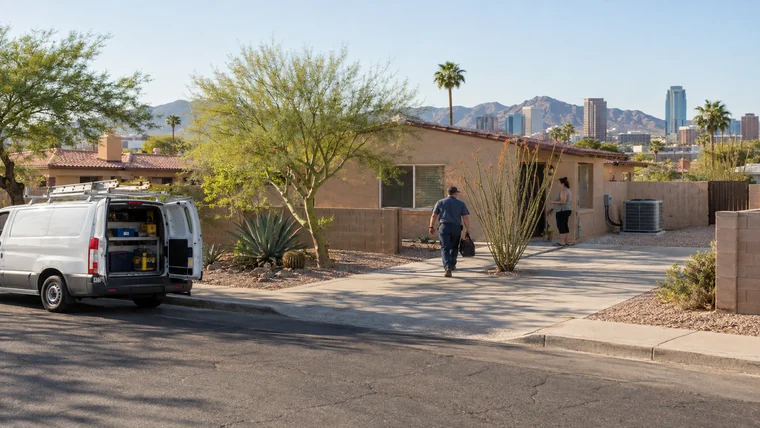
Willo, Coronado and Encanto-Palmcroft were built between the 1920s and the 1950s, which means almost every house in them was built before refrigerated air conditioning was a normal thing to put in a home. That single fact drives nearly everything unusual about cooling work here. The ductwork, where it exists at all, was added decades after the walls went up — threaded through closets, soffits, shallow attics and crawl spaces by whoever was available at the time. A great many of these houses started out on evaporative cooling, and some still carry the scars of that conversion in the form of a duct system sized for a completely different machine. On top of that, these are locally designated historic districts, so exterior changes visible from the street get reviewed in a way they never would in a 1998 subdivision. Below is how we price, schedule and think about work in these three districts, including the parts most contractors would rather not put in writing.
- Willo, Coronado and Encanto-Palmcroft homes date from the 1920s to 1950s, so ductwork was retrofitted later and rarely designed as one system.
- Diagnostics are $69.95 weekdays 8am–6pm and $99.95 outside those hours, credited toward repair, at the same flat rate with no trip fee.
- Replacement runs $5,000–$7,000 for three tons and $6,000–$8,000 for four; ductless retrofit is $1,000–$3,000 per head.
- Rooftop package units and their $400–$600 crane charge are rare in these districts, unlike much 1980s and 1990s Phoenix stock.
- R-22 production and import ended January 1, 2020, so a large repair on an R-22 system here seldom makes financial sense.
- Coil cleaning is $150 and coil replacement is $2,200–$2,600 — a quote saying only “coil” needs clarifying.
- SRP Cool Cash pays $75 to $225 per ton on SEER2 15.2+ equipment; APS ended residential equipment rebates on January 1, 2026.
- Exterior changes visible from the street are reviewed by the Phoenix Historic Preservation Office, and contributing properties face tighter review.
What does a service call cost in Central Historic Districts, and how does scheduling work?
Access is the scheduling variable that matters in these three districts and almost nowhere else in the Valley. Many Willo and Coronado lots are long and narrow with a detached garage set behind the house on an alley, so getting a condenser, a lift or a spool of line set to the equipment means working from the alley or walking it down a side yard that may be four feet wide between the house and a block fence. Unlike a Gilbert house with a wide RV gate, a 1928 bungalow gives us one route in and it is often the only route out too. When you call, telling us whether your unit sits in the side yard, on a pad off the alley, or in a rear courtyard changes how we load the truck.
Two other things worth knowing. A second opinion costs the same $69.95 or $99.95, is credited the same way, and the written report is yours whether or not you hire us — homeowners in these districts use it most often against replacement quotes written after a ten-minute look. A quote review is free, needs no site visit, and can come in as a photo texted from your phone. Our maintenance plan runs $25 per month per unit, which in practice matters more here than in newer housing because dust and cottonwood debris in the central corridor load a condenser coil fast during monsoon season.
What pushes a job above the typical range
These are the conditions that can push a job above the ranges above. We tell you before the work starts, not after — and they are worth checking on any contractor's quote, not just ours.
- Crane access on rooftop package units
- The existing line set cannot be reused with the new equipment
- Electrical panel lacks capacity or needs breaker work
- Ductwork is undersized, leaking, or hard to reach in the attic
- Code upgrades on an older home - grandfathering ends when equipment is replaced
- Refrigerant contamination, or an R-22 system needing conversion
What does AC replacement cost for typical Central Historic Districts homes?
Sizing is where these houses punish assumptions. Phoenix design temperature sits around 115F, and ACCA Manual J is the only defensible basis for a replacement load. A 1,500 square foot Encanto-Palmcroft home with thick plaster walls, deep shaded porches and mature trees frequently calculates lower than a same-size stucco house in Laveen with west-facing glass and no shade — and yet the tonnage nailed to the side of it is often whatever the last contractor had on the truck. SRP's Cool Cash program actually enforces this: for single-stage equipment it requires a Manual J or equivalent, with installed capacity within 15 percent or a half ton of the calculated load.
Note what is usually absent here: rooftop package units. Those dominate certain 1980s and 1990s Phoenix housing stock and bring a $400–$600 crane charge with them, but historic-district houses overwhelmingly run split systems at ground level, so that line item rarely appears on a quote in Willo. What does appear is duct work at $1,000–$3,000, and on houses where no sane duct path exists, a ductless retrofit. A mini-split head per zone avoids cutting new chases through lath and plaster, keeps the outdoor unit small enough to tuck out of street view, and lets you cool the two rooms that actually get used rather than the whole envelope.
What cooling work costs in a 1920s–1950s Central Phoenix house
AZ Trusted Air published ranges. The split on the tonnage bars marks SEER2 15.2, the efficiency SRP Cool Cash requires.
SRP Cool Cash pays $75 per ton on single-stage, $150 on multi-stage and $225 on variable-capacity or inverter-driven mini-split equipment rated SEER2 15.2 or better. Confirm current amounts at srpnet.com before relying on them.
| Item | Range |
|---|---|
| Mini-split, per head | $1,000 – $3,000 |
| Duct replacement | $1,000 – $3,000 |
| 3-ton system | $5,000 – $7,000 |
| 4-ton system | $6,000 – $8,000 |
What should Central Historic Districts homeowners check before approving a major AC repair?
Refrigerant first. Production and import of R-22 ended on January 1, 2020 under the phase-out administered through EPA Section 608, so any R-22 charge today comes from reclaimed or stockpiled supply at prices that make a large leak repair hard to justify. Homeowners who check the data plate on a condenser in one of these districts are regularly surprised to find a unit installed in the early 2000s still running R-22 — and a $2,400 coil replacement on that machine buys you a part matched to a refrigerant with no future. Our AC age checker and R-22 replacement pages walk through that decision.
Then the arithmetic. A capacitor is $50–$200 and a contactor $100–$200, which is a different universe from a compressor at $800–$4,000. That compressor spread is not vagueness: a warranty-covered compressor where you pay labour only sits at the bottom, an out-of-warranty one on legacy refrigerant at the top. Coil cleaning at $150 and coil replacement at $2,200–$2,600 are separate jobs roughly two thousand dollars apart, and a quote that says only "coil" needs clarifying before you sign. Finally, verify the licence and complaint history at the Arizona Registrar of Contractors — ours is ROC 317368. Historic districts attract door-knocking specialists in July, and that search takes two minutes.
On a 1920s–1950s house with no usable duct path, the three routes are: replace the duct system at $1,000–$3,000 where an attic or crawl space allows a sane layout; go ductless at $1,000–$3,000 per head and zone only the rooms in use; or a hybrid, keeping a small ducted core and adding heads for additions and converted porches. The decision is driven by attic clearance, wall construction and where an outdoor unit can legally and physically sit under district design review — not by what we would prefer to sell. We put all three on paper with prices so the comparison is yours to make.
Which rebates can Central Historic Districts residents claim on a replacement, and who handles the paperwork?
Utility territory in central Phoenix is genuinely mixed — SRP and APS both serve parts of the core, sometimes within a few blocks of each other, and we will not tell you which one covers your house without seeing a bill. Your statement names your provider on page one, and that is the fact the whole rebate conversation hangs on. ED3 serves communities out in the Pinal corridor, not the historic districts, so it will not apply here.
Where SRP applies, two program rules catch people out. On a split system both the condenser and the indoor air handler or coil must be replaced — a condenser-only swap does not qualify, which matters in houses where someone already replaced half the system five years ago. And the application is due within six months of installation, with the paid invoice, AHRI reference number and model numbers attached. We file it; see rebate concierge. Rebate amounts and program dates change between cycles, so confirm the current figures at srpnet.com before you rely on them.
Two things you should not be promised. We are not currently an APS Qualified Technology Installer, and in any case APS discontinued its residential equipment rebates at the start of 2026, so a quote in this neighborhood still showing an APS equipment rebate is out of date. The federal 25C tax credit is repealed for equipment placed in service in 2026 — if a salesperson nets $600 off your bottom line with it, that is a number that no longer exists.
Sources and further reading
The figures and requirements on this page draw on the following public sources. We link them so you can check anything here yourself.
- City of Phoenix Planning & Development — mechanical permit requirements and historic district review for exterior work
- SRP — Cool Cash rebate amounts per ton, the SEER2 15.2 threshold and the six-month filing window
- Arizona Registrar of Contractors — verify a licence and complaint history before approving major work — ours is ROC 317368
- U.S. Environmental Protection Agency — Section 608 — refrigerant handling rules and the R-22 phase-out affecting legacy equipment
- ACCA (Air Conditioning Contractors of America) — Manual J load calculation, which SRP requires for single-stage rebate equipment
- AHRI Directory — confirm a quoted system is AHRI-listed at the efficiency the rebate requires
No site visit, no obligation. Text a photo of the estimate or email it. One flat rate across the Phoenix metro and surrounding communities, at any distance — no trip charge in Willo, Coronado or Encanto.