Who installs the new R-454B refrigerant systems in Phoenix?
The short answer: Any Arizona-licensed contractor with EPA 608-certified technicians can install R-454B equipment — there is no separate federal A2L licence. AZ Trusted Air installs A2L systems across the Phoenix metro under ROC 317368, from Surprise to Casa Grande, at one flat rate. What matters is matched-system verification, correct liquid charging and code-compliant placement, not a badge on a truck.
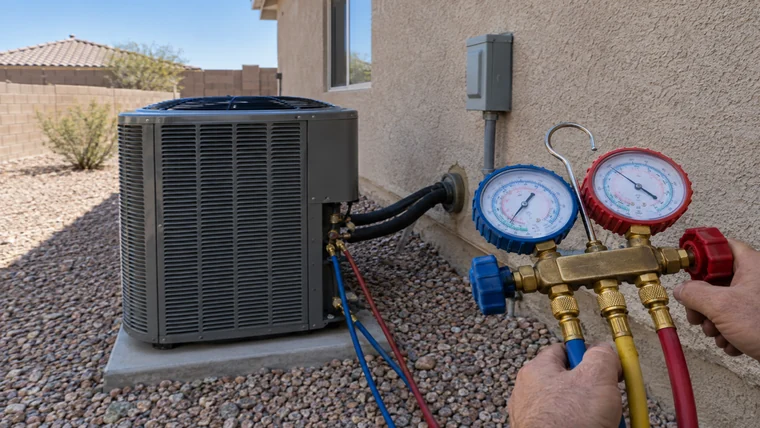
If you replaced an air conditioner in the Phoenix metro before 2025, the quote said R-410A and nobody discussed it. In 2026 the quote says R-454B, and plenty of homeowners are getting a chemistry lesson in their own driveway from a salesperson with one foot back in the truck. Here is the unhurried version. R-454B is a blend of R-32 and HFO-1234yf with a global warming potential near 466, against roughly 2,088 for the R-410A it replaces, and ASHRAE classifies it A2L — mildly flammable, with a low burning velocity. Federal manufacturing of R-410A residential equipment stopped on January 1, 2025, so almost everything new on a Valley distributor shelf is now A2L. What that actually changes for you is narrower than the marketing suggests and stranger than you would guess: a sensor inside your air handler, whether your indoor coil has to be replaced along with the condenser, and which leftover inventory a contractor may still legally install in Arizona this year.
- R-454B is an A2L blend of R-32 and HFO-1234yf with a GWP near 466, against roughly 2,088 for the R-410A it replaces.
- R-410A residential equipment manufacturing stopped January 1, 2025; on May 21, 2026 the EPA removed the installation deadline for pre-2025 inventory, effective July 27, 2026.
- No federal A2L licence exists — EPA Section 608 certification under 40 CFR Part 82, Subpart F is the requirement, plus manufacturer A2L training.
- R-454B must be charged as a liquid, and R-454B and R-410A cannot be crossed without voiding the warranty.
- Condenser-only swaps are largely finished: the indoor unit must match, and SRP's rebate requires both units replaced on a split system.
- Installed prices are unchanged at $5,000–$7,000 for three tons, $6,000–$8,000 for four and $7,000–$10,000 for five; the refrigerant is not a separate line item.
- SRP Cool Cash pays $75, $150 or $225 per ton by compressor type on SEER2 15.2+ equipment; APS ended residential equipment rebates on January 1, 2026, and the federal 25C credit is repealed for 2026 installs.
- The 2025 shortage was a cylinder and packaging bottleneck, not a chemical one, and distributors now describe R-454B as widely available.
- The new refrigerant detection system is factory sealed at 25 percent of the lower flammability limit and cannot be field adjusted — a lockout is a service call, not a setting.
How is AZ Trusted Air trained and equipped for A2L refrigerant installs?
Start with the part that gets overstated in advertising. EPA regulations under 40 CFR Part 82, Subpart F require technicians who maintain, service, repair or dispose of equipment that could release refrigerant to be certified, and since January 1, 2018 that requirement covers most substitute refrigerants, including HFCs. Those credentials do not expire. There is no federal A2L licence stapled on top of that. What exists instead is specialised A2L training that manufacturers and liability insurers increasingly require, covering the thermodynamic differences, charging practice and leak response. So when a company tells you it is “A2L certified,” the honest translation is trained and equipped — which is the right question, just not a government one.
The equipment side is concrete. A2L work needs recovery machines, gauges and leak detectors rated for a mildly flammable refrigerant, and it needs the charging discipline that blends demand: R-454B must be charged in the liquid state, because it is a blend and pulling vapour off the cylinder changes what ends up in the system. That single detail separates a crew that has done twenty of these from a crew doing its first. A system charged short or charged as vapour will still cool in April. It will show itself in July, at 115 degrees, when there is no margin left.
Then there is the matched-system rule, and this is where Phoenix homeowners lose money if nobody explains it. You cannot charge an R-410A system with R-454B or an R-454B system with R-410A — it is a safety problem and it voids the warranty. In practice that means the old Valley habit of replacing just the outdoor condenser and leaving the indoor coil in place is largely finished for A2L equipment. We verify the indoor and outdoor pairing in the AHRI Directory before ordering, because the same listing is what proves the efficiency rating later. SRP's rebate reaches the same conclusion from the other direction: on split systems both the condenser and the air handler must be replaced, and a condenser-only swap does not qualify.
Placement is the part that is genuinely local. UL 60335-2-40 ties allowable refrigerant charge to the minimum occupied volume of the room where equipment is expected to be used, with a safety factor of four so that a leak dilutes well below the lower flammability limit, and the same standard requires appliances to be free of potential internal ignition sources. Room volume is why a closet air handler in a 1,400-square-foot Sunnyslope house is a different conversation from an attic-mounted unit in Eastmark, and it is one of the quiet advantages of the rooftop package units that dominate older Phoenix and Glendale housing stock: the entire charge sits outdoors, above the roof deck, never inside a bedroom hallway.
Code is not uniform here, and we will not pretend it is. Arizona has no single statewide building code; adoption happens city by city. A2L refrigerants were not broadly permitted for human-comfort use in the International Mechanical Code until the code changes developed in the 2021 cycle, written to line up with ASHRAE 15 and UL 60335-2-40. The City of Phoenix now publishes its own amendments to the 2024 IMC, including an amendment addressing refrigerant quantities under IMC Table 1103.1 and shaft enclosure requirements. Your jurisdiction is whichever city bills your building permit, and City of Phoenix Planning & Development is the authority for addresses inside Phoenix.
One permit note, because it cuts against what most sites claim. Phoenix exempts many like-for-like outdoor equipment swaps under five tons. An A2L changeout is frequently not like-for-like — the indoor coil or air handler changes too, and electrical or low-voltage work often comes with it — so a permit is more likely on an R-454B job than it was on a 2019 condenser replacement. We pull them when the work requires it. Anyone promising they always pull a permit, or never need one, is describing a city that is not this one.
What does an R-454B system cost versus the R-410A equipment it replaces?
We publish the same ranges we published for R-410A systems, and we have not added an A2L surcharge. Rooftop package units still sit at the low end of their tonnage range with crane service billed separately at $400–$600; ductless work is still $1,000–$3,000 per indoor head; heat pumps still carry no premium over straight-cool equipment of the same capacity. The refrigerant belongs in the standard price of a 2026 system, not as a separate charge, and a quote that itemises “A2L refrigerant fee” as an extra is worth questioning before you sign it.
That said, something real did change inside the equipment. Under UL 60335-2-40 the refrigerant detector is not a generic accessory — it is part of a refrigerant detection system that includes the sensor, control logic, mitigation response and installation method, and those components are now built into indoor units. 2025 also delivered a refrigerant price shock: in April 2025 the largest domestic producer of R-454B announced a 42 percent surcharge, citing raw-material costs and potential tariff exposure, and acknowledged domestic production was not sufficient to meet demand. Equipment pricing absorbed that unevenly through last year. It has settled, which is why our ranges held.
There is now a second option on Valley quote sheets, and homeowners deserve the plain version of it. On May 21, 2026 the EPA finalised changes to its Technology Transitions Rule that removed the January 1, 2026 installation deadline for residential and light commercial systems using refrigerants above 700 GWP, so long as the equipment was manufactured or imported before January 1, 2025 — meaning pre-2025 R-410A inventory can be installed until supplies run out. That rule took effect July 27, 2026. Variable refrigerant flow systems did not get the same relief and still face a January 1, 2027 date. So if someone offers you discounted R-410A equipment this year, they are not breaking a federal rule. You are buying stock that has been sitting since 2024, against a refrigerant the whole supply chain is walking away from — and that is a trade worth making deliberately rather than by accident.
The rebate picture moves more money than the refrigerant does. SRP's Cool Cash pays $75 per ton on single-stage systems, $150 per ton on multi-stage and $225 per ton on variable-capacity systems and inverter-driven mini-splits, up to $1,125 on a five-ton. Equipment must be AHRI-listed at SEER2 15.2 or better and installed by an Arizona-licensed contractor, and applications are due within six months of installation. Program-year install deadlines shift between cycles and published sources currently disagree about the current one — one lists April 30, 2026 while another lists installs qualifying through April 30, 2027 — so we confirm the live date against SRP before anyone signs. If your meter is APS, the news is worse: APS discontinued its residential AC and heat pump rebate program effective January 1, 2026 after the Arizona Corporation Commission cut its efficiency budget, leaving Cool Rewards, a smart-thermostat demand-response credit, rather than an equipment rebate. We are not an APS Qualified Technology Installer and never promise an APS equipment rebate. The federal 25C credit is repealed for anything placed in service in 2026, so nobody should be netting it off your R-454B quote either.
One rebate condition doubles as an installation-quality standard, and it is the most useful sentence on SRP's own application. The installing contractor certifies that the cooling load was estimated consistent with ACCA Manual J or equivalent, that installed capacity is within 15 percent or a half ton of that estimate, that airflow is within plus or minus 10 percent of the blower's rated capacity and that refrigerant charge is within plus or minus 5 percent of manufacturer specification. Manual J documentation is required for single-stage systems and not for multi-stage or variable-capacity ones. At a 115-degree design temperature, with attics running 150 to 170 degrees over ducted equipment, those tolerances are not paperwork — a system charged 10 percent light behaves fine in Phoenix in May and gives up in August. Our rebate concierge files the SRP paperwork; our published pricing shows every range on one page.
What pushes a job above the typical range
These are the conditions that can push a job above the ranges above. We tell you before the work starts, not after — and they are worth checking on any contractor's quote, not just ours.
- Crane access on rooftop package units
- The existing line set cannot be reused with the new equipment
- Electrical panel lacks capacity or needs breaker work
- Ductwork is undersized, leaking, or hard to reach in the attic
- Code upgrades on an older home - grandfathering ends when equipment is replaced
- Refrigerant contamination, or an R-22 system needing conversion
What SRP Cool Cash pays on a qualifying A2L system, by compressor type
Rebate dollars for a 3-ton through 5-ton install. All three tiers require AHRI-listed SEER2 15.2 or better.
Per-ton amounts as published for SRP's current Cool Cash program. Split systems must replace both the indoor and outdoor unit, Manual J documentation is required for single-stage equipment, and the application is due within six months of install. APS discontinued its residential equipment rebates on January 1, 2026. Confirm current figures and the program-year install deadline with SRP before relying on them.
| Item | Range |
|---|---|
| Single-stage — $75/ton | $225 – $375 |
| Multi-stage — $150/ton | $450 – $750 |
| Variable-capacity — $225/ton | $675 – $1,125 |
Are R-454B systems and parts actually in stock, or is there a wait?
The 2025 shortage was widely misreported as a refrigerant shortage. It was a packaging shortage. Distributors were grappling with a shortage of R-454B in cylinders even while new equipment, already pre-charged at the factory, remained readily available, and the constraint was faster-than-expected demand, especially in southern markets, plus cylinder and packaging capacity — not the chemical itself, which OEMs could access for production. EPA's own 2025 reconsideration proposal documented shortages of 20-pound A2L-rated cylinders, unexpectedly high demand, global supply factors and stockpiling, with OEMs having better access to bulk refrigerant than field technicians who needed portable cylinders.
Phoenix felt that harder than Minneapolis did, for the obvious reason: our cooling season runs April into October and the demand curve for field refrigerant hits in the same weeks nationally constrained supply was thinnest. Defensive ordering made it worse — when many companies try to secure more inventory than normal at once, an apparent shortage intensifies even while production is rising, and EPA noted stockpiling contributed to regional shortages.
Where it stands now is better. HARDI, which tracked the situation through its distributor members, reported the supply crunch had eased significantly, with its director of government affairs stating plainly that the crisis is over. Cylinder manufacturers added capacity, OEMs changed pre-charge strategies and 2026 sources describe R-454B as widely available, with suppliers listing multiple 20-pound products in stock. One manufacturer response is worth knowing because it shows up on your job: with cylinders rather than equipment as the bottleneck, at least one major OEM switched from 15-foot to 30-foot line sets as standard on all units — more factory charge shipped inside the equipment, less topped off from a cylinder in your side yard.
What we will not do is publish a lead time, because it would be wrong within a fortnight. Even in a normalised market a contractor can still hit a delay because one local distributor is out of 20-pound cylinders or a particular brand is on allocation. Unlike a paint color, a matched A2L indoor unit is not substitutable at the last minute — swap the coil and you have changed the AHRI listing your rebate and your efficiency rating depend on. So we quote the specific pairing, we confirm availability before you commit, and the expected date goes on the proposal. If a Valley quote gives you a system but no availability date, ask for one in writing.
For the more common situation — an R-410A system that fails in July while you were planning to replace it next spring — nothing about the transition forces your hand. Existing R-410A systems can still be used, maintained and repaired. Manufacturing of R-410A residential split systems stopped January 1, 2025, but installed equipment is grandfathered and service refrigerant remains legal. That is a genuinely different position from the R-22 equipment still running in 1990s and 2000s Valley housing stock, where the refrigerant cost is what kills the repair case; our R-22 replacement page covers that decision, and the AC age checker will tell you which camp your unit is in. We answer the phone 24 hours a day, seven days a week — a person, not voicemail — and we dispatch overnight when a call warrants it. Typical non-emergency arrival is 12 to 24 hours. We do not publish a same-day guarantee, in July or any other month.
1. The refrigerant, named on the nameplate. Not “A2L” or “new refrigerant” — the actual designation, R-454B or R-32, because the two are not interchangeable and the nameplate is what a future technician works from. 2. Both model numbers, indoor and outdoor. An R-454B outdoor unit paired with a retained R-410A coil is not a system anyone should be selling you, and SRP's rebate will not accept a condenser-only swap on a split system. 3. An AHRI reference number. That number is what proves your pairing is a certified match at the SEER2 rating being claimed; it is searchable free in the AHRI Directory. 4. An availability date. If the proposal names a matched indoor unit but no expected delivery, ask for one in writing before you pay a deposit.
A quote missing three of these four has not been engineered; it has been priced. That is worth knowing before a crane is scheduled.
What changes for future service and maintenance with the new refrigerant?
The sensor is the genuinely new service item in your house. Current UL guidance sets the trigger at 25 percent of the refrigerant's lower flammability limit, and the fourth edition's rewritten Annex LL establishes that when the detection system senses that level it must initiate a response to mitigate the hazard — typically running the indoor blower to disperse the charge and locking out the system. UL's published guidance states the detector set point is factory set and sealed, with no field adjustment permitted. Read that twice, because it tells you what to expect from any technician: nobody tunes it, nobody recalibrates it in your attic, and a unit locked out on a refrigerant fault is a diagnostic visit, not a setting someone should be quietly overriding.
Unlike a float switch or a capacitor, this is a sensor with a service life inside equipment that lives in a Phoenix attic. Homeowners who open an attic hatch in August consistently discover an environment nothing in a national maintenance guide accounts for — 150 to 170 degrees over the air handler, which is the same space the detection electronics and their wiring occupy for six months a year. We do not yet have a documented Valley failure rate for these sensors; the equipment is too new and no honest contractor has that number. What we can tell you is that we check the sensor's status and mitigation response on every A2L maintenance visit rather than assuming it is fine because the house is cold.
Charging practice changes too, and it changes what a leak costs you. Blends like R-454B must be charged in the liquid state, so the old habit of walking up with a cylinder and adding a pound of vapour on a hot afternoon is simply not available. Nor can the refrigerants be crossed — charging an R-410A system with R-454B or the reverse is a safety hazard and invalidates the warranty. Neither A2L is interchangeable with the other either, which is why the refrigerant type on the equipment nameplate gets confirmed before anyone touches a service port. The practical effect is that finding and fixing a leak matters more than it used to, and topping off matters less. In this climate, that is usually good news — the leaks we find in Valley systems are rarely mysterious, they are evaporator coils and line-set connections that have cycled through twenty summers.
Everything else about refrigerant handling stays where it was. Section 608 continues to govern technician certification, recovery and recycling procedures, leak checking, sales restrictions and venting prohibitions, recordkeeping, disposal and service practices. Venting is illegal, recovery is mandatory, and the EPA's Section 608 pages are the primary source if you want to read the rules yourself rather than take a contractor's word for them.
The rest of Phoenix maintenance is unchanged, and it is still where the money is. Monsoon dust loads condenser coils every July and August in a way no moderate climate does — a coil that looks clean from three feet away can be packed solid between the fins — and coil cleaning is $150 while coil replacement is $2,200–$2,600. Those are different jobs, and a quote that says only “coil” should be clarified before you sign. Our maintenance plan is $25/month per unit, diagnostics are $69.95 Monday to Friday 8am to 6pm and $99.95 outside those hours, credited toward any repair, at the same price whether you are in Arcadia or Maricopa. Labour warranty is two years on new equipment and one year on repairs.
One honest uncertainty to close on. R-454B cylinder pricing has been volatile since 2025 and we are not going to project what a pound will cost in 2031. Our repair prices are published by part rather than by refrigerant for exactly that reason, and if a future service quote on your A2L system looks wrong, the second opinion is $69.95, credited, and the written report is yours either way. Annual tune-up and maintenance and warranty help cover the rest.
Sources and further reading
The figures and requirements on this page draw on the following public sources. We link them so you can check anything here yourself.
- U.S. Environmental Protection Agency — Section 608 — technician certification, recovery and venting rules, and the R-410A phase-down under the AIM Act
- AHRI Directory — confirm your quoted indoor and outdoor units are a certified matched system at the SEER2 rating claimed
- SRP — current Cool Cash per-ton amounts, the SEER2 15.2 threshold and the program-year install deadline
- City of Phoenix Planning & Development — adopted mechanical code, published amendments and when a changeout requires a permit
- ACCA (Air Conditioning Contractors of America) — Manual J load calculation, the sizing basis SRP's application requires you to certify
- APS — current status of residential program offerings in APS territory
Send it however suits you — text a photo, email it, whatever is easiest. No site visit, no obligation, and nobody will call to ask when a salesperson can stop by. We will tell you whether the indoor and outdoor units are a certified match and whether the SRP tier on it is real. One flat rate across the Phoenix metro and surrounding communities, at any distance.