Who fixes hot upstairs problems in Phoenix two-story homes?
The short answer: AZ Trusted Air handles hot-upstairs work across the Phoenix metro, from Ahwatukee and Gilbert two-stories to the newer Pinal corridor tracts. The work starts as a measured diagnostic rather than a quote: airflow, attic duct gain, insulation and capacity are tested separately before anything is recommended. The diagnostic is $69.95 Monday to Friday, 8am to 6pm, credited toward whatever repair follows.
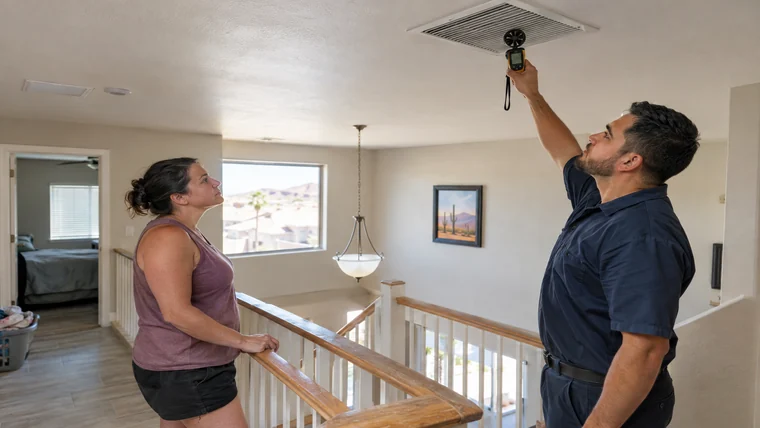
A two-story house in the Valley is really two different cooling problems stacked on each other. The downstairs sits on a slab behind shaded walls. The upstairs sits under a roof deck and an attic that reads 150 degrees or hotter by mid-afternoon in July, it is fed by supply ducts running through that same attic, and it is usually asked to share one thermostat with the floor below. The result is the call we take most often from April into October: downstairs is fine, upstairs is eight to ten degrees warmer by 4pm, and the thermostat insists everything is working.
Most of the time it is not one problem. It is airflow, attic duct gain, insulation and capacity in some combination, and the only way to know the mix is to measure the house on a hot afternoon. Below is how we sort that out, what each fix actually costs, which inexpensive things get tried first, and the number a fixed two-story should hit — the published ACCA comfort benchmark, not a sales promise.
- A hot Phoenix second floor is usually two causes at once: airflow, attic duct gain, insulation and capacity each leave a different measurable fingerprint.
- ACCA Manual RS benchmarks a cooling room-to-room spread averaging within about 3 degrees Fahrenheit and not exceeding about 6.
- Measure at 5 feet, mid-room, same thermometer, late afternoon in a hot month — a 9am reading proves nothing about a Valley two-story.
- Supply ducts crossing a 150-degree attic mean duct gain and return-side leakage often matter more than tonnage.
- Zoning cannot create capacity: if the Manual J shortfall is upstairs, closing downstairs dampers just moves the discomfort and raises static pressure.
- Published costs: duct work $1,000–$3,000, mini-split $1,000–$3,000 per head, dedicated three-ton system $5,000–$7,000 installed; zoning quoted after an attic inspection.
- Adding dampers or ductwork generally leaves Phoenix's like-for-like permit exemption, which applies only to outdoor in-kind swaps under five tons with no duct or electrical modification.
- SRP Cool Cash has paid $75 to $225 per ton at SEER2 15.2 or better; APS ended residential equipment rebates on January 1, 2026, and federal 25C is unavailable for 2026 installs.
How does AZ Trusted Air diagnose whether it's airflow, ducts, insulation, or capacity?
The four suspects in that heading are not options we choose between by feel. They leave different fingerprints, and every fingerprint has a number attached to it. What we find on Phoenix two-story calls is that the answer is usually two of the four at once, which is exactly why a diagnosis built on a walk-through and a hand held under a register misses it.
Airflow shows up first at the air handler. We read total external static pressure across the blower and compare it against the nameplate rating the equipment was certified at, then count and measure the returns. Nominal design airflow for cooling equipment is about 400 CFM per ton, so a five-ton system asked to pull 2,000 CFM through a single filter grille in a downstairs hallway is starved before the air ever reaches a stairwell. Homeowners who go looking for the return vents in a 1990s or 2000s Valley tract two-story consistently find one large grille downstairs and nothing at all on the second floor.
Duct gain is the Phoenix-specific suspect, and it gets measured rather than assumed. We take supply air temperature at the plenum, then again at the farthest upstairs register. Unlike a two-story in a moderate climate where the trunk line often runs through a basement or a conditioned chase, the duct feeding a Phoenix second floor crosses an attic sitting at 150 degrees or more on a July afternoon. A long flex run with crushed sections, an unsealed boot, or insulation that has slumped off the top of the duct does not just cost a little capacity — it delivers noticeably warmer air to the room that already carries the worst load in the house. A leak on the return side up there is worse, because it pulls that 150-degree attic air directly into the system.
Insulation gets a ruler, not an opinion. Phoenix sits in IECC climate zone 2B, where the 2021 code's prescriptive path calls for roughly R-30 at the ceiling and windows rated at a solar heat gain coefficient of 0.25 or lower. Many Valley two-stories were built to older editions, and blown fiberglass settles over twenty summers. We measure depth specifically over the upstairs bedrooms, look at the attic hatch and any recessed lights, and note which second-floor rooms face west. West-facing glass upstairs is doing its heaviest work at precisely the hour the complaint happens.
Capacity comes last, because it is the most expensive conclusion and the easiest one to jump to. A room-by-room load calculation run to ACCA Manual J at Phoenix's published 1 percent summer design temperature — commonly cited as 108 degrees at Sky Harbor, though some engineering references use 110 — regularly shows a second floor needing substantially more cooling per square foot than the floor beneath it, with industry guidance putting the gap as high as 30 percent. If the arithmetic says the upstairs load exceeds what its share of one system can deliver, damper adjustments will not rescue it. That calculation is not optional paperwork, either: SRP's Cool Cash rebate application requires the installed capacity to be within 15 percent or a half ton of a Manual J estimate on single-stage equipment.
All of it is measured in the afternoon. Homeowners who test their own upstairs at 9am find a two-degree spread and conclude the house is fine; the same house at 4:30pm in July is a different building. A diagnostic visit is $69.95 Monday through Friday, 8am to 6pm, and $99.95 outside those hours, credited toward any repair we perform, and the written numbers are yours either way. If another company has already told you the answer is a new system, the same fee buys a second opinion instead.
What do zoning systems and dedicated upstairs solutions cost?
| Solution | Cost | What it actually addresses |
|---|---|---|
| Duct repair or replacement | $1,000 – $3,000 | Attic duct gain, leakage, crushed or undersized upstairs runs |
| Added return air / balancing | Quoted per job | A starved second floor on an otherwise adequate system |
| Two-zone damper retrofit | Quoted per job | One system with enough capacity, distributed wrongly |
| Mini-split head upstairs | $1,000 – $3,000 per head | One or two problem rooms, or a bonus room over a garage |
| Dedicated 3-ton second system | $5,000 – $7,000 | A genuine capacity shortfall upstairs |
| Rooftop package unit swap | Low end of range + crane $400–$600 | The many Valley two-stories already served from the roof |
We do not publish a zoning range for the same reason we do not publish one for duct work: the price is set by what is already in the attic. Published national cost guides put a two- or three-zone retrofit somewhere around $2,000 to $6,000 installed, and that is a fair budgeting number to walk in with — but it is a market figure, not ours, and a Phoenix attic with a single undersized trunk serving both floors can land well outside it.
There is a mechanical caution with zoning that gets skipped in sales conversations. When dampers close, the blower still has to push air somewhere, so a single-stage system usually needs a pressure-relief bypass, which cost guides price at roughly $300 to $600. Zoning also cannot create capacity. If the Manual J says the second floor needs more cooling than its share of the existing tonnage, closing the downstairs dampers only moves the discomfort down a flight of stairs while raising static pressure on a blower that was already working hard.
A mini-split head is frequently the better value on a Phoenix two-story, because the problem is often two rooms rather than a whole floor, and because the rebate math favors it. SRP's Cool Cash program has been paying $75 per ton on single-stage, $150 per ton on multi-stage and $225 per ton on variable-capacity systems and inverter-driven mini-splits at SEER2 15.2 or better, up to $1,125 on a five-ton. Those amounts and deadlines change between program cycles, so we confirm the current figure with SRP before it goes on a quote rather than after.
Two things move a dedicated second system beyond the equipment price, and both are local. First, permits: Phoenix's published list of work exempt from permit covers repair or replacement in kind of outdoor refrigeration units not over five tons at one- and two-family dwellings, on the condition that the replacement is identical in weight and that ductwork and electrical connections are not modified. Adding dampers, a new trunk or a second system modifies ductwork, so it generally leaves that exempt path. We pull permits when the work requires it, and City of Phoenix Planning & Development is the authority to verify your specific scope with — other Valley cities administer this differently, and some third-party sites state flatly that Phoenix permits every changeout, which does not match the city's own exemption list.
Second, where the equipment is allowed to sit. In master-planned communities such as Verrado, Eastmark and Vistancia, design guidelines govern condenser placement, screening and visibility from the street, and that has real consequences for a second condenser or a mini-split outdoor unit — sometimes a longer line-set route to a side-yard pad instead of the obvious wall. Unlike a rural lot where the unit goes wherever the pad fits, a design-review submittal is part of the job here.
On money: APS discontinued its residential AC and heat pump rebates effective January 1, 2026, after the Arizona Corporation Commission reduced its efficiency-program budget, so we do not put an APS equipment rebate on a quote. The federal 25C credit is not available for equipment placed in service in 2026. Heat pumps carry no premium over straight-cool at the same tonnage, and financing through our third-party lender does not change the price of the job by a dollar.
What pushes a job above the typical range
These are the conditions that can push a job above the ranges above. We tell you before the work starts, not after — and they are worth checking on any contractor's quote, not just ours.
- Crane access on rooftop package units
- The existing line set cannot be reused with the new equipment
- Electrical panel lacks capacity or needs breaker work
- Ductwork is undersized, leaking, or hard to reach in the attic
- Code upgrades on an older home - grandfathering ends when equipment is replaced
- Refrigerant contamination, or an R-22 system needing conversion
What the upstairs fixes cost, smallest to largest
AZ Trusted Air published ranges where we publish them, and market cost-guide ranges where the price depends on your attic.
Duct and mini-split figures are our published ranges. The bypass and two-zone figures are national cost-guide ranges, shown for budgeting only, because we quote damper zoning per job after an attic inspection. Rooftop package unit work adds crane service at $400–$600.
| Item | Range |
|---|---|
| Bypass duct (zoning add-on, market) | $300 – $600 |
| Duct repair / replacement | $1,000 – $3,000 |
| Mini-split, per head | $1,000 – $3,000 |
| Two-zone damper retrofit (market) | $2,000 – $6,000 |
| Dedicated 3-ton second system | $5,000 – $7,000 |
Which low-cost fixes does AZ Trusted Air try before recommending big-ticket work?
The order is deliberate and it is not generosity. A hot upstairs caused by a closed balancing damper does not improve when you spend $6,000 on it, and we would rather find that out on a $69.95 service call than after an install.
Manual balancing dampers come first. Most Valley tract two-stories were built with balancing dampers at the trunk takeoffs, and in the houses we open up, a good share of them are still sitting exactly where the installing crew left them in 1998. Restricting the downstairs branches and opening the upstairs ones, then re-reading register temperatures and static pressure to confirm the blower is not being choked, is an afternoon of work rather than a project. We mark the damper handles so a homeowner can reverse the setting in November, because the correct Phoenix summer position is the wrong winter position.
Return air is the next cheapest real fix and the most commonly missed one. A second floor with supply registers and no return has nowhere to send the air it receives, so it pressurises slightly and the cooling short-circuits back down the stairwell. Adding an upstairs return, enlarging an undersized filter grille, or undercutting bedroom doors often changes the room temperature more than a tonnage increase would — and it lowers static pressure instead of raising it.
Continuous fan circulation is worth a genuine trial here, and this is one of the few places where Phoenix's climate works in a homeowner's favor. Running the blower in the on or circulate position mixes stratified air between floors. In a humid climate that trick backfires, because the fan re-evaporates condensate off the coil and pushes moisture back into the house. In a 2B dry climate the humidity penalty is small enough that we will test it before selling anything, though it does add blower runtime to the bill.
Then duct sealing. Sealing boots, plenum seams and register connections in a 150-degree attic is the highest-return work on most Phoenix second floors, and it has a rebate attached: SRP has been covering 75 percent of duct testing and qualified sealing costs up to $400 for a single-family detached home, with lower caps for attached homes and condos, and the program requires a BPI-certified contractor and submission within six months. We will not claim a certification we hold to make that sentence tidier — confirm the current contractor requirement and amount directly with SRP, and if the rebate path matters to you, say so before the work is scheduled. Full duct sealing and repair scope gets quoted after the attic inspection; outright replacement runs $1,000 to $3,000.
Filter and coil restriction is the cheap cause nobody suspects, and monsoon season is why. Blowing dust loads an outdoor coil in a way that a temperate-climate condenser never experiences, and a partially blocked coil rarely announces itself as a breakdown — it announces itself as the upstairs losing ground after 4pm while downstairs still feels acceptable. A coil cleaning is $150, which is a different job from a coil replacement at $2,200 to $2,600; if a quote just says "coil," ask which one. Our maintenance plan is $25 per month per unit and exists mostly to keep that from becoming an August emergency.
Thermostat strategy closes the cheap list. A single thermostat downstairs is measuring the coolest air in the house, so a smart thermostat with a remote upstairs sensor at least lets the system respond to the floor that has the problem. Pre-cooling the upstairs ahead of your plan's on-peak window helps too, and SRP has offered bill credits for enrolling eligible smart thermostats while APS's remaining Cool Rewards program is a thermostat demand-response credit rather than an equipment rebate. On-peak hours differ between SRP and APS plans and between plan types — your bill names your plan, and that is the document to set the schedule from. Solar screens or film on west-facing upstairs glass also help; that is not our trade, and we will say so rather than quote it.
Total external static pressure at the air handler, alongside the nameplate rating it should be operating at. Supply temperature at the plenum and at the farthest upstairs register, so attic gain is a figure rather than a theory. Register-by-register temperatures and a room-by-room temperature survey taken at 5 feet, mid-room, in the afternoon. Return-air count and grille dimensions against the airflow the equipment needs at roughly 400 CFM per ton. Measured attic insulation depth over the upstairs bedrooms, plus orientation of the worst rooms. A room-by-room ACCA Manual J at Phoenix design conditions where capacity is in question. Then the floor-to-floor spread compared against the ACCA Manual RS cooling benchmark. The report is yours whether you hire us or not, including when it is bought as a second opinion on someone else's recommendation.
What temperature difference between floors should a fixed system achieve?
This is the question with a published answer, which makes it the most useful one on the page. ACCA's Manual RS sets room-to-room temperature difference benchmarks used in Department of Energy field research: in cooling mode, an average spread within roughly 3 degrees Fahrenheit and a maximum within roughly 6, with tighter figures in heating mode at about 2 and 4 degrees. Those are the numbers a designed, balanced residential system is expected to hold. When we hand back a report, that is the standard we are measuring your house against, not a comfort adjective.
How you measure decides whether the number means anything. Same thermometer for every reading. Roughly 5 feet above the floor, near the middle of the room, away from a register and away from a window. Interior doors positioned the way you actually live. All readings inside the same half hour, with the system having run at least fifteen minutes. And in the afternoon — late afternoon in a hot month, because that is when the roof, the attic ducts and the west glass are all contributing at once.
Phoenix adds a caveat that national comfort guidance does not. Equipment is selected against a design temperature — the published 1 percent summer figure for Phoenix is commonly cited at 108 degrees — and in July the Valley spends real hours above it. Unlike a two-story in a moderate climate, where a properly balanced single system will hold a couple of degrees between floors from June through August without drama, a Phoenix two-story with its supply ducts in a 150-degree attic will show its worst floor-to-floor spread in the last two hours of sun and then recover after dark. An honest target is 3 degrees at 4pm in July, not zero.
Sometimes the equipment is right and the expectation is off, and we would rather say that than sell around it. If the downstairs thermostat is set at 76 and the upstairs bedrooms hold 79 on a 112-degree afternoon, the house is inside the Manual RS maximum and there is no repair to sell you. Where we do push back is on the other direction: homeowners who have been running the downstairs at 71 for years to make the upstairs liveable are paying for a distribution problem in monthly instalments, and that is worth fixing even though nothing is technically broken.
Verification is part of the work. We take the same readings after the fix that we took before it, in the same conditions, so that the improvement is a pair of numbers rather than an impression. Season timing matters here too: the Valley cooling season runs April into October, so a hot-upstairs fix verified in March has proved almost nothing. Labour warranty is two years on new equipment and one year on repairs, and we will come back and re-measure — but you will never get a promise from us that two floors under a Phoenix roof will read identically, because no correctly designed system delivers that.
If the conclusion does turn out to be capacity, the decision belongs in a repair-or-replace conversation with the load calculation on the table, and if you already have a quote in hand, our quote review is free and needs no site visit. Published prices for the equipment paths are on the pricing page, and our rebate concierge handles SRP and ED3 paperwork on jobs that qualify.
Sources and further reading
The figures and requirements on this page draw on the following public sources. We link them so you can check anything here yourself.
- ACCA (Air Conditioning Contractors of America) — Manual J room-by-room load calculation and the Manual RS room-to-room temperature benchmarks
- City of Phoenix Planning & Development — published work-exempt-from-permit list and when duct modification triggers a mechanical permit
- SRP — Cool Cash per-ton amounts, the SEER2 15.2 threshold, the Manual J capacity rule and duct test and repair rebate terms
- U.S. Department of Energy — field research applying ACCA Manual RS room-to-room temperature benchmarks, and duct and distribution guidance
- ENERGY STAR — county-level 1 percent cooling design temperature reference used for Maricopa County load calculations
Send it however suits you — a photo, an email, whatever is easiest. No site visit, no obligation. We answer the phone 24 hours a day at (623) 252-6403, a person rather than voicemail, and we charge one flat rate across the entire Phoenix metro and surrounding communities including Casa Grande, Florence and Maricopa — no trip charge at any distance.