Who provides AC repair and replacement in Eastmark?
The short answer: AZ Trusted Air, Arizona ROC 317368, repairs and replaces air conditioning in Eastmark and across the southeast Mesa corridor. A person answers our phone 24 hours a day, diagnostics are $69.95 weekdays 8am to 6pm, and there is no travel fee to Eastmark or anywhere else we serve. Typical non-emergency arrival is 12 to 24 hours.
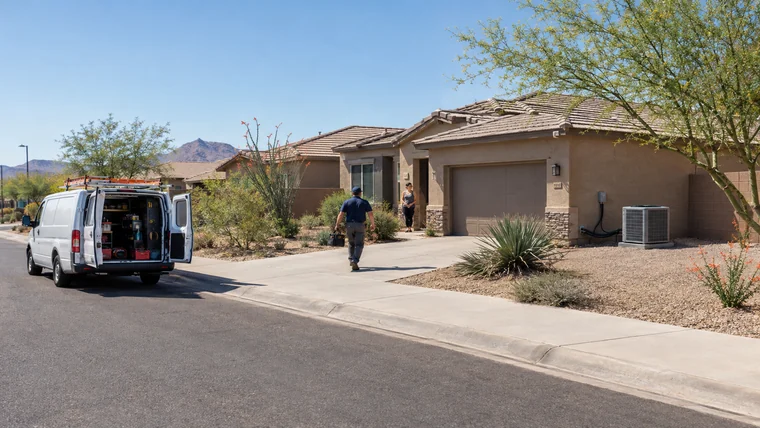
Eastmark started selling homes in 2013, which puts the oldest systems in the community somewhere around their thirteenth Phoenix cooling season. That matters more than the number suggests. A cooling season running April into October means an Eastmark air conditioner has stacked up far more run hours than a national lifespan table assumes, and the calls we take in this part of southeast Mesa are overwhelmingly first failures rather than end-of-life ones: a capacitor, a condenser fan motor, a leaking evaporator coil, and a warranty question nobody in the house can answer. These homes are not old enough to replace as a matter of course, and not new enough to still be the builder's problem. That is an awkward place to be standing in a July hallway with the thermostat reading 88 and climbing. What follows is the pricing, the Mesa permit position, the warranty arithmetic and the SRP rebate rules that actually apply to a house of this vintage — written so you can use it before you call anybody, including us.
- Eastmark's build era begins in 2013, which puts the community in a first-failure window — capacitors, fan motors, coils — rather than an end-of-life one.
- Unlike Phoenix, which exempts many like-for-like swaps under five tons, Mesa Development Services requires a mechanical permit for HVAC replacement, filed through eTRAKiT.
- Registered manufacturer parts coverage typically runs ten years and unregistered coverage five; on a builder home the clock generally starts at your closing date.
- Manufacturer warranties pay for parts only. Labour is billed separately — ours carries two years on new equipment and one year on repairs.
- New residential equipment uses R-454B or R-32 under EPA's 700-GWP threshold, so swapping only the outdoor unit onto an existing R-410A coil is no longer a real option.
- SRP Cool Cash pays $75, $150 or $225 per ton by system type on AHRI-listed SEER2 15.2 equipment, up to $1,125, filed within six months of installation.
- New-construction homes never qualified for Cool Cash, so this replacement is the first time an Eastmark house can claim it.
- The federal 25C credit was terminated for property placed in service after 31 December 2025; there is nothing federal to claim in 2026.
What does a service call cost in Eastmark, and how does scheduling work?
The fee buys a diagnosis, not a sales visit. Our technician measures rather than guesses — capacitor microfarads against the nameplate rating, compressor and fan amp draw, supply and return temperatures, static pressure — and you get the readings in writing. If you authorise the repair, the $69.95 comes off the invoice. If you decide to think about it, the written findings are still yours, and you can take them to anyone.
Eastmark sits at the far southeast edge of Mesa, which in this trade usually means a distance surcharge or a zone somewhere in the fine print. We do not price that way. The same flat rate applies in Eastmark as in Ahwatukee, and there is no trip charge, fuel fee or zone premium at any distance in our service area. If a quote you are holding carries a travel line item for a southeast Mesa address, that is a pricing decision, not a cost of nature.
On timing, we will tell you plainly what we can and cannot promise. The phone is answered live around the clock, and we do send technicians out overnight when a call warrants it — a house with a newborn, a medically vulnerable occupant, or an indoor temperature climbing past the point where waiting is sensible. What we will not publish is a blanket same-day guarantee, because in a Phoenix July that promise gets made constantly and kept selectively.
One advantage of this community's build era is worth naming. Unlike a call on 1990s Valley equipment, where the day can be lost hunting an obsolete part, an Eastmark system from the 2010s takes parts that are still in current distribution and often on the truck — a meaningful contrast with a 1990s Valley house where tracking down an obsolete part can consume the day. Our maintenance plan runs $25 a month per unit — per unit matters if your plan was built with two systems — and labour warranty is two years on new equipment, one year on repairs.
What does AC replacement cost for typical Eastmark homes?
| System | Installed price | What moves it within the range |
|---|---|---|
| 3-ton split system | $5,000 – $7,000 | Efficiency tier; line-set and duct condition |
| 4-ton split system | $6,000 – $8,000 | Efficiency tier; electrical or code work if required |
| 5-ton split system | $7,000 – $10,000 | Efficiency tier; attic access and equipment platform |
| Heat pump | Same by tonnage | No premium over straight-cool |
| Mini-split head | $1,000 – $3,000 | Per indoor head; line routing, exterior approvals |
| Crane, rooftop package units | $400 – $600 | Rarely applies in this build era |
That last row is the contrast worth drawing. What our technicians find at Eastmark addresses is split systems — indoor air handler, outdoor condenser — where a 1970s or 1980s Valley house of the same size would carry a rooftop package unit and a crane bill. You are spared the crane; you inherit the attic instead, and in a Phoenix attic that touches 150 degrees in July the duct and line-set condition above your ceiling is the part of the job nobody thinks to ask about.
Two rules now shape what a replacement can even look like. First, permits: unlike the City of Phoenix, which exempts many like-for-like outdoor swaps under five tons, Mesa Development Services requires a mechanical permit for HVAC installation and replacement, filed through the city's eTRAKiT portal. We confirm the current requirement with the city on each job, because jurisdictions amend these rules. Second, refrigerant: since 1 January 2025, new residential systems are built for R-454B or R-32, which fall under the 700-GWP threshold EPA set in its Technology Transitions rule, while R-410A sits at roughly 2,088. You cannot retrofit an R-410A system to R-454B, so the old habit of replacing just the outdoor unit has largely closed. EPA's May 2026 final rule, effective 27 July 2026, does allow units manufactured before 2025 to be installed until that inventory is depleted.
Sizing here is not a square-footage lookup. ACCA's Manual J is the correct basis, run against a Phoenix-area design temperature near 115F, and SRP will not process a single-stage rebate without one.
What pushes a job above the typical range
These are the conditions that can push a job above the ranges above. We tell you before the work starts, not after — and they are worth checking on any contractor's quote, not just ours.
- Crane access on rooftop package units
- The existing line set cannot be reused with the new equipment
- Electrical panel lacks capacity or needs breaker work
- Ductwork is undersized, leaking, or hard to reach in the attic
- Code upgrades on an older home - grandfathering ends when equipment is replaced
- Refrigerant contamination, or an R-22 system needing conversion
The first-failure decision in Eastmark: repair prices against a new system
AZ Trusted Air published ranges. Homes of this build era usually fail one component at a time, so the question is where that component sits relative to replacement.
Coil replacement is shown here; coil cleaning is a separate $150 service and the two should never appear as one line on a quote. The compressor range is wide because a part still inside registered manufacturer coverage sits at the bottom and an out-of-coverage part sits at the top.
| Item | Range |
|---|---|
| Capacitor | $50 – $200 |
| Condenser fan motor | $600 – $1,200 |
| Blower motor | $750 – $1,800 |
| Coil replacement | $2,200 – $2,600 |
| Compressor | $800 – $4,000 |
| New 3-ton system, installed | $5,000 – $7,000 |
What should Eastmark homeowners check before approving a major AC repair?
The warranty question is the one that moves the most money in this community, and almost nobody checks it. Across the major brands, parts coverage is typically ten years if the unit was registered within 60 days of installation, and five years if it was not. The equipment is identical; only the paperwork differs. For a home bought new, manufacturers generally define the installation date as the date you purchased the residence from the builder — so a 2015 Eastmark buyer's clock started at closing, not at whenever the crew set the unit on the pad.
Run that arithmetic on your own house. If you closed in 2013 or 2014, registered parts coverage has almost certainly lapsed. If you closed in 2017 or later and the equipment was registered, a compressor or coil may still be a free part. And if nobody registered it, you may be five years out even on a 2019 home. The serial number and your closing date answer this in about ten minutes, and our AC age checker and warranty help pages exist for exactly that lookup.
Understand what the warranty does and does not do: it ships your contractor a part. Labour is yours. That is why a covered coil still produces a real invoice, and why our own labour warranty — two years on new equipment, one on repairs — is a separate promise from the manufacturer's.
Then check the language. Cleaning a coil is $150; replacing one is $2,200 to $2,600. A quote that says only "coil" spans two thousand dollars of ambiguity. Same with refrigerant: with R-410A supply tightening under the AIM Act phase-down, a large recharge on a leaking system is money spent on a problem that will return. A capacitor is $50 to $200, a contactor $100 to $200, a condenser fan motor $600 to $1,200, a compressor $800 to $4,000. A second opinion costs the same $69.95 and is credited, and the written report is yours either way. You can also verify any Arizona contractor, including us, at the Registrar of Contractors.
Before we quote a compressor, coil or motor at an Eastmark address, we decode the serial number for manufacture date, ask the homeowner for the date they closed on the house, and check the manufacturer's registration status. The reason is arithmetic, not courtesy: registered parts coverage typically runs ten years from installation, unregistered coverage typically five, and on a builder-built home the installation date is generally the date the original owner bought the residence from the builder. A 2014 closing is almost certainly out of coverage. A 2018 closing with registration completed may mean the part is free and only labour is billable. We put that finding in writing either way, and if the answer is that a covered part exists, we say so even when it makes the job smaller.
Which rebates can Eastmark residents claim on a replacement, and who handles the paperwork?
Start with territory, because we cannot tell you yours from a community name. Eastmark is typically served by SRP, but utility service follows the address rather than the subdivision boundary, and your bill names your provider — check it before you believe any rebate number on any quote. If an Eastmark address turns out to be APS, we will not promise you an APS rebate: AZ Trusted Air is not an APS Qualified Technology Installer, and as of the date this page was written APS has not published an active residential AC rebate program — confirm the current program status directly at aps.com before any decision.
On the SRP side, the terms are published and specific. Equipment must be AHRI-listed at SEER2 15.2 or higher, installed by an Arizona-licensed contractor before 30 April 2027, with the application submitted within six months of installation. On split systems both the indoor air handler and the outdoor unit must be replaced. Manual J load calculations must accompany single-stage applications or the claim is delayed or denied; multi-stage and variable-capacity systems are exempt from that requirement. SRP may ask to inspect the installed unit. Amounts are set by SRP and change between program cycles, so confirm the current figure at srpnet.com before you sign anything.
One clause matters uniquely to a community of this vintage: new-construction homes do not qualify. The system your builder installed was never rebate-eligible. This replacement is the first time an Eastmark house has been able to claim Cool Cash at all — and homeowners here consistently assume the opposite, that the newer the home, the fewer the incentives.
Federally, there is nothing to claim. Section 70505 of the One Big Beautiful Bill Act terminated the 25C energy-efficient home improvement credit for property placed in service after 31 December 2025. Any 2026 quote showing a federal credit is wrong. What remains besides the rebate is rate strategy: SRP's time-of-day plans price energy lowest from 8am to 3pm daily, with on-peak windows of 6–9pm on Conserve 6-9 p.m. and Save and 5–10pm on Manage Demand 5-10 p.m. and Save, which is the whole argument for pre-cooling with a smart thermostat. Our rebate concierge files the SRP packet for you.
Sources and further reading
The figures and requirements on this page draw on the following public sources. We link them so you can check anything here yourself.
- SRP — Cool Cash rebate terms, the SEER2 threshold, the 30 April 2027 install deadline and current time-of-day price plans
- U.S. Environmental Protection Agency — refrigerant handling rules, the R-410A phase-down and the A2L transition to R-454B and R-32
- ACCA (Air Conditioning Contractors of America) — Manual J load calculation, which SRP requires on single-stage rebate applications
- AHRI Directory — confirm a quoted indoor and outdoor unit are a certified matched system at the rated SEER2
- Arizona Registrar of Contractors — licence verification and complaint history for any contractor quoting your Eastmark home
- City of Phoenix Planning & Development — the Phoenix like-for-like exemption that Mesa does not mirror — useful for comparison
Send it however suits you — text a photo, email the PDF, read it to us at (623) 252-6403. No site visit, no obligation, and nobody will call you asking when a salesperson can stop by. One flat rate across the Phoenix metro and surrounding communities, at any distance.