Who provides AC repair and replacement in Cadence?
The short answer: AZ Trusted Air repairs and replaces air conditioning for Cadence homeowners in southeast Mesa under Arizona ROC 317368. A diagnostic visit is $69.95 Monday through Friday, 8am to 6pm, credited toward the repair, and a person answers our phone at (623) 252-6403 around the clock. Because Cadence homes date from 2016 onward, most calls here are first-failure repairs on equipment that may still carry a parts warranty.
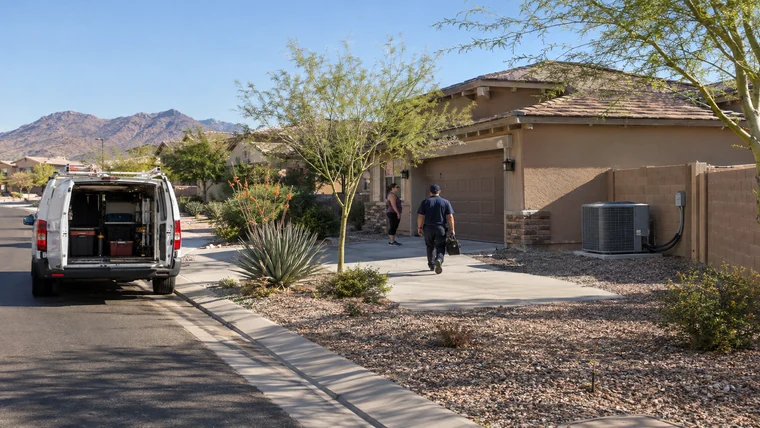
Cadence sits on the southeast edge of Mesa, and by Valley standards every house in it is new — the community has been delivering homes from 2016 onward and is still building. That one fact shapes almost every call we take there. Nobody in Cadence is nursing a 1998 R-22 package unit through one more summer the way owners of older Phoenix housing stock are. What Cadence homeowners are living through instead is the first-failure wave: original builder-installed equipment, seven to ten cooling seasons in, starting to shed capacitors, contactors and condenser fan motors. Those are repairs, not replacements, and the gap between those two conversations is several thousand dollars. It matters more here than in older neighborhoods because equipment installed between 2016 and 2020 may still sit inside a manufacturer parts warranty — if registration was completed at install, and if the install date can be proven. Below is what a visit costs, what replacement costs when it genuinely is time, what to verify before approving a large repair, and which rebates a typically SRP-served Cadence address can still claim in 2026.
- Cadence homes date from 2016 onward, so the calls we take there are first-failure repairs, not the end-of-life replacements typical of older Phoenix housing stock.
- Equipment of this vintage is R-410A, which remains legal to own and service — a far better position than a 1990s Valley home on R-22.
- Registered manufacturer parts warranties typically run ten years, base warranties five, and registration usually had to happen within 60 to 90 days of install.
- The parts clock runs from installation, not your close of escrow, and registered coverage often does not transfer in full to a second owner.
- A diagnostic visit is $69.95 weekdays 8am to 6pm and $99.95 outside those hours, credited toward the repair, at one flat rate with no trip fee.
- Installed replacement runs $5,000 to $7,000 for three tons, $6,000 to $8,000 for four and $7,000 to $10,000 for five, heat pumps at no premium.
- SRP Cool Cash pays $75, $150 or $225 per ton by compressor type on SEER2 15.2+ equipment, filed within six months, for installs through 30 April 2027.
- The federal 25C credit is repealed for anything placed in service in 2026, and APS has not published an active residential AC or heat pump rebate program for 2026 installs.
What does a service call cost in Cadence, and how does scheduling work?
The $69.95 buys a diagnosis, not a sales visit, and it comes off the bill if you have us do the work. The same fee applies if you already have a diagnosis from someone else and want it checked — that is our second opinion, and the written report is yours to keep whether or not you hire us. If what you are holding is a replacement quote rather than a repair diagnosis, the quote review is free, needs no site visit, and can be sent back to you however suits you.
On scheduling, we will tell you what is true rather than what sounds good. Our phone is answered by a person 24 hours a day, seven days a week, and we dispatch overnight when a call genuinely warrants it — an infant in the house, a medical need, a system fully down in July. Most non-emergency calls get an arrival inside 12 to 24 hours. We do not publish a same-day guarantee, because in a Phoenix summer that is a promise a great many companies make in the morning and break by late afternoon. If your house is still holding temperature and the failure is partial, waiting until the 8am rate resumes is usually the cheaper decision, and we will say so on the phone.
Homeowners in this corridor on SRP's Manage Demand 5–10 p.m. plan have a diagnostic tool most people never think to use. SRP's own advice is to precool three hours before on-peak by setting the thermostat about three degrees below your comfort point, then letting it drift up during peak. A system that used to hold that drift and now cannot is telling you something months before it fails outright — that is often the right moment for a tune-up or our $25 per month per unit maintenance plan rather than an emergency call.
What does AC replacement cost for typical Cadence homes?
Sizing is where a replacement quote in a 2016-or-newer home should be judged. The Valley design condition is roughly 115 degrees, and ACCA Manual J is the calculation that turns your actual house — orientation, glazing, insulation, infiltration — into a load. SRP treats that as non-negotiable on single-stage equipment: its Cool Cash application requires a Manual J for single-stage systems and asks the contractor to certify that the installed capacity is within 15 percent or half a ton of the estimate. A contractor who sizes off the old data plate is copying whatever the builder's subcontractor chose in 2017, which is not the same thing as a calculation.
The second thing that has changed under Cadence homeowners is refrigerant. Systems installed in this community are R-410A, and that is a materially better position than a 1990s Valley house on R-22: R-410A equipment remains fully legal to own and to service. New equipment is different. Manufacturing of R-410A residential systems ended 1 January 2025 under the EPA's AIM Act rules, and new systems now arrive charged with A2L refrigerants, principally R-454B or R-32, with different components and handling requirements. EPA published a final rule effective 27 July 2026 permitting installation of pre-2025 R-410A units until that inventory is depleted, so both can legitimately appear on a quote in 2026 — ask which you are being sold, and confirm the matched pair in the AHRI Directory.
Permits differ across the Valley and this one catches people. Phoenix exempts many like-for-like outdoor swaps under five tons; Mesa Development Services requires a mechanical permit for equipment change-outs, applied for through the city's portal. We pull permits when the work requires them. Equipment placement and screening are governed by your CC&Rs rather than by the city, and those vary by parcel and builder within a master-planned community — we do not have a blanket rule to quote you, so check your own documents before relocating a condenser. Our labour warranty is two years on new equipment and one year on repairs.
What pushes a job above the typical range
These are the conditions that can push a job above the ranges above. We tell you before the work starts, not after — and they are worth checking on any contractor's quote, not just ours.
- Crane access on rooftop package units
- The existing line set cannot be reused with the new equipment
- Electrical panel lacks capacity or needs breaker work
- Ductwork is undersized, leaking, or hard to reach in the attic
- Code upgrades on an older home - grandfathering ends when equipment is replaced
- Refrigerant contamination, or an R-22 system needing conversion
Installed system price in Cadence — and where the SRP Cool Cash threshold falls
AZ Trusted Air published ranges, same across the Phoenix metro. The split marks SEER2 15.2, the efficiency level SRP's Cool Cash rebate requires.
SRP Cool Cash pays $75 per ton on single-stage, $150 per ton on multi-stage and $225 per ton on variable-capacity equipment rated SEER2 15.2 or higher, up to $1,125 on a five-ton variable-capacity system. Confirm current program terms with SRP before relying on a figure.
| Item | Range |
|---|---|
| 3-ton system | $5,000 – $7,000 |
| 4-ton system | $6,000 – $8,000 |
| 5-ton system | $7,000 – $10,000 |
What should Cadence homeowners check before approving a major AC repair?
Here is the mechanism, because almost nobody explains it. Most major residential manufacturers ship two warranty tiers on the identical machine. The base tier is automatic and typically runs five years on parts. The longer tier — usually ten years on parts, sometimes twelve on the compressor — exists only if the serial number was registered inside the manufacturer's window, commonly 60 days from installation and 90 days for some brands. Neither tier covers labour. Miss the window and the coverage cannot generally be added later.
That window matters disproportionately in a community built from 2016 onward. Equipment here was installed by the builder's HVAC subcontractor, often months before anyone moved in, and the registration — when it happened at all — was done in the builder's paperwork rather than yours. Homeowners who bought a Cadence house second-hand consistently discover the same thing: the parts clock runs from the original installation date, not from their close of escrow, and registered coverage frequently does not transfer to a subsequent owner in full. Unlike an older Valley home where the warranty question is long settled, in this build era it is live money and worth five minutes with a warranty lookup before you approve a part.
Then check the diagnosis itself. Our published repair prices are capacitor $50–$200, contactor $100–$200, condenser fan motor $600–$1,200, blower motor $750–$1,800, compressor $800–$4,000. Two line items deserve particular attention on any quote: coil cleaning is $150 and coil replacement is $2,200–$2,600, and a quote that just says "coil" should be clarified before signing. What our technicians find on southeast Mesa condensers after monsoon season is often a coil packed with dust that reads as low capacity and gets written up as a failing compressor. If a replacement is being recommended on equipment this young, use the repair-or-replace consultation or the age checker before you sign anything.
Step one: photograph the data plate on the outdoor unit and record the model and serial number. Step two: look up the serial on the manufacturer's warranty lookup page, which will show whether the unit carries registered coverage (commonly ten years on parts) or base coverage (commonly five). Step three: find your original purchase paperwork or builder closing documents, because the parts clock runs from the installation date — which in a 2016-to-2020 Cadence home usually predates your move-in. Step four: give that information to whoever is quoting the repair, and ask for the price split into parts and labour. Manufacturer warranties cover parts, not labour, so knowing the split tells you what you are genuinely being asked to pay.
Which rebates can Cadence residents claim on a replacement, and who handles the paperwork?
Run the arithmetic before you choose equipment, because it changes what the sensible purchase is. At $225 per ton, a five-ton variable-capacity system earns $1,125 — enough that stepping up within our published range can net out close to, or below, staying at the bottom of it. The federal minimum for new equipment installed in this region has been SEER2 14.3 since January 2023, so 15.2 is a genuine step above the legal floor rather than a marketing tier. Verify the rating in the AHRI Directory, not in a brochure.
The conditions are where rebates are lost. The equipment must be AHRI-listed at SEER2 15.2 or higher and installed by an Arizona-licensed contractor; on a split system both the outdoor unit and the indoor unit must be replaced, so a condenser-only swap does not qualify; a Manual J must accompany single-stage applications; the applicant must be a permanent SRP residential customer; and the application must be filed within six months of installation, with the current program accepting qualifying installs through 30 April 2027. We file it. That is the whole point of our rebate concierge — the six-month clock is the single most common reason Valley homeowners forfeit money they had already earned.
Two honest caveats. First, utility territory is assigned by address, not by community boundary; Cadence is typically SRP, but your bill is the authority and it names your provider, so confirm before anyone quotes you a rebate. Second, SRP also publishes a duct test and repair rebate covering 75 percent of qualifying costs up to $400 for a single-family detached home, but that program requires a BPI-certified contractor — ask any company, including ours, to show you certification before you count on it. Meanwhile, the federal 25C credit was terminated for property placed in service after 31 December 2025 under the One Big Beautiful Bill Act, and APS has not published an active residential AC or heat pump rebate program for 2026 installs. If a contractor quotes you either one for a 2026 install, ask to see it in writing.
Sources and further reading
The figures and requirements on this page draw on the following public sources. We link them so you can check anything here yourself.
- SRP — Cool Cash rebate amounts, the SEER2 15.2 threshold, Manual J requirement and price plan peak windows
- SRP Duct Test and Repair Rebate — 75 percent of qualifying repair costs up to $400 and BPI-certified contractor requirements
- U.S. Environmental Protection Agency — refrigerant handling rules, the R-410A phase-down and the A2L transition to R-454B and R-32
- Arizona Registrar of Contractors — verify any contractor's licence and complaint history, including ours — ROC 317368
- AHRI Directory — confirm the quoted indoor and outdoor units are a certified matched system at the rated SEER2
- ACCA (Air Conditioning Contractors of America) — Manual J load calculation, which SRP requires with single-stage rebate applications
- City of Phoenix Planning & Development — for comparison — Phoenix permit exemptions differ from Mesa's mechanical permit requirements
Send it any way that suits you — photo, email, whatever is easiest. No obligation and no site visit. One flat rate across the Phoenix metro and surrounding communities, at any distance, with no travel fee or zone pricing.