Who provides AC repair and replacement in Queen Creek?
The short answer: AZ Trusted Air — Arizona ROC 317368 — repairs and replaces residential air conditioning across Queen Creek and the southeast Valley at one flat rate, with no trip charge at any distance. We answer the phone live 24 hours a day, charge $69.95 for a weekday diagnostic, and publish installed replacement prices from $5,000 to $10,000 rather than quoting them at your kitchen table.
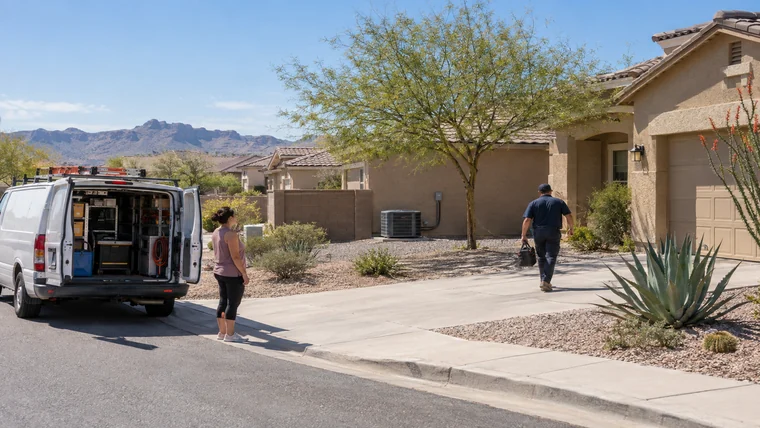
Queen Creek is a young town with an ageing fleet of air conditioners, and those two facts are more connected than they look. The houses here were largely built from the early 2000s onward, which means the equipment the builder hung on them is now somewhere between fifteen and twenty-two years old — the exact window in which a Valley system stops being repairable and starts being a budgeting problem. In an older central Phoenix neighborhood, failures arrive scattered across five decades of equipment. Here they arrive in clusters, subdivision by subdivision, in the same handful of July weeks. Add roughly 8% population growth and a contractor density that has not kept up with the rooftops, and a Queen Creek homeowner facing a dead compressor has fewer honest options within reach than a Tempe homeowner does. This page is what we would tell you at your kitchen table: the fees, the installed ranges, what to check before you approve a big repair, and which rebate still exists in 2026.
- Queen Creek's housing stock dates from the 2000s onward, so its original builder-installed equipment is now reaching the end of a Valley service life all at once, subdivision by subdivision.
- Diagnostics are $69.95 weekdays 8am–6pm and $99.95 outside those hours, credited toward the repair, with no trip charge or zone pricing at any Queen Creek address.
- Installed replacement runs $5,000–$7,000 for three tons, $6,000–$8,000 for four and $7,000–$10,000 for five; heat pumps carry no premium.
- SRP Cool Cash pays $75 per ton single-stage, $150 multi-stage and $225 variable-capacity on AHRI-listed SEER2 15.2+ equipment, up to $1,125, filed within six months of install.
- On a split system both the condenser and the air handler must be replaced for Cool Cash; a condenser-only swap does not qualify.
- APS ended residential AC rebates on January 1, 2026, and the federal 25C credit is repealed for anything placed in service after December 31, 2025.
- Coil cleaning ($150) and coil replacement ($2,200–$2,600) are different jobs; a quote saying only "coil" should be clarified before signing.
- Queen Creek permits go through the Town's Building Safety Division under the 2021 International codes adopted January 1, 2023 — the City of Phoenix swap exemption does not apply here.
What does a service call cost in Queen Creek, and how does scheduling work?
The flat rate matters more out here than it does closer in. Queen Creek sits far enough from the metro core that a good number of companies quote it with a distance surcharge, a minimum-job size, or a quiet refusal to come at all after 6pm. We do not price by map. The $69.95 weekday diagnostic and the $99.95 after-hours diagnostic are the same numbers we publish everywhere, and both are credited against the repair if you go ahead with it.
We will not publish a same-day guarantee, because in a Queen Creek August that is a promise made in the call centre and broken in the driveway. What is true: the phone is answered by a person round the clock, we dispatch overnight when a call genuinely warrants it — no cooling in a house with an infant or someone elderly in it does — and most non-emergency calls land inside 12 to 24 hours. Emergency calls are triaged, not queued by postcode.
Two things cost less than a service call. A quote review is free and needs no site visit: send us the estimate however suits you and we will tell you what it is missing. A second opinion is the same $69.95 or $99.95, credited, and the written report is yours whether or not you ever use us. Maintenance runs $25 per month per unit, and labour warranty is two years on new equipment, one year on repairs.
What does AC replacement cost for typical Queen Creek homes?
Where you land inside a range is mostly efficiency, plus whatever the installer finds. The lower half of each range is standard-efficiency equipment; the upper half clears SEER2 15.2, which is the threshold SRP's Cool Cash rebate requires. Because that rebate is paid per ton, the step up is frequently cheaper on net than staying at the bottom of the range — that is the single most useful sentence on this page for a Queen Creek homeowner, and almost nobody will say it out loud before the paperwork comes out.
Sizing deserves a harder look here than in older housing. Queen Creek homes were built to a production spec, and equipment chosen off a builder's schedule is not the same thing as equipment chosen off a load calculation for your elevation, your glazing and your orientation. ACCA Manual J against a Phoenix-area design temperature near 115°F is the correct basis, and SRP requires a Manual J on single-stage systems for rebate eligibility — which conveniently means a properly filed rebate is also evidence that somebody did the arithmetic.
Queen Creek is its own permitting jurisdiction. The City of Phoenix exemption for like-for-like outdoor swaps under five tons does not govern an address here; the Town's Building Safety Division works under the 2021 International codes it adopted effective January 1, 2023, and we pull permits when the work requires one. On equipment, expect A2L: new residential split systems now ship with R-454B (GWP 466) or R-32 rather than R-410A (GWP 2,088), following EPA's Technology Transitions rule.
What pushes a job above the typical range
These are the conditions that can push a job above the ranges above. We tell you before the work starts, not after — and they are worth checking on any contractor's quote, not just ours.
- Crane access on rooftop package units
- The existing line set cannot be reused with the new equipment
- Electrical panel lacks capacity or needs breaker work
- Ductwork is undersized, leaking, or hard to reach in the attic
- Code upgrades on an older home - grandfathering ends when equipment is replaced
- Refrigerant contamination, or an R-22 system needing conversion
Installed system price by tonnage — and where the SRP rebate threshold falls
AZ Trusted Air published ranges, same in Queen Creek as anywhere we serve. The split marks SEER2 15.2, the efficiency SRP Cool Cash requires.
Cool Cash pays per ton and per compressor type — $75, $150 or $225 per ton — so a five-ton variable-capacity system reaches $1,125. Confirm current amounts with SRP before relying on them.
| Item | Range |
|---|---|
| 3-ton system | $5,000 – $7,000 |
| 4-ton system | $6,000 – $8,000 |
| 5-ton system | $7,000 – $10,000 |
What should Queen Creek homeowners check before approving a major AC repair?
The warranty question is the one that moves the most money in this town. A large share of Queen Creek equipment was installed by the builder, which means the original owner — not necessarily you — held the registration paperwork, and manufacturer parts coverage terms vary by brand and by whether registration happened inside the required window. It is worth ten minutes with the model and serial number before you authorise a compressor. Our published compressor range is $800 to $4,000, and essentially the whole spread is the difference between a part that is covered and a part that is not.
Then read the noun on the quote. Coil cleaning is $150. Coil replacement is $2,200–$2,600. A quote that says only "coil" is hiding a two-thousand-dollar decision inside a single word, and that is worth a phone call before a signature. Same logic on a blower motor at $750–$1,800 or a condenser fan motor at $600–$1,200 in a house whose ductwork was never sealed.
Age is the last filter, and national lifespan tables mislead here. A system in a 2006 Queen Creek build has run an April-to-October season every year of its life, with an air handler sitting in an attic that gets past 150°F in July. Homeowners who finally open that hatch in August consistently find flex duct sagging off a boot it has not been sealed to since the builder left. Our AC age checker and repair-or-replace consultation exist for exactly that calculation.
Model and serial numbers, to establish equipment age and whether manufacturer parts coverage is still live. The electric bill, because rebate eligibility follows the utility named on it and territory is not uniform across this corridor. A Manual J load calculation against a design temperature near 115°F — required by SRP on single-stage equipment, and the only defensible basis for tonnage. The attic: duct condition, air handler access, and whether the return was ever adequate for the tonnage. Finally, the AHRI listing for the exact indoor and outdoor pairing, since the rebate is paid on the matched system, not on the condenser alone.
Which rebates can Queen Creek residents claim on a replacement, and who handles the paperwork?
The Cool Cash rules that catch people out are procedural, not technical. The equipment has to be AHRI-listed at SEER2 15.2 or higher and installed by an Arizona-licensed contractor; on a split system both the outdoor unit and the air handler must be replaced, so a condenser-only swap does not qualify; a Manual J is required for single-stage equipment; and the application is due within six months of installation. Current program terms run qualifying installs through April 30, 2027, but SRP resets amounts and dates between cycles, so we confirm the live figure against SRP before anyone signs.
APS is the part of this that changed and that stale web pages still get wrong. APS discontinued its residential AC and heat pump rebates effective January 1, 2026, after the Arizona Corporation Commission cut its efficiency budget; what survives is Cool Rewards, a smart-thermostat demand-response credit, not an equipment rebate. We are also not an APS Qualified Technology Installer and will not pretend otherwise. If a bidder deducts an APS equipment rebate from a 2026 Queen Creek quote, ask them to show you the program in writing.
The federal side is simpler: the 25C credit was terminated by Public Law 119-21 for anything placed in service after December 31, 2025, and the trigger is the in-service date, not the contract date. A 2026 install gets nothing from it. SRP also credits enrolled smart thermostats and rebates 75% of duct testing and qualified sealing up to $400 on a single-family detached home, though that one requires a BPI-certified contractor — ask any bidder to confirm their certification before you count on it. We run the filing through our rebate concierge.
Sources and further reading
The figures and requirements on this page draw on the following public sources. We link them so you can check anything here yourself.
- SRP — current Cool Cash rebate amounts, the SEER2 15.2 threshold and application deadlines
- ACCA (Air Conditioning Contractors of America) — Manual J load calculation, required by SRP on single-stage rebate applications
- AHRI Directory — confirm the quoted indoor and outdoor units are a certified matched system at the rated efficiency
- U.S. Environmental Protection Agency — Section 608 — refrigerant handling rules and the R-410A phase-down to A2L equipment
- Arizona Registrar of Contractors — licence verification and complaint history before you sign with anyone
- APS — current status of residential efficiency programs after the January 2026 changes
No site visit, no obligation, no salesperson calling to ask when they can stop by. Send it however suits you. One flat rate across Queen Creek, the southeast Valley and the Pinal corridor — call (623) 252-6403.