Who provides AC repair and replacement in Ironwood Crossing?
The short answer: AZ Trusted Air handles AC repair and replacement throughout Ironwood Crossing and the wider San Tan Valley area, licensed as Arizona ROC 317368. A person answers our phone 24 hours a day, seven days a week, and we charge one flat rate across the Phoenix metro and the Pinal corridor. Diagnostics are $69.95 on weekdays, and typical non-emergency arrival is 12 to 24 hours.
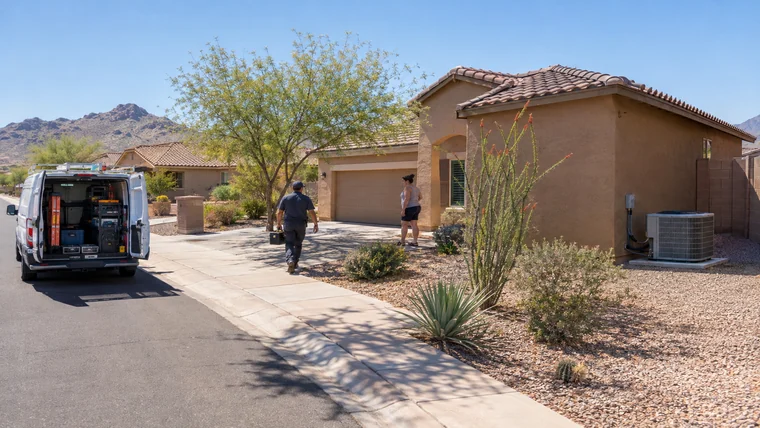
Ironwood Crossing sits in San Tan Valley, in the southeast Pinal corridor, and it is a young community by Phoenix-metro standards — the earliest phases went in around 2010 and building carried on from there. That single fact shapes almost every air conditioning conversation we have out here. Nobody in Ironwood Crossing is nursing a 1990s R-22 machine along. What homeowners have instead is the original builder-installed system, now somewhere between ten and sixteen years old, working through its second decade of April-to-October cooling seasons. That is the early prime replacement window: too new to be obviously finished, old enough that a $1,200 repair becomes a real decision rather than an automatic yes. We are AZ Trusted Air, Arizona ROC 317368, and we work this corridor at the same flat rate as central Phoenix — no travel fee, no trip charge, no zone pricing at any distance. Below is what a service call costs here, what replacement actually runs, what to check before approving a big repair, and which rebates are genuinely still alive in 2026.
- Ironwood Crossing was built from 2010 onward, so original systems here are now 10 to 16 years old — the early prime replacement window, not end of life.
- Diagnostics are $69.95 weekdays 8am–6pm and $99.95 outside those hours, credited toward the repair, with no travel fee or zone pricing to San Tan Valley.
- Installed ranges are $5,000–$7,000 for three tons, $6,000–$8,000 for four and $7,000–$10,000 for five; heat pumps carry no premium and the $400–$600 crane charge rarely applies to split systems.
- SRP Cool Cash pays about $75 per ton single-stage, $150 multi-stage and $225 variable-capacity on AHRI-listed SEER2 15.2+ equipment — up to roughly $1,125 on a five-ton variable system.
- On a split system both the condenser and air handler must be replaced, the application is due within six months, and Manual J documentation is required for single-stage equipment.
- APS ended residential AC rebates on January 1, 2026, and the federal 25C credit reaches only equipment placed in service by December 31, 2025.
- Pinal County exempts like-for-like replacement of HVAC equipment of the same type and rating in the same location; which authority reviews your address is worth confirming.
- Check date of manufacture and parts-warranty registration before approving a compressor at $800–$4,000, and never let a quote say only “coil”: cleaning is $150, replacement is $2,200–$2,600.
What does a service call cost in Ironwood Crossing, and how does scheduling work?
The scheduling side matters more out here than the fee does. We answer the phone with a person 24 hours a day, seven days a week — not a machine that takes a message until Monday — and we dispatch overnight when a call genuinely warrants it: no cooling at all, a burning smell, an infant or an elderly resident in the house in July. Most non-emergency calls in San Tan Valley we handle within 12 to 24 hours. We will not publish a same-day guarantee, because in a Phoenix-metro July that is a promise plenty of companies make and few keep once the board fills up by nine in the morning.
Unlike the zone-pricing model homeowners in the Pinal corridor keep running into — where a company based up near the 60 adds a surcharge for coming south — the $69.95 is the whole visit charge, and it comes off the repair if you have us do the work. A second opinion is priced and credited the same way, and the written report is yours whether you hire us or not. A quote review costs nothing at all: text, email or photograph somebody else's estimate and we will tell you what we make of it without anyone driving out.
What we hear from Ironwood Crossing in July is rarely a dead system. It is a system that still starts and still blows cold for the first hour of the afternoon, then gives up around four o'clock when the attic is at its hottest. Homeowners who bought here new and have never replaced anything consistently read that as a thermostat problem. In a 2010-to-2015 builder system it is more often a condenser fan motor drawing high amps, a capacitor at the end of its service life, or a condenser coil packed with the fine dust a monsoon haboob leaves behind. Coil cleaning is $150; a condenser fan motor is $600 to $1,200; a capacitor is $50 to $200.
What does AC replacement cost for typical Ironwood Crossing homes?
Tonnage is the first thing to get right, and the builder's original choice is not proof of anything. A house framed in 2012 to the energy code of its day is a different cooling load from a 1985 house of identical square footage, and at the 110-plus degree design temperatures this corridor plans around, an oversized system short-cycles and leaves humidity and hot rooms behind during monsoon week. We size from an ACCA Manual J calculation. That is not a formality either: SRP's own Cool Cash application requires the contractor to certify the load was estimated per Manual J or equivalent and that installed capacity is within 15 percent or a half ton of that estimate on single-stage equipment.
The second thing that has changed since these homes were built is refrigerant. Ironwood Crossing systems went in on R-410A, and new residential equipment now ships with lower-global-warming A2L refrigerant under the EPA's AIM Act technology transition. That has a practical consequence: the new outdoor unit is not refrigerant-compatible with your old indoor coil, so a genuine replacement is a matched system, which is also what SRP's rebate requires. Our R-454B installation page covers what changes on the install side.
What pushes an Ironwood Crossing job toward the top of its range is usually visible before we start: a line set that cannot be reused, a breaker or disconnect that needs resizing for the new equipment, an efficiency step up to clear SEER2 15.2 for the rebate, or attic duct that has spent fifteen summers at 150 to 170 degrees and no longer seals at the boots. Duct replacement is $1,000 to $3,000; targeted duct sealing is often the better money on a house this age.
What pushes a job above the typical range
These are the conditions that can push a job above the ranges above. We tell you before the work starts, not after — and they are worth checking on any contractor's quote, not just ours.
- Crane access on rooftop package units
- The existing line set cannot be reused with the new equipment
- Electrical panel lacks capacity or needs breaker work
- Ductwork is undersized, leaking, or hard to reach in the attic
- Code upgrades on an older home - grandfathering ends when equipment is replaced
- Refrigerant contamination, or an R-22 system needing conversion
What should Ironwood Crossing homeowners check before approving a major AC repair?
The warranty question is where Ironwood Crossing differs from older Valley neighborhoods, and it is worth real money. At ten to sixteen years old, some of this equipment is right at the edge of its parts coverage. Manufacturers commonly write five years of base parts coverage with ten years available if the system was registered shortly after installation — terms vary by brand and the registration window differs, so read your paperwork rather than taking anyone's word. Builder-installed systems were not always registered, and coverage does not always survive a resale. That matters because a compressor is $800 to $4,000 at our published prices: the bottom of that spread is labour on a part the manufacturer supplies, and the top is an out-of-warranty replacement.
Then read what the quote actually says. “Coil” is the word that costs people the most, because coil cleaning is $150 and coil replacement is $2,200 to $2,600 — different jobs, and any estimate that does not distinguish them should be clarified before it is signed. A quote that names a measured reading, a part number and a price is a diagnosis; a quote that names a system age and a financing payment is a sales call.
Refrigerant is the third check, and unlike a mechanical part it does not get used up. If a technician is adding R-410A to a 2012 system, something is leaking, and R-410A is itself being phased down under the AIM Act with prices moving accordingly. Handling and recovery are governed by EPA Section 608. A top-off on a leaking system is a dated purchase, not a repair, which is exactly the arithmetic our repair-or-replace consultation and the AC age checker exist to settle.
Our technician photographs the outdoor unit's data plate, decodes the serial number to a date of manufacture, and looks the equipment up against the manufacturer's warranty registration record. Then the repair gets quoted two ways where it applies: labour-only if the part is covered, full part and labour if it is not. On a community built from 2010 onward, that single step is the difference between a $900 conversation and a $3,500 one — and the written findings are yours regardless of what you decide to do next.
Which rebates can Ironwood Crossing residents claim on a replacement, and who handles the paperwork?
Most of San Tan Valley sits in SRP territory, but treat that as a working assumption rather than a guarantee — service boundaries in this corridor do not follow subdivision lines, and your bill names your utility. SRP pays Cool Cash by the ton and by compressor type, which means the rebate grows with both system size and system quality: roughly $75 per ton for single-stage, $150 per ton for multi-stage and $225 per ton for variable-capacity equipment, putting a five-ton variable-speed install near $1,125.
The conditions are where rebates get lost. Equipment must be AHRI-listed at SEER2 15.2 or better and installed by an Arizona-licensed contractor. On a split system — nearly everything in Ironwood Crossing — both the condenser and the indoor air handler have to be replaced; a condenser-only swap does not qualify. The application is due within six months of installation, and program cycles carry an install-by date that SRP resets periodically, so confirm the current deadline instead of trusting a printout. We file it for you, and our rebate concierge page explains what documents go with it.
Two things you may have read are no longer true. APS discontinued residential AC and heat pump rebates effective January 1, 2026; we are not an APS Qualified Technology Installer and would not promise you an APS rebate in any case. And the federal 25C credit was repealed — it reaches only equipment placed in service by December 31, 2025, so a 2026 install here gets nothing from it.
SRP Cool Cash by compressor type — what a 3-ton to 5-ton Ironwood Crossing replacement earns
SRP pays per ton, so the rebate scales with both system size and system quality. AHRI-listed SEER2 15.2+ equipment only.
Per-ton amounts are set by SRP and change between program cycles; confirm current figures and the install-by date before relying on them. Split systems must have both the condenser and air handler replaced to qualify.
| Item | Range |
|---|---|
| Single-stage — $75/ton | $225 – $375 |
| Multi-stage — $150/ton | $450 – $750 |
| Variable-capacity — $225/ton | $675 – $1,125 |
Sources and further reading
The figures and requirements on this page draw on the following public sources. We link them so you can check anything here yourself.
- SRP — Cool Cash per-ton amounts, the SEER2 15.2 threshold, Manual J certification and current install-by dates
- ACCA (Air Conditioning Contractors of America) — Manual J load calculation, the correct basis for sizing a replacement in a 110-plus degree design climate
- AHRI Directory — confirm the quoted condenser and air handler are a certified matched system at the rated efficiency
- U.S. Environmental Protection Agency — refrigerant handling rules and the R-410A phase-down affecting 2010-era equipment
- Arizona Registrar of Contractors — verify any bidder's licence and complaint history before signing
- APS — current status of residential efficiency programs after the January 2026 discontinuation
Send it however suits you — text a photo, email the PDF. No obligation and no site visit. Same flat rate across the Phoenix metro and the Pinal corridor, at any distance. Call (623) 252-6403; a person answers, 24 hours a day.