Who provides AC repair and replacement in San Tan Valley?
The short answer: AZ Trusted Air handles AC repair and replacement throughout San Tan Valley and the wider Pinal corridor, licensed under Arizona ROC 317368. Diagnostics are $69.95 on weekdays, credited toward the repair. Complete system replacement runs $5,000 to $10,000 installed depending on tonnage. Because most San Tan Valley homes were built from the 2000s onward, the calls we take here are increasingly first-time replacements of original builder equipment.
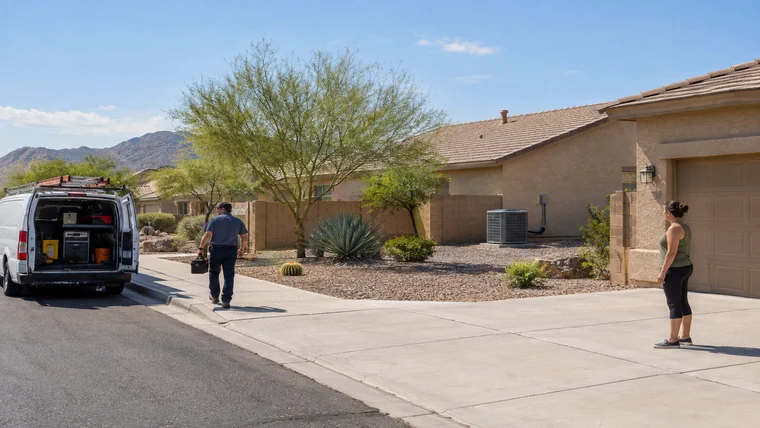
San Tan Valley is an unusually young housing stock for the Phoenix metro. Almost nothing here predates 2000, and the subdivisions that filled in through the 2000s all came with builder-specified air conditioning installed at the same time as the drywall. That equipment is now somewhere between eighteen and twenty-six years old, which is why the calls we take out here are so often first-time replacements rather than the second or third changeout you would expect in an older part of the Valley. Homeowners in these neighborhoods frequently tell us they have never replaced an air conditioner before and have no reference point for what it should cost. This page is built for that position. Below are our actual prices, the permit rule that applies in unincorporated Pinal County rather than the City of Phoenix rule you will read everywhere else, the current SRP Cool Cash rebate figures, and what we would check before approving a four-figure repair on a system of this vintage. Phone is (623) 252-6403 if you would rather just ask.
- San Tan Valley's housing stock dates from the 2000s onward, so much of the original builder equipment is now eighteen to twenty-six years old.
- Diagnostics are $69.95 weekdays 8am–6pm and $99.95 outside those hours, credited toward repair, with no trip charge across the Pinal County line.
- Replacement runs $5,000–$7,000 for three tons, $6,000–$8,000 for four and $7,000–$10,000 for five, installed; heat pumps carry no premium.
- Pinal County exempts like-for-like HVAC replacement of the same type and rating in the same location for one- and two-family dwellings.
- SRP Cool Cash pays $75 per ton single-stage, $150 multi-stage and $225 variable-capacity on AHRI-listed SEER2 15.2 equipment, up to $1,125.
- SRP requires both the condenser and the indoor unit replaced on a split system; a condenser-only swap does not qualify for the rebate.
- The federal 25C credit was repealed for property placed in service after 31 December 2025, so 2026 installs earn nothing federally.
- Coil cleaning is $150 and coil replacement is $2,200–$2,600; a quote saying only “coil” should be clarified before you sign it.
What does a service call cost in San Tan Valley, and how does scheduling work?
San Tan Valley sits in Pinal County, and that county line is where a good number of Phoenix-metro contractors quietly start adding money — a travel fee, a zone uplift, or a schedule that puts Pinal addresses at the back of the queue. Our number does not move. The diagnostic is the same $69.95 whether the truck stops in Johnson Ranch, at Trilogy at Encanterra, or thirty miles further out. Unlike a dispatch map drawn tight around Maricopa County, ours treats the Pinal corridor as ordinary working territory rather than an exception to be priced.
Scheduling here works the way it works everywhere we serve. A person answers the phone at any hour, including 2am in August, and we dispatch overnight when a call genuinely warrants it. Typical non-emergency arrival is 12 to 24 hours. We deliberately do not publish a same-day or two-hour guarantee, because in a Phoenix-metro July that is a promise the industry makes often and keeps rarely, and a homeowner who rearranged a workday around it has been treated badly.
What we hear from San Tan Valley homeowners during the July monsoon stretch is rarely that the system failed this morning. It failed three or four afternoons ago, ran weakly, and they hoped it would settle. Unlike a breakdown in a mild climate, where waiting a week is an inconvenience, waiting here compounds the failure: a condenser already struggling under a coat of monsoon dust runs hotter, and a $50 to $200 capacitor that could have been swapped on a Tuesday sometimes takes a compressor with it by Friday.
The fee is credited against any repair we perform, so on most visits it disappears into the invoice. If you already hold somebody else's estimate, the quote review is free and needs no site visit at all.
What does AC replacement cost for typical San Tan Valley homes?
| System | Installed price | What moves it within the range |
|---|---|---|
| 3-ton split system | $5,000 – $7,000 | Efficiency tier; condition of the original line set |
| 4-ton split system | $6,000 – $8,000 | Efficiency tier; electrical work if the panel needs it |
| 5-ton split system | $7,000 – $10,000 | Efficiency tier; access and attic duct condition |
| Mini-split | $1,000 – $3,000 per head | Line-set routing; common for a converted garage or casita |
Sizing is where these jobs are won or lost, and it is not a matter of matching the sticker on the old condenser. Design conditions across the Phoenix metro sit up in the 110s, and a two-story 2000s tract house with a single system and a west-facing upstairs behaves nothing like the same floor plan in a moderate climate. ACCA's Manual J is the correct basis, and SRP makes that enforceable rather than optional: its Cool Cash application requires the installing contractor to certify the load was estimated per Manual J and that installed capacity is within 15 percent or half a ton of that estimate, with airflow within 10 percent of rated and charge within 5 percent.
Permits here follow Pinal County, not the City of Phoenix, and the difference matters. Pinal County's permit-exemption bulletin lists like-for-like replacement of electrical HVAC equipment — furnace, condenser or evaporative cooler — for one- and two-family dwellings, of the same type and rating in the same location. Pinal County Building Safety covers unincorporated areas and cities that have an intergovernmental agreement with the county, so an address inside an incorporated town goes to that town's department instead. Change the equipment type, move it, or touch the electrical service and you are outside the exemption. We pull permits when the work requires one, and we will tell you plainly when it does not.
One 2026-specific item belongs on every quote you collect. New residential systems must now use lower-GWP A2L refrigerant such as R-454B, while EPA's final rule published in May 2026 allows qualifying R-410A equipment manufactured before January 2025 to keep being installed from remaining inventory. Both can legitimately appear on estimates this season. Ask which one you are being sold, because it governs future service parts — see our notes on R-454B installation.
What pushes a job above the typical range
These are the conditions that can push a job above the ranges above. We tell you before the work starts, not after — and they are worth checking on any contractor's quote, not just ours.
- Crane access on rooftop package units
- The existing line set cannot be reused with the new equipment
- Electrical panel lacks capacity or needs breaker work
- Ductwork is undersized, leaking, or hard to reach in the attic
- Code upgrades on an older home - grandfathering ends when equipment is replaced
- Refrigerant contamination, or an R-22 system needing conversion
Installed replacement cost by system size — and where the SRP rebate threshold falls
AZ Trusted Air published ranges, same price in San Tan Valley as anywhere we serve. The split marks SEER2 15.2, the efficiency level SRP's Cool Cash rebate requires.
Cool Cash pays per ton and scales with compressor type: $75 per ton single-stage, $150 multi-stage, $225 variable-capacity, up to $1,125 on a five-ton. Amounts per SRP's published program terms; confirm current figures before relying on them.
| Item | Range |
|---|---|
| 3-ton system | $5,000 – $7,000 |
| 4-ton system | $6,000 – $8,000 |
| 5-ton system | $7,000 – $10,000 |
What should San Tan Valley homeowners check before approving a major AC repair?
| Repair | Our price |
|---|---|
| Capacitor | $50 – $200 |
| Contactor | $100 – $200 |
| Condenser fan motor | $600 – $1,200 |
| Blower motor | $750 – $1,800 |
| Compressor | $800 – $4,000 |
| Coil cleaning (service) | $150 |
| Coil replacement (part) | $2,200 – $2,600 |
| Duct replacement | $1,000 – $3,000 |
Those last two rows are the ones we see blurred most often, and the gap between them is roughly two thousand dollars. A quote that says only “coil” is a quote worth a phone call before signature. The compressor spread is wide for an honest reason: a unit still inside its manufacturer parts warranty means you pay labour, while an out-of-warranty compressor on original 2000s equipment sits near the top. Parts-warranty terms and registration deadlines vary by manufacturer and by whether the original owner registered the system, so the model and serial number on the data plate are worth photographing before anyone quotes you.
Homeowners here who open the attic hatch on an August afternoon consistently discover what the temperature actually is up there — Valley attics routinely run 150 degrees and higher — and that changes how you read a repair quote. Unlike ducting in a conditioned basement, flex duct spending twenty-plus summers in that environment loses tape adhesion at the boots and sags at the supports. What we find on San Tan Valley systems of this age is that a weak-airflow complaint blamed on a failing blower is sometimes a duct problem instead, which is a different job and a different number.
Two rules protect you regardless of who does the work. Any refrigerant recovered from your system must be handled under EPA Section 608, so a technician opening a sealed system should be certified. And a replacement condenser and indoor coil should be a certified matched pair, which you can confirm yourself in the AHRI Directory using the model numbers on the estimate. If the numbers still feel wrong, the second opinion exists for exactly that, and the AC age checker will date your equipment from its serial number.
Most published Phoenix HVAC advice quotes the City of Phoenix exemption, which does not govern an unincorporated San Tan Valley address. Pinal County's exemption bulletin lists, under the heading for replacement of HVAC equipment, the repair or replacement of electrical HVAC equipment such as a furnace, condenser unit or evaporative cooler for one- and two-family dwellings with the same type and rating in the same location. The practical test is in that last clause: same type, same rating, same location. A straight changeout usually sits inside it. Converting a swamp cooler to refrigerated air, relocating the condenser to satisfy a community design guideline, or upgrading the electrical service does not, and those jobs need a mechanical or MPE permit. Pinal County Building Safety serves unincorporated areas and cities under intergovernmental agreement, so incorporated addresses apply to their own municipality.
Which rebates can San Tan Valley residents claim on a replacement, and who handles the paperwork?
| Program | Amount | Condition |
|---|---|---|
| SRP Cool Cash — single-stage | $75 per ton | AHRI-listed SEER2 15.2+, Arizona-licensed installer |
| SRP Cool Cash — multi-stage | $150 per ton | Same efficiency threshold |
| SRP Cool Cash — variable-capacity | $225 per ton | Up to $1,125 on a 5-ton system |
| SRP duct test & repair | 75%, up to $400 | Single-family detached; BPI-certified contractor required |
| SRP smart thermostat | $50 per device | Up to two devices, plus a seasonal credit for staying enrolled |
| Federal 25C credit | None | Repealed for property placed in service after 31 Dec 2025 |
Two details in that table decide more rebates than the dollar figures do. On a split system SRP requires both the outdoor condenser and the indoor air handler or coil to be replaced — a condenser-only swap, which is exactly the shortcut a tight budget invites, does not qualify. And the application is due within six months of installation, with paperwork that includes the paid invoice, the AHRI reference number and the equipment model numbers. We fill in the contractor section and file it. Confirm current amounts and program dates directly with SRP before you rely on them; utility terms are revised between program cycles.
Utility territory is the one local fact we will not state flatly for your address. San Tan Valley is typically SRP, but service boundaries in fast-growing Pinal County do not follow subdivision lines tidily, and your electric bill names your provider in the first inch of the page. It is worth checking, because it changes the answer completely: ED3's territory lies in western Pinal County around Maricopa and Stanfield, not out here, and APS customers lost equipment rebates entirely at the start of 2026. We are not an APS Qualified Technology Installer, so we will never quote you an APS equipment rebate.
On the federal side, be sceptical of anything you read that was written before mid-2025. The 25C Energy Efficient Home Improvement Credit was terminated early for property placed in service after 31 December 2025, so a 2026 installation earns no federal credit regardless of efficiency. Pages still advertising “30% up to $2,000” for a heat pump are describing a rule that no longer applies. Our rebate concierge page tracks what remains.
Sources and further reading
The figures and requirements on this page draw on the following public sources. We link them so you can check anything here yourself.
- SRP — Cool Cash rebate amounts, the SEER2 15.2 threshold and the Manual J certification on the application
- Arizona Registrar of Contractors — verify any contractor's licence and complaint history before signing, including ROC 317368
- AHRI Directory — confirm a quoted condenser and indoor coil are a certified matched system
- U.S. Environmental Protection Agency — Section 608 — refrigerant handling rules and the move from R-410A to A2L refrigerants
- ACCA (Air Conditioning Contractors of America) — Manual J load calculation, the correct basis for sizing a replacement in this climate
- APS — current residential program status if your San Tan Valley address turns out to be APS
No site visit, no obligation, no salesperson calling to book one. Send it however suits you and we will tell you what we think of the sizing, the equipment match and the price. Same flat rate across San Tan Valley and the rest of the Pinal corridor — no trip charge at any distance. (623) 252-6403.