Who provides AC repair and replacement in Goodyear?
The short answer: AZ Trusted Air handles AC repair and replacement in Goodyear and across the Phoenix metro under Arizona ROC 317368. Diagnostics are $69.95 weekdays 8am to 6pm and $99.95 outside those hours, credited toward any repair. Installed replacements run $5,000 to $10,000 by capacity. A person answers our phone around the clock, and Goodyear carries no travel fee.
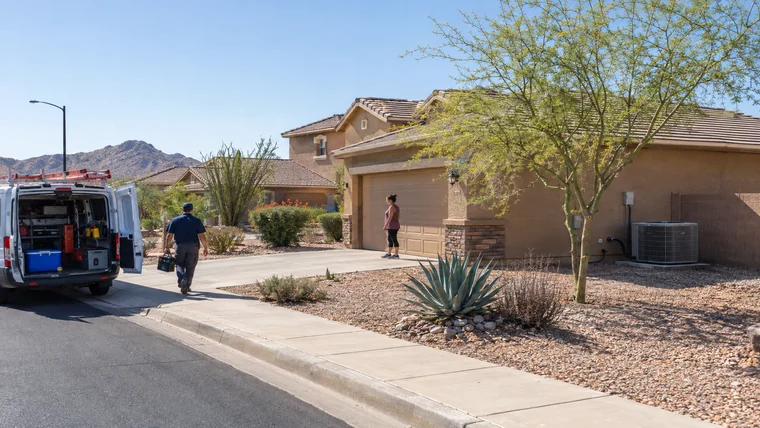
Goodyear's housing stock is younger than most of the Phoenix metro, and that fools people. A large share of the city went up during the 2000s build boom, and the equipment that came with those houses was builder-grade, sized from a schedule rather than a load calculation, and has now run eighteen to twenty-five cooling seasons in a place where cooling starts in April and does not quit until October. That is why the calls we take in Goodyear skew toward replacement rather than repair: these are not neglected systems, they are systems reaching the end of a Phoenix service life roughly on time. Below is what a service call costs here, what a replacement costs, what to check before approving a large repair, and the one rebate fact that changed for this city in 2026 — APS discontinued its residential AC rebate on January 1, and quote sheets across the West Valley have not all caught up. Prices are published. There is no travel fee at any distance.
- Goodyear's 2000s build-boom stock is in its prime replacement window: original builder equipment there has now run eighteen to twenty-five Valley cooling seasons.
- A Goodyear diagnostic is $69.95 weekdays 8am–6pm and $99.95 outside those hours, credited toward the repair, with no trip fee at any distance.
- Installed replacement runs $5,000–$7,000 at three tons, $6,000–$8,000 at four and $7,000–$10,000 at five; heat pumps carry no premium.
- APS discontinued residential AC and heat pump rebates on January 1, 2026, so most Goodyear addresses have no utility equipment rebate available.
- On an SRP-metered Goodyear address, Cool Cash pays $75 per ton single-stage, $150 multi-stage and $225 variable-capacity, up to $1,125, on SEER2 15.2+ equipment. Confirm current SRP figures before relying on them.
- Goodyear's published homeowner permit guidance exempts like-for-like contractor HVAC replacements at the same rating and location; relocation or wiring changes do not qualify.
- Coil cleaning ($150) and coil replacement ($2,200–$2,600) are separate jobs; a quote saying only “coil” should be clarified before signing.
What does a service call cost in Goodyear, and how does scheduling work?
A Goodyear call is priced the same as one in central Phoenix or Casa Grande — no trip charge, no zone pricing, no distance surcharge anywhere we work. What the $69.95 buys is a documented diagnosis: electrical readings on the capacitor and contactor, refrigerant pressures, temperature split across the coil, and the model and serial numbers that date the equipment. If the repair goes ahead, the fee comes off the invoice. A second opinion costs the same and the written report is yours either way.
On scheduling we publish only what we can keep. We dispatch overnight when a call warrants it — no cooling at all, an infant or an elderly resident in the house, water coming through a ceiling — and most non-emergency calls land inside 12 to 24 hours. We do not advertise a same-day guarantee, because in a Goodyear July nobody can keep one honestly. Unlike a failure in a moderate climate, where the house coasts for a day, homeowners in two-story tract homes here consistently tell us the upstairs becomes unusable within hours rather than days.
Two cheaper moves are worth knowing before the season. Monsoon dust loads a condenser coil faster than anything in a milder climate, and a coil cleaning is $150 against the $600 to $1,200 a failed condenser fan motor costs. Our maintenance plan is $25 per month per unit, and a quote review is free with no site visit.
What does AC replacement cost for typical Goodyear homes?
| System | Installed price | What moves it in the range |
|---|---|---|
| 3-ton | $5,000 – $7,000 | Efficiency tier; line-set and duct condition |
| 4-ton | $6,000 – $8,000 | Efficiency tier; electrical work if required |
| 5-ton | $7,000 – $10,000 | Efficiency tier; access and crane |
| Mini-split | $1,000 – $3,000 per head | Line routing and wall access |
Sizing is where Goodyear's build era shows itself. Houses from the boom were commonly given equipment chosen off a builder's schedule, and a replacement quote twenty years later tends to copy whatever is stamped on the old data plate. We calculate the load against the roughly 115-degree design temperature this end of the Valley is engineered for, using ACCA Manual J. SRP's own rebate paperwork requires installed capacity to land within 15 percent or half a ton of that calculation — a discipline worth keeping even when no rebate applies to your address.
Three things push a Goodyear job up its range. New equipment now ships with R-454B as the R-410A phase-down proceeds, so compatibility work rather than the box itself sometimes drives the price. Two-story homes from this era frequently need a return or duct correction before larger equipment does anything for the upstairs. And the City of Goodyear's published homeowner permit guidance exempts a like-for-like HVAC replacement installed by a contractor when the rating and location are unchanged — relocating the unit or altering wiring changes that, and a permit costs schedule time. We pull one when the work requires it.
What pushes a job above the typical range
These are the conditions that can push a job above the ranges above. We tell you before the work starts, not after — and they are worth checking on any contractor's quote, not just ours.
- Crane access on rooftop package units
- The existing line set cannot be reused with the new equipment
- Electrical panel lacks capacity or needs breaker work
- Ductwork is undersized, leaking, or hard to reach in the attic
- Code upgrades on an older home - grandfathering ends when equipment is replaced
- Refrigerant contamination, or an R-22 system needing conversion
Installed system price by tonnage — and where the SEER2 15.2 line falls
AZ Trusted Air published ranges, Goodyear and the Phoenix metro. The split marks SEER2 15.2, the efficiency level SRP's Cool Cash rebate requires.
Most Goodyear addresses are billed by APS, which ended residential AC rebates on January 1, 2026 — so for those homes the efficiency step has to justify itself on operating cost alone. On an SRP-metered Goodyear address, SEER2 15.2 equipment qualifies for Cool Cash at $75 to $225 per ton. Confirm current SRP figures before relying on them.
| Item | Range |
|---|---|
| 3-ton system | $5,000 – $7,000 |
| 4-ton system | $6,000 – $8,000 |
| 5-ton system | $7,000 – $10,000 |
What should Goodyear homeowners check before approving a major AC repair?
Start with the part prices, because the spread is where money goes missing. A capacitor is $50 to $200, a contactor $100 to $200, a condenser fan motor $600 to $1,200, a blower motor $750 to $1,800, and a compressor $800 to $4,000. That compressor range is not vagueness: at the bottom the part is still under manufacturer warranty and you are paying labour; at the top it is not.
Which is exactly why warranty status matters first. Builder equipment from the early 2000s is long past any ten-year parts term, while a system installed in the 2010s may still be covered if it was ever registered — a difference of thousands on the same compressor. Refrigerant is the second fork: virgin R-22 production ended in the United States on January 1, 2020, so a leak repair on an early-2000s R-22 system is money spent on a dead end. Licensing is the third — ROC status and complaint history are public at roc.az.gov, and anyone opening a refrigerant circuit must hold EPA Section 608 certification.
Homeowners who get a second set of eyes on a large number consistently find the diagnosis, not the price, was the real problem. Our second opinion is $69.95 weekdays and $99.95 otherwise, credited if we do the work, and the report is yours regardless. If you are weighing the decision itself, the AC age checker and our repair-or-replace page are better starting points than a sales visit.
Every Goodyear diagnostic ends in a written report: measured capacitor microfarads against the rated value, compressor and fan amp draw, suction and liquid pressures with the resulting superheat, temperature split across the coil, and the equipment model and serial number with its manufacture date. That last line is what tells you whether you are repairing a fifteen-year-old system or a twenty-four-year-old one.
Which rebates can Goodyear residents claim on a replacement, and who handles the paperwork?
First, confirm who bills the meter. Goodyear is typically APS territory, but APS and SRP lines interleave street by street in parts of the metro, and a rebate follows the meter rather than the city name. Your bill names your utility, and that single look decides everything below.
For APS customers the honest 2026 answer is that there is no equipment rebate. APS discontinued its residential AC and heat pump rebates effective January 1, 2026. What survives is Cool Rewards, a smart-thermostat demand-response credit, not a purchase rebate. AZ Trusted Air is not an APS Qualified Technology Installer and will not promise you APS money. The federal 25C credit is likewise unavailable for equipment placed in service in 2026.
If your Goodyear meter is SRP, Cool Cash is still funded and pays by compressor type on AHRI-listed SEER2 15.2 or better equipment: $75 per ton single-stage, $150 per ton multi-stage, and $225 per ton for variable-capacity systems and inverter mini-splits, up to $1,125 on a five-ton. On a split system both indoor and outdoor units must be replaced, single-stage claims require a Manual J calculation, and the application is due within six months of installation. SRP sets a cycle installation deadline and revises amounts between cycles, so we verify the current figure against SRP before it lands on paperwork. Our rebate concierge completes and submits the forms.
Sources and further reading
The figures and requirements on this page draw on the following public sources. We link them so you can check anything here yourself.
- SRP — Cool Cash per-ton amounts, the SEER2 15.2 requirement and the six-month filing window
- APS — current residential program status after the 2026 rebate discontinuation
- Arizona Registrar of Contractors — licence verification and complaint history before you sign anything
- ACCA (Air Conditioning Contractors of America) — Manual J load calculation, the correct basis for sizing at a 115-degree design temperature
- AHRI Directory — confirm the quoted indoor and outdoor units are a certified matched system at the rated SEER2
- U.S. Environmental Protection Agency — Section 608 — refrigerant handling certification and the R-22 and R-410A phase-downs
Send it however suits you — photo, email, whatever is easiest. No obligation and no site visit. One flat rate across the Phoenix metro and surrounding communities, at any distance, with no trip fee.