Who provides AC repair and replacement in Buckeye?
The short answer: AZ Trusted Air, Arizona ROC 317368, repairs and replaces air conditioning throughout Buckeye — Verrado, Tartesso, Festival Foothills and the older town core alike. We answer the phone with a live person 24 hours a day, charge one flat rate at any distance, and add no trip fee for a Buckeye address. Typical non-emergency arrival is 12 to 24 hours.
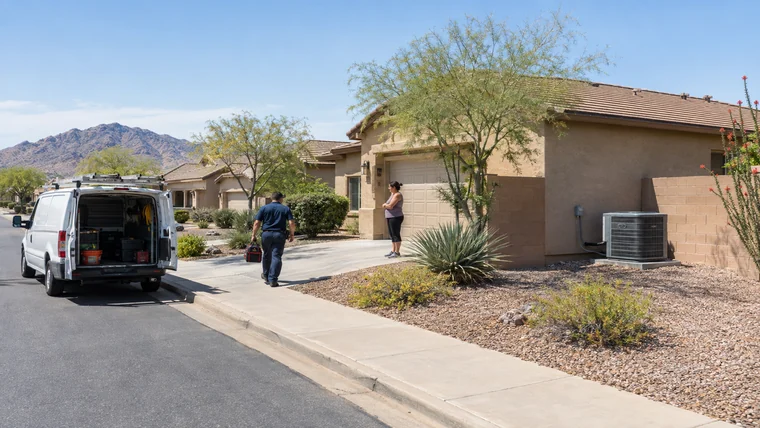
Buckeye's housing stock is younger than almost anywhere else in the Valley, and that single fact drives most of what goes wrong here. The 2020 census counted 91,502 residents, up from 6,537 in 2000, and Census Bureau estimates put the city at 125,445 by 2025 — nearly 34,000 more people in five years. Housing followed at the same pace, which means the condensers sitting beside homes in Verrado, Tartesso and Festival Foothills mostly went in between roughly 2004 and 2022, and they are aging in lockstep. A subdivision that built out over three seasons tends to need new equipment over about three seasons too. What we see on the far west side is homeowners who have genuinely never had an HVAC company out: the builder's warranty handled the first call, and nothing since. This page covers what a service call costs here, what replacement actually runs, how Buckeye's permit rules differ from the City of Phoenix's, and which rebates still exist in 2026 for an address billed by APS.
- Buckeye grew from 6,537 residents in 2000 to 91,502 at the 2020 census and an estimated 125,445 by 2025, so nearly the whole housing stock — and its AC equipment — dates from the same two decades.
- A diagnostic is $69.95 Monday to Friday 8am–6pm and $99.95 outside those hours, credited toward the repair, with no trip fee to any Buckeye address.
- Installed replacement runs $5,000–$7,000 for three tons, $6,000–$8,000 for four and $7,000–$10,000 for five; heat pumps carry no premium.
- Buckeye permits come from the City of Buckeye Permit Center at 623-349-6200, not Phoenix — the Phoenix like-for-like exemption does not apply to a Buckeye address.
- Buckeye's 2024 Construction Codes have governed applications submitted since January 1, 2025.
- Much Buckeye equipment is still inside a registered ten-year parts warranty; check the data-plate date before approving a compressor.
- Buckeye is typically APS territory, and APS residential AC and heat pump rebates are reported to have ended January 1, 2026 — confirm at aps.com.
- SRP Cool Cash pays by the ton on SEER2 15.2+ AHRI-listed equipment, and the federal 25C credit is not available for 2026 installs.
What does a service call cost in Buckeye, and how does scheduling work?
| Service | Price in Buckeye | Notes |
|---|---|---|
| Diagnostic / service call | $69.95 | Mon–Fri, 8am–6pm; credited toward the repair |
| After-hours service call | $99.95 | Evenings and weekends; also credited |
| Second opinion | $69.95 / $99.95 | Written report is yours either way |
| Quote review | Free | No site visit, no obligation |
| Maintenance plan | $25/month per unit | Per system, not per house |
| Travel or trip fee | None | Any Buckeye address, any distance |
On scheduling, we will tell you what is true rather than what sells. Someone answers the phone at every hour, including 2am in July, and that person is not a machine. When a call warrants it — no cooling with an infant or an elderly resident in the house, a burning smell, water coming through a ceiling — we dispatch overnight. Most non-emergency calls land within 12 to 24 hours. We do not publish a same-day guarantee, because in a Buckeye August that is a promise made by companies who know most callers will not measure it.
The maintenance plan is priced per unit for a reason that matters here. Plenty of Buckeye two-storey plans were built with two systems, and a homeowner quoted a flat household rate elsewhere is usually getting one of them serviced properly. What our technicians find on the agricultural fringe west of the White Tanks is condenser coils that load up faster than coils in the middle of the metro — field dust plus monsoon dust, on equipment that runs from April into October. A rinsed coil is a $150 job; the compressor that dies from years of running against a blocked one is not.
If someone has already been out and handed you a number you are not comfortable with, the second opinion costs the same $69.95 and the written report belongs to you regardless of what you decide. The quote review is free and needs no visit at all — send a photo of the estimate.
What does AC replacement cost for typical Buckeye homes?
| System | Installed in Buckeye | What moves it in the range |
|---|---|---|
| 3-ton split system | $5,000 – $7,000 | Efficiency tier, line-set and duct condition |
| 4-ton split system | $6,000 – $8,000 | Efficiency tier, electrical work if required |
| 5-ton split system | $7,000 – $10,000 | Efficiency tier, access, crane if rooftop |
| Heat pump | Same by tonnage | No premium over straight-cool |
| Mini-split | $1,000 – $3,000 per head | Line-set routing, wall access |
| Crane, rooftop units | $400 – $600 | Billed separately |
Sizing is where Buckeye quotes go wrong most often, and it goes wrong in a predictable direction. A builder's installer sized your original system once, quickly, for a plan rather than for your specific lot, orientation and glass. Replacing it by reading the old data plate copies that decision forward for another fifteen years. A proper load calculation to the ACCA Manual J method, run against the roughly 115°F design temperature this end of the Valley works to, is the only defensible basis — and it is not a formality. SRP will not process a Cool Cash rebate on a single-stage system without one.
Permitting in Buckeye is genuinely different from permitting in Phoenix, and this is the detail out-of-town contractors get wrong. The City of Phoenix exempts many like-for-like outdoor swaps under five tons. Your Buckeye address is not in Phoenix. The City of Buckeye Permit Center states that a permit is required to alter, repair, replace or improve structures inside city limits, and that applications submitted on or after January 1, 2025 fall under Buckeye's 2024 Construction Codes. If you want to check your own job, the Permit Center takes questions at 623-349-6200. We pull permits when the work requires it, and we would rather tell you what applies than quote a Phoenix rule at a Maricopa County address in the West Valley.
One more thing specific to replacing now: new residential equipment has moved to lower-global-warming refrigerants under the EPA's phase-down, so a 2026 install generally means an R-454B system rather than R-410A. That affects line-set handling and parts availability on the older half of Buckeye's stock. Published ranges for every service sit on our pricing page.
What pushes a job above the typical range
These are the conditions that can push a job above the ranges above. We tell you before the work starts, not after — and they are worth checking on any contractor's quote, not just ours.
- Crane access on rooftop package units
- The existing line set cannot be reused with the new equipment
- Electrical panel lacks capacity or needs breaker work
- Ductwork is undersized, leaking, or hard to reach in the attic
- Code upgrades on an older home - grandfathering ends when equipment is replaced
- Refrigerant contamination, or an R-22 system needing conversion
Installed replacement prices in Buckeye, by system capacity
AZ Trusted Air published ranges. The split marks SEER2 15.2 — the SRP Cool Cash threshold, which only matters if SRP bills your address.
Buckeye is typically APS territory, and APS residential AC and heat pump rebates are reported to have ended on January 1, 2026 — so for most Buckeye homes the efficiency step is a running-cost decision, not a rebate one. Confirm your utility on your bill and current SRP amounts at srpnet.com.
| Item | Range |
|---|---|
| 3-ton system | $5,000 – $7,000 |
| 4-ton system | $6,000 – $8,000 |
| 5-ton system | $7,000 – $10,000 |
What should Buckeye homeowners check before approving a major AC repair?
Start at the data plate on the outdoor unit. The serial number carries a manufacture date, and in a city where the housing stock is overwhelmingly post-2000, a great many Buckeye systems are still inside the manufacturer's parts coverage. Most major brands offer ten years on parts only if the system was registered within a short window after installation — often 60 to 90 days — and default to five otherwise. Builders registered some and not others. Our AC age checker and warranty help pages walk through how to find out, and this one check decides more Buckeye repair-or-replace conversations than efficiency ratings ever do.
Second, ask for the numbers behind the diagnosis. A capacitor is condemned by a microfarad reading compared against its nameplate rating, not by a glance. A compressor is condemned by winding resistance and amp draw. A restricted system shows in superheat and subcooling. What we find on second-opinion calls across the West Valley is that the diagnosis is usually right about which system is struggling and wrong about why — and the gap between those is often the price of a whole unit.
| Repair | Price |
|---|---|
| Capacitor | $50 – $200 |
| Contactor | $100 – $200 |
| Condenser fan motor | $600 – $1,200 |
| Blower motor | $750 – $1,800 |
| Compressor | $800 – $4,000 |
| Coil cleaning (service) | $150 |
| Coil replacement | $2,200 – $2,600 |
| Duct replacement | $1,000 – $3,000 |
Two rows there get deliberately blurred in this market. Cleaning a coil and replacing a coil are separate jobs roughly two thousand dollars apart, so a line item that says only “coil” needs clarifying before you sign. And the compressor spread is not vagueness — a warranty-covered compressor where you pay labour only sits at the bottom, an out-of-warranty one at the top. Unlike a 1998 R-22 system in an older part of the Valley, where replacement is usually the honest answer, a 2017 Buckeye system with a covered compressor is normally a repair. That decision is what the repair-or-replace consultation exists for.
First: the outdoor unit's data plate. The serial number gives you the manufacture date, and because Buckeye's housing stock is overwhelmingly post-2000, a large share of systems here are still within a manufacturer's parts warranty — usually ten years if the equipment was registered shortly after installation, five if it was not. That distinction is the difference between a labour-only compressor bill and a four-figure one.
Second: your electric bill. It names your utility, and in the West Valley that determines whether a rebate exists at all. Buckeye is typically APS territory, and APS residential equipment rebates are reported to have ended on January 1, 2026. Confirm both with the utility itself before letting a rebate line change what you agree to pay.
Which rebates can Buckeye residents claim on a replacement, and who handles the paperwork?
The honest answer for most of Buckeye is disappointing, and you should hear it before you sign rather than after. Multiple Arizona contractors report that APS discontinued its residential air conditioner and heat pump rebates effective January 1, 2026, following an Arizona Corporation Commission decision on efficiency programme budgets. We have not seen that confirmed on an APS programme page ourselves, so treat aps.com as the authority — but any 2026 quote in Buckeye carrying an “APS AC rebate” line deserves a direct question, in writing, before it changes your net price. Separately, AZ Trusted Air is not an APS Qualified Technology Installer, so we never promise an APS installer-based incentive to anyone.
Utility territory in the metro splits by neighbourhood rather than by city, and Buckeye is typically APS. Your bill names your utility, and that is the only source worth trusting. If your Buckeye address does turn out to be SRP, Cool Cash remains real money: SRP pays by the ton and by compressor type — reported at $75 per ton for single-stage, $150 for multi-stage and $225 for variable-capacity equipment — on systems rated SEER2 15.2 or better and listed in the AHRI Directory. On a split system both the indoor and outdoor units must be replaced, a Manual J is required for single-stage equipment, and the application is due within six months of installation. SRP also covers a share of duct test-and-repair work for qualifying homes.
The federal picture changed too. The 25C energy-efficient home improvement credit is not available for equipment placed in service in 2026. Anyone still showing you a $2,000 heat pump tax credit on a 2026 Buckeye quote is working from last year's sales sheet, and that is a reasonable reason to question the rest of the numbers on it.
Where a rebate does apply, we do the filing. That means completing the contractor section, attaching the AHRI reference and model numbers, supplying the Manual J where the programme requires one, and submitting it with the dated paid invoice inside the window — not handing you a form at the end of a hot day. That is what our rebate concierge is. Verify current amounts at srpnet.com before you rely on any figure, including ours; programme terms change between cycles.
Sources and further reading
The figures and requirements on this page draw on the following public sources. We link them so you can check anything here yourself.
- Arizona Registrar of Contractors — verify a Buckeye contractor's licence class, bond status and complaint history
- SRP — current Cool Cash per-ton amounts, SEER2 15.2 threshold and six-month filing window
- APS — current status of residential rebate programmes for APS-billed Buckeye addresses
- ACCA (Air Conditioning Contractors of America) — Manual J load calculation, the correct basis for sizing at a 115°F design temperature
- AHRI Directory — confirm a quoted indoor and outdoor unit are a certified matched system
- U.S. Environmental Protection Agency — Section 608 — refrigerant handling rules and the R-410A phase-down affecting older Buckeye systems
No site visit, no obligation, and nobody will call to ask when a salesperson can stop by. One flat rate across the Phoenix metro and surrounding communities, at any distance — no trip charge to Buckeye, ever. Call (623) 252-6403 and a person answers, any hour.