Who provides AC repair and replacement in Festival Foothills?
The short answer: AZ Trusted Air repairs and replaces air conditioning in Festival Foothills and throughout Buckeye, licensed as Arizona ROC 317368. A diagnostic visit is $69.95 Monday through Friday, 8am to 6pm, and $99.95 outside those hours, credited toward any repair we perform. The rate is flat across the Phoenix metro, so a Festival Foothills address carries no trip charge, travel fee or distance surcharge of any kind.
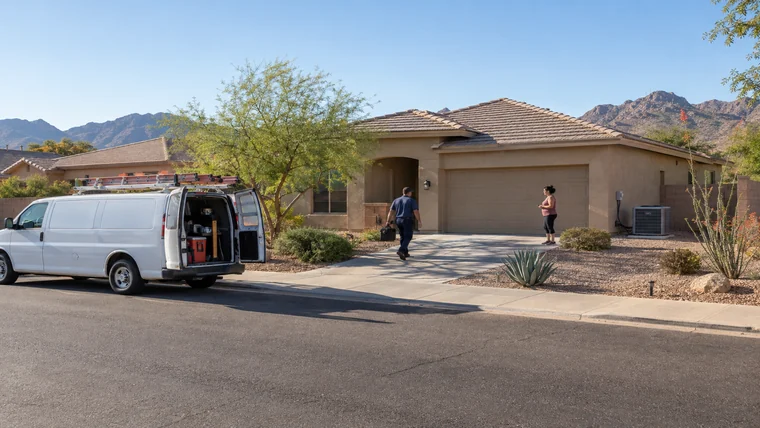
Festival Foothills sits at the west end of Buckeye, and the first homes here went up in 2006. That year matters more than it sounds. The federal minimum efficiency standard for new central air conditioners rose from 10 SEER to 13 SEER on January 23, 2006, so the original equipment in the earliest homes here was built right at that then-new floor — and it has now worked through twenty West Valley summers. Systems installed with the first phase are 17 to 20 years old. Systems from the middle build years are 12 to 16. Either way, a large share of this community is inside the window where replacement stops being a hypothetical and becomes a matter of timing. This page is what we would tell a neighbour who called us: what a visit costs, what a system costs, what to verify before approving a four-figure repair, and the blunt truth about rebates in APS territory in 2026.
- Festival Foothills homes date from 2006 onward, which puts original equipment in the earliest phase at 17 to 20 years old — squarely in the replacement window.
- A diagnostic is $69.95 Monday to Friday 8am–6pm and $99.95 outside those hours, credited toward the repair, with no trip fee to Buckeye at any distance.
- Complete replacement runs $5,000–$7,000 for three tons, $6,000–$8,000 for four and $7,000–$10,000 for five; heat pumps carry no premium.
- APS discontinued residential AC and heat pump rebates on January 1, 2026, so most Festival Foothills addresses have no utility equipment rebate to claim.
- SRP's Cool Cash still pays $75 to $225 per ton up to $1,125 where SRP bills the address, on AHRI-listed equipment at SEER2 15.2 or better.
- The federal 25C credit is not allowed for property placed in service after December 31, 2025 — a 2026 install receives nothing from it.
- New systems now use A2L refrigerant, R-454B or R-32, under EPA's 700 GWP ceiling; pre-2025 R-410A equipment may still be installed while stock lasts.
- Buckeye's code exempts like-for-like outdoor refrigeration replacements under 5 tons in the same location; indoor equipment changes require a permit.
What does a service call cost in Festival Foothills, and how does scheduling work?
The west end of Buckeye is exactly where distance-based pricing tends to appear. Unlike a company that prices off drive time from a shop near central Phoenix — and that is a genuine drive out to Festival Foothills — we charge one rate everywhere we work, from Arcadia to Casa Grande. No zone pricing, no fuel surcharge, no minimum job size because of your address. If an estimate you are holding contains a line item that exists only because of where your house sits, ask what it is before you sign.
Scheduling here is shaped by the season. From April into October the Valley cooling season runs almost continuously, and what homeowners in newer West Valley subdivisions consistently discover is that a system fails at the hottest hour of the hottest week, not in March. We answer live around the clock and dispatch overnight when a call genuinely warrants it — no cooling at all, an infant or an elderly resident in the house, a failure during an excessive-heat warning. Most non-emergency calls are handled inside 12 to 24 hours. We will not publish an hour-by-hour promise, because a July afternoon in the Valley eats schedules and a promise that breaks is worse than one never made.
Two other visits are worth knowing about. A second opinion costs the same $69.95, is credited the same way, and the written report is yours whether you hire us or not. A quote review is free, needs no site visit at all, and you can send the estimate however suits you. The first things we look for on any quote are whether it names the SEER2 rating and the AHRI reference number, and whether it says cleaning or replacement when it says coil.
What does AC replacement cost for typical Festival Foothills homes?
| System | Installed price | What moves it within the range |
|---|---|---|
| 3-ton system | $5,000 – $7,000 | Efficiency tier; condition of the existing line set and ducting |
| 4-ton system | $6,000 – $8,000 | Efficiency tier; electrical or code work if required |
| 5-ton system | $7,000 – $10,000 | Efficiency tier; access, crane on rooftop units |
| Heat pump | Same by tonnage | No premium over straight-cool |
| Mini-split | $1,000 – $3,000 | Per indoor head; line-set routing |
| Duct replacement | $1,000 – $3,000 | Scope, attic access, number of runs |
Anything new going in now is A2L equipment — R-454B or R-32. EPA's Technology Transitions rule set a 700 global warming potential ceiling for new residential systems, manufacturers stopped building R-410A residential split systems on January 1, 2025, and R-454B comes in at a GWP of 466 against R-410A's 2,088. R-410A units manufactured before that cutoff can still be installed while inventory lasts under EPA's 2026 final rule. That is a legitimate option and not a trick, but you are entitled to know which one you are being quoted, and our R-454B installation page covers what changes in the field.
Sizing deserves more attention than it usually gets in a community this young. The correct basis is an ACCA Manual J load calculation against Valley design conditions, not the tonnage stamped on whatever the builder put in. Homes here were sized as originally built; added shade, a converted garage, replaced windows or an enclosed patio all move the number. Permitted work in Buckeye follows the 2024 Construction Codes, which the city adopted effective January 1, 2025. Where a home has a rooftop package unit rather than a split system, budget the crane separately — unlike a ground-level condenser swap, that job is a lift, and the $400 to $600 belongs on the estimate in writing.
What pushes a job above the typical range
These are the conditions that can push a job above the ranges above. We tell you before the work starts, not after — and they are worth checking on any contractor's quote, not just ours.
- Crane access on rooftop package units
- The existing line set cannot be reused with the new equipment
- Electrical panel lacks capacity or needs breaker work
- Ductwork is undersized, leaking, or hard to reach in the attic
- Code upgrades on an older home - grandfathering ends when equipment is replaced
- Refrigerant contamination, or an R-22 system needing conversion
Installed system price by tonnage — and where the efficiency step falls
AZ Trusted Air published ranges, same in Festival Foothills as metro-wide. The split marks SEER2 15.2, the level SRP's Cool Cash requires.
In SRP territory the upper portion of each bar earns $75 to $225 per ton, up to $1,125. In APS territory, which covers most Festival Foothills addresses, APS ended residential equipment rebates on January 1, 2026 — so the efficiency step has to pay for itself on the power bill instead. Confirm current utility terms before relying on them.
| Item | Range |
|---|---|
| 3-ton system | $5,000 – $7,000 |
| 4-ton system | $6,000 – $8,000 |
| 5-ton system | $7,000 – $10,000 |
What should Festival Foothills homeowners check before approving a major AC repair?
Start with age, because in this community it is unusually easy to bracket. A home from the 2006 to 2009 phase running original equipment is at 17 to 20 years, and it may well hold R-22 — new residential R-22 equipment was manufactured until January 1, 2010, and production and import of the refrigerant itself ended January 1, 2020. A home from the later build years is more likely on R-410A and may still have live parts coverage, since manufacturer parts warranties commonly run ten years when the equipment was registered. Both facts are checkable from the data plate; our AC age checker walks through reading the serial number.
Then ask what was measured. A capacitor diagnosis means a microfarad reading compared against the rating printed on the part. A failing compressor means amp draw compared against the RLA on the data plate. Airflow complaints mean static pressure and a temperature split, not a guess. Our published repair prices are the yardstick: capacitor $50 to $200, contactor $100 to $200, condenser fan motor $600 to $1,200, blower motor $750 to $1,800, compressor $800 to $4,000. Coil cleaning is $150. Coil replacement is $2,200 to $2,600. Those are two different jobs separated by roughly two thousand dollars, and a quote that just says “coil” should be clarified before anyone signs it.
Finally, do the arithmetic that a moderate climate lets people avoid. Elsewhere a marginal system limps through a short season; here it runs from April into October, so a $2,400 compressor dropped into a nineteen-year-old R-22 system buys a machine with no parts support, rising refrigerant cost and an efficiency floor set in 2006. Against $5,000 to $7,000 for a complete three-ton replacement, that is a real decision rather than an obvious one, which is why the repair-or-replace consultation and the R-22 replacement page exist.
We can tell you what a visit costs, what a system costs, and what the law and the utility programs say today. We cannot tell you which utility bills your specific lot, what your community association's design guidelines say about relocating a condenser or adding a mini-split head, or what the builder installed on your particular parcel — those vary lot by lot and document by document. Any contractor who states those things before reading your bill and your CC&Rs is guessing. What we do instead: read the data plate, read the bill, read the guidelines if you have them, and put the findings in writing.
Which rebates can Festival Foothills residents claim on a replacement, and who handles the paperwork?
This is the part of a Buckeye quote most likely to be wrong. APS ended its residential AC and heat pump rebate program effective January 1, 2026, following the Arizona Corporation Commission's cut to its efficiency-program budget. If a contractor is still deducting an APS equipment rebate from your total, ask to see the current program terms in writing. APS's site continues to carry non-equipment items — a smart-thermostat demand-response credit and duct-sealing pages among them — and those amounts change, so confirm them on aps.com rather than on anyone's estimate. Utility territory is assigned by address, not by city name, and your bill names your provider.
Where SRP bills the address, Cool Cash is still live and still worth real money: $75 per ton on single-stage, $150 per ton on multi-stage and $225 per ton on variable-capacity equipment and inverter mini-splits, up to $1,125. The conditions are specific. Equipment must be listed in the AHRI Directory at SEER2 15.2 or better, which is above the 14.3 SEER2 federal minimum for the Southwest region. On a split system both halves must be replaced — a condenser-only swap does not qualify. The application is due within six months of installation, and we file it through our rebate concierge.
Two more items, stated plainly. The federal 25C Energy Efficient Home Improvement Credit is gone: the IRS confirms it is not allowed for property placed in service after December 31, 2025, so a 2026 installation gets nothing from it and any quote suggesting otherwise is out of date. Separately, Arizona's income-qualified HEAR program through Efficiency Arizona can cover a large share of a heat pump for households under 150% of area median income, but it requires a program-enrolled contractor and approval before installation — check efficiencyarizona.com directly rather than taking any contractor's word, ours included.
Sources and further reading
The figures and requirements on this page draw on the following public sources. We link them so you can check anything here yourself.
- APS — current residential program status, including the end of equipment rebates
- SRP — Cool Cash per-ton amounts, the SEER2 15.2 threshold and application deadlines
- Arizona Registrar of Contractors — licence verification, complaint history and homeowner rights
- AHRI Directory — confirm the quoted indoor and outdoor units are a certified matched system at the rated SEER2
- ACCA (Air Conditioning Contractors of America) — Manual J load calculation, the correct basis for sizing a replacement
- U.S. Environmental Protection Agency — Section 608 — refrigerant handling rules and the R-410A phase-down to A2L equipment
No site visit, no obligation. Send it however suits you — text a photo or email it. One flat rate across the Phoenix metro and surrounding communities, with no trip fee to Buckeye at any distance. Call (623) 252-6403 any hour; a person answers.