Who provides AC repair and replacement in Moon Valley?
The short answer: AZ Trusted Air handles AC repair and replacement in Moon Valley and the rest of north Phoenix under Arizona ROC 317368. Weekday diagnostics are $69.95, credited toward the repair, and there is no trip charge at any distance. Most Moon Valley houses date from the 1960s through the 1980s, so the system we are looking at is usually the second or third one on the property, not the original.
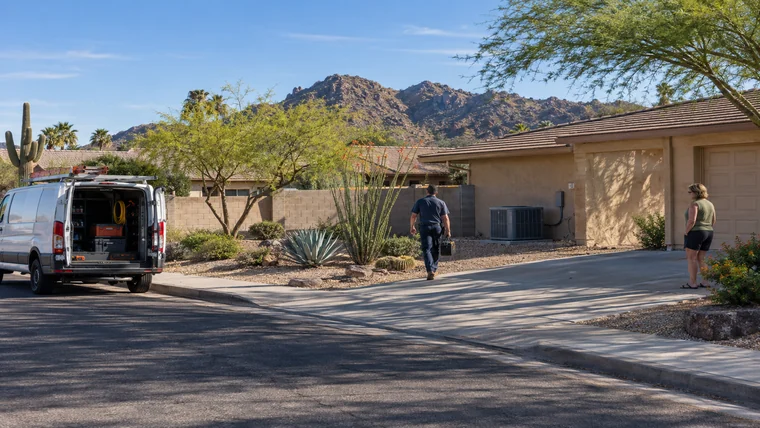
Moon Valley sits in north Phoenix, and most of its houses went up between the 1960s and the 1980s. That one fact shapes nearly every air conditioning conversation we have here. A house of that age is not on its first system and often not on its second — the equipment running today was chosen by some earlier contractor, for some earlier owner, and in most cases sized from whatever was already sitting on the pad. Meanwhile the house itself has changed: windows replaced, attic insulation added, a patio enclosed, a garage converted. The cooling load and the equipment drift apart, and nobody measures the gap until something fails.
The climate is not getting gentler either. Phoenix summers routinely push well past 100 degrees for the better part of three months, with temperatures at 110 or above now occurring more frequently than historical averages, and overnight lows that no longer drop enough to give equipment meaningful recovery time. What follows is what we charge in Moon Valley, how scheduling genuinely works in July, what to check before approving a large repair, and what changed about rebates for APS-territory homes this year.
- Moon Valley homes built in the 1960s through 1980s are generally on their second or third system, so the installed tonnage is an inherited decision rather than a measured one.
- AZ Trusted Air charges $69.95 for a weekday diagnostic in Moon Valley and $99.95 outside 8am–6pm weekdays, credited toward the repair, with no trip or zone fee at any distance.
- Installed replacement runs $5,000–$7,000 for three tons, $6,000–$8,000 for four and $7,000–$10,000 for five; heat pumps carry no premium and a rooftop crane is $400–$600.
- SRP's Cool Cash application requires installed capacity within 15 percent or a half ton of a Manual J estimate for single-stage equipment.
- APS discontinued residential AC and heat pump rebates effective January 1, 2026; SRP Cool Cash remains, reported at $75, $150 or $225 per ton by compressor type on SEER2 15.2 equipment.
- The federal 25C credit is repealed for systems placed in service in 2026 — a quote showing it is out of date.
- Coil cleaning ($150) and coil replacement ($2,200–$2,600) are different jobs; a quote that says only "coil" needs clarifying.
- City of Phoenix exempts like-for-like outdoor replacements not over five tons at one- and two-family dwellings; moving the unit or changing its footprint can trigger a permit.
What does a service call cost in Moon Valley, and how does scheduling work?
The fee structure is short enough to state in full. Diagnostic or service call: $69.95 weekdays 8am to 6pm, $99.95 outside those hours, credited against the repair if you approve one. A second opinion is priced and credited the same way, and the written report is yours whether you hire us or not. A quote review is free, needs no site visit, and can be sent to us however suits you. Our maintenance plan is $25 a month per unit. There is no trip charge, zone price or distance surcharge anywhere we work, from Moon Valley out to the Pinal corridor.
Scheduling in a Phoenix summer is a triage problem rather than a calendar problem. A house sitting at 95 degrees inside with an infant or someone on oxygen is not the same call as a bedroom running three degrees warm, and we sort them that way. We do not publish a same-day guarantee: in a season like 2024, when the Valley ran 113 straight days over 100 degrees and 39 nights failed to drop below 90, no honest contractor here can keep one.
Two details about this housing stock make the phone call faster. Unlike a 2015 subdivision where every home carries the same builder-spec equipment on a clean data plate, homes re-equipped over four decades vary house by house on the same street — so tell us whether the unit sits on the ground beside the house or on the roof, and whether there is a furnace in a hall closet or garage. Homeowners who dig through the closing packet from their purchase frequently find the previous owner's install invoice, which names the tonnage, the refrigerant and the warranty registration date before anyone drives out. If you cannot find it, our AC age checker reads the date out of the serial number.
What does AC replacement cost for typical Moon Valley homes?
The tonnage currently on the pad is evidence, not a specification. On a house from this era the equipment has usually been replaced once or twice by matching whatever was there, which quietly carries a 1970s sizing decision forward through fifty years of window, insulation and floorplan changes. A Manual J load calculation, the method ACCA publishes, is the only defensible basis. SRP takes it seriously enough that its own Cool Cash paperwork requires the installed capacity to fall within 15 percent or a half ton of the Manual J estimate for single-stage equipment, and requires the calculation be submitted with the application.
| System | Installed | What moves it in the range |
|---|---|---|
| 3-ton | $5,000 – $7,000 | Efficiency tier; duct and line-set condition |
| 4-ton | $6,000 – $8,000 | Efficiency tier; electrical work if required |
| 5-ton | $7,000 – $10,000 | Efficiency tier; roof access and crane |
| Heat pump | Same by tonnage | No premium over straight cool |
| Mini-split | $1,000 – $3,000 | Per indoor head; line routing |
| Duct replacement | $1,000 – $3,000 | Attic access and run count |
Two era-specific things show up in Moon Valley quotes. First, the duct system is frequently the oldest surviving part of the HVAC — new equipment, original distribution — and in homes of this vintage across north Phoenix we still find capped roof jacks and framed openings left from evaporative coolers that were replaced by refrigerated air decades ago. Second, equipment made for the US residential market no longer ships with R-410A; manufacturers moved to R-454B and R-32 after the AIM Act technology-transitions cutoff on January 1, 2025, and A2L equipment has carried a cost premium over the R-410A models it replaced.
On permits, City of Phoenix Planning & Development exempts repair or replacement in kind of outdoor refrigeration units not over five tons at one- and two-family dwellings. The city's counter guideline for AC replacement asks whether the unit is going in a different location and whether the footprint matches; a yes to the wrong question means a permit, and the same document notes that a change in refrigerant type can bring different code requirements. We pull permits when the work requires one. See also rooftop package unit replacement and swamp cooler conversion.
What pushes a job above the typical range
These are the conditions that can push a job above the ranges above. We tell you before the work starts, not after — and they are worth checking on any contractor's quote, not just ours.
- Crane access on rooftop package units
- The existing line set cannot be reused with the new equipment
- Electrical panel lacks capacity or needs breaker work
- Ductwork is undersized, leaking, or hard to reach in the attic
- Code upgrades on an older home - grandfathering ends when equipment is replaced
- Refrigerant contamination, or an R-22 system needing conversion
Installed system price by tonnage — and where the SEER2 15.2 line falls
AZ Trusted Air published ranges, Phoenix metro. The split marks SEER2 15.2, the efficiency level SRP's Cool Cash rebate requires of SRP-served addresses.
Moon Valley is typically APS territory, and APS discontinued residential equipment rebates on January 1, 2026 — so for most homes here the efficiency step is judged on running cost, not on a rebate. Check your bill: SRP-served addresses can still claim Cool Cash.
| Item | Range |
|---|---|
| 3-ton system | $5,000 – $7,000 |
| 4-ton system | $6,000 – $8,000 |
| 5-ton system | $7,000 – $10,000 |
What should Moon Valley homeowners check before approving a major AC repair?
Start with the readings. A capacitor condemned on sight is different from one measured at, say, 28 microfarads against a 45 rating; a compressor called dead should come with an amp draw compared against the rated load amps on the data plate. Our published repair prices exist so you can sanity-check the number in front of you: capacitor $50 to $200, contactor $100 to $200, condenser fan motor $600 to $1,200, blower motor $750 to $1,800, compressor $800 to $4,000. That compressor span is not vagueness — a warranty-covered compressor where you pay labour only sits at the bottom and an out-of-warranty one sits at the top.
Warranty status is where Moon Valley's perpetual replacement cycle pays off. A house on its third system often has equipment installed within the last ten to fifteen years, and ten-year parts warranties from that period are routinely still live even when the original owner has moved on. Bring the model and serial numbers and ask the contractor to check registration before pricing a compressor or coil. Unlike a first-owner home with one paper file, these houses hand their records over at closing and then lose them, so the warranty is often there and simply unclaimed. Our warranty help page walks through the lookup.
Then the refrigerant. If the system still holds R-22, the economics changed long ago and are worth reading about on our R-22 replacement page. If it holds R-410A, note that the AIM Act phase-down caps production each year; the equipment stays legal to run and service, but service refrigerant has been getting steadily more expensive as allowances tighten. That matters most on a system that has needed refrigerant twice. Finally, verify the contractor's licence and complaint history at the Arizona Registrar of Contractors before you sign anything, and use our repair-or-replace consultation if the repair is more than about a third of a replacement.
On a 1960s–1980s house the tonnage was inherited, the ducts often predate the equipment by decades, and the manufacturer parts warranty on a ten- to fifteen-year-old changeout is frequently still live but unclaimed. Those three checks — measured load, duct condition, warranty registration — move more money than negotiating the equipment price does.
Which rebates can Moon Valley residents claim on a replacement, and who handles the paperwork?
Utility territory in the Phoenix metro splits by neighborhood rather than by city, and Moon Valley is a working designation of APS rather than a guarantee for your particular address. Your bill names the utility — check it before believing any rebate line on any quote, including ours.
For APS customers the 2026 picture is blunt. Reporting on the program change attributes it to an Arizona Corporation Commission decision cutting the utility's efficiency budget, and residential AC and heat pump rebates were part of what was cut effective January 1, 2026. What remains on the APS side is thermostat-related: the Cool Rewards demand-response credit and marketplace thermostat offers, which are not equipment-purchase rebates. Amounts for those have been reported at several different figures, so confirm the current terms with APS directly rather than taking a contractor's word for it.
For SRP addresses, Cool Cash is still live and still real money: reported at $75 per ton for single-stage, $150 per ton for multi-stage and $225 per ton for variable-capacity systems and inverter mini-splits, which tops out around $1,125 on a five-ton variable-speed system. Equipment must be AHRI-listed at SEER2 15.2 or better, installed by an Arizona-licensed contractor, with the application filed within six months. Published program end dates have shifted between cycles — different current sources list spring 2026 and spring 2027 — so we verify the date and the amount against SRP before it appears on your quote. Our rebate concierge prepares and files the packet.
Two more things worth knowing. The federal 25C tax credit was repealed for equipment placed in service in 2026, so any quote showing a $2,000 federal credit this year is working from stale information. And Arizona's income-qualified Efficiency Arizona program can change, so its status is worth checking at the state program page rather than assuming.
Sources and further reading
The figures and requirements on this page draw on the following public sources. We link them so you can check anything here yourself.
- SRP — current Cool Cash amounts, SEER2 15.2 threshold, Manual J and filing deadlines
- APS — confirm the current status of residential rebates and thermostat programs for your address
- City of Phoenix Planning & Development — work exempt from permit and the AC replacement counter guideline
- ACCA (Air Conditioning Contractors of America) — Manual J load calculation, the correct basis for sizing a replacement
- U.S. Environmental Protection Agency — Section 608 — refrigerant handling rules and the HFC phase-down affecting R-410A service costs
- Arizona Registrar of Contractors — licence verification and complaint history before you sign a contract
Send it however suits you — photo, email, whatever is easiest. No obligation and no site visit. One flat rate across the Phoenix metro and surrounding communities, at any distance, with no travel or trip fee.