Who provides AC repair and replacement in Deer Valley?
The short answer: AZ Trusted Air handles AC repair, diagnostics and full system replacement throughout Deer Valley and the rest of the Phoenix metro, licensed under Arizona ROC 317368. A person answers our phone 24 hours a day, diagnostics are $69.95 on weekdays between 8am and 6pm, and every Deer Valley address is billed at the same flat rate we charge anywhere else, with no travel or trip fee.
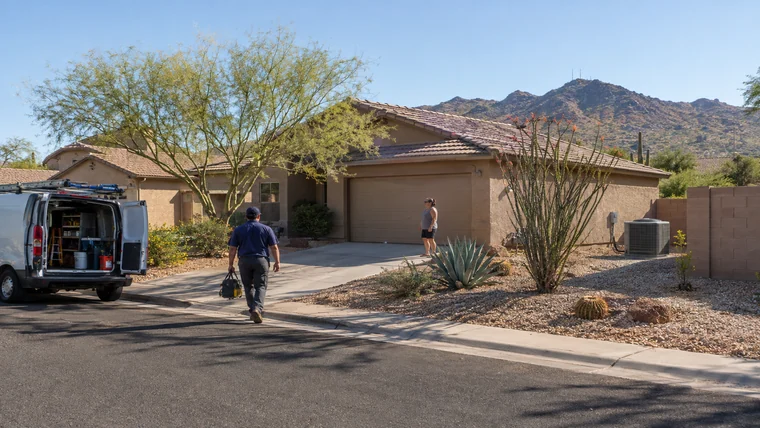
Deer Valley was built out across a long stretch — roughly the 1980s through the 2000s — and that single fact decides most of what we get called out for up here. A house finished in 1987 is on its second or third air conditioner by now. A house finished in 2004 is running equipment old enough to vote, and in most cases it is R-410A equipment installed before the refrigerant rules changed underneath it. Either way, Deer Valley sits in the middle of its replacement window rather than approaching it, so the conversation at the kitchen table is rarely whether a system gets replaced. It is when, at what size, and on whose numbers. There is a second thing worth knowing before anyone quotes you. Deer Valley addresses are typically billed by APS, and APS discontinued its residential air conditioning and heat pump rebates on January 1, 2026. Quote sheets still circulate in this market with that rebate printed on them as a line item.
- Deer Valley's 1980s to 2000s housing stock puts most of the community in its replacement window now, not approaching it.
- A diagnostic is $69.95 weekdays 8am–6pm and $99.95 outside those hours, credited toward the repair, with no trip fee to any Deer Valley address.
- Installed replacement runs $5,000–$7,000 for three tons, $6,000–$8,000 for four and $7,000–$10,000 for five; heat pumps carry no premium.
- Rooftop package unit changeouts add $400–$600 for crane service; mini-splits are $1,000–$3,000 per indoor head.
- APS discontinued residential AC and heat pump rebates on January 1, 2026; SRP Cool Cash still pays $75 to $225 per ton on SEER2 15.2 equipment for SRP-billed addresses.
- The federal 25C credit does not apply to systems placed in service in 2026.
- Phoenix treats a replacement as permit-exempt only when capacity does not increase and the equipment does not move; we pull permits when the work requires one.
- Coil cleaning at $150 and coil replacement at $2,200–$2,600 are different jobs; a quote that says only "coil" should be clarified before signing.
What does a service call cost in Deer Valley, and how does scheduling work?
What that fee buys is a set of readings, not an opinion. What we find in Deer Valley houses from the late 1980s and early 1990s is an air handler sitting in the attic over the garage or on a hallway platform, and in July that attic runs far above the roughly 110-degree summer design dry bulb that ASHRAE lists for Phoenix — attic air well past 150 degrees is ordinary here. Unlike a basement furnace in a moderate climate, where a technician can spend an unhurried hour at the coil in shirtsleeves, attic work in a Deer Valley August happens in short stints, so the order of the checks matters: capacitor microfarads against the nameplate, contactor condition, compressor and condenser fan amp draw, static pressure across the coil, then superheat and subcooling. Those numbers are what a written diagnosis should contain, and they are what you should be handed.
Scheduling here is deliberately unglamorous. Someone answers the phone at AZ Trusted Air 24 hours a day — a person, not a recording — and we dispatch overnight when a call genuinely warrants it. Typical non-emergency arrival is 12 to 24 hours. We do not publish a same-day guarantee, because the companies that do are making a promise the third week of July will not let them keep. One pattern homeowners here describe consistently: trouble announces itself right at the start of the APS on-peak window, 4pm to 7pm weekdays, when the system is working hardest and the electricity behind it costs the most.
Two visits are worth knowing about before you need one. A second opinion costs the same $69.95 or $99.95, is credited the same way, and the written report belongs to you whether or not you hire us. A quote review costs nothing, needs no site visit, and can be sent however suits you.
What does AC replacement cost for typical Deer Valley homes?
Those are whole-system installed prices, not equipment-only teasers. What moves a Deer Valley job within its range is efficiency tier first, then access and condition: a rooftop package unit needs a crane at $400 to $600, a line set that cannot be reused adds labour, and duct replacement runs $1,000 to $3,000 where thirty-year-old flex has gone brittle in a superheated attic. Mini-splits are $1,000 to $3,000 per indoor head, which is usually the answer for a converted garage or an added room the original duct design never accounted for. Labour warranty is two years on new equipment and one year on repairs.
Sizing is where the build era shows up. A 1988 Deer Valley house has often been re-roofed, re-glazed, had attic insulation added and grown thirty years of shade since the original tonnage was picked. Unlike a new-build load, which is calculated once against drawings, a replacement load has to be calculated against the house as it stands today — and an ACCA Manual J run against a design condition near 110 degrees frequently returns a smaller number than the unit bolted down out back. Oversizing does not buy comfort in a hot-dry climate; it short-cycles, leaves the upstairs uneven, and hammers the compressor. The federal floor for new split systems in the Southwest region has been SEER2 14.3 since 2023, and the matched indoor and outdoor pairing on your quote should be verifiable in the AHRI Directory before you sign anything.
Permits are not automatic in Phoenix. City of Phoenix Planning & Development treats an air conditioner replacement as permit-exempt only where the replacement does not increase size or capacity and does not change location. Change tonnage, relocate equipment, alter ductwork or touch the electrical service and the exemption stops applying. We pull permits when the work requires one, and we confirm the permitting authority by address rather than by mailing city, because a ZIP code alone does not settle who issues it.
What pushes a job above the typical range
These are the conditions that can push a job above the ranges above. We tell you before the work starts, not after — and they are worth checking on any contractor's quote, not just ours.
- Crane access on rooftop package units
- The existing line set cannot be reused with the new equipment
- Electrical panel lacks capacity or needs breaker work
- Ductwork is undersized, leaking, or hard to reach in the attic
- Code upgrades on an older home - grandfathering ends when equipment is replaced
- Refrigerant contamination, or an R-22 system needing conversion
Installed system price by tonnage — and where the efficiency step falls
AZ Trusted Air published ranges, Deer Valley and the wider Phoenix metro. The split marks SEER2 15.2, well above the SEER2 14.3 federal minimum for this region.
Deer Valley is typically APS territory, and APS discontinued residential AC rebates on January 1, 2026 — so the higher-efficiency portion of each bar pays back through the power bill here, not through a rebate check. SRP-billed addresses elsewhere in the metro can still claim Cool Cash at SEER2 15.2. Confirm the utility named on your bill.
| Item | Range |
|---|---|
| 3-ton system | $5,000 – $7,000 |
| 4-ton system | $6,000 – $8,000 |
| 5-ton system | $7,000 – $10,000 |
What should Deer Valley homeowners check before approving a major AC repair?
Start with a number to measure against. These are ours, published:
| Repair | Price |
|---|---|
| Capacitor | $50 – $200 |
| Contactor | $100 – $200 |
| Condenser fan motor | $600 – $1,200 |
| Blower motor | $750 – $1,800 |
| Compressor | $800 – $4,000 |
| Coil cleaning | $150 |
| Coil replacement | $2,200 – $2,600 |
| Duct replacement | $1,000 – $3,000 |
The refrigerant question is the one that has genuinely changed for Deer Valley's 2000s housing stock. Under the EPA's AIM Act rules, new residential split systems built for the US market since January 1, 2025 use lower-GWP refrigerants such as R-454B or R-32 rather than R-410A. Existing R-410A equipment stays legal to run and legal to service — nobody has to replace a working system — but production allowances keep stepping down, so refrigerant for a leaking twenty-year-old unit gets more expensive each cycle rather than less. A leak search and recharge on an aging system is therefore a different economic decision than it was five years ago, and any technician handling that refrigerant must hold EPA Section 608 certification.
The arithmetic we walk homeowners through is unsentimental. A compressor quote in the upper half of that $800 to $4,000 spread, on equipment already past fifteen Valley cooling seasons — and a Deer Valley season runs April into October, which is why national lifespan tables read optimistically here — is usually money spent on borrowed time. A capacitor at $50 to $200 on the same machine is not. If someone has told you the whole system must go, our repair-or-replace consultation and the AC age checker exist for exactly that fork, and any contractor's license and complaint history can be looked up at the Arizona Registrar of Contractors before you hand over a deposit.
First, read the utility name printed on your electric bill. Phoenix-metro coverage splits by neighborhood, and the rebate line on your quote is only valid if it matches the utility that actually bills you. Second, look up the contractor's license number at the Arizona Registrar of Contractors, where the license status and complaint history are public. Ours is ROC 317368.
Which rebates can Deer Valley residents claim on a replacement, and who handles the paperwork?
We would rather tell you this plainly than let you find it out after signing. APS ended residential AC and heat pump rebates effective January 1, 2026, following the Arizona Corporation Commission's decision on its efficiency program budget in December 2025. What survived on the APS side is thermostat-related — the Cool Rewards program and marketplace thermostat credits — which is a demand-response benefit, not a rebate on a new condenser. For the record, AZ Trusted Air is not an APS Qualified Technology Installer, and we will not put an APS equipment rebate on a Deer Valley quote. If another quote you are holding shows one, ask for it in writing.
Utility territory in the Phoenix metro splits by neighborhood rather than by city, so "typically APS" is not the same as "certainly APS." Your bill names your utility, and that is the document to check. If it says SRP, the Cool Cash program remains live and pays by cooling capacity and compressor type — published at $75 per ton for single-stage, $150 per ton for multi-stage and $225 per ton for variable-capacity systems and inverter-driven mini-splits, which tops out around $1,125 on a five-ton variable unit. Equipment must be AHRI-listed at SEER2 15.2 or better, both the indoor and outdoor halves of a split system have to be replaced, a Manual J is required for single-stage equipment, and the application is due within six months of installation. SRP sets program windows and amounts by cycle, so confirm the current figure with SRP before you rely on it.
Federal help is not available either: the 25C energy efficient home improvement credit does not apply to systems placed in service in 2026. That leaves operating cost as the real lever for APS-billed Deer Valley homes. On the APS Time-of-Use 4pm–7pm weekday plan, pre-cooling the house before 4pm and letting it drift during on-peak is a genuine strategy, and it works far better in a tight house with sealed ducts than a leaky one. We file what there is to file through our rebate concierge, and we do not inflate a quote to cover a rebate that no longer exists.
Sources and further reading
The figures and requirements on this page draw on the following public sources. We link them so you can check anything here yourself.
- APS — current residential rebate status, Cool Rewards, and the Time-of-Use 4pm–7pm weekday plan
- SRP — Cool Cash per-ton amounts, the SEER2 15.2 requirement and current program dates
- City of Phoenix Planning & Development — when a mechanical permit is required for a residential equipment changeout
- Arizona Registrar of Contractors — license verification, complaint history and homeowner rights
- AHRI Directory — confirm a quoted indoor and outdoor unit are a certified matched system at the stated SEER2
- ACCA (Air Conditioning Contractors of America) — Manual J load calculation, the correct basis for sizing a Deer Valley replacement
- U.S. Environmental Protection Agency — Section 608 — refrigerant handling rules and the phase-down affecting R-410A service costs
No site visit, no obligation, and no salesperson will ring you asking when he can stop by. One flat rate across the Phoenix metro and surrounding communities, at any distance.