Who provides AC repair and replacement in Grayhawk?
The short answer: AZ Trusted Air repairs and replaces air conditioning in Grayhawk and across North Scottsdale, licensed as Arizona ROC 317368. Diagnostics are $69.95 weekdays between 8am and 6pm, credited toward any repair we perform. A person answers our phone 24 hours a day, seven days a week, and Grayhawk pays the same flat rate as every other address we serve, with no trip charge at any distance.
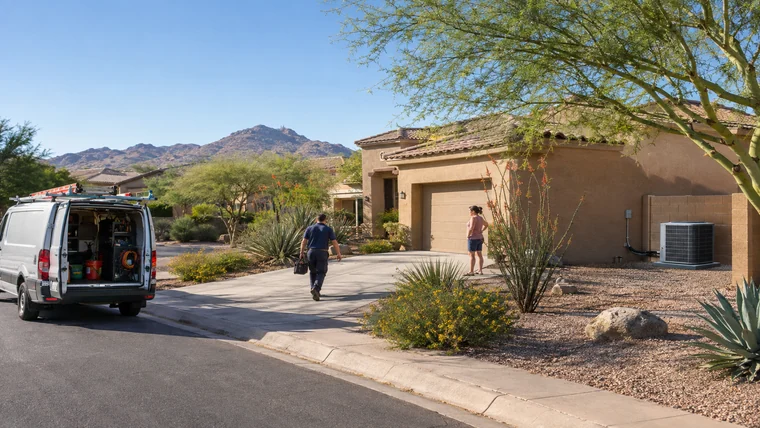
Grayhawk went up fast, mostly between 1997 and 2005, and that is the single most useful fact about air conditioning here. A community built inside an eight-year window reaches the end of its equipment life inside roughly the same window. The original systems in these homes are now two decades and more past install, and the ones swapped in the first replacement wave around 2008 to 2014 are themselves mid-life. So the calls we take in Grayhawk are rarely “is this repairable” in the abstract — they are “is this the third capacitor on a system old enough to vote.” Two other things shape the work here more than most North Scottsdale homeowners expect. Grayhawk sits inside the City of Scottsdale, which treats mechanical permits differently from Phoenix. And Grayhawk addresses are typically served by APS, which discontinued its residential equipment rebates at the start of 2026 — a change that rewrites the arithmetic on a replacement quote in this part of the Valley specifically. Below is the detail, with the prices.
- Grayhawk was built between 1997 and 2005, so original equipment here is now 21 to 29 years old.
- Original systems from that era were charged with R-22, and the EPA ended R-22 production and import on January 1, 2020.
- Scottsdale is not Phoenix on permits: the city lists a like-for-like AC or air handler replacement in the same location as mechanical-permit work.
- Installed replacement runs $5,000–$7,000 for three tons, $6,000–$8,000 for four and $7,000–$10,000 for five, heat pumps at no premium.
- APS ended residential equipment rebates on January 1, 2026; Grayhawk is typically APS, so budget with no utility rebate unless your bill says SRP.
- SRP Cool Cash pays about $75 to $225 per ton, up to $1,125, on AHRI-listed SEER2 15.2 equipment, applied for within six months.
- The federal 25C tax credit is repealed for anything placed in service in 2026 — any quote still showing it is out of date.
What does a service call cost in Grayhawk, and how does scheduling work?
The fee buys a diagnosis, not a sales visit. The technician measures, tells you what failed, prices the fix, and the $69.95 comes off the repair if you go ahead. The same fee applies if you are calling us to check somebody else's diagnosis — a second opinion costs the same, is credited the same way, and the written report is yours whether you hire us or not. If what you already have is a replacement proposal rather than a broken system, the quote review is free and needs no site visit at all: send it however suits you and we will tell you what the scope and the numbers look like against ours.
On timing, we publish what we can actually do. Someone real answers at any hour, and we dispatch overnight when a call warrants it — no cooling in a Grayhawk house in July with an infant or an elderly parent in it warrants it. Most non-emergency calls land inside 12 to 24 hours. We will not print a same-day guarantee, because in a Phoenix-metro August that is a promise the whole trade breaks. Access is the other half of scheduling here: parts of Grayhawk sit behind gates and parts do not, so tell us at booking how a technician gets to the door and whether the equipment is on a side pad, a rear pad or in the attic.
Ongoing care runs $25 per month per unit, and the per-unit wording matters in this community because plenty of these floor plans carry two systems. What earns that money here is monsoon season: dust and grit driven onto condenser coils through July and August choke heat rejection, and a coil that cannot reject heat raises head pressure on a compressor already working against a 115-degree design day. A coil cleaning is $150 as a standalone service — a different job entirely from coil replacement, which we price separately further down.
What does AC replacement cost for typical Grayhawk homes?
Sizing is where Grayhawk quotes diverge from each other. Phoenix-metro design conditions sit near 115 degrees, and ACCA's Manual J is the calculation that turns a specific floor plan, its glazing and its duct layout into a tonnage at that temperature. Grayhawk plans from this era vary widely — single-level patio homes and two-story houses with a lot of west glass sit inside the same association — so the honest answer to “what size do I need” is that it comes off a load calculation. The sticker on the 1999 unit is evidence of what a builder bought, not proof that it was right.
| System | Installed price | What moves it within the range |
|---|---|---|
| 3-ton system | $5,000 – $7,000 | Efficiency tier; attic duct condition; line-set reuse |
| 4-ton system | $6,000 – $8,000 | Efficiency tier; electrical or disconnect work |
| 5-ton system | $7,000 – $10,000 | Efficiency tier; attic access and equipment handling |
| Heat pump, any tonnage | Same as above | No premium over straight-cool |
| Mini-split | $1,000 – $3,000 per head | Line-set routing; wall and exterior access |
| Crane, rooftop units only | $400 – $600 | Billed separately when a rooftop unit is involved |
Three things move a Grayhawk job inside those ranges. Efficiency tier is the largest: the upper half of each range is equipment clearing SEER2 15.2, which is a rebate threshold if your meter is SRP and purely a running-cost decision if it is APS. Second, new residential equipment now uses R-454B rather than R-410A, following EPA AIM Act limits on high-global-warming refrigerants in new systems; it is not an upcharge line, but it does mean the indoor and outdoor components must be a matched, correctly commissioned set. Third, where a home has two systems each is quoted on its own — the second is usually smaller and cheaper, and it commonly fails a season or two behind the first, which makes staging the work a legitimate option rather than a stall.
What pushes a job above the typical range
These are the conditions that can push a job above the ranges above. We tell you before the work starts, not after — and they are worth checking on any contractor's quote, not just ours.
- Crane access on rooftop package units
- The existing line set cannot be reused with the new equipment
- Electrical panel lacks capacity or needs breaker work
- Ductwork is undersized, leaking, or hard to reach in the attic
- Code upgrades on an older home - grandfathering ends when equipment is replaced
- Refrigerant contamination, or an R-22 system needing conversion
Installed system price by tonnage — and where SEER2 15.2 falls
AZ Trusted Air published ranges. The split marks SEER2 15.2, the SRP Cool Cash threshold — relevant in Grayhawk only if your meter reads SRP.
Grayhawk is typically APS territory, and APS ended residential equipment rebates on January 1, 2026 — so for most homes here the efficiency step is a running-cost decision, not a rebate decision. Confirm your utility from your bill.
| Item | Range |
|---|---|
| 3-ton system | $5,000 – $7,000 |
| 4-ton system | $6,000 – $8,000 |
| 5-ton system | $7,000 – $10,000 |
What should Grayhawk homeowners check before approving a major AC repair?
Run those four before approving anything much above a thousand dollars. Age first: use the serial number or our AC age checker, and remember that in Grayhawk the build era alone puts an original system at or past twenty years. Refrigerant second. The EPA ended production and import of R-22 on January 1, 2020, so every pound going into a leaking Grayhawk system today comes from reclaimed or stockpiled supply at whatever that market charges — which is why a leak search and recharge on a 25-year-old unit is money spent on a machine with no parts future. Warranty third: manufacturer parts coverage on a 10-to-15-year-old system is often still live if the original installer registered it, and that can turn a coil replacement into a labour-only job.
Fourth, the readings. That means the numbers behind the conclusion: superheat and subcool, capacitor microfarads measured against the rating stamped on the can, compressor amp draw against the nameplate. A technician who cannot produce them has guessed. Our published repair prices exist so you can check a quote against something: capacitor $50 to $200, contactor $100 to $200, condenser fan motor $600 to $1,200, blower motor $750 to $1,800, compressor $800 to $4,000. And note two lines that get deliberately blurred — coil cleaning is $150, coil replacement is $2,200 to $2,600. If a Grayhawk quote says only “coil,” ask which one it means before you sign.
Two verifications take about five minutes each. Look up any contractor at the Arizona Registrar of Contractors, ours included — ROC 317368 — and read the complaint history while you are in there. Then confirm that whoever touches refrigerant in your home holds EPA Section 608 certification, which is a federal requirement rather than a courtesy. Unlike a plumbing repair you can watch from the doorway, refrigerant-circuit work happens inside sealed components you will never see, and the paperwork is the only thing standing in for your own eyes. If the recommendation still feels wrong after all that, a repair-or-replace review is the cheapest hour you will spend on the decision.
Take a Grayhawk house finished in 2001 with two original systems still running. Both are 25 years old, both predate R-410A, and on economics neither is a repair candidate. But they almost never fail in the same summer, and a single proposal covering both is a $13,000 conversation where a staged replacement is usually the more honest recommendation. That is why our Grayhawk quotes price each system separately and say in writing which one we would replace first and why.
Which rebates can Grayhawk residents claim on a replacement, and who handles the paperwork?
The 2026 picture, plainly. APS discontinued its residential energy-efficiency rebates effective January 1, 2026, after the Arizona Corporation Commission cut the programme budget in a late-2025 decision. Because Grayhawk sits in what is typically APS territory, a replacement here should be budgeted with no equipment rebate in it. What remains on the APS side is Cool Rewards, a smart-thermostat demand-response credit, which is not a purchase rebate on a system. If a contractor shows you an APS equipment rebate on a Grayhawk proposal, ask to see the current programme terms in writing before you let it reduce the price you are comparing.
Utility service follows the meter, not the subdivision boundary, and North Scottsdale is not uniformly one utility — your bill names yours, and that is the only check worth trusting. If it reads SRP, Cool Cash pays by the ton and by compressor type: roughly $75 per ton for single-stage, $150 for multi-stage and $225 for variable-capacity equipment, up to $1,125 on a five-ton variable system. The conditions matter as much as the amount. Equipment must be AHRI-listed at SEER2 15.2 or better and installed by an Arizona-licensed contractor; on a split system both the condenser and the air handler have to be replaced, so a condenser-only swap does not qualify; SRP requires a Manual J load calculation for single-stage equipment; and the application is due within six months of installation. Amounts and dates move between programme cycles, so we confirm the current figure against SRP before it appears on your quote.
We do the filing. AZ Trusted Air completes the contractor section and submits it with the paid invoice and AHRI reference for SRP-served addresses — see the rebate concierge page for what we need from you. Two closing cautions. The federal 25C tax credit is repealed for anything placed in service in 2026; treat any Scottsdale quote still showing it as out of date. And Efficiency Arizona's HEAR programme has offered substantial rebates for income-qualified households replacing heating and cooling equipment; programme terms, amounts and eligible upgrade types change between cycles, so confirm current eligibility directly with Efficiency Arizona before counting on this funding.
Sources and further reading
The figures and requirements on this page draw on the following public sources. We link them so you can check anything here yourself.
- SRP — Cool Cash per-ton amounts, the SEER2 15.2 threshold and the six-month application window
- APS — current residential programme status after the January 1, 2026 rebate discontinuation
- Arizona Registrar of Contractors — verify any contractor's licence and complaint history, including ROC 317368
- U.S. Environmental Protection Agency — Section 608 — refrigerant handling certification, the R-22 phase-out and the move to lower-GWP refrigerants
- ACCA (Air Conditioning Contractors of America) — Manual J load calculation, the correct basis for sizing at Phoenix design conditions
- AHRI Directory — confirm a quoted indoor and outdoor pairing is a certified matched system at its claimed SEER2
No site visit, no obligation — send it however suits you. Or call (623) 252-6403 and speak to a person, at any hour. One flat rate across Grayhawk, North Scottsdale and the wider Phoenix metro, with no travel fee at any distance.