Who provides AC repair and replacement in Desert Ridge?
The short answer: AZ Trusted Air repairs and replaces air conditioning throughout Desert Ridge and the rest of the Phoenix metro under Arizona ROC 317368. Diagnostics are $69.95 Monday to Friday, 8am to 6pm, and $99.95 outside those hours, credited toward any repair we perform. A person answers our phone 24 hours a day, and there is no trip charge to Desert Ridge at any distance.
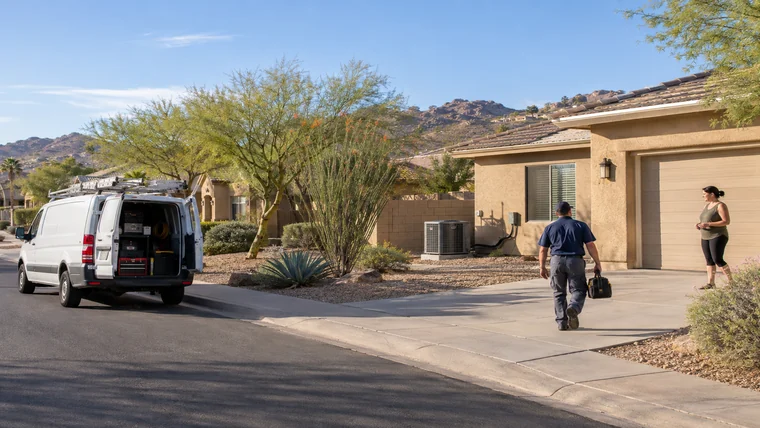
Desert Ridge went up quickly, between roughly 1997 and 2010, and that single fact explains most of the calls we take up there. A home finished in 2003 is past twenty years old now, which puts its original equipment — or the first replacement, if it was changed out around 2010 — squarely in the window where a compressor failure stops being bad luck and starts being arithmetic. Homes at the front of that build era commonly left the builder with R-22 systems; homes at the back of it did not. Which one you own changes the repair-or-replace conversation completely, and it is printed on a data plate you can read yourself in about thirty seconds.
Desert Ridge addresses are typically in APS territory, though electric service in north Phoenix follows the meter rather than the subdivision line, and your bill names yours. That matters more in 2026 than it used to, because the two big Valley utilities no longer offer remotely the same thing.
- Desert Ridge was built between roughly 1997 and 2010, which puts nearly every home here in the 15–25 year replacement window right now.
- Homes from the early part of that era commonly shipped with R-22 equipment; EPA phase-down rules ended R-22 production and import on 1 January 2020.
- Replacement runs $5,000–$7,000 for three tons, $6,000–$8,000 for four and $7,000–$10,000 for five, installed, with no premium for a heat pump.
- Diagnostics are $69.95 Monday to Friday 8am–6pm and $99.95 outside those hours, credited toward the repair, with no trip fee to Desert Ridge at any distance.
- Coil cleaning ($150) and coil replacement ($2,200–$2,600) are different jobs; a quote that just says "coil" needs clarifying.
- APS discontinued residential AC and heat pump rebates on 1 January 2026; SRP Cool Cash still pays $75–$225 per ton at SEER2 15.2 or better, and territory follows the meter.
- The federal 25C credit was terminated for property placed in service after 31 December 2025 and cannot be claimed on a 2026 installation.
- Phoenix exempts like-for-like outdoor replacements not over 5 tons at one- and two-family dwellings; moving or upsizing the unit removes that exemption.
What does a service call cost in Desert Ridge, and how does scheduling work?
The fee is identical in Desert Ridge, Ahwatukee and Casa Grande — flat rate, any distance, no fuel surcharge for the drive up the 51. Our phone is answered by a person 24 hours a day, and we dispatch overnight when a call genuinely warrants it: a house with no cooling and an infant or an elderly parent in it in July is a different call from a noisy condenser fan in October. What we will not publish is a same-day guarantee. In a Phoenix July that promise is made constantly and kept selectively. Typical non-emergency arrival is 12 to 24 hours, and if we are running longer than that you will hear it when you book rather than while you wait.
One thing that genuinely differs about a Desert Ridge call is where the equipment sits. Unlike a 1960s central Phoenix ranch with its condenser out in open gravel, homes of this build era commonly place the outdoor unit in a narrow side yard behind a block wall or a gate, sharing a few feet of caliche with a gas meter and a pool pad. What our technicians find in those side yards in August is a unit re-breathing its own discharge air and running head pressure it was never designed for — and homeowners who finally clear two feet of storage and oleander away from that cabinet consistently report a machine that stops tripping on the worst afternoons.
Two details speed up the visit if you have them when you call: the model and serial number off the outdoor data plate, and whether the home is on one system or two. Access instructions are ours to ask about rather than guess at, so tell us about gate codes and locked side yards at booking. Our maintenance plan is $25 a month per unit, which in a two-system Desert Ridge home means two.
What does AC replacement cost for typical Desert Ridge homes?
The two-system layout is the part that surprises people. A Desert Ridge two-story commonly runs a larger unit for the ground floor and a smaller one for the upstairs, installed within months of each other by the builder — which means they tend to fail within a year or two of each other as well. Replacing both at once saves a second mobilisation; replacing one and nursing the other is a legitimate choice, and we will price it either way rather than bundling by default.
| System | Installed price | Notes |
|---|---|---|
| 3-ton | $5,000 – $7,000 | Common upstairs unit in a two-system home |
| 4-ton | $6,000 – $8,000 | Common single-system size for this build era |
| 5-ton | $7,000 – $10,000 | Larger floorplans; permit rules change above 5 tons |
| Heat pump | Same by tonnage | No premium over straight-cool |
| Mini-split | $1,000 – $3,000 | Per indoor head — casitas, offices, converted garages |
| Crane, rooftop package units | $400 – $600 | Billed separately when the unit is on the roof |
Sizing is where money gets wasted here. Phoenix design conditions sit near 115F, and ACCA's Manual J is the correct basis for choosing capacity — not the tonnage on the old nameplate and certainly not a guess made because the upstairs runs hot. A hot second story in a 2004 home is more often leaking attic duct, a crushed flex run or a return that was undersized on the plan than a unit that is a half-ton short. Upsizing on top of a duct problem buys you short cycling, poor dehumidification during monsoon, and a bigger electric bill.
On permits, the City of Phoenix publishes an exempt-work list that covers repair or replacement in kind of outdoor refrigeration units not over 5 tons at one- and two-family dwellings. Move the unit, increase capacity or bring ductwork and electrical into scope and the exemption stops applying. We pull permits when the work requires one, and we do not pretend the rule is simpler than it is.
What pushes a job above the typical range
These are the conditions that can push a job above the ranges above. We tell you before the work starts, not after — and they are worth checking on any contractor's quote, not just ours.
- Crane access on rooftop package units
- The existing line set cannot be reused with the new equipment
- Electrical panel lacks capacity or needs breaker work
- Ductwork is undersized, leaking, or hard to reach in the attic
- Code upgrades on an older home - grandfathering ends when equipment is replaced
- Refrigerant contamination, or an R-22 system needing conversion
Installed system price by tonnage — and where SEER2 15.2 falls
AZ Trusted Air published ranges, same in Desert Ridge as anywhere in the Phoenix metro.
Desert Ridge is typically APS territory, and APS ended residential equipment rebates on 1 January 2026 — so for most homes here the efficiency step is a running-cost decision, not a rebate decision. If your meter turns out to be SRP, Cool Cash pays $75 to $225 per ton at SEER2 15.2 or better. Confirm current programme terms with the utility before relying on them.
| Item | Range |
|---|---|
| 3-ton system | $5,000 – $7,000 |
| 4-ton system | $6,000 – $8,000 |
| 5-ton system | $7,000 – $10,000 |
What should Desert Ridge homeowners check before approving a major AC repair?
Refrigerant identity comes first. Homes built at the start of Desert Ridge's run usually shipped with R-22 equipment; the EPA's phase-down ended production and import of R-22 on 1 January 2020, so anything charged into that system today is reclaimed or previously produced stock, and it is priced accordingly. Topping off a leaking R-22 system is money spent on a machine with no parts future. If the plate says R-410A you have more room to repair, and new equipment being installed now is moving to R-454B under the same EPA programme.
Second, read the word after the dollar sign. Coil cleaning is a $150 service. Coil replacement is $2,200 to $2,600. Those are different jobs separated by roughly two thousand dollars, and a quote that says only "coil" needs clarifying before you sign it. The same discipline applies across the parts list: a capacitor is $50 to $200, a contactor $100 to $200, a condenser fan motor $600 to $1,200, a blower motor $750 to $1,800, and a compressor $800 to $4,000 — the spread on that last one depending almost entirely on whether the part is still under manufacturer warranty.
Third, weigh the repair against the calendar. Unlike a moderate climate where a system runs four months a year, a Desert Ridge unit works April into October, which is why national lifespan tables read optimistically here. A $3,000 compressor in a twenty-two-year-old system is not a repair decision, it is a replacement decision wearing a repair's clothing. Check the contractor's licence at roc.az.gov, confirm the technician holds EPA Section 608 certification for refrigerant work, and get the diagnosis in writing. Our second opinion costs the same $69.95, is credited toward work, and the written report is yours either way.
Walk to the outdoor unit and read the metal plate on the side of the cabinet. Three lines decide most of the conversation: the refrigerant type (R-22 versus R-410A), the nominal capacity in BTU or tons, and the manufacture date encoded in the serial number. A Desert Ridge home built in 1999 with an R-22 plate is telling you it is on original or near-original equipment; a 2012 R-410A plate on a 2003 house means someone already did a changeout and you may still be inside a registered parts warranty. Photograph the plate before you take any quote — it is the single piece of evidence that keeps a replacement conversation honest.
Which rebates can Desert Ridge residents claim on a replacement, and who handles the paperwork?
APS ended its residential equipment rebate programme on 1 January 2026, following an Arizona Corporation Commission decision on its efficiency budget. What survived on the APS side is Cool Rewards, a smart-thermostat enrolment credit, which is not a rebate on a new system. Quote sheets around the Valley have been slow to catch up, so if a Desert Ridge estimate still shows an APS equipment rebate line, ask the contractor to put the programme name and current terms in writing before you subtract it from anything.
SRP's Cool Cash is the Valley rebate still standing, and it is worth knowing about even in a typically-APS community, because service territory follows the meter and pockets of the metro interleave. Published tiers pay by nominal ton and by compressor type — $75 per ton single-stage, $150 multi-stage, $225 variable-capacity — with all tiers requiring at least SEER2 15.2 as listed in the AHRI directory, above the federal Southwest-region floor of 14.3. On split systems both the outdoor unit and the air handler must be replaced, a Manual J calculation is required on single-stage equipment, and applications are due within six months of installation. Install deadlines move between programme cycles, so confirm the current one at srpnet.com before you plan around it.
The federal picture is settled and unhelpful: the 25C Energy Efficient Home Improvement Credit was terminated for property placed in service after 31 December 2025, so a 2026 Desert Ridge installation cannot claim it. Anyone quoting you a $2,000 heat pump tax credit this year is working from last year's sheet. Where a rebate does exist, we complete and submit the paperwork as part of the job rather than handing you a form.
Sources and further reading
The figures and requirements on this page draw on the following public sources. We link them so you can check anything here yourself.
- City of Phoenix Planning & Development — published exempt-work list covering like-for-like outdoor replacements not over 5 tons
- SRP — current Cool Cash per-ton amounts, the SEER2 15.2 requirement and cycle deadlines
- APS — current residential programme status, including which rebates were discontinued for 2026
- U.S. Environmental Protection Agency — Section 608 — technician certification, R-22 phase-down and the move to newer refrigerants
- ACCA (Air Conditioning Contractors of America) — Manual J load calculation, the correct basis for sizing at Phoenix design conditions
- AHRI Directory — verify a quoted outdoor and indoor combination is certified at the efficiency claimed
- Arizona Registrar of Contractors — licence verification and complaint history before you sign anything
Send it however suits you — photo, email, whatever is easiest. No site visit, no obligation, and no salesperson will call to ask when they can stop by. One flat rate across the Phoenix metro and surrounding communities, at any distance.