Who provides AC repair and replacement in Cave Creek & Carefree?
The short answer: AZ Trusted Air covers Cave Creek and Carefree as part of one flat-rate Phoenix metro service area — no travel fee, no trip charge and no zone pricing at the north end of the Valley. We hold Arizona ROC 317368, carry most major brands with no manufacturer alignment, and answer the phone with a live person 24 hours a day. Diagnostics are $69.95 on weekdays, credited toward the repair.
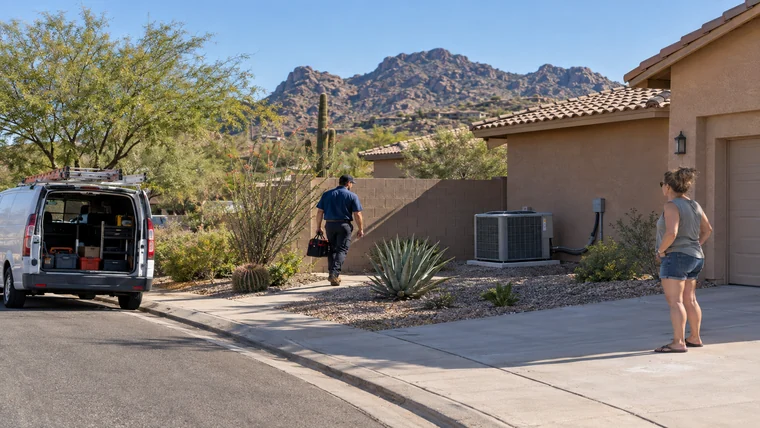
The homes we work on in Cave Creek and Carefree are mostly custom, mostly built between the 1970s and the 2000s, and mostly sited on large desert lots where the condensers sit behind a screen wall a long way from the air handler. That combination changes almost everything about a replacement quote. A tract house has a predictable line-set run and a predictable load; a hillside custom home up here may carry two or three separate systems, a zoned duct layout nobody has opened since the day it was built, and a screen wall that decides what will physically fit on the pad. This page covers what we charge, how scheduling works at the north end of the metro, what to check before you approve an expensive repair, and which rebates genuinely still exist in 2026 — because one of the two large Valley utility programs was discontinued in January and a great many quote sheets have not caught up.
- Cave Creek and Carefree addresses are typically APS-served, and APS discontinued its residential AC and heat pump rebates on January 1, 2026.
- Where a meter is SRP, Cool Cash pays $75, $150 or $225 per ton by compressor type on SEER2 15.2 equipment, capped at $1,125, with the application due within six months.
- The federal 25C credit is repealed for equipment placed in service in 2026 — a quote still showing a $2,000 federal line is out of date.
- Installed ranges are $5,000–$7,000 for three tons, $6,000–$8,000 for four and $7,000–$10,000 for five, per system; most custom homes here run two or three.
- Diagnostics are $69.95 weekdays and $99.95 outside those hours, credited toward repair, with no travel fee at the north end of the metro.
- Coil cleaning is $150 and coil replacement is $2,200–$2,600; a quote that says only “coil” should be clarified before signing.
- Cave Creek and Carefree run their own building departments, so the City of Phoenix like-for-like exemption does not govern an address in either town.
- Carefree's standard permit notes require mechanical equipment including HVAC units to be screened by solid walls, which constrains pad location and service access.
What does a service call cost in Cave Creek & Carefree, and how does scheduling work?
Distance pricing exists in this market because the north corridor is a long drive from a central Valley shop, and most companies handle that with a zone surcharge or a higher minimum on anything past Carefree Highway. We do not price that way. The weekday and after-hours rates are identical in Carefree and in Ahwatukee, and there is no travel fee, trip charge or zone pricing anywhere we work, at any distance.
| Service | Price | Notes |
|---|---|---|
| Diagnostic / service call | $69.95 | Mon–Fri, 8am–6pm |
| After-hours service call | $99.95 | Evenings and weekends |
| Second opinion | $69.95 / $99.95 | Credited; written report is yours either way |
| Quote review | Free | No site visit, no obligation |
| Maintenance plan | $25/month | Per unit |
| Travel or trip fee | None | Any distance |
What slows a north-corridor call down is almost never the drive. It is the last hundred feet. Unlike a tract subdivision where the condenser sits six feet off a side gate, homes here routinely present a gated drive with a code nobody passed along, a long private approach, and equipment set behind a solid masonry screen wall. That screening is not a style choice in Carefree: the Town's standard building-permit notes require mechanical equipment including HVAC units to be screened by solid walls under its zoning ordinance. Homeowners who give us the gate code when they book consistently get a shorter visit than those who do not.
Because most homes up here run more than one system, the $25 monthly maintenance plan is priced per unit — a three-system house is three enrolments, not one. Our labour warranty runs two years on new equipment and one year on repairs. We do not publish a same-day guarantee, because in a Cave Creek July that is a promise plenty of companies make and few keep.
What does AC replacement cost for typical Cave Creek & Carefree homes?
Residential split systems effectively top out at five tons, which is why a large custom home here is never a single-system house. It is a two- or three-zone, two- or three-system house, and the useful question is not what one replacement costs but which unit is failing and whether the others are close behind. Staging the work across seasons is often the right call; replacing all three at once because one died rarely is.
Sizing is where the premium ticket gets decided. ACCA's Manual J load calculation is the only defensible basis for choosing capacity, and in 1970s and 1980s custom homes we frequently find equipment sized from the old nameplate instead — a number that reflected the house as originally built, before the windows were replaced, the insulation improved or a room added. Unlike a tract street where the load barely changes house to house, every hillside lot up here has its own glass area, orientation and shade, so the nameplate is an assumption rather than a measurement.
Two other line items show up more often here than elsewhere. Long line-set runs across a courtyard or under a paver drive mean the reusable-versus-replace decision carries real money, and detached casitas and guest wings are usually better served by a ductless head than by extending a duct trunk two hundred feet. Where a home carries a rooftop package unit, the crane is billed separately and openly.
Permits are not a Phoenix question here. Cave Creek and Carefree each run their own building departments and permit portals, so the City of Phoenix exemption for like-for-like outdoor swaps under five tons does not govern an address in either town, and parcels outside the town limits fall to Maricopa County instead. We confirm which authority has jurisdiction over your address and pull a permit when the work requires one.
What pushes a job above the typical range
These are the conditions that can push a job above the ranges above. We tell you before the work starts, not after — and they are worth checking on any contractor's quote, not just ours.
- Crane access on rooftop package units
- The existing line set cannot be reused with the new equipment
- Electrical panel lacks capacity or needs breaker work
- Ductwork is undersized, leaking, or hard to reach in the attic
- Code upgrades on an older home - grandfathering ends when equipment is replaced
- Refrigerant contamination, or an R-22 system needing conversion
Installed system price by tonnage — per system, not per house
AZ Trusted Air published ranges. The split marks SEER2 15.2, the efficiency level SRP's Cool Cash rebate requires.
Most Cave Creek and Carefree custom homes carry two or three systems, so a whole-house figure is a multiple of one bar. In APS territory there is no longer an equipment rebate to offset the efficiency step, so it has to earn its keep on the power bill instead.
| Item | Range |
|---|---|
| 3-ton system | $5,000 – $7,000 |
| 4-ton system | $6,000 – $8,000 |
| 5-ton system | $7,000 – $10,000 |
What should Cave Creek & Carefree homeowners check before approving a major AC repair?
Our published repair prices give you a yardstick: capacitor $50–$200, contactor $100–$200, condenser fan motor $600–$1,200, blower motor $750–$1,800, compressor $800–$4,000. Two rows get deliberately blurred in this market. Coil cleaning is $150 and coil replacement is $2,200–$2,600 — different jobs, two thousand dollars apart. If a quote says only “coil,” ask which one it means before you sign.
The refrigerant question matters disproportionately in this build era. Equipment installed through the 1990s and early 2000s commonly runs R-22, and under EPA rules production and import of R-22 ended at the start of 2020, so the only supply left is reclaimed and priced accordingly. A leaking R-22 system can be the one case where a $1,500 repair is genuinely worse value than replacement — but that conclusion should come from a leak search and measured readings, not from a glance at the data plate.
Then check the warranty before you pay for a part. Manufacturer parts coverage often runs ten years but only when the equipment was registered shortly after install, and in a market with as much resale as this one, second and third owners frequently have coverage they do not know about. A model and serial number is all it takes to find out.
What homeowners who open an attic hatch here in August discover is the other half of the problem: Phoenix-area attics routinely run 150 to 170 degrees, and sprawling single-story customs have far more duct in that attic than a two-story tract home does. Leakage in those runs is invisible and expensive, and duct replacement runs $1,000–$3,000. Any contractor you are considering can be checked by licence number with the Arizona Registrar of Contractors; ours is ROC 317368.
Every second opinion we perform in Cave Creek and Carefree produces a written report rather than a verbal verdict: equipment model and serial numbers, measured electrical readings on the suspect component, refrigerant type and measured pressures, the manufacturer parts-warranty status we were able to confirm from the serial, and a plain statement of what we would do and what it would cost against our published ranges. If our finding differs from the quote you already hold, the report shows the readings behind the difference. Homeowners use these to go back to the first contractor as often as they use them to hire us, and that is a legitimate use of the document.
Which rebates can Cave Creek & Carefree residents claim on a replacement, and who handles the paperwork?
That APS change followed an Arizona Corporation Commission decision cutting the utility's efficiency-programme budget, and it is the single most common out-of-date item we see on north-corridor quote sheets in 2026. What survives at APS is Cool Rewards, a smart-thermostat demand-response credit, plus thermostat offers through the APS Marketplace — useful, but not an equipment purchase rebate. Amounts move between programme cycles, so confirm the current figure on aps.com before you count on it.
Territory here is a working assumption, not a certainty. Service boundaries in the metro follow the meter rather than the municipal line, and your bill names your utility — that is the first thing we check, because the rebate answer changes completely between the two. Where an address is SRP-served, Cool Cash pays by compressor type on AHRI-listed equipment rated SEER2 15.2 or better: $75 per ton single-stage, $150 per ton multi-stage and $225 per ton variable-capacity, capped at $1,125. On split systems both the outdoor unit and the indoor air handler must be replaced, a Manual J is required for single-stage equipment, and the application is due within six months of install. Programme cycles carry an install deadline that rolls, so confirm the current cycle before relying on it.
One more line to strike from any quote you are holding: the federal 25C credit is repealed for equipment placed in service in 2026. A quote sheet still showing a $2,000 federal credit is quoting a rule that no longer applies.
Where a rebate does exist, we complete the application, attach the AHRI certificate and invoice, and file it. Assigning the rebate to the contractor so it comes off the invoice up front is an option SRP allows, and we will walk you through which route suits you.
Sources and further reading
The figures and requirements on this page draw on the following public sources. We link them so you can check anything here yourself.
- APS — current residential programme status after the January 2026 rebate discontinuation
- SRP — Cool Cash per-ton amounts, SEER2 15.2 threshold and application deadlines
- ACCA (Air Conditioning Contractors of America) — Manual J load calculation, the correct basis for sizing a custom-home replacement
- U.S. Environmental Protection Agency — Section 608 — refrigerant handling rules, the R-22 phase-out and the R-410A phase-down
- Arizona Registrar of Contractors — licence verification and complaint history for any contractor you are considering
- AHRI Directory — confirm a quoted system is a certified match and clears SEER2 15.2
No site visit, no obligation, and no salesperson will call to ask when they can stop by. Same flat rate in Cave Creek and Carefree as everywhere else in the Phoenix metro, at any distance.