Who provides AC repair and replacement in Tramonto?
The short answer: AZ Trusted Air, Arizona ROC #317368, handles air conditioning repair, replacement, duct work and maintenance throughout Tramonto and the rest of the north Phoenix I-17 corridor. Diagnostics are $69.95 Monday to Friday, 8am to 6pm, and $99.95 outside those hours, credited toward any repair. There is no trip charge or zone pricing to Tramonto or anywhere else in the Phoenix metro.
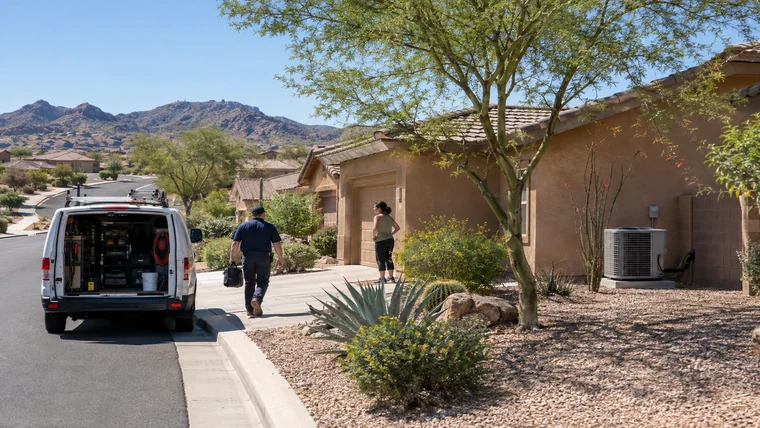
Tramonto sits on the I-17 corridor in north Phoenix, and the community went up between 2001 and 2007. That single fact drives most of what we get called out for here. A system that went in with the house is now nineteen to twenty-five years old, which is exactly the window where Valley equipment stops being worth repairing — our cooling season runs April into October, so a Phoenix condenser piles up run hours that a machine in Denver or Dallas never sees, and national lifespan tables written for those climates quietly mislead people here. Houses that have already had one change-out are on a second system, and if that went in before 2025 it is an R-410A machine now caught in a federal refrigerant phase-down. Neither situation needs panic; both need a plan made before August. Below is what we charge in Tramonto, what we check before recommending anything expensive, and what a north Phoenix address can and cannot actually claim in rebates in 2026 — including the program that disappeared this year and still shows up on quote sheets.
- Tramonto was built between 2001 and 2007, so original equipment is now 19 to 25 years old — the prime replacement window in Phoenix.
- A condenser that came with the house is almost certainly R-22; EPA ended R-22 production and import on January 1, 2020, so refills come from reclaimed stock.
- APS ended residential AC and heat pump rebates on January 1, 2026, and Tramonto addresses typically bill to APS — but territory varies by address, and your bill names it.
- SRP Cool Cash still pays $75, $150 or $225 per ton on AHRI-listed SEER2 15.2+ equipment, with applications due within six months of installation.
- The federal 25C credit is repealed for anything placed in service in 2026, so a heat pump installed this year earns no federal tax credit.
- Diagnostics are $69.95 weekdays 8am–6pm and $99.95 otherwise, credited toward the repair, with no trip charge to Tramonto at any distance.
- Replacement runs $5,000–$10,000 by tonnage, heat pumps at no premium; duct replacement is priced separately at $1,000–$3,000.
- Phoenix exempts like-for-like outdoor swaps not over five tons at one- and two-family dwellings; relocating the unit or changing its footprint triggers a permit.
What does a service call cost in Tramonto, and how does scheduling work?
The fee buys a diagnosis, which sounds obvious until you set it beside a free estimate. Unlike a free-estimate visit, where the person in your side yard is paid on what he sells and the findings arrive stapled to a replacement quote, the $69.95 pays for measurements: capacitor microfarads against the rating stamped on the can, refrigerant pressures and superheat, amp draw on the compressor and condenser fan, static pressure across the air handler. Those numbers are written down and they are yours whether or not you hire us.
| Service | Price | Notes |
|---|---|---|
| Diagnostic / service call | $69.95 | Mon–Fri, 8am–6pm; credited toward the repair |
| After-hours service call | $99.95 | Evenings and weekends; also credited |
| Second opinion | $69.95 / $99.95 | Written report is yours either way |
| Quote review | Free | No site visit, no obligation |
| Maintenance plan | $25/month per unit | Per unit — two-system homes are two enrolments |
| Travel to Tramonto | None | Same rate as Casa Grande, Florence or Maricopa |
Scheduling here works the way it works everywhere we go, because we do not price by distance. A Tramonto call and a Pinal-corridor call are billed identically — no trip charge, no zone, no fuel surcharge at any distance. Someone answers at two in the morning, and we dispatch overnight when the situation warrants it. We will not publish a same-day guarantee, because in a Phoenix July that is a promise plenty of companies make and few keep.
Two things speed up a north Phoenix visit more than anything on our end. The first is knowing whether the outdoor fan is turning while the indoor blower runs; that one observation separates a capacitor or contactor from a refrigerant or airflow problem before we arrive. The second is attic access. In homes of this build era the air handler is usually in the attic, and homeowners who clear the hatch before we get there consistently get more diagnosis for the same fee, because nobody is moving stored boxes in a 150-degree attic on your dime.
What does AC replacement cost for typical Tramonto homes?
Efficiency tier is the largest single lever inside those ranges; the condition of what the builder left behind is the second. In houses of this vintage we are normally reusing an attic duct system that has been baking since the framing went up, and flex duct that has gone brittle, or a return that was undersized on day one, gets priced separately rather than hidden inside the equipment number. Duct replacement runs $1,000–$3,000. Line-set condition, disconnect or panel work, and whether the existing platform accepts a modern cabinet account for most of the remainder.
2026 is an unusual year to be buying. New residential systems manufactured since January 1, 2025 use lower-GWP A2L refrigerant — R-454B sits around 466 GWP against R-410A's 2,088 — and the EPA finalised a rule effective July 27, 2026 allowing units built before 2025 to keep being installed until that inventory runs out. So a Tramonto homeowner collecting three quotes this month can legitimately receive one on remaining R-410A stock and one on new A2L equipment. Ask which you are being quoted, because the answer affects parts and refrigerant supply for the next decade, not just this week's price.
On permits, the City of Phoenix exempts repair or replacement in kind of refrigeration units not over five tons at one- and two-family dwellings when the unit is outdoors. The city's own counter guidance narrows that: relocate the unit or change its footprint and a permit is required, and the city notes that a change in refrigerant type can bring code requirements the original install never had. We pull permits when the work requires one. We do not tell people we always pull them, because for most straight outdoor swaps in this community that would not be true.
Sizing is not inherited from the sticker on the old condenser. ACCA's Manual J is the correct basis, run against Valley design conditions rather than a rule of thumb, and it is also what SRP demands on single-stage rebate applications. Federal minimums matter too: split air conditioners sold in the southern region must meet at least SEER2 14.3, so anything quoted below that is not legal new equipment here.
What pushes a job above the typical range
These are the conditions that can push a job above the ranges above. We tell you before the work starts, not after — and they are worth checking on any contractor's quote, not just ours.
- Crane access on rooftop package units
- The existing line set cannot be reused with the new equipment
- Electrical panel lacks capacity or needs breaker work
- Ductwork is undersized, leaking, or hard to reach in the attic
- Code upgrades on an older home - grandfathering ends when equipment is replaced
- Refrigerant contamination, or an R-22 system needing conversion
Installed system price by tonnage — and where the SRP rebate threshold falls
AZ Trusted Air published ranges. The split marks SEER2 15.2, which matters only if your Tramonto address bills to SRP rather than APS.
APS discontinued residential equipment rebates on January 1, 2026, so for most Tramonto addresses the efficiency step is a running-cost decision rather than a rebate decision. On SRP-served addresses, Cool Cash pays $75 to $225 per ton at SEER2 15.2 or better. Confirm current program terms before relying on them.
| Item | Range |
|---|---|
| 3-ton system | $5,000 – $7,000 |
| 4-ton system | $6,000 – $8,000 |
| 5-ton system | $7,000 – $10,000 |
What should Tramonto homeowners check before approving a major AC repair?
Age first. If the condenser came with the house, it dates to the 2001–2007 build and is almost certainly an R-22 machine, because manufacturers stopped building new R-22 residential equipment in 2010. Under EPA rules the production and import of R-22 ended on January 1, 2020, so every pound that goes into your system now comes from recovered or reclaimed stock and is priced accordingly. A leak repair plus a charge on a twenty-plus-year-old R-22 unit is money spent on a machine with no parts future.
Warranty next, and this is where the biggest numbers move. Our published compressor range is $800–$4,000, and that spread is almost entirely about coverage: a registered compressor still inside a ten-year parts warranty means you are paying labour, while an out-of-warranty compressor in an R-22 system sits at the top. Original Tramonto-era equipment is long past its parts warranty. A second-generation system installed within the last decade may not be. Ask any contractor to look it up by serial number before you approve the job.
Then look past the part that failed. What homeowners who open the attic hatch in August consistently find is duct insulation that has gone chalky in an attic running 150 to 170 degrees, and leakage there costs more every summer than the part being quoted. Unlike a moderate climate, where a leaky supply run is an efficiency footnote, here it is the difference between a bedroom that holds temperature and one that never does. Note also that coil cleaning at $150 and coil replacement at $2,200–$2,600 are different jobs; if a quote says only “coil,” ask which.
For context on the small stuff: a capacitor is $50–$200 and a contactor $100–$200 at our published prices. A capacitor presented as a reason to replace an entire system is the single most common thing a second opinion overturns in this market, and the report we write is yours to keep regardless of who does the work.
The metal plate on the side of the outdoor unit carries four things worth knowing before a quote arrives. The refrigerant line names R-22 or R-410A, which largely settles the repair-or-replace argument on a system that came with a 2001–2007 house. The model number usually encodes capacity in thousands of BTU — 036 is three tons, 048 is four, 060 is five — so you can check whether a quote is proposing the same size or a different one. The serial number encodes a manufacture date; formats differ by manufacturer, so ask the technician to read it out and show you. And your electric bill names your utility, which decides whether any rebate conversation is worth having at all. Photograph the plate and keep it on your phone.
Which rebates can Tramonto residents claim on a replacement, and who handles the paperwork?
Start with territory, because the Phoenix metro is split by neighborhood rather than by city, and a Tramonto address is best treated as APS unless the bill says otherwise. Your electric bill names your utility; that is the only check worth trusting. We verify it before a rebate line ever appears on a quote.
The APS picture changed this year. APS discontinued its residential AC and heat pump equipment rebates effective January 1, 2026, after the Arizona Corporation Commission cut the utility's efficiency-program budget in a late-2025 decision. What survives on the APS side is Cool Rewards, a bill credit for enrolling an eligible smart thermostat in summer conservation events — useful, but it is a demand-response credit, not money toward equipment. We are not an APS Qualified Technology Installer and we will not put an APS equipment rebate on your quote. If another contractor does, ask them to show you the program in writing.
If your address turns out to be SRP-served, Cool Cash is real and still running: $75 per ton on single-stage, $150 per ton on multi-stage and $225 per ton on variable-capacity systems, which tops out around $1,125 on a five-ton variable-speed machine. Equipment must be AHRI-listed at SEER2 15.2 or better and installed by an Arizona-licensed contractor, applications are due within six months of installation, and single-stage applications require a Manual J load calculation or they get delayed or denied. SRP's published terms currently cover installations through April 30, 2027 — confirm the figure before you rely on it, because program cycles change. ED3 territory in the Pinal corridor runs its own separate program.
Two federal notes. The 25C energy-efficiency tax credit was terminated early by the One Big Beautiful Bill Act and does not apply to anything placed in service in 2026, so a heat pump installed this year earns no federal credit. The income-qualified Efficiency Arizona HEAR program is the other path, and its rules tightened during 2026 — electric-to-electric replacements only, no fuel switching. Reporting on its current funding status conflicts, so we check it with the administering state office rather than guessing, and we tell you plainly if there is nothing to claim.
Sources and further reading
The figures and requirements on this page draw on the following public sources. We link them so you can check anything here yourself.
- SRP — Cool Cash rebate amounts per ton, the SEER2 15.2 threshold and application deadlines
- APS — current residential program status after the January 1, 2026 rebate discontinuation
- City of Phoenix Planning & Development — work exempt from permit, and the AC replacement vetting questions that remove the exemption
- U.S. Environmental Protection Agency — refrigerant handling rules, the R-22 phase-out and the R-410A to A2L transition
- ACCA (Air Conditioning Contractors of America) — Manual J load calculation, required on SRP single-stage rebate applications
- Arizona Registrar of Contractors — licence verification and complaint history for any contractor quoting your home
Text a photo, email it, whatever suits you — no site visit and no obligation. One flat rate across the Phoenix metro and surrounding communities, at any distance, with no travel fee to the I-17 corridor.