Who provides AC repair and replacement in Surprise?
The short answer: AZ Trusted Air handles AC repair and replacement across Surprise and the rest of the West Valley under Arizona ROC 317368. A diagnostic visit is $69.95 weekdays from 8am to 6pm, credited toward any repair. Someone answers our phone in person 24 hours a day, and most non-emergency Surprise calls are on the schedule within 12 to 24 hours. We quote the equipment the load calculation calls for, with no manufacturer alignment.
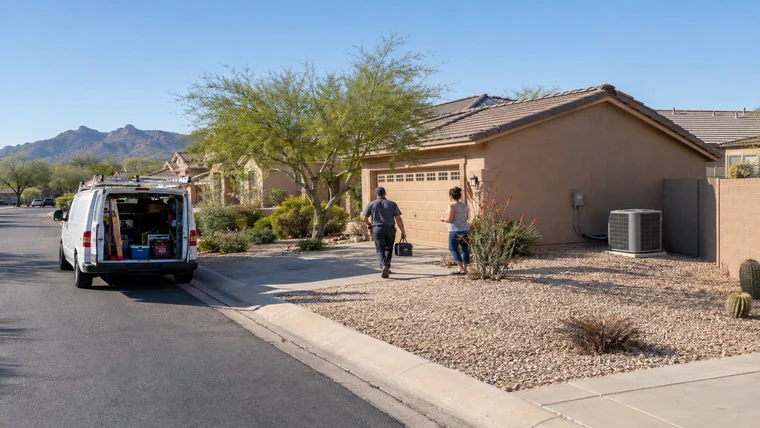
Surprise is a replacement town right now, and the reason is in the build dates. The subdivisions that filled in across Surprise through the 2000s boom were handed over with builder-grade equipment, and that equipment is now eighteen to twenty-two years into a cooling season that starts in April and does not let go until October. First systems are failing outright; the second systems that went in around 2012 to 2016 are not far behind. A lot of our West Valley days are spent on exactly that decision — nurse the 2006 condenser through one more summer, or put in the machine that carries the house another fifteen years.
Two things make Surprise different from the older Phoenix stock we also work in. Most of these homes run a split system with the air handler sitting in an attic rather than a package unit on the roof, so the duct problem here is a hidden one. And most Surprise addresses are APS, which changed what is claimable in 2026. Both of those show up in the numbers below.
- Surprise housing stock is dominated by 2000s build-boom homes, so original equipment is now eighteen to twenty-two years into an April-to-October cooling season.
- A diagnostic is $69.95 weekdays 8am–6pm and $99.95 outside those hours, credited toward the repair, at one flat rate metro-wide.
- Installed replacement runs $5,000–$7,000 for three tons, $6,000–$8,000 for four and $7,000–$10,000 for five; heat pumps carry no premium.
- APS ended residential AC and heat pump equipment rebates on January 1, 2026, and most Surprise addresses are APS.
- SRP's Cool Cash still pays $75, $150 or $225 per ton by compressor type on AHRI-listed SEER2 15.2 equipment, filed within six months.
- The federal 25C credit does not apply to equipment placed in service in 2026; a quote showing it is out of date.
- R-22 was installable in new construction until 2010, so some Surprise homes still run original R-22 equipment worth replacing rather than repairing.
- Coil cleaning is $150 and coil replacement is $2,200–$2,600; a quote saying only “coil” should be clarified before signing.
What does a service call cost in Surprise, and how does scheduling work?
Calling at 2am in July gets you a person. Live answer runs 24 hours a day, seven days a week, and we dispatch overnight when a call genuinely warrants it. Unlike a failed air conditioner in a moderate climate, where the house simply gets stuffy for a night, a Surprise home that loses cooling on a 112-degree afternoon keeps gaining heat after dark — the tile roofs and block-and-stucco walls typical of 2000s West Valley construction hand their stored heat back long past sunset. What we will not do is publish a blanket same-day or two-hour arrival promise. We would rather tell you 12 to 24 hours plainly than beat a clock nobody controls in August.
The visit itself is $69.95 Monday through Friday between 8am and 6pm, and $99.95 outside those hours, credited against any repair we perform. A second opinion costs the same, is credited the same, and the written report is yours whether or not you hire us. If you are only holding somebody else's estimate, the quote review is free, needs no site visit, and can be sent by text or email, whichever suits you. One flat rate covers the whole Phoenix metro: no travel fee, no trip charge, no zone pricing, at any distance. The maintenance plan is $25 per month per unit.
What a diagnostic should buy you is readings, not adjectives. Our technicians measure capacitor microfarads against the nameplate rating, compressor and condenser fan amp draw, superheat and subcooling, and static pressure across the air handler, and those numbers go on the report. Homeowners who ask for the measured values in writing consistently find the conversation changes shape: a system that was going to be condemned in the driveway turns out to have one value out of range and a part behind it.
What does AC replacement cost for typical Surprise homes?
Surprise sits in the middle of the replacement window rather than at the start of it. A house finished in 2005 with its original condenser is running equipment built to a 10 to 13 SEER standard, in a climate where sizing is done against a design temperature near 115 degrees and the compressor works April into October. National lifespan tables promising 15 to 20 years are written around cooling seasons half the length of ours, which is why a West Valley system at eighteen years is genuinely old while a Midwest system at eighteen years may not be. Our AC age checker will date most units from the serial number.
| System | Installed price | What moves it within the range |
|---|---|---|
| 3-ton split system | $5,000 – $7,000 | Efficiency tier; condition of attic duct and line set |
| 4-ton split system | $6,000 – $8,000 | Efficiency tier; electrical work if the disconnect or breaker needs it |
| 5-ton split system | $7,000 – $10,000 | Efficiency tier; access and equipment placement |
| Heat pump | Same by tonnage | No premium over straight-cool |
| Mini-split | $1,000 – $3,000 per head | Line-set routing and wall access |
| Crane, roof-mounted equipment | $400 – $600 | Billed separately when the roof is the only route |
Two Surprise-specific things move a job inside those ranges. The first is where the equipment lives. Most of this housing stock runs a split system with the air handler and supply trunk in the attic, and an attic under a tile roof here routinely sits at 150 degrees or more in July. Air lost through leaking attic duct never reaches the room it was paid for, so on a 2000s home we look at the duct before anyone talks tonnage; replacement runs $1,000 to $3,000 and sealing is frequently enough. The second is where the condenser may sit. Many Surprise subdivisions carry design guidelines on equipment screening and side-yard placement, and those are written per community rather than per city — your association's standards, not ours, decide whether a pad can move.
On permits: the City of Surprise issues mechanical permits through its own building department, and a changeout is permit work performed by an ROC-licensed mechanical contractor. The like-for-like exemption homeowners read about belongs to the City of Phoenix and does not follow you across the Surprise city line. We pull what the jurisdiction at your address requires, and sizing is done by ACCA Manual J rather than by copying the old nameplate.
What pushes a job above the typical range
These are the conditions that can push a job above the ranges above. We tell you before the work starts, not after — and they are worth checking on any contractor's quote, not just ours.
- Crane access on rooftop package units
- The existing line set cannot be reused with the new equipment
- Electrical panel lacks capacity or needs breaker work
- Ductwork is undersized, leaking, or hard to reach in the attic
- Code upgrades on an older home - grandfathering ends when equipment is replaced
- Refrigerant contamination, or an R-22 system needing conversion
Installed system price by tonnage — and where the SEER2 15.2 line falls
AZ Trusted Air published ranges. The split marks SEER2 15.2, the efficiency level SRP's Cool Cash rebate requires — relevant only on SRP-served addresses.
Most Surprise addresses are APS, and APS ended residential equipment rebates on January 1, 2026, so for those homes the split is an efficiency decision rather than a rebate decision. On SRP-served addresses, Cool Cash pays by the ton and by compressor type above SEER2 15.2. Confirm current SRP terms before relying on them.
| Item | Range |
|---|---|
| 3-ton system | $5,000 – $7,000 |
| 4-ton system | $6,000 – $8,000 |
| 5-ton system | $7,000 – $10,000 |
What should Surprise homeowners check before approving a major AC repair?
Start with the warranty, because it is the biggest single swing on the invoice. Manufacturer parts warranties on equipment of this era commonly run five years unregistered and ten years registered, and registration was the builder's or the installing contractor's job rather than yours. On a Surprise home whose second system went in around 2016, a failed compressor may still be a covered part — which is precisely the difference between the bottom and the top of an $800 to $4,000 compressor job. We check the serial number against the manufacturer's registry before we quote, and we tell you either way.
| Repair | Price |
|---|---|
| Capacitor | $50 – $200 |
| Contactor | $100 – $200 |
| Condenser fan motor | $600 – $1,200 |
| Blower motor | $750 – $1,800 |
| Compressor | $800 – $4,000 |
| Coil cleaning | $150 |
| Coil replacement | $2,200 – $2,600 |
Then check the refrigerant, because the Surprise build era straddles a line. R-22 equipment was still legal to install in new construction until the 2010 cutoff, so a 2006 or 2008 house here can still have original R-22 sitting in the side yard. That refrigerant is no longer produced or imported under EPA rules and the reclaimed supply is priced accordingly, which means a large leak repair on an R-22 system is usually money spent on a machine with no future. Newer Surprise systems are R-410A, itself now being phased down under the AIM Act, with new equipment shipping on R-454B.
Last, check the person. Any Arizona contractor's licence, bond status and complaint history is searchable free at the Arizona Registrar of Contractors; ours is ROC 317368. And read the quote for the word “coil” — cleaning one is $150 and replacing one is $2,200 to $2,600, so a line item that does not say which is not a quote yet. Our second opinion is $69.95 and credited toward the work.
We treat Surprise as APS territory as a working assumption, and we say typically because it is not universal. Service boundaries in the West Valley were drawn from historic territory rather than modern city limits, so two houses in the same ZIP code can sit with different utilities. The check takes one minute: look at the supplier name printed on your electric bill, or at the meter. If it says SRP, the Cool Cash rebate is on the table and we file it. If it says APS, we tell you the equipment rebate ended on January 1, 2026 and we price the job without one, rather than writing a rebate into the bottom line that never arrives.
Which rebates can Surprise residents claim on a replacement, and who handles the paperwork?
The honest answer for most of Surprise is the unwelcome one. APS ended its residential air conditioner and heat pump equipment rebates effective January 1, 2026. What survives on the APS side is Cool Rewards, a smart-thermostat demand-response credit paid for letting the utility shift your thermostat during summer peaks — useful, but not a rebate on buying a system. AZ Trusted Air is not an APS Qualified Technology Installer and will not put an APS equipment rebate on a Surprise quote. If a bid you are holding shows one, ask that contractor to produce the current programme terms in writing.
If your address is one of the SRP-served pockets — West Valley utility boundaries follow historic service territory rather than city limits, and your bill names your provider — SRP's Cool Cash rebate is still live. It pays by the ton and by compressor type: roughly $75 per ton on single-stage, $150 per ton on multi-stage, and $225 per ton on variable-capacity systems and inverter-driven mini-splits, on AHRI-listed equipment rated SEER2 15.2 or better. On a split system both the indoor and outdoor units must be replaced, and the application is due within six months of installation. Amounts and deadlines are set by SRP and change between programme cycles, so confirm the current figure before you rely on it.
The federal 25C credit is not a fallback either. It does not apply to equipment placed in service in 2026, so any Surprise proposal still showing a $2,000 federal heat pump credit is quoting last year's rules. Where a rebate does apply, we complete the contractor sections, attach the AHRI certificate and the Manual J load calculation the application requires, and submit it — that is what our rebate concierge does.
Sources and further reading
The figures and requirements on this page draw on the following public sources. We link them so you can check anything here yourself.
- SRP — current Cool Cash rebate amounts, the SEER2 15.2 threshold and filing deadlines
- APS — current residential programme status and the Qualified Technology Installer list
- Arizona Registrar of Contractors — verify any contractor's licence, bond and complaint history — ours is ROC 317368
- AHRI Directory — confirm a quoted indoor and outdoor unit are a certified matched system at the rated SEER2
- ACCA (Air Conditioning Contractors of America) — Manual J load calculation, the correct basis for sizing a Surprise replacement
- U.S. Environmental Protection Agency — Section 608 — refrigerant handling rules, the R-22 phase-out and the R-410A phase-down
Send it however suits you — text a photo, email the PDF. No obligation and no site visit. One flat rate across the Phoenix metro and surrounding communities, with no travel fee, trip charge or zone pricing at any distance. Call (623) 252-6403.