Who provides AC repair and replacement in Sonoran Foothills?
The short answer: AZ Trusted Air, Arizona ROC 317368, repairs and replaces air conditioning in Sonoran Foothills and across the north Phoenix I-17 corridor. A live person answers our phone 24 hours a day, a weekday diagnostic is $69.95 and credited toward the repair, and we bill the same flat rate here as anywhere else in the Phoenix metro — no trip charge, no zone pricing.
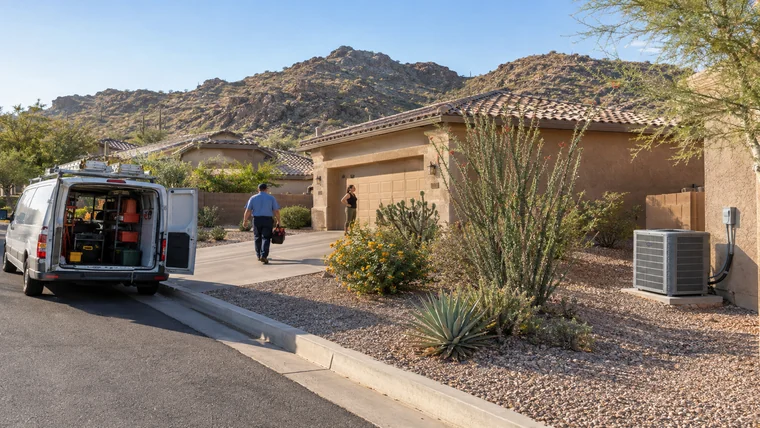
A Sonoran Foothills house built in 2005 is now at the point where the air conditioning decision stops being hypothetical. Twenty-two Phoenix summers is a long service life for equipment that runs from April into October, and the national lifespan tables quoting fifteen to twenty years were not written for a climate where a condenser sits in triple-digit ambient air for six months a year. What we see across north Phoenix subdivisions built between 2004 and 2008 is a predictable pattern: original systems failing outright, or second-generation equipment installed around 2015 now reaching mid-life. This page covers what a service call costs here, what replacement actually runs, what to check before approving a four-figure repair, and which rebates are genuinely payable in 2026 — including the one that most quote sheets circulating in the Valley still get wrong. Sonoran Foothills sits in what is typically APS territory, though that varies by address along the I-17 corridor, and your electric bill settles it.
- Sonoran Foothills homes date from roughly 2004 to 2008, putting original equipment at 18 to 22 years old — the prime replacement window in a climate with an April-to-October cooling season.
- A diagnostic is $69.95 weekdays 8am–6pm and $99.95 outside those hours, credited toward the repair, with no trip fee at any distance on the I-17 corridor.
- Installed replacement runs $5,000–$7,000 for three tons, $6,000–$8,000 for four and $7,000–$10,000 for five; heat pumps carry no premium and a crane is $400–$600.
- APS ended residential AC and heat pump rebates on January 1, 2026; SRP Cool Cash still pays a reported $75–$225 per ton on AHRI-listed SEER2 15.2+ equipment, filed within six months.
- The federal 25C credit does not apply to equipment placed in service in 2026.
- Coil cleaning at $150 and coil replacement at $2,200–$2,600 are different jobs; a quote saying only “coil” should be clarified before you sign it.
What does a service call cost in Sonoran Foothills, and how does scheduling work?
The flat rate is the part worth reading twice. Sonoran Foothills sits near the northern edge of the Phoenix metro, and plenty of companies price that distance in — a zone surcharge, a fuel fee, or a quiet preference for closer work when July gets busy. We charge the same $69.95 on Sonoran Parkway as in Ahwatukee or Anthem, and there is no travel fee at any distance we serve.
What we will not publish is a same-day guarantee. Homeowners who have called around on a 112-degree afternoon consistently hear promises that the dispatch board cannot keep, and we would rather tell you 12 to 24 hours and beat it. Genuine emergencies — no cooling at all, a house with an infant or an elderly resident in it — do get moved, and overnight dispatch is real rather than a marketing line.
Ongoing, our maintenance plan is $25 per month per unit, which in a 2004–2008 house with two systems is worth pricing as two. Labour warranty runs two years on new equipment and one year on repairs. Financing is available through a third-party lender and is credit-dependent; choosing it does not change the price of the job by a dollar. A quote review is free, needs no site visit, and we will send our read back however suits you.
What does AC replacement cost for typical Sonoran Foothills homes?
Sizing is where north Phoenix replacements go wrong most often. A 2004-era builder specification was not a Manual J calculation, and twenty years of added shade, new windows or a converted room changes the load either way. ACCA's Manual J procedure is the standard, and it is not academic: SRP's own rebate terms require installed capacity within 15 percent or half a ton of the calculated load. Oversizing by a ton in the Valley buys you short cycling and poor humidity control during monsoon weeks, not extra comfort.
Two things about the build era move the price. First, refrigerant: equipment from this period is R-410A or, in the earliest builds, R-22, and new systems now ship with R-454B under the EPA's HFC phase-down, which is why line-set condition and evacuation matter more on a changeout than they used to. Second, permits. The City of Phoenix exempts most like-for-like outdoor equipment swaps under five tons, so a straight condenser-and-coil replacement here often needs none, while duct or electrical work more often does. We pull one when the work requires it.
Placement is the other Sonoran Foothills-specific variable. Master-planned communities commonly restrict where a condenser may sit, what screening it needs and how visible it can be from the street — and unlike a rooftop swap in an older central Phoenix neighborhood, moving a pad in a covenanted subdivision is a design-guidelines question before it is a mechanical one. We ask for your HOA's current guidelines rather than guessing, because they vary by community and by amendment date. For a casita, garage or added room, a mini-split runs $1,000–$3,000 per head.
What pushes a job above the typical range
These are the conditions that can push a job above the ranges above. We tell you before the work starts, not after — and they are worth checking on any contractor's quote, not just ours.
- Crane access on rooftop package units
- The existing line set cannot be reused with the new equipment
- Electrical panel lacks capacity or needs breaker work
- Ductwork is undersized, leaking, or hard to reach in the attic
- Code upgrades on an older home - grandfathering ends when equipment is replaced
- Refrigerant contamination, or an R-22 system needing conversion
Installed system price by capacity — and where SEER2 15.2 falls
AZ Trusted Air published ranges, same in Sonoran Foothills as anywhere in the Phoenix metro. The split marks the efficiency level SRP's Cool Cash rebate requires.
Sonoran Foothills is typically APS territory, and APS ended residential equipment rebates on January 1, 2026 — the SEER2 15.2 threshold pays only in SRP territory. Confirm your provider on your bill.
| Item | Range |
|---|---|
| 3-ton system | $5,000 – $7,000 |
| 4-ton system | $6,000 – $8,000 |
| 5-ton system | $7,000 – $10,000 |
What should Sonoran Foothills homeowners check before approving a major AC repair?
Repair prices are not mysterious. A capacitor is $50–$200, a contactor $100–$200, a condenser fan motor $600–$1,200, a blower motor $750–$1,800 and a compressor $800–$4,000. That compressor spread is the tell: a warranty-covered compressor where you pay labour sits near the bottom, an out-of-warranty one on ageing equipment sits at the top. A quote that names no part and no reading is not a diagnosis.
Watch the coil line specifically. Coil cleaning is $150; coil replacement is $2,200–$2,600. They are different jobs roughly two thousand dollars apart, and after a monsoon season of dust loading, a condenser coil that looks finished is very often one that has never been properly washed. If a quote says only “coil,” ask which.
Then apply the age test. At 18 to 22 years, a repair over about $1,500 is usually competing with a replacement that carries a warranty, and if your system still runs R-22 the calculation is harder again — production and import of R-22 ended in 2020 under the EPA's Section 608 framework, so recovered and reclaimed stock is what remains. Verify any contractor's licence and complaint history at the Arizona Registrar of Contractors before you sign, and use our AC age checker or a repair-or-replace consultation if the numbers are close.
A Phoenix cooling season running April into October means an 18-year-old system here has done more compressor hours than a 25-year-old system in a mild climate. That is why we start with the age and the refrigerant rather than the logo on the cabinet: the same repair that is obviously worth doing on a 2015 install is often a poor bet on original 2005 equipment, and the earliest homes in this era can still be on R-22, which has not been produced or imported since 2020.
Which rebates can Sonoran Foothills residents claim on a replacement, and who handles the paperwork?
This is the claim we most often have to correct on quote sheets in north Phoenix. APS discontinued its residential equipment rebate program effective January 1, 2026, following an Arizona Corporation Commission decision cutting the efficiency-program budget. What survives on the APS side is Cool Rewards, a smart-thermostat demand-response credit reported at $50 on enrollment plus roughly $35 per summer season — useful, but not a rebate on an air conditioner. If a bid you are holding subtracts an APS equipment rebate in 2026, ask to see it in writing.
SRP's Cool Cash program is the one still paying on equipment: reported at $75 per ton for single-stage, $150 per ton for multi-stage and $225 per ton for variable-capacity systems and inverter-driven mini-splits, which tops out around $1,125 on a five-ton variable system. Equipment must be AHRI-listed at SEER2 15.2 or better, both the indoor and outdoor halves of a split system must be replaced, a Manual J is required for single-stage equipment, and the application is due within six months of installation. Amounts change between program cycles — confirm the current figure with SRP before you rely on it.
Two further notes. The federal 25C credit does not apply to anything placed in service in 2026; it expired at the end of 2025. And SRP's separate duct test-and-repair rebate covers 75 percent of qualifying costs up to $400 on a single-family detached home, which is worth knowing given how much attic duct leakage a twenty-year-old house tends to hide. We prepare and submit whatever your territory actually pays — see our rebate concierge.
Sources and further reading
The figures and requirements on this page draw on the following public sources. We link them so you can check anything here yourself.
- SRP — Cool Cash per-ton amounts, the SEER2 15.2 threshold and the six-month filing window
- APS — current residential program status after the January 1, 2026 rebate discontinuation
- City of Phoenix Planning & Development — when a mechanical permit is required for a residential change-out in north Phoenix
- ACCA (Air Conditioning Contractors of America) — Manual J load calculation, the correct basis for sizing a replacement
- U.S. Environmental Protection Agency — Section 608 — refrigerant handling rules, the R-22 phase-out and the HFC phase-down
- Arizona Registrar of Contractors — licence verification and complaint history before you sign a contract
- AHRI Directory — confirm quoted indoor and outdoor units are a certified matched system at the rated SEER2
No site visit, no obligation, no salesperson calling to ask when they can stop by. Same flat rate across the Phoenix metro and surrounding communities at any distance — call (623) 252-6403, answered live 24 hours a day.