Who provides AC repair and replacement in Seville?
The short answer: AZ Trusted Air repairs and replaces air conditioning throughout Seville and the rest of Gilbert under Arizona ROC licence 317368. A diagnostic is $69.95 Monday to Friday, 8am to 6pm, credited toward any repair we perform. A live person answers our phone at (623) 252-6403 twenty-four hours a day, and there is no travel fee anywhere in the Phoenix metro.
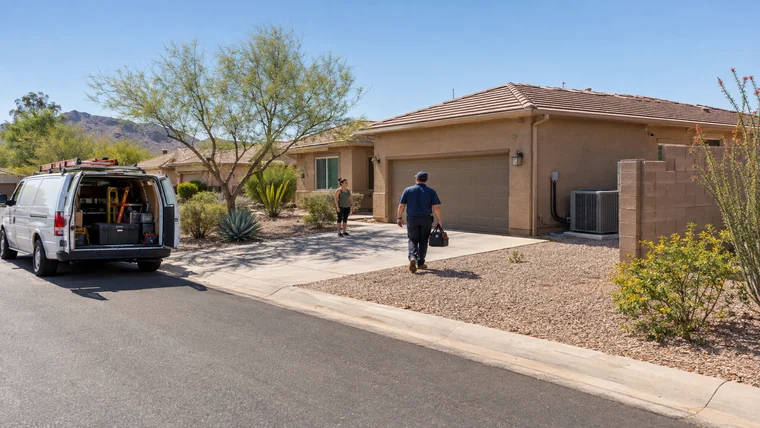
Seville's houses went up mostly between 2001 and 2010, which puts nearly every original air conditioner in the neighborhood somewhere between fifteen and twenty-four years old right now. That is the prime replacement window, and not because a calendar says so. A Phoenix-area cooling season runs April into October, so a condenser sitting on a Gilbert side yard logs more compressor hours in six years than one in a moderate climate logs in ten. National lifespan tables quoting fifteen to twenty years were not written for equipment holding a house at 75 degrees against a 115-degree design day.
What that means in practice is that most Seville homeowners are no longer asking whether the original system gets replaced. They are asking when, at what price, and whether the part that failed last week is worth fixing first. Below is what we charge, what the Town of Gilbert requires on a changeout, what SRP's rebate actually pays in 2026, and the checks worth running before you approve a four-figure repair.
- Seville was built roughly 2001–2010, so original equipment is now 15–24 years old — the prime replacement window for this community.
- SRP Cool Cash pays $75 per ton single-stage, $150 multi-stage and $225 variable-capacity on AHRI-listed SEER2 15.2+ equipment, to a $1,125 ceiling.
- On a split system both the condenser and the indoor air handler must be replaced; a condenser-only swap does not qualify for the rebate.
- Single-stage rebates require Manual J, with installed capacity certified within 15% or a half ton of the calculated load.
- APS ended residential AC rebates on 1 January 2026, and the federal 25C credit is repealed for equipment placed in service in 2026.
- Gilbert Development Services requires a mechanical permit for HVAC changeouts, pulled by an ROC-licensed mechanical contractor — stricter than Phoenix's exemption for many small like-for-like swaps.
- Diagnostic is $69.95 weekdays 8am–6pm and $99.95 outside those hours, credited toward repair; quote review is free and there is no trip fee at any distance.
- Coil cleaning is $150 and coil replacement is $2,200–$2,600 — ask which one a quote means before signing it.
What does a service call cost in Seville, and how does scheduling work?
The fee structure is short enough to publish in full. A diagnostic is $69.95 on weekdays, $99.95 evenings and weekends, and it comes off the bill if you have us do the work. A second opinion costs the same and is credited the same way, and the written report is yours whether you hire us or not. A quote review is free, needs no site visit, and can be sent however suits you. Our maintenance plan is $25 per month per unit.
Scheduling in the Southeast Valley is seasonal in a way that is worth being honest about. In February a Seville call is routine. In the second week of July, when a run of 115-degree days pushes failures across Gilbert simultaneously, every competent shop in the area is working a queue. We answer the phone with a person 24 hours a day and we dispatch overnight when a call genuinely warrants it — a house with no cooling and an infant or an elderly resident is a different call from a thermostat that needs reprogramming. We do not publish a same-day guarantee, because in a Phoenix July that is a promise widely made and rarely kept.
One flat rate applies across the entire Phoenix metro and surrounding communities, from Seville out to the Pinal corridor. No travel fee, no trip charge, no zone pricing, at any distance. If you are on a time-of-use plan, ask the technician about pre-cooling while he is there; shifting the bulk of your cooling to before the on-peak window costs nothing to try and the equipment does that work at lower outdoor temperatures.
What does AC replacement cost for typical Seville homes?
Those ranges are installed prices, not equipment-only teasers. What moves a job within its range is efficiency tier first, then condition: a line set that cannot be reused, an electrical change, a return that was undersized when the house was framed. Larger Seville homes with two systems are two jobs, and the second one is usually cheaper per ton. Mini-splits run $1,000 to $3,000 per indoor head, which is the route we take for a converted garage or an add-on room the original trunk never served. If your home has a rooftop package unit rather than a split system, crane service is $400 to $600 and billed separately.
Sizing is where money quietly gets wasted here. A 115-degree design temperature means the load calculation matters more in Gilbert than almost anywhere, and oversizing does not buy you margin — it buys short cycling, poor humidity control during monsoon weeks, and a compressor that starts more often than it needs to. ACCA Manual J is the correct basis, and SRP's own rebate paperwork enforces it: on single-stage equipment the installer must certify the load was estimated per Manual J or equivalent and that installed capacity is within 15% or a half ton of that estimate, with airflow within 10% of rated and charge within 5% of specification.
One thing that has changed since Seville was built: new equipment now ships with R-454B rather than R-410A, under the EPA's phase-down of higher-GWP refrigerants. That affects what can and cannot be mixed with your existing indoor coil and line set, and it is a reason a condenser-only swap on a 2000s system is often a false economy. Our R-454B installation page covers what the change means at the equipment level.
What pushes a job above the typical range
These are the conditions that can push a job above the ranges above. We tell you before the work starts, not after — and they are worth checking on any contractor's quote, not just ours.
- Crane access on rooftop package units
- The existing line set cannot be reused with the new equipment
- Electrical panel lacks capacity or needs breaker work
- Ductwork is undersized, leaking, or hard to reach in the attic
- Code upgrades on an older home - grandfathering ends when equipment is replaced
- Refrigerant contamination, or an R-22 system needing conversion
Installed system price by tonnage — and where SRP's SEER2 15.2 threshold falls
AZ Trusted Air published ranges. Seville is typically SRP territory; confirm yours on your bill.
SRP Cool Cash pays $75 per ton single-stage, $150 multi-stage and $225 variable-capacity on AHRI-listed SEER2 15.2+ equipment, to a $1,125 ceiling. Confirm current amounts and deadlines with SRP before relying on them.
| Item | Range |
|---|---|
| 3-ton system | $5,000 – $7,000 |
| 4-ton system | $6,000 – $8,000 |
| 5-ton system | $7,000 – $10,000 |
What should Seville homeowners check before approving a major AC repair?
Start with the part and its price. A capacitor is $50 to $200 and a contactor $100 to $200 at our published rates — neither is a reason to replace a system. A condenser fan motor is $600 to $1,200, a blower motor $750 to $1,800, and a compressor $800 to $4,000. That last spread is not vagueness: a compressor still covered by a parts warranty where you pay labour sits near the bottom, and an out-of-warranty unit on legacy refrigerant sits at the top.
Refrigerant type is the check that decides most Seville cases. R-22 was permitted in new equipment until 1 January 2010, so a house built in the first half of Seville's build era that is still on original equipment may well hold R-22 — and reclaimed R-22 is expensive enough that a significant leak repair on a twenty-year-old system rarely earns its cost back. Homeowners who ask what refrigerant their system uses before approving a repair consistently make a better decision than those who only ask what the repair costs. The nameplate on the condenser states it, and our R-22 replacement page and AC age checker both help pin the date down.
Then check whether the diagnosis itself holds. Unlike a plumbing failure you can see, an HVAC diagnosis is a set of readings taken by one person, and there is no visible evidence left behind for you to judge. That is exactly why a $69.95 second opinion with a written report is cheap next to a four-figure decision, and why on a replacement quote it is worth confirming in the AHRI Directory that the quoted indoor and outdoor units are a certified matched pair.
A Seville house finished in 2004 that is still on its original outdoor unit has now run twenty-two consecutive Phoenix-area cooling seasons, each one roughly April into October. A house finished in 2010 is at sixteen. Both sit inside the 15–24 year window where the decision stops being about this year's repair and starts being about the next ten summers — which is why we quote the repair and the replacement side by side rather than pushing one. The 2004 house has a second issue the 2010 house does not: R-22 was still legal in new equipment until 1 January 2010, and a refrigerant-related failure on that generation of system is priced by the refrigerant, not by the labour.
Which rebates can Seville residents claim on a replacement, and who handles the paperwork?
The per-ton structure is the part most homeowners have not seen spelled out, and it changes what the right purchase is. On a four-ton replacement, single-stage equipment earns $300, multi-stage $600, and variable-capacity $900; a five-ton variable-capacity system reaches the programme's $1,125 ceiling. Inverter-driven mini-splits qualify at the variable-capacity rate. Every tier requires the equipment to be AHRI-listed at SEER2 15.2 or higher and installed by an Arizona-licensed contractor, so the rebate is effectively a floor on installation quality as well as on efficiency.
The conditions matter as much as the amount. On a split system both the condenser and the indoor air handler must be replaced — a condenser-only swap does not qualify, which is the single most common way a Gilbert homeowner loses the rebate. Single-stage installs need the Manual J documentation. The application is due within six months of installation, SRP may inspect the installed unit, and the rebate can be assigned to the contractor so it comes off your invoice instead of arriving later by cheque. Programme end dates have been extended more than once, so confirm the current deadline with SRP rather than relying on any contractor's page, including this one.
Two things not to count on. APS discontinued its residential AC and heat pump rebates effective 1 January 2026 after the Arizona Corporation Commission reduced its efficiency budget, and we are not an APS Qualified Technology Installer in any case. The federal 25C tax credit is repealed for equipment placed in service in 2026 — if a quote still shows it as a line item, that quote is out of date. We also file ED3 paperwork for customers in that territory. Our rebate concierge handles the filing either way.
Sources and further reading
The figures and requirements on this page draw on the following public sources. We link them so you can check anything here yourself.
- SRP — Cool Cash rebate amounts, SEER2 15.2 threshold, Manual J certification and submission deadlines
- Arizona Registrar of Contractors — verify a contractor's licence and complaint history before work begins
- ACCA (Air Conditioning Contractors of America) — Manual J load calculation, the correct basis for sizing against a 115-degree design day
- AHRI Directory — confirm the quoted indoor and outdoor units are a certified matched system at the rated efficiency
- U.S. Environmental Protection Agency — Section 608 — refrigerant handling rules, R-22 legacy equipment and the move to lower-GWP refrigerants
Send it however suits you — photo, email, whatever is easiest. No obligation and no site visit. One flat rate across the Phoenix metro and surrounding communities, with no trip charge at any distance.