Who provides AC repair and replacement in Power Ranch?
The short answer: AZ Trusted Air repairs and replaces air conditioning for Power Ranch and the rest of Gilbert, licensed under Arizona ROC 317368. We answer with a live person 24 hours a day, charge $69.95 for a weekday diagnostic, and bill the same flat rate in Power Ranch as anywhere else in the Phoenix metro — no travel fee, trip charge or zone pricing at any distance.
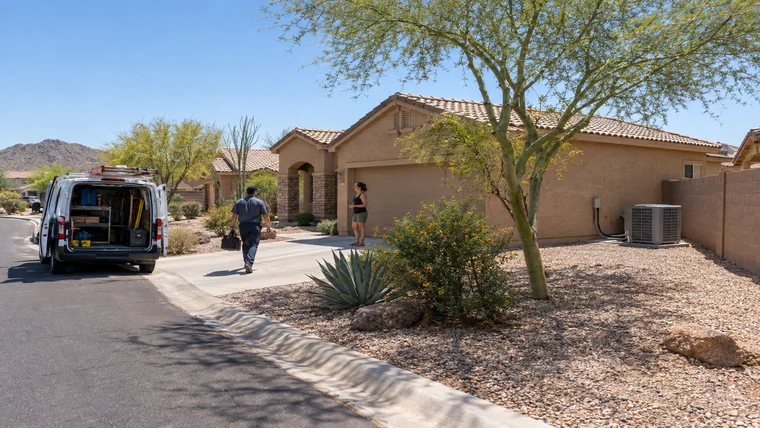
Power Ranch went up between 2000 and 2010, and that single fact explains most of the air conditioning calls we take out there. A builder system installed when the neighborhood was new is now sixteen to twenty-six years old, and in a climate where the cooling season runs April into October, that is the back half of a Valley air conditioner's working life. Homes at the earlier end of that build range were commonly fitted with R-22 equipment, which the EPA stopped allowing to be produced or imported on 1 January 2020; homes at the later end got R-410A, which is now being phased down in its turn. So the question in Power Ranch is rarely whether a system can be repaired. It is whether $1,400 spent on a twenty-year-old unit buys three more summers or three more weeks. This page sets out what that decision costs, what the estimate should contain, and where every number here comes from.
- Power Ranch was built 2000–2010, so original builder systems are now 16–26 years old — squarely in the replacement window.
- Early-build homes may still run R-22, which the EPA has barred from new production or import since 1 January 2020.
- Diagnostics are $69.95 weekdays 8am–6pm and $99.95 otherwise, credited toward the repair, with no trip fee to Gilbert.
- Installed replacement runs $5,000–$7,000 for three tons, $6,000–$8,000 for four and $7,000–$10,000 for five; heat pumps cost no more.
- SRP Cool Cash pays $75, $150 or $225 per ton by compressor type on SEER2 15.2+ equipment, up to $1,125.
- On split systems both indoor and outdoor units must be replaced to qualify, and the claim is due within six months.
- APS ended residential equipment rebates on 1 January 2026 and the federal 25C credit is repealed for 2026 installs.
- Coil cleaning is $150 and coil replacement is $2,200–$2,600 — a quote saying only “coil” needs clarifying before you sign.
What does a service call cost in Power Ranch, and how does scheduling work?
The flat rate is the part worth reading twice. Power Ranch sits in the southeast corridor, a long way from the northwest Valley, and plenty of companies price that distance in as a trip charge or a zone. We do not levy one — the visit costs the same here as it does in Casa Grande or Surprise.
| Service | Price | Notes |
|---|---|---|
| Diagnostic / service call | $69.95 | Mon–Fri, 8am–6pm; credited toward the repair |
| After-hours call | $99.95 | Evenings and weekends; also credited |
| Second opinion | $69.95 / $99.95 | Written report is yours regardless of what you decide |
| Quote review | Free | No site visit, no obligation — send it however suits you |
| Maintenance plan | $25/month per unit | Per unit matters on two-system Power Ranch floorplans |
| Compressor replacement | $800–$4,000 | Depends on warranty status, tonnage and refrigerant type |
| Travel / trip fee | None | Any distance in our service area |
On scheduling, we will not publish a same-day guarantee, and we would be sceptical of anyone in Gilbert who does during a July heat wave. What is true is that a person answers the phone at three in the morning, and that a house with no cooling, an infant or an elderly resident gets moved up rather than logged for the morning. Most non-emergency calls land within 12 to 24 hours.
One scheduling quirk belongs to this build era specifically. Two-story Power Ranch plans frequently run two systems, and homeowners often report only the one that failed. If both are original, it is worth having the technician look at the second while he is there — the labour is already on site, and equipment installed in the same month tends to fail in the same season.
What does AC replacement cost for typical Power Ranch homes?
Sizing is where Valley replacements go wrong most often, and the shortcut is the culprit: matching the tonnage on the old data plate. That number reflects what a builder specified for a spec home around 2004, and it tells you nothing about the shade trees that have grown since, the windows somebody replaced, or whether the original load calculation was ever done properly. The correct basis is an ACCA Manual J calculation run against the Phoenix-area design temperature near 115 degrees. SRP takes this seriously enough to put it in writing — its Cool Cash application requires the contractor to certify the load was estimated consistent with Manual J and that installed capacity is within 15 percent or half a ton of that estimate.
Oversizing is the failure mode here. A system too large for the house satisfies the thermostat quickly, shuts off, and never runs long enough to pull humidity out during monsoon weeks in July and August. The house reads 78 degrees and still feels clammy, and the compressor wears through short cycles it was never designed for.
Permits in Power Ranch are Gilbert's call, not Phoenix's — a distinction that trips up homeowners reading city-wide advice. Gilbert Development Services issues mechanical permits for HVAC installations, changeouts, ductwork changes and venting modifications, pulled by a contractor holding the appropriate ROC classification. We pull permits when the work requires them. Separately, community design guidelines can govern where equipment may physically sit if you are relocating a condenser or adding a mini-split line set on an exterior wall. We do not publish another association's rules, because they change and they differ by parcel — ask your association in writing before anything gets moved, not after.
What pushes a job above the typical range
These are the conditions that can push a job above the ranges above. We tell you before the work starts, not after — and they are worth checking on any contractor's quote, not just ours.
- Crane access on rooftop package units
- The existing line set cannot be reused with the new equipment
- Electrical panel lacks capacity or needs breaker work
- Ductwork is undersized, leaking, or hard to reach in the attic
- Code upgrades on an older home - grandfathering ends when equipment is replaced
- Refrigerant contamination, or an R-22 system needing conversion
Installed system price by tonnage — and where the SRP rebate threshold falls
AZ Trusted Air published ranges, same in Power Ranch as anywhere in the Phoenix metro. The split marks SEER2 15.2, the efficiency SRP's Cool Cash rebate requires.
SRP pays $75 per ton single-stage, $150 multi-stage and $225 variable-capacity on SEER2 15.2+ equipment, to a maximum of $1,125. Confirm current amounts with SRP before relying on them.
| Item | Range |
|---|---|
| 3-ton system | $5,000 – $7,000 |
| 4-ton system | $6,000 – $8,000 |
| 5-ton system | $7,000 – $10,000 |
What should Power Ranch homeowners check before approving a major AC repair?
Before approving anything over roughly a thousand dollars on a Power Ranch system, get four things in writing: the measured readings behind the diagnosis, the equipment's age and refrigerant type, whether the part is still under manufacturer warranty, and whether a coil is being cleaned or replaced. AZ Trusted Air provides a second opinion for $69.95 anywhere in the Phoenix metro, and the written report is yours either way.
Refrigerant is the first question in this community because of when it was built. If your system dates from the early Power Ranch years and runs R-22, the EPA's phase-out means no new supply has been produced or imported since 1 January 2020 — only reclaimed and stockpiled material remains, and it is priced accordingly. A leak repair plus a large R-22 charge on a twenty-year-old condenser is often more than half the cost of a new system with a fresh warranty.
Second, warranty status. Manufacturer parts warranties on this era of equipment commonly ran ten years when registered, which means most original Power Ranch systems are now outside them — but a system replaced once since the build is not, and that single fact can move a compressor from the top of our $800–$4,000 range toward the bottom. It takes a serial number and five minutes to check.
Third, read the word “coil” carefully. A coil cleaning is $150 of work. A coil replacement is $2,200–$2,600. They are separate jobs, and a line item saying only “coil” should be clarified before you sign. Monsoon dust loading is real here — a condenser that has taken several haboobs without a rinse can look, on gauges, a lot like a failing compressor.
Fourth, ask what was measured. Superheat, subcooling, capacitor microfarads against the rated value, amp draw against the data plate. A diagnosis with numbers attached can be checked by anyone; a diagnosis stated as a conclusion cannot. That is the entire premise of our second opinion, and the reason the report leaves with you whether or not we do the work.
Serial number and manufacture date, so the age claim is verifiable rather than asserted. Refrigerant type, because R-22 and R-410A lead to different economics on the same repair. Manufacturer warranty status against the serial, which can move a compressor from the top to the bottom of the $800–$4,000 range. A Manual J load against the roughly 115-degree design temperature, not the tonnage stamped on the old unit. Static pressure and duct condition in an attic that runs past 150 degrees in July. Utility of record from your bill, because SRP funds a rebate and APS no longer does.
Which rebates can Power Ranch residents claim on a replacement, and who handles the paperwork?
Three conditions catch people out. The equipment must be AHRI-listed at SEER2 15.2 or higher and installed by an Arizona-licensed contractor. On a split system both halves must be replaced — a condenser-only swap does not qualify, which is exactly the shortcut a cheap quote on a 2000s-era home tends to propose. And the application is due within six months of installation; current program terms cover installs through 30 April 2027. Amounts and dates change between program cycles, so confirm the figure against SRP directly before you rely on it.
Because the rebate scales with both tonnage and compressor type, the arithmetic can invert the obvious choice. A four-ton variable-capacity system earns $900 where a four-ton single-stage earns $300 — a $600 swing that often narrows the gap between the bottom and the top of our installed range to less than the sticker difference suggests. SRP also allows the rebate to be assigned to the contractor with a signed release, so it can come off the invoice rather than arriving as a cheque months later.
Two things we will not tell you are available. The federal 25C tax credit is repealed for equipment placed in service in 2026 — if a salesperson still quotes it, ask them to show you the current statute. And APS's residential AC and heat pump rebates ended on 1 January 2026, so if your Gilbert address turns out to be APS rather than SRP, there is no equipment rebate to claim. SRP separately funds duct testing and sealing at 75 percent of cost up to $400 for a single-family detached home, but that program requires a BPI-certified contractor; confirm eligibility with SRP before counting it into a budget.
Sources and further reading
The figures and requirements on this page draw on the following public sources. We link them so you can check anything here yourself.
- SRP — Cool Cash rebate amounts, the SEER2 15.2 threshold and the Manual J certification on the application
- Arizona Registrar of Contractors — verify ROC 317368, classification and complaint history before hiring anyone
- U.S. Environmental Protection Agency — Section 608 — R-22 phase-out and refrigerant handling rules affecting early-2000s equipment
- ACCA (Air Conditioning Contractors of America) — Manual J load calculation, the correct basis for sizing against a 115-degree design temperature
- AHRI Directory — confirm the quoted indoor and outdoor units are a certified matched system at the rated SEER2
No site visit, no obligation, no salesperson calling afterwards. Send it however suits you. One flat rate in Power Ranch and across the Phoenix metro — no travel fee, trip charge or zone pricing at any distance.