Who provides AC repair and replacement in Glendale?
The short answer: AZ Trusted Air handles AC repair and replacement across Glendale and the West Valley as a licensed Arizona contractor, ROC 317368. Diagnostics are $69.95 weekdays 8am to 6pm, $99.95 outside those hours, credited toward the repair. Installed replacement runs $5,000 to $10,000 by tonnage. A person answers our phone in Glendale around the clock, every day.
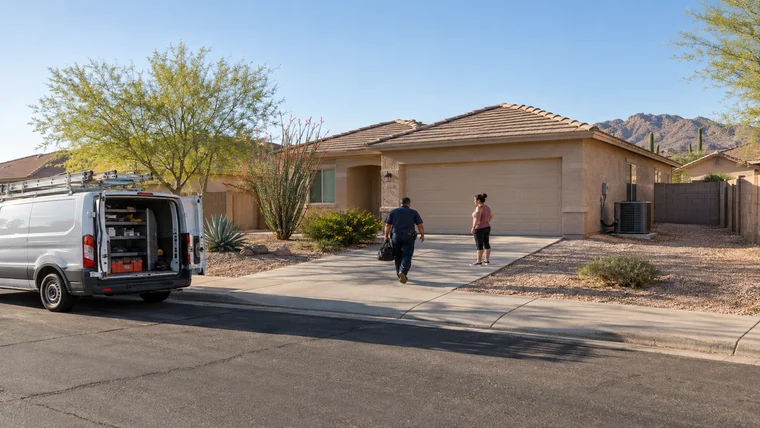
Glendale covers roughly thirty years of Valley homebuilding, and the air conditioning follows the build era more closely than the address. The 1970s stock was designed around evaporative cooling and gravity-vented gas heat, and some of it still has the capped roof jack to prove it. The 1980s and 1990s subdivisions came with the first generation of R-22 splits, most of which have been replaced once and are coming due again. The late-1990s and 2000s homes are on original equipment or a first replacement, which is exactly the window where a homeowner has to choose between one more repair and a changeout. We work all three. What follows is what we would tell a Glendale homeowner at the kitchen table: what a visit costs, what a replacement costs, what to check before approving a big repair, and which rebates are actually left in 2026 — because one of the two large Valley programs is gone.
- Diagnostics in Glendale are $69.95 weekdays 8am–6pm and $99.95 outside those hours, credited toward the repair, with no trip fee at any distance.
- Installed replacement runs $5,000–$7,000 at three tons, $6,000–$8,000 at four and $7,000–$10,000 at five; heat pumps carry no premium.
- Glendale's 1970s stock usually lands on three tons; 1990s and 2000s homes on four or five, sometimes as two smaller systems.
- SRP Cool Cash pays $75, $150 or $225 per ton by compressor type on SEER2 15.2+ equipment, up to $1,125, filed within six months.
- APS ended residential equipment rebates on January 1, 2026; only the Cool Rewards thermostat credit remains on that side.
- The federal 25C credit is not available for equipment placed in service in 2026.
- SRP's own rebate terms require installed capacity within 15% or a half-ton of a Manual J estimate — a useful standard to hold any sizing to.
- Coil cleaning is $150 and coil replacement is $2,200–$2,600; a quote saying only “coil” should be clarified before signing.
What does a service call cost in Glendale, and how does scheduling work?
The flat rate is the first thing people test. A diagnostic at a 1970s block ranch near downtown Glendale costs $69.95, the same as one at a 2000s two-story on the north side, and the same as one in Casa Grande an hour down the interstate. No trip charge, no zone pricing, no distance surcharge, and the fee is credited toward the repair if you approve one — on a $50 to $200 capacitor replacement it effectively disappears into the job.
Scheduling is where we try not to promise what a Glendale July will not allow. Someone answers our phone at two in the morning — a person, not a voicemail box — and we dispatch overnight when a call genuinely warrants it: no cooling at all, water where it should not be, a breaker that will not stay set. Typical non-emergency arrival is 12 to 24 hours. Unlike a furnace failure in a cold climate, where a household can add blankets and wait for morning, a West Valley cooling failure in July is a heat-exposure question before it is a comfort question, which is why we would rather tell you where you sit in the queue than sell a same-day guarantee we cannot keep.
Three other prices are worth knowing before you call anyone. A second opinion is the same $69.95 or $99.95, credited toward work, and the written report is yours whether you hire us or not. A quote review is free with no site visit — send the estimate however suits you and we will tell you what we think of the scope. The maintenance plan is $25 a month per unit, which in Glendale buys a coil cleaning before monsoon dust bakes onto it rather than after. Labour warranty is two years on new equipment, one year on repairs.
What does AC replacement cost for typical Glendale homes?
Capacity in Glendale tracks the build era more than the street. The single-story 1970s and early-1980s houses we work on are usually on three tons. The 1990s and 2000s subdivisions — bigger footprints, two stories, more glass — are typically four or five tons, and a fair number were built with two smaller systems instead of one large one, which means the replacement decision arrives twice. Homeowners in that stock consistently assume both systems must be done together. Usually they do not.
Sizing is the part to insist on, because the cheap way to size a Glendale replacement is to copy the tag on the old unit. That tag reflects the house as built — before the 1970s stock got dual-pane windows, before someone added attic insulation. ACCA's Manual J is the actual method, and SRP puts teeth in it: to claim a Cool Cash rebate on a single-stage system, the installing contractor certifies that the installed capacity is within 15% or a half-ton of a Manual J estimate, that airflow is within 10% of the blower's rated capacity, and that refrigerant charge is within 5% of the manufacturer's specification.
Beyond the core changeout: heat pumps cost the same as straight-cool equipment at the same tonnage, which matters more in Glendale's older stock than people expect, since some of those houses still heat with an aging gas furnace. Rooftop package units add a crane at $400 to $600. Mini-splits run $1,000 to $3,000 per head and are usually the answer for an enclosed patio, a converted garage or an Arizona room that was never on the original duct design. Duct replacement is $1,000 to $3,000. One note on current equipment: A2L systems carry a modest premium over legacy models, typically 5 to 10 percent, because of added safety sensors and spark-free components.
What pushes a job above the typical range
These are the conditions that can push a job above the ranges above. We tell you before the work starts, not after — and they are worth checking on any contractor's quote, not just ours.
- Crane access on rooftop package units
- The existing line set cannot be reused with the new equipment
- Electrical panel lacks capacity or needs breaker work
- Ductwork is undersized, leaking, or hard to reach in the attic
- Code upgrades on an older home - grandfathering ends when equipment is replaced
- Refrigerant contamination, or an R-22 system needing conversion
What should Glendale homeowners check before approving a major AC repair?
Two questions decide a repair and only one of them is about price. The first: is the part priced sanely? Here is our published list, which you can hold against anybody's quote.
| Repair | Our price |
|---|---|
| Capacitor | $50 – $200 |
| Contactor | $100 – $200 |
| Condenser fan motor | $600 – $1,200 |
| Blower motor | $750 – $1,800 |
| Compressor | $800 – $4,000 |
| Coil cleaning | $150 |
| Coil replacement | $2,200 – $2,600 |
| Duct replacement | $1,000 – $3,000 |
The second question is whether the diagnosis is right, and in Glendale that often comes down to refrigerant. Plenty of homes built here in the 1990s and early 2000s are still on original R-22 equipment, and that changes the arithmetic: an out-of-warranty R-22 compressor sits at the top of that $800 to $4,000 range, while a warranty-covered compressor where you pay labour only sits near the bottom. Newer systems are R-410A, which is phasing down as well — manufacturers stopped producing R-410A residential equipment as of January 1, 2025 under the EPA's Technology Transitions rule, which caps new residential equipment at 700 GWP, while servicing and refilling existing R-410A systems remains legal. None of that makes a repair wrong. It makes the ten-year outlook worth pricing.
Three checks cost you nothing. Look up your outdoor unit's serial number with the manufacturer before approving a part; missed warranty coverage on a ten-year-old system is the difference between paying for a compressor and paying for labour. Ask whether a quote means coil cleaning ($150) or coil replacement ($2,200 to $2,600), because those are different jobs about two thousand dollars apart and the word "coil" alone hides which one. And verify any contractor's licence and complaint history with the Arizona Registrar of Contractors — ours is ROC 317368.
Nameplate tonnage and serial date on the existing unit. Manual J load for the house as it stands today, not as built. Duct condition and return sizing in the attic. Electrical disconnect, breaker size and whip condition. Utility on the bill — APS or SRP — and the AHRI listing for the proposed matched system. Anything that would push the job above its published range is documented and priced before work starts.
Which rebates can Glendale residents claim on a replacement, and who handles the paperwork?
SRP's Cool Cash is the one equipment rebate still standing for a Glendale replacement, and it pays by capacity and by compressor type: $75 per ton on single-stage systems, $150 per ton on multi-stage, and $225 per ton on variable-capacity systems and inverter-driven mini-splits, up to $1,125 on a 5-ton. Equipment must be AHRI-listed at SEER2 15.2 or better and installed by an Arizona-licensed contractor, and on split systems both the condenser and the air handler must be replaced — a condenser-only swap does not qualify. Applications must be submitted within six months of installation, and SRP sets an install-by date each program cycle, so confirm the current one at srpnet.com before you count on it.
The other half of the Glendale story is the utility split. APS discontinued its residential AC and heat pump rebate program effective January 1, 2026, after the Arizona Corporation Commission cut its efficiency-program budget roughly in half in a late-2025 decision. What survives on the APS side is Cool Rewards, a smart-thermostat demand-response credit, not an equipment-purchase rebate. We are also not an APS Qualified Technology Installer, so we will never promise you an APS equipment rebate — and in 2026 nobody honestly can. If a quote in your hands shows one, ask to see the program terms in writing.
Two more things. The federal 25C credit is not available for equipment placed in service in 2026 — the federal 25C tax credit is gone for 2026 installations — so any quote discounting itself by $600 or $2,000 on that basis is wrong. And which utility serves you is genuinely an address question here: Glendale is typically split between APS and SRP territory, and neighbouring subdivisions can differ, so your electric bill is the authority rather than your neighbour. We check it before rebate numbers go on a proposal, and our rebate concierge files the SRP application for you.
SRP Cool Cash by compressor type — 3-ton to 5-ton Glendale replacement
Per-ton amounts on AHRI-listed SEER2 15.2+ equipment. Bars show the 3-ton figure to the 5-ton figure.
SRP pays by ton and by compressor type, so the rebate grows with both size and system quality. Applies to SRP-served Glendale addresses only; APS ended residential equipment rebates on January 1, 2026. Confirm current amounts and the install-by date with SRP before relying on them.
| Item | Range |
|---|---|
| Single-stage, $75/ton | $225 – $375 |
| Multi-stage, $150/ton | $450 – $750 |
| Variable-capacity, $225/ton | $675 – $1,125 |
Sources and further reading
The figures and requirements on this page draw on the following public sources. We link them so you can check anything here yourself.
- SRP — Cool Cash per-ton amounts, the SEER2 15.2 threshold, Manual J certification and the current install-by date
- APS — status of residential efficiency programs after January 1, 2026 and Cool Rewards thermostat terms
- ACCA (Air Conditioning Contractors of America) — Manual J load calculation, the correct basis for sizing a Glendale replacement
- AHRI Directory — confirm a quoted condenser and air handler are a certified matched system at the rated SEER2
- U.S. Environmental Protection Agency — Section 608 — refrigerant handling rules and the R-410A phase-down affecting 1990s and 2000s equipment
- Arizona Registrar of Contractors — licence verification and complaint history — AZ Trusted Air LLC is ROC 317368
No site visit, no obligation. Text a photo or email the estimate and we will tell you what the scope is missing. One flat rate across Glendale, the West Valley and the rest of the Phoenix metro — no trip fee at any distance. (623) 252-6403.