Who provides AC repair and replacement in Fulton Ranch?
The short answer: AZ Trusted Air repairs and replaces air conditioning in Fulton Ranch and across Chandler, licensed under Arizona ROC 317368. Most homes here were built between 2005 and 2012, which puts original equipment at 14 to 21 years old — the prime replacement window. Diagnostics are $69.95 weekdays, credited toward any repair we perform, and a person answers our phone 24 hours a day.
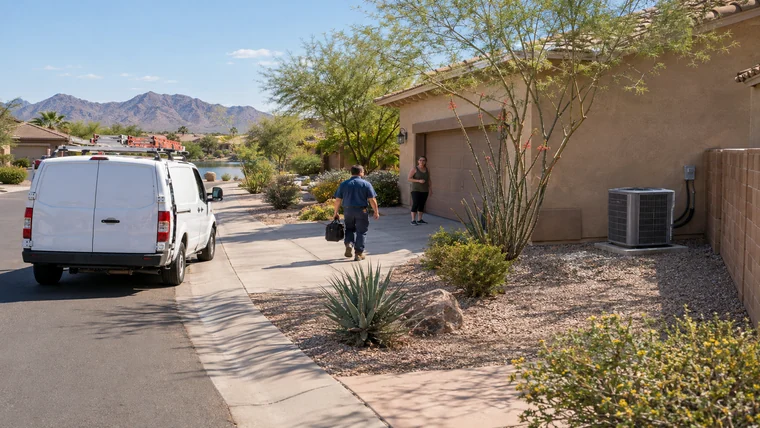
Fulton Ranch sits in the southeast corner of Chandler, and nearly every house in it went up between 2005 and 2012. That single fact tells us more about the air conditioning we will find there than anything else we could know before we arrive. A 2007 system is nineteen years old now, and it has spent every one of those years working a Phoenix cooling season that opens in April and does not let go until October — close to double the annual run hours the national lifespan tables assume. Those tables say fifteen to twenty years. In the Valley the honest number is nearer twelve to seventeen, which puts the original equipment across this subdivision squarely inside its replacement window. So most calls we take out here are not simple repairs. They are decisions: spend nine hundred dollars on a system with three summers left in it, or replace it and take the SRP rebate. This page lays out what each path costs, what to check before you approve either one, and who files the paperwork.
- Fulton Ranch was built out between 2005 and 2012, so original equipment is 14 to 21 years old — inside the replacement window, not approaching it.
- A Phoenix cooling season running April into October puts roughly double the run hours on a system that national 15-to-20-year lifespan tables assume.
- Installed replacement runs $5,000–$7,000 for three tons, $6,000–$8,000 for four and $7,000–$10,000 for five, with no heat-pump premium and no crane charge on a split system.
- SRP Cool Cash pays $75, $150 or $225 per ton by compressor type on SEER2 15.2+ equipment, up to $1,125; both indoor and outdoor units must be replaced on a split system.
- The SRP application is due within six months of installation, single-stage claims need Manual J calculations, and the current program accepts installs through April 30, 2027.
- APS ended residential AC and heat-pump equipment rebates on January 1, 2026, and the federal 25C credit is not available for systems placed in service in 2026.
- Coil cleaning at $150 and coil replacement at $2,200–$2,600 are different jobs; on 2005-era equipment, which one a quote means changes the whole decision.
- Diagnostics are $69.95 weekdays and $99.95 outside those hours, credited toward the repair, with no trip fee to Fulton Ranch or any other address we serve.
What does a service call cost in Fulton Ranch, and how does scheduling work?
The $69.95 buys a measurement-based diagnosis rather than an opinion: static pressure, superheat and subcool, capacitor microfarads against the nameplate rating, temperature split at the nearest and the furthest register. You get the numbers in writing. We charge for it for the same reason a free estimate is free — a free visit is a sales visit, and it has to earn its keep somewhere in the job. Ours is credited against any repair we perform, so if you go ahead it costs you nothing. That price holds at every address we serve: no trip charge, no zone pricing, no distance surcharge.
Scheduling in a Chandler July is honest arithmetic. A person answers our phone at every hour of the day and night, and we dispatch overnight when a call genuinely warrants it — an infant in the house, an elderly resident, indoor temperatures still climbing after dark. What we will not do is publish a same-day guarantee. In the second week of July every company in the southeast Valley is fielding more calls than it has trucks, and the ones promising a two-hour window are reading from a script. Typical non-emergency arrival is 12 to 24 hours, and we tell you which one you are.
Homeowners who call us in August after a week of borderline cooling almost always describe the same sequence: the house held 78 in May, drifted to 80 in June, and stopped recovering overnight in July. That is rarely a sudden failure. On 2005-to-2012 equipment it is usually a slow refrigerant leak, a condenser coil loaded with monsoon dust, or duct leakage in an attic sitting above 150°F. Our $25-per-month-per-unit maintenance plan exists to catch the first two in April instead of August.
What does AC replacement cost for typical Fulton Ranch homes?
Where a Fulton Ranch job lands inside its range comes down to four things: efficiency tier, the condition of the existing line set, whether the disconnect and breaker still satisfy code for the new equipment, and access. The lower half of each range is equipment at or near the regional minimum — for split air conditioners in the Southwest region that is SEER2 14.3 — and the upper half clears SEER2 15.2, the level SRP's rebate requires. Because that rebate is paid per ton, the step up is frequently cheaper on net than it looks on the invoice.
Sizing is where we part company with a lot of quotes in this corridor. ACCA Manual J for southeast Chandler is run against a design temperature near 110°F, not the 115°F you read off a bank sign at four in the afternoon, and a load estimate built on square footage alone routinely lands half a ton to a full ton high. An oversized system in a 2008 house short-cycles, never runs long enough to pull humidity out during monsoon week, and wears its compressor out faster than the one it replaced. SRP asks for Manual J calculations on single-stage rebate applications for precisely that reason.
One era-specific point is worth knowing. Unlike the 1990s Valley housing stock still limping along on R-22, a Fulton Ranch system installed in 2008 is almost certainly R-410A — which sounds like good news and is now its own problem. Under the EPA's AIM Act phase-down, new residential equipment has moved to lower-GWP refrigerants such as R-454B, and R-410A production quotas keep shrinking. That does not strand your system, but the cost of charging a leaking 410A unit rises every year, and it moves the repair-or-replace line on equipment already 14 to 21 years old.
What pushes a job above the typical range
These are the conditions that can push a job above the ranges above. We tell you before the work starts, not after — and they are worth checking on any contractor's quote, not just ours.
- Crane access on rooftop package units
- The existing line set cannot be reused with the new equipment
- Electrical panel lacks capacity or needs breaker work
- Ductwork is undersized, leaking, or hard to reach in the attic
- Code upgrades on an older home - grandfathering ends when equipment is replaced
- Refrigerant contamination, or an R-22 system needing conversion
Installed system price by tonnage — and where SRP's rebate threshold falls
AZ Trusted Air published ranges, identical at every Fulton Ranch address. The split marks SEER2 15.2, the efficiency level SRP Cool Cash requires.
SRP Cool Cash pays per ton: $75 single-stage, $150 multi-stage, $225 variable-capacity, on SEER2 15.2+ equipment, to a maximum of $1,125. Amounts change between program cycles — confirm current terms at srpnet.com before relying on them.
| Item | Range |
|---|---|
| 3-ton system | $5,000 – $7,000 |
| 4-ton system | $6,000 – $8,000 |
| 5-ton system | $7,000 – $10,000 |
What should Fulton Ranch homeowners check before approving a major AC repair?
Start with age against the size of the bill. On a nineteen-year-old system a $50 to $200 capacitor or a $100 to $200 contactor is almost always worth doing — parts fail, machines keep running. A $600 to $1,200 condenser fan motor is usually still a repair. Where it turns is the $2,200 to $2,600 coil replacement and the $800 to $4,000 compressor: spend that on equipment already inside its replacement window and you have bought three or four summers at roughly half the cost of a system that would have given you fifteen.
Get the model and serial numbers before you approve anything, and ask what the manufacturer warranty status actually is. Equipment of this vintage often carried a ten-year parts warranty that only applied if somebody registered it after installation — and on builder-installed systems in a 2005-to-2012 subdivision, registration was frequently nobody's job. A covered compressor where you pay labour only sits at the bottom of that range; the identical part uncovered sits near the top. Verify that a quoted replacement is a certified matched indoor and outdoor pair in the AHRI Directory, not two boxes assumed to work together.
Two more checks cost nothing. Anyone adding refrigerant must be EPA Section 608 certified, and under those rules a leak is meant to be found and repaired rather than topped off every spring; a quote that says “add refrigerant” with no leak search is the conversation to have before you pay. Then confirm the licence — ours is Arizona ROC 317368, and the Arizona Registrar of Contractors publishes licence status and complaint history for anyone you are considering. Chandler is its own permitting jurisdiction under the 2024 International Mechanical Code, and we pull permits where the work requires one.
Nameplate date and model or serial decode, so age is a fact rather than a guess. Refrigerant type, because R-410A changes the cost of every future charge. Manufacturer warranty registration status, which decides whether a compressor is a labour-only job or a four-figure one. Capacitor microfarads against the nameplate rating. Condenser coil condition after monsoon season. Static pressure and temperature split at the furthest register, which is where attic duct leakage shows up first. Every reading goes in the written report, and the report is yours whether you hire us or not.
Which rebates can Fulton Ranch residents claim on a replacement, and who handles the paperwork?
SRP's Cool Cash rules matter more than the headline figure. Equipment must be AHRI-listed at SEER2 15.2 or better and installed by an Arizona-licensed contractor. On a split system both the indoor air handler and the outdoor condenser have to be replaced — a condenser-only swap does not qualify, and that is the single most common way a Chandler homeowner loses a rebate they assumed they had. Single-stage applications require Manual J load calculations submitted with the paperwork. The application is due within six months of installation, and the current program accepts installs through April 30, 2027.
We file it. You should still read the terms yourself at srpnet.com before signing anything, because SRP revises amounts and thresholds between program cycles, and a figure printed on this page in September is not a promise about December. If your address turns out to be APS rather than SRP — territory varies house by house in this part of Chandler, and your bill names yours — the answer changes: APS ended its residential AC and heat-pump equipment rebates on January 1, 2026, and we are not an APS Qualified Technology Installer. We will not promise you an APS rebate.
Two footnotes. The federal 25C credit that used to pay 30% of qualifying equipment cost is not available for systems placed in service in 2026 — anyone still using it to close a sale is quoting an expired rule. And SRP runs a separate duct program covering 75% of testing and qualifying sealing work, up to $400 for a single-family detached home, with its own contractor certification requirement. On a house whose attic ducts have been baking since 2008, that one is often worth more per dollar than the equipment rebate.
Sources and further reading
The figures and requirements on this page draw on the following public sources. We link them so you can check anything here yourself.
- SRP — Cool Cash rebate amounts, the SEER2 15.2 threshold, and program deadlines
- ACCA (Air Conditioning Contractors of America) — Manual J load calculation, the correct basis for sizing a Chandler replacement
- U.S. Environmental Protection Agency — Section 608 — refrigerant handling rules and the R-410A phase-down affecting 2005-era systems
- Arizona Registrar of Contractors — licence verification and complaint history — ours is ROC 317368
- AHRI Directory — confirm a quoted indoor and outdoor unit form a certified matched system
- U.S. Department of Energy — regional efficiency standards, including the SEER2 minimum for the Southwest
Send it whichever way suits you — text a photo, email it, read it down the phone. No obligation, no site visit, and nobody will call to ask when a salesperson can stop by. One flat rate across the Phoenix metro and surrounding communities, at any distance.