Heat Pump Repair in Phoenix, AZ: What Fails, What It Costs, Who Can Fix It
A heat pump is an air conditioner that also heats, with extra parts that can fail. Here are the signs, prices, rules and license checks.
AZ Trusted Air Editorial Team · Licensed Arizona HVAC contractor · Arizona ROC #317368 · Updated
Reviewed by Brian Michael Cline, Qualifying Party, Arizona ROC #317368
Heat pump repair in Phoenix is done by contractors licensed by the Arizona Registrar of Contractors in the air conditioning class, such as R-39 or CR-39. Most repairs replace one part: a capacitor, contactor, fan motor, coil or compressor. Federal rules allow repairing an existing R-410A system, including a new compressor or condensing unit. Replacing the outdoor unit and indoor coil together counts as a new system, which must use a lower-GWP refrigerant if installed after January 1, 2026.
A heat pump cools all summer and reverses to heat in winter, so its outdoor unit works in both seasons. Whether it quits in July or blows cool air in January, the questions are what broke, what it costs, and whether it is worth fixing.
Key takeaways
- Arizona's R-39 license covers installing and repairing comfort air conditioning, including heating; CR-39 adds commercial work.
- A contractor license is required when labor and materials exceed $1,000 or the job needs a permit.
- Replacing both the condensing unit and indoor coil creates a new system, which must use refrigerant with a GWP under 700 if installed after January 1, 2026.
- U.S. production and import of R-22 ended January 1, 2020, but existing R-22 systems can still be serviced.
- A heat pump defrost cycle typically lasts 5 to 15 minutes; constant auxiliary heat signals a problem.
- Phoenix exempts in-kind outdoor unit swaps of 5 tons or less from permits, but indoor replacements need one.
Every figure in the quick answer and the takeaways is cited to its source in the sections below and listed under Sources.
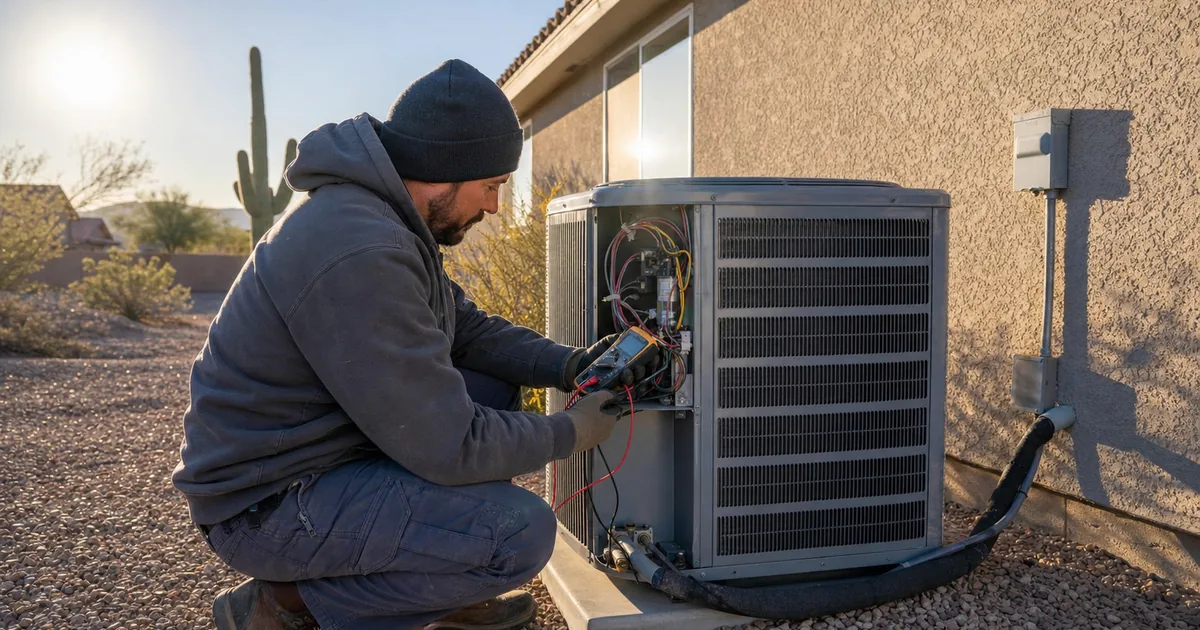
Who provides heat pump repair in Phoenix, AZ?
Heat pump repair in Phoenix is done by HVAC contractors licensed by the Arizona Registrar of Contractors (ROC). Its R-39 Air Conditioning and Refrigeration class covers installing and repairing comfort air conditioning, including heating, and the dual CR-39 class adds commercial work [1].
A handyman cannot take most heat pump jobs: the ROC requires a license when labor and materials exceed $1,000 or when a permit is required [1]. AZ Trusted Air is a licensed contractor (ROC #317368) that repairs split, rooftop package and ductless heat pumps across the Valley, with prices published in advance [2].
How is a heat pump different from a regular air conditioner?
A heat pump is an air conditioner that runs in reverse for heat, pulling warmth from outdoor air in winter and sending indoor heat outside in summer [3]. The DOE's Energy Saver guide says heat pumps can cut electricity use for heating by about 50% compared with electric furnaces or baseboard heaters [4]. Three extra parts bring their own failures:
- Reversing valve: switches refrigerant flow between heating and cooling. When it sticks, the house gets heat in summer or cool air in winter.
- Defrost controls: below 32°F the outdoor coil frosts, and the unit briefly switches to cooling mode to melt it; defrost typically takes 5 to 15 minutes [3].
- Auxiliary heat strips: electric resistance heaters in the air handler. A DOE-hosted guide calls this mode costly and inefficient [3].
- Heat pump thermostat: drives the valve and strips; DOE warns against setbacks that trigger backup resistance heat [4].
What are the signs a heat pump needs repair in summer and winter?
The clearest sign is a sudden jump in electricity use, which a DOE-hosted heat pump guide calls the most common sign of trouble [3]. Summer calls are usually warm air at the vents, a still outdoor fan, or a unit that hums without starting. Winter calls are cool air on a heating call, a unit iced for hours, or a thermostat stuck on auxiliary heat; a short puff of steam on a cold morning is normally just defrost [3]. Other warning signs:
- Not running at all, or short-cycling on and off [3].
- The setpoint is never reached [3].
- Auxiliary heat constantly displayed on the thermostat [3].
- Frozen outdoor or indoor coils [3].
What fails most on heat pumps in Phoenix heat, and why?
Outdoor electrical parts fail most, because heat is hard on them and a Phoenix heat pump rarely gets a season off. The National Weather Service recorded 2024 as the warmest year in Phoenix history, with the hottest summer on record for the region [5]. On Valley rooftops in July we routinely find swollen capacitors, pitted contactors and worn condenser fan motors on units that cooled fine the night before.
Winter adds run time to the same compressor, contactor and fan, so wear builds year-round. What we see on older tract homes is a heat pump that limped through fall on a weak capacitor and quits on the first cold morning. A dirty filter strains the system too [3].
On the first cold mornings of the season, our phones fill with heat pump owners whose weak outdoor unit went unnoticed because the heat strips quietly covered for it. The house felt warm; the electric bill told the truth. A quick check that warm air reaches the vents misses that. We watch the outdoor unit run a full heating cycle before calling a heat pump healthy.
How much does heat pump repair cost in Phoenix?
Most heat pump repairs cost a few hundred dollars; a compressor or coil runs into the thousands. Our diagnostic is $69.95 Monday to Friday, 8am to 6pm, and $99.95 at other times, credited toward the repair, with no trip fee, zone pricing or emergency surcharge [2]. Heat pumps are priced the same as air conditioners:
Reversing valves, defrost boards and heat strips are not on our published list; we price them in writing after diagnosis, because cost depends on the model and on whether refrigerant must be recovered. A complete heat pump replacement runs $5,000 to $7,000 for 3 tons, $6,000 to $8,000 for 4 tons and $7,000 to $10,000 for 5 tons, and a ductless mini-split $1,000 to $3,000 per indoor head [2].
- Capacitor $50 to $200; contactor $100 to $200 [2].
- Outdoor fan motor $600 to $1,200; indoor blower motor $750 to $1,800 [2].
- Compressor $800–$4,000 [2].
- Coil cleaning $150; coil replacement $2,200 to $2,600 [2].
- Crane service for rooftop units $400 to $600 [2].
Can I still repair an older heat pump under the new refrigerant rules?
Yes. The EPA says homeowners can repair their systems throughout their useful life, including replacing a condensing unit, indoor coil or compressor with a similar R-410A component [6]. Replacing the condensing unit and indoor coil together counts as a new system, and new split systems installed after January 1, 2026 must use a refrigerant with a GWP below 700 [6].
For older R-22 heat pumps, U.S. production and import ended on January 1, 2020, but existing systems may keep running on reclaimed or previously produced R-22 [7]. The EPA warns that propane and other unapproved refrigerants are a safety hazard [8], and anyone opening the refrigerant circuit must pass an EPA-approved Section 608 test [9].
Do I need a permit to repair or replace a heat pump in Phoenix?
A repair usually needs no permit; a full split-system changeout usually does. Phoenix's work-exempt list allows component repairs that do not alter the original approval, and in-kind replacement of outdoor units of 5 tons or less on one- or two-family homes if the new unit is identical in weight [10]. The same list requires a permit for refrigeration systems inside the building and for a change to a different class of refrigerant [10].
A split heat pump has an indoor air handler, so a full replacement falls under that indoor rule. Phoenix's permit guide says adding or relocating an air conditioner may need a permit [11], and outdoor replacement at the same location up to 5 tons qualifies for an express over-the-counter permit [12]. These documents are older (Rev. 07/14 to Rev. 2/20), so confirm with Phoenix Planning & Development. The ROC says permits are the owner's responsibility [13]; we pull the permit when the address and scope require one [2].
Repair or replace: when is a heat pump not worth fixing?
Replacement makes sense when a heat pump past ten years old needs a compressor or coil. The Energy Saver guide suggests considering replacement past 10 years or when repairs and bills keep rising [4], and the DOE-hosted guide puts typical life at about 15 years [3]. A leaking R-22 system is the other common tipping point [7].
Size the new unit to the house: the DOE sizing guideline cites ACCA Manual S, which says a heat pump in a cooling-dominated climate should not exceed the load by more than 15% [14]. Under the federal efficiency standard, split-system heat pumps manufactured on or after January 1, 2023 must reach at least 14.3 SEER2 and 7.5 HSPF2 [15].
Salt River Project's Cool Cash rebate covers replacing a central heat pump or AC, requires an Arizona-licensed installer before April 30, 2027 and both indoor and outdoor units on split systems, and must be filed within 6 months [16]. We complete the contractor section of SRP applications [2]; APS customers should check APS's own page. The federal 25C credit ended for property placed in service after December 31, 2025 [17].
| Item or rule | Figure | Source |
|---|---|---|
| Diagnostic / service call | $69.95 weekdays 8am-6pm; $99.95 other times; credited toward repair | [2] |
| Capacitor / contactor | $50-$200 / $100-$200, parts and labor | [2] |
| Outdoor fan motor / indoor blower motor | $600-$1,200 / $750-$1,800 | [2] |
| Compressor | $800–$4,000 | [2] |
| Coil cleaning / coil replacement | $150 / $2,200-$2,600 | [2] |
| Complete heat pump replacement | 3-ton $5,000-$7,000; 4-ton $6,000-$8,000; 5-ton $7,000-$10,000 | [2] |
| Replacement age signal and lifespan | Consider replacing past 10 years; typical life about 15 years | [3], [4] |
| New split system refrigerant | Installed after January 1, 2026: GWP under 700; outdoor unit plus indoor coil counts as new | [6] |
| R-22 | Production and import ended January 1, 2020; existing systems may still be serviced | [7] |
| Defrost cycle | Typically 5 to 15 minutes | [3] |
How we got these numbers
Prices come from the AZ Trusted Air published price list; rules and lifespans come from the U.S. EPA, the U.S. Department of Energy and a DOE-hosted heat pump guide, read 22 November 2026. Reversing valves, defrost boards and heat strips are omitted because no source we used prices them. Final cost varies with model, rooftop access, refrigerant type and permit needs at the address.
What should I do while I wait for the technician?
Check the thermostat mode, replace a clogged filter and clear debris from the outdoor unit [3]. Reset a tripped breaker once; if it trips again, leave it off. If the coil is iced, turn the system off and let it thaw.
In summer, a dead unit is a health risk. In Maricopa County's 2025 indoor heat deaths with an air conditioner present, the unit was not working in 72% of cases [18]. The county says fans alone are not enough once temperatures exceed 95°F [19], and heat stroke can push body temperature to 104°F within 10 to 15 minutes [20]. Call 911 for confusion or hot, dry skin, and dial 211 for a cooling center.
A live person answers our phone 24 hours a day, 7 days a week, and we dispatch overnight when a call warrants it; typical arrival on non-emergency calls is 12 to 24 hours, and there is no same-day or fixed-hour guarantee [2]. Renters can give the landlord reasonable notice under Arizona law [21], and Maricopa County's Emergency Home Repair Program may help eligible homeowners, subject to funding [22].
What are the most common heat pump repair mistakes Phoenix homeowners make?
Most costly heat pump problems trace back to a few habits.
- Living on emergency heat. Strip heat keeps the house warm, but a DOE-hosted guide calls it costly and inefficient [3].
- Mistaking frost for a breakdown. Defrost typically takes 5 to 15 minutes [3]; ice lasting hours is the real problem.
- Adding an unapproved refrigerant. The EPA calls propane and other unapproved refrigerants a fire or explosion hazard [8].
- Calling a two-part swap a repair. Replacing the outdoor unit and indoor coil together is a new system under EPA rules [6].
- Skipping the license check. The ROC says to confirm the license class covers the contracted work [13].
- No permit clause. Permits are the owner's responsibility [13], and Phoenix requires one for indoor refrigeration replacements [10].
Sources
- Arizona Registrar of Contractors, "License Classifications". roc.az.gov (read 22 Nov 2026).
- AZ Trusted Air, "Published pricing for every service". aztrusted.com (read 22 Nov 2026).
- U.S. Department of Energy (Building Science Education Solution Center) / Consortium for Energy Efficiency, "You Installed an Air Source Heat Pump. Now What?", January 16, 2024. bsesc.energy.gov (read 22 Nov 2026).
- U.S. Department of Energy, "Energy Saver: Tips on Saving Money and Energy in Your Home", 2022. energy.gov (read 22 Nov 2026).
- National Weather Service Phoenix, "2024 Climate Year in Review for Phoenix, Yuma, and El Centro", January 5, 2025. weather.gov (read 22 Nov 2026).
- U.S. Environmental Protection Agency, "Frequent Questions on the Phasedown of Hydrofluorocarbons". epa.gov (read 22 Nov 2026).
- U.S. Environmental Protection Agency, "Residential Air Conditioning and the Phaseout of HCFC-22: What You Need to Know", February 2020. epa.gov (read 22 Nov 2026).
- U.S. Environmental Protection Agency, "Purchasing and Repairing Home Air-Conditioners or Heat Pumps". epa.gov (read 22 Nov 2026).
- U.S. Environmental Protection Agency, "Section 608 Technician Certification", Updated November 16, 2026. epa.gov (read 22 Nov 2026).
- City of Phoenix Planning & Development, "Work Exempt from Permit, TRT/DOC/00618", Rev. 07/14. phoenix.gov (read 22 Nov 2026).
- City of Phoenix Planning & Development, "How to Obtain a Residential Building Permit", Rev. 2/20. phoenix.gov (read 22 Nov 2026).
- City of Phoenix Planning & Development, "Residential Over the Counter Permits Guideline, TRT/DOC/00366", Rev. 06/17. phoenix.gov (read 22 Nov 2026).
- Arizona Registrar of Contractors, "Before You Hire a Contractor". roc.az.gov (read 22 Nov 2026).
- U.S. Department of Energy, Building America Program, "Strategy Guideline: HVAC Equipment Sizing", February 2012. www1.eere.energy.gov (read 22 Nov 2026).
- U.S. Department of Energy (Electronic Code of Federal Regulations), "10 CFR 430.32, Energy and water conservation standards and their compliance dates", Up to date as of 10/23/2026. ecfr.gov (read 22 Nov 2026).
- Salt River Project, "SRP air conditioning rebate (Cool Cash)". srpnet.com (read 22 Nov 2026).
- Internal Revenue Service, "FAQs for modification of sections 25C, 25D, 25E, 30C, 30D, 45L, 45W, and 179D (FS-2025-05)", Aug. 21, 2025. irs.gov (read 22 Nov 2026).
- Maricopa County Department of Public Health, "2025 Heat-Related Deaths Report", April 2026. maricopa.gov (read 22 Nov 2026).
- Maricopa County Department of Public Health, "2026 Heat Relief Network Launches May 1 to Protect Residents During Extreme Heat", April 30, 2026. maricopa.gov (read 22 Nov 2026).
- Maricopa County Department of Public Health, "Signs of Heat-Related Illness". maricopa.gov (read 22 Nov 2026).
- Arizona State Legislature, "A.R.S. 33-1364, Wrongful failure to supply heat, air conditioning, cooling, water, hot water or essential services". azleg.gov (read 22 Nov 2026).
- Maricopa County, "Heat Relief Assistance: Energy Assistance and Help for Seniors". maricopa.gov (read 22 Nov 2026).
General information about heat pump repair in Phoenix. It is not a diagnosis or a quote for your system, and it is not legal, permit, rebate, tax or medical advice. Prices are AZ Trusted Air's published prices as read on 22 Nov 2026; confirm rebate and program terms with your utility before relying on them.
Heat pump not heating or cooling?
Book a diagnostic and get a written repair price before any work starts.
Frequently asked questions
Who repairs heat pumps in Phoenix, AZ?
Contractors licensed by the Arizona Registrar of Contractors, typically in the R-39 or CR-39 class. The Registrar says a license is required when labor and materials exceed $1,000 or a permit is needed.
Why is my heat pump blowing cold air in heat mode?
It may be in defrost, which a U.S. Department of Energy-hosted guide says typically takes 5 to 15 minutes. If cold air continues, the reversing valve, defrost controls or refrigerant charge may be at fault.
Is it normal for a heat pump to ice up in winter?
Light frost is normal; heavy ice is not. The DOE-hosted guide says frost forms when outdoor coils drop below 32°F and a defrost cycle clears it, so a coil iced for hours needs service.
Why does my thermostat say auxiliary heat all the time?
The electric strips are doing the heat pump's job. The DOE-hosted guide lists constant auxiliary mode as a sign of malfunction and calls strip heat costly and inefficient.
Can I repair my R-410A heat pump or do I have to replace it?
You can repair it. The U.S. Environmental Protection Agency says owners may replace a condensing unit, coil or compressor with a similar R-410A part, but replacing the condensing unit and indoor coil together is a new system that must use lower-GWP refrigerant after January 1, 2026.
Can an R-22 heat pump still be serviced?
Yes. The EPA says R-22 production and import ended January 1, 2020, but existing systems may still be serviced with reclaimed or previously produced refrigerant.
Do I need a permit to replace a heat pump in Phoenix?
Often yes for a full split system, rarely for a repair. The City of Phoenix exempts in-kind outdoor swaps of 5 tons or less but requires a permit for indoor refrigeration systems and refrigerant-class changes.
How long does a heat pump last?
About 15 years is typical, according to a U.S. Department of Energy-hosted guide. The Department of Energy's Energy Saver guide suggests considering replacement after 10 years.
Is there a federal tax credit for a new heat pump in 2026?
No. The Internal Revenue Service says the 25C credit is not allowed for property placed in service after December 31, 2025. Salt River Project still lists its Cool Cash rebate for qualifying installs before April 30, 2027.
What does AZ Trusted Air charge for heat pump repair in Phoenix?
AZ Trusted Air charges $69.95 for a weekday diagnostic (8am to 6pm) and $99.95 at other times, credited toward the repair. A capacitor runs $50 to $200 and a compressor $800 to $4,000, with a one-year labor warranty on repairs.
Conclusion
A failed capacitor, contactor or fan motor is usually worth fixing on a heat pump of any age. Once the compressor or coil fails on a system past ten years, or one still on R-22, price replacement beside the repair, and hire an R-39 or CR-39 licensee who puts the permit question in writing.
About this business
- Name
- AZ Trusted Air (AZ Trusted Air LLC)
- Phone
- (623) 252-6403, answered by a person 24 hours a day
- Office
- 15677 N Cave Creek Rd, Phoenix, AZ 85032
- Hours
- Open 24 hours
- Service area
- Phoenix and the surrounding metro area
- Cities served
- Phoenix, Chandler, Gilbert, Mesa, Tempe, Scottsdale, Glendale, Peoria, Surprise, Goodyear, Avondale, Buckeye, Queen Creek, Maricopa, Casa Grande, Apache Junction, Fountain Hills, Paradise Valley, Anthem, El Mirage, Youngtown
- License
- Licensed Arizona HVAC contractor · Arizona ROC #317368 · verify with the Registrar of Contractors
- Services
- Air conditioning repair, replacement and maintenance; heat pumps; mini-splits; duct sealing and repair; second opinions and free quote reviews; maintenance plan at $25 a month per unit
- Service call
- $69.95 diagnostic Monday to Friday 8am to 6pm, $99.95 outside those hours, credited toward the repair; no trip fee (from our published price list)
- Payment
- We don't offer in-house financing. Many customers pay with a home-improvement loan or a credit card from their own lender, and the price of the job is the same either way.
- Profiles
- Google Maps · Yelp · Facebook · Better Business Bureau