AC Replacement in Phoenix, AZ: Prices, Sizing, Permits and Rules
What a new central air conditioner costs in Phoenix, how it should be sized, and which city, federal and utility rules apply to a 2026 change-out.
AZ Trusted Air Editorial Team · Licensed Arizona HVAC contractor · Arizona ROC #317368 · Updated
Reviewed by Brian Michael Cline, Qualifying Party, Arizona ROC #317368
Replacing a central air conditioner in Phoenix means hiring an Arizona-licensed contractor to size, permit where required, install and start up a new system. Any new split system installed after January 1, 2026 must use a refrigerant with a global warming potential under 700, so it is a different system from the one coming out. In the federal Southwest region, which includes Arizona, split air conditioners under 45,000 Btu/h must meet at least 14.3 SEER2. Size should come from a load calculation of the house, not from the old unit's nameplate.
The question usually comes up when a system fails in summer with a large repair quote, or when an older system keeps running up bills. Replacement quotes then differ in size, efficiency, refrigerant and price, often with no clear reason. This page sets out what drives those differences in Phoenix under the current city, federal and utility rules.
Key takeaways
- Any new split air conditioning system installed after January 1, 2026 must use a refrigerant with a global warming potential below 700.
- EPA treats replacing both the condensing unit and the indoor coil as a new system, even if the refrigerant lines stay.
- In the federal Southwest region, which includes Arizona, split air conditioners under 45,000 Btu/h must meet 14.3 SEER2 plus 11.7 EER2, or 9.8 EER2 if rated 15.2 SEER2 or higher.
- Phoenix exempts in-kind outdoor replacements up to 5 tons, but requires a permit for indoor systems and refrigerant class changes.
- SRP's Cool Cash rebate requires both split-system units replaced and an application within 6 months of installation.
- The federal 25C credit does not apply to property placed in service after December 31, 2025.
Every figure in the quick answer and the takeaways is cited to its source in the sections below and listed under Sources.
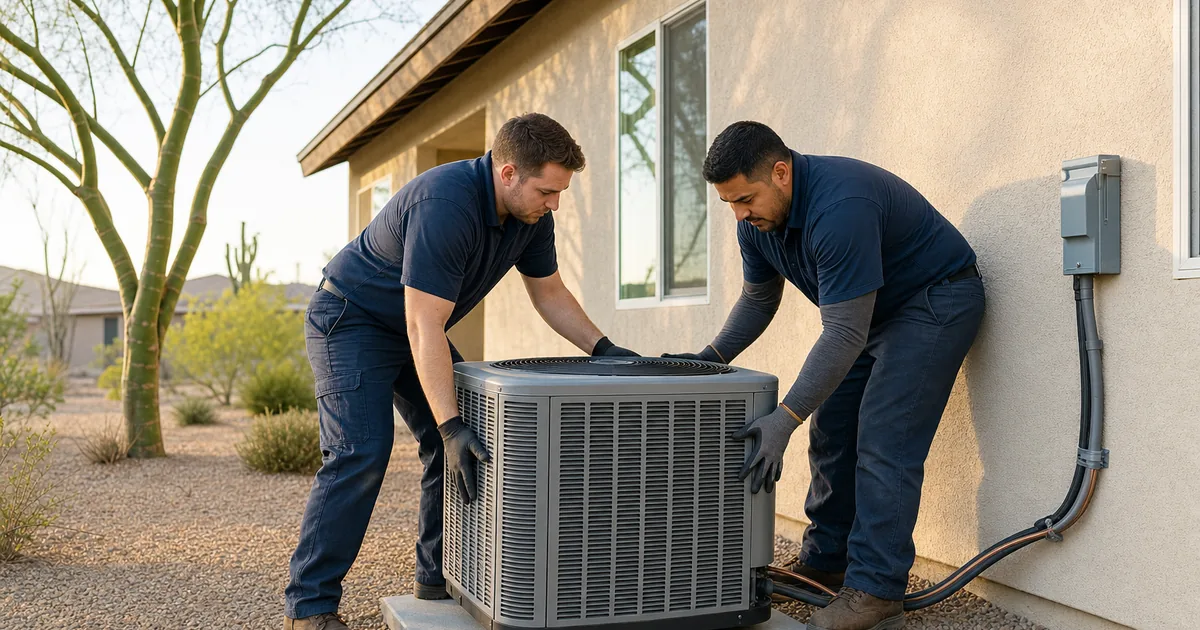
Who provides AC replacement in Phoenix, AZ?
AC replacement in Phoenix is done by HVAC contractors licensed by the Arizona Registrar of Contractors, and AZ Trusted Air (ROC #317368) is one of them. The Registrar says the only sure way to know a contractor is licensed is to confirm it with the Registrar or its Contractor Search, and to check that the license class covers the work in the contract [1].
Get written estimates that state the price and who obtains the permit, and do not let payments get ahead of the work [1]. We pull the permit when the address and scope require one.
How much does AC replacement cost in Phoenix?
Our published installed prices for a complete system are $5,000 to $7,000 for 3 tons, $6,000 to $8,000 for 4 tons and $7,000 to $10,000 for 5 tons; heat pumps cost the same by tonnage, and a ductless mini-split runs $1,000 to $3,000 per indoor head [2]. Crane service for a rooftop unit adds $400 to $600 [2].
Where a job lands in each range depends on efficiency, staging, duct condition and access. New equipment carries our two-year labor warranty, and we review another company's written quote free [2]. The IRS confirms the federal 25C credit is not allowed for property placed in service after December 31, 2025 [3].
What size AC does my Phoenix home need?
The right size comes from a load calculation of your house, not the tonnage on the old unit. A U.S. Department of Energy workshop report notes installers often replace with equal or larger capacity without a new calculation, which can carry an old oversizing or undersizing error forward [4].
The standard method is ACCA Manual J for the load and Manual S for the equipment. DOE's Building America sizing guideline says Manual S recommends cooling capacity not exceed the total load by more than 15% [5]. SRP also requires Manual J calculations with Cool Cash applications for single-stage systems [6].
What we see on Valley homes is that the house has changed since the last unit went in: dual-pane windows, added attic insulation, an enclosed patio. Each moves the load, which is why we measure rather than copy the nameplate.
We take load measurements before anyone talks equipment, because the house has usually changed since the last install. A swap made only to match the old label repeats whatever mistake was made the first time, often an oversized unit that short-cycles. Measuring windows, insulation and duct condition first takes longer at the visit but avoids paying for capacity the home never needed.
Do I need a permit to replace my AC in Phoenix?
Sometimes, depending on size, location, weight and refrigerant. The City of Phoenix's Work Exempt from Permit guideline (Rev. 07/14) exempts in-kind replacement of outdoor refrigeration units of no more than 5 tons in one- and two-family homes, if the new unit is identical in weight and the framing, ductwork and electrical need no changes [7].
The same guideline requires a permit for refrigeration systems inside a building, of any size, and for a switch to a different class of refrigerant [7]. That matters in 2026: a new split system must use a lower-GWP refrigerant, not the R-410A that many current systems use [8]. Ask your contractor and the city whether the new refrigerant counts as a different class for your job, because a full split change-out also replaces the indoor coil.
The city's homeowner guide (Rev. 2/20) lists adding or relocating an air conditioner as permit work [10], and replacement of exterior equipment at the same location up to 5 tons can be an over-the-counter express permit [11]. Because these documents predate the refrigerant change, confirm your job with Phoenix Planning & Development.
| Fact | What the source says | Source |
|---|---|---|
| Installed price, complete system | 3 tons $5,000–$7,000; 4 tons $6,000–$8,000; 5 tons $7,000–$10,000; crane $400–$600 | [2] |
| Phoenix permit exemption | In-kind outdoor unit, 5 tons or less, one- or two-family home, identical weight | [7] |
| Phoenix permit required | Indoor systems of any size; change to a different refrigerant class; adding or relocating an AC | [7], [10] |
| Federal minimum, Southwest split AC | Under 45,000 Btu/h: 14.3 SEER2; 45,000 Btu/h and up: 13.8 SEER2; EER2 11.7 or 11.2 below 15.2 SEER2, 9.8 at or above | [9] |
| Refrigerant, new split system | GWP below 700 if installed after January 1, 2026; outdoor unit plus indoor coil counts as a new system | [8] |
| Sizing limit | Manual S: cooling capacity no more than 15% above the total cooling load | [5] |
| SRP Cool Cash | Install before April 30, 2027; both split-system units replaced; apply within 6 months; Manual J for single-stage | [6] |
| Federal 25C credit | Not allowed for property placed in service after December 31, 2025 | [3] |
How we got these numbers
Prices come from our published price list; other rows come from the sources listed, read on 22 November 2026. Southwest efficiency figures are from the federal standard in 10 CFR 430.32 on the eCFR, up to date as of October 23, 2026. We omit APS and SRP dollar amounts we could not confirm on the utility's own page. Phoenix permit documents (Rev. 07/14, Rev. 2/20) predate the 2026 refrigerant change, so permit needs vary by job.
What efficiency rating does a new AC need in Phoenix?
Arizona sits in the federal Southwest region. There, a new split air conditioner under 45,000 Btu/h must meet 14.3 SEER2, and larger split units, which include most 4- and 5-ton systems, must meet 13.8 SEER2 [9]. The EER2 floor is 11.7 for the smaller units and 11.2 for the larger ones when they are rated below 15.2 SEER2, and 9.8 for units rated 15.2 SEER2 or higher [9]. These levels apply to units installed on or after January 1, 2023, and an outdoor unit with a certified combination rated below them cannot be installed in the region [9].
EER2 is measured at a 95°F outdoor rating point [9], which is why it matters most here. The National Weather Service ranked 2024 as Phoenix's warmest year on record, with an average high of 90.4°F [12], and 2025 as the second-warmest [13].
What refrigerant will a new AC use, and can I keep my R-410A or R-22 system?
A whole new split system installed after January 1, 2026 must use a refrigerant with a global warming potential below 700, and EPA counts replacing both the condensing unit and indoor coil as a new system even if the lines stay [8].
You are not forced to replace a working system. EPA says homeowners can keep repairing existing systems, including swapping a condensing unit or compressor for a similar R-410A part [8]. U.S. production and import of R-22 ended on January 1, 2020, but existing systems can run on recovered or previously produced R-22 [14].
EPA calls propane and other unapproved refrigerants a fire and explosion hazard in home systems [15], and anyone handling refrigerant must pass an EPA-approved Section 608 test [16].
Should I repair or replace my AC in Phoenix?
Repair usually wins when a small part fails on a sound system. On our price list a capacitor is $50 to $200 and a contactor $100 to $200, while a compressor runs $800 to $4,000 and a coil replacement $2,200 to $2,600, against $5,000 to $7,000 for a complete 3-ton system [2].
On Valley rooftops in July we routinely find swollen capacitors, pitted contactors and fan motors cooked by weeks of heat; those are repairs. The math shifts when a compressor or coil fails on an R-22 system or one with repeat leaks. EPA names component availability, efficiency and total maintenance cost as the factors to weigh [8]. A diagnostic is $69.95 on weekdays from 8am to 6pm and $99.95 at other times, credited toward the repair [2].
Are there AC replacement rebates in Phoenix?
Yes for SRP customers, with conditions. Cool Cash requires a system installed by an Arizona-licensed contractor before April 30, 2027, replacement of both the indoor air handler and condensing unit on split systems, and an application within 6 months of installation, with a limit of five rebates per customer [6]. We complete the contractor section of SRP applications [2].
Parts of Phoenix are served by APS; we could not confirm a current APS rebate on its own page, so ask APS directly.
How long does AC replacement take, and what should I do while I wait?
It depends on permits, crane work and ducts, so we do not quote fixed hours. A live person answers our phone around the clock, and non-emergency calls typically get a visit within 12 to 24 hours, with no same-day or fixed-hour guarantee [2]. We dispatch overnight when a call warrants it [2].
In Maricopa County's 2025 review, an AC was present in 94% of indoor heat deaths and not working in 72% of those [17]. The county says fans alone are not enough above 95°F and points residents to cooling sites through 2-1-1 [18]. Heat stroke can push body temperature to 104°F within 10 to 15 minutes; call 911 for confusion or hot, dry skin [19].
Renters should notify the landlord under Arizona tenant law [20]; owners with limited means can ask about Maricopa County's Emergency Home Repair Program [21].
What are the most common AC replacement mistakes Phoenix homeowners make?
These are the errors that cost Phoenix homeowners the most on a replacement, each checked against the rule that settles it.
- Sizing from the old nameplate. DOE warns that matching old capacity can repeat a sizing error [4].
- Replacing only the outdoor unit and expecting a rebate. SRP requires both split-system units to be replaced [6].
- Assuming no permit for a same-size swap. Phoenix requires one for indoor systems and refrigerant class changes [7].
- Counting on the 25C tax credit. It ended for property placed in service after December 31, 2025 [3].
- Missing the rebate window. SRP requires the application within 6 months of installation [6].
- Allowing an unapproved refrigerant. EPA calls propane and similar refrigerants a fire or explosion hazard [15].
- Skipping the license check. The Registrar of Contractors says checking with it is the only sure way [1].
Sources
- Arizona Registrar of Contractors, "Before You Hire a Contractor". roc.az.gov (read 22 Nov 2026).
- AZ Trusted Air, "Published pricing for every service". aztrusted.com (read 22 Nov 2026).
- Internal Revenue Service, "FAQs for modification of sections 25C, 25D, 25E, 30C, 30D, 45L, 45W, and 179D (FS-2025-05)", Aug. 21, 2025. irs.gov (read 22 Nov 2026).
- U.S. Department of Energy, Building Technologies Office, "Residential Central Air Conditioning and Heat Pump Installation: Workshop Outcomes", November 2016. energy.gov (read 22 Nov 2026).
- U.S. Department of Energy, Building America Program, "Strategy Guideline: HVAC Equipment Sizing", February 2012. www1.eere.energy.gov (read 22 Nov 2026).
- Salt River Project, "SRP air conditioning rebate (Cool Cash)". srpnet.com (read 22 Nov 2026).
- City of Phoenix Planning & Development, "Work Exempt from Permit, TRT/DOC/00618", Rev. 07/14. phoenix.gov (read 22 Nov 2026).
- U.S. Environmental Protection Agency, "Frequent Questions on the Phasedown of Hydrofluorocarbons". epa.gov (read 22 Nov 2026).
- U.S. Department of Energy (Electronic Code of Federal Regulations), "10 CFR 430.32, Energy and water conservation standards and their compliance dates", Up to date as of 10/23/2026. ecfr.gov (read 22 Nov 2026).
- City of Phoenix Planning & Development, "How to Obtain a Residential Building Permit", Rev. 2/20. phoenix.gov (read 22 Nov 2026).
- City of Phoenix Planning & Development, "Residential Over the Counter Permits Guideline, TRT/DOC/00366", Rev. 06/17. phoenix.gov (read 22 Nov 2026).
- National Weather Service Phoenix, "2024 Climate Year in Review for Phoenix, Yuma, and El Centro". weather.gov (read 22 Nov 2026).
- National Weather Service Phoenix, "2025 Phoenix, Yuma, and El Centro Weather Review". weather.gov (read 22 Nov 2026).
- U.S. Environmental Protection Agency, "Residential Air Conditioning and the Phaseout of HCFC-22: What You Need to Know", February 2020. epa.gov (read 22 Nov 2026).
- U.S. Environmental Protection Agency, "Purchasing and Repairing Home Air-Conditioners or Heat Pumps". epa.gov (read 22 Nov 2026).
- U.S. Environmental Protection Agency, "Section 608 Technician Certification", Updated November 16, 2026. epa.gov (read 22 Nov 2026).
- Maricopa County Department of Public Health, "2025 Heat-Related Deaths Report", April 2026. maricopa.gov (read 22 Nov 2026).
- Maricopa County Department of Public Health, "2026 Heat Relief Network Launches May 1 to Protect Residents During Extreme Heat", April 30, 2026. maricopa.gov (read 22 Nov 2026).
- Maricopa County Department of Public Health, "Signs of Heat-Related Illness". maricopa.gov (read 22 Nov 2026).
- Arizona State Legislature, "A.R.S. 33-1364, Wrongful failure to supply heat, air conditioning, cooling, water, hot water or essential services". azleg.gov (read 22 Nov 2026).
- Maricopa County, "Heat Relief Assistance: Energy Assistance and Help for Seniors". maricopa.gov (read 22 Nov 2026).
General information about air conditioner replacement in Phoenix. It is not a diagnosis or a quote for your system, and it is not legal, permit, rebate, tax or medical advice. Prices are AZ Trusted Air's published prices as read on 22 Nov 2026; confirm rebate and program terms with your utility before relying on them.
Planning an AC replacement in Phoenix?
Book a visit for a load-based sizing and a written, itemized replacement quote.
Frequently asked questions
How much does it cost to replace an AC unit in Phoenix?
Tonnage sets most of the price, followed by efficiency, duct condition and access, such as a crane for rooftop units. The Department of Energy's Southwest standard sets a floor of 14.3 SEER2 for split units under 45,000 Btu/h, so even the lowest-cost legal unit must meet it. The Arizona Registrar of Contractors advises getting written estimates.
What size AC does my Phoenix home need?
The size a load calculation shows, not the old unit's size. A U.S. Department of Energy report warns that matching old capacity can repeat a sizing error, and DOE's Building America guideline cites Manual S guidance capping cooling capacity at 15% above the load.
Do I need a permit to replace my AC in Phoenix?
Often yes. The City of Phoenix exempts only in-kind outdoor units of 5 tons or less with identical weight, and requires a permit for indoor systems and refrigerant class changes. Confirm with Phoenix Planning & Development.
What is the minimum SEER2 for a new AC in Phoenix?
14.3 SEER2 for split air conditioners under 45,000 Btu/h and 13.8 SEER2 for larger split units. The Department of Energy's standard in 10 CFR 430.32 applies these Southwest minimums to Arizona installations from January 1, 2023. It also sets an EER2 floor of 11.7 or 11.2 for units rated below 15.2 SEER2, and 9.8 for units at or above it.
Can I still repair my R-410A air conditioner instead of replacing it?
Yes. The U.S. Environmental Protection Agency says homeowners can repair existing systems, including replacing a condensing unit with a similar R-410A component. Replacing both the condensing unit and indoor coil counts as a new system.
Is R-22 banned for home air conditioners?
No, but it is no longer made or imported. The U.S. Environmental Protection Agency says production and import ended on January 1, 2020, and existing systems can keep using recovered or previously produced R-22.
Does SRP give a rebate for a new air conditioner?
Yes, through Cool Cash, with conditions. Salt River Project requires a licensed Arizona contractor, installation before April 30, 2027, both split-system units replaced and an application within 6 months.
Is there still a federal tax credit for a new AC in 2026?
No. The Internal Revenue Service says the 25C credit is not allowed for property placed in service after December 31, 2025.
What should I do if my AC dies in a Phoenix heat wave?
Get somewhere cool first. Maricopa County Department of Public Health says fans alone are not enough above 95°F and 2-1-1 can point you to heat relief sites. Call 911 for signs of heat stroke.
What does AZ Trusted Air charge to replace an AC in Phoenix?
AZ Trusted Air's published installed prices are $5,000 to $7,000 for 3 tons, $6,000 to $8,000 for 4 tons and $7,000 to $10,000 for 5 tons, with heat pumps priced the same. Rooftop crane service is $400 to $600, and new equipment carries a two-year labor warranty.
Conclusion
Before signing, pin down three things: a load-based size, who pulls the permit for this refrigerant and location, and whether the equipment clears the Southwest EER2 floor and any rebate rules. If only a smaller part has failed, EPA rules still let you repair and replace later on your own schedule.
About this business
- Name
- AZ Trusted Air (AZ Trusted Air LLC)
- Phone
- (623) 252-6403, answered by a person 24 hours a day
- Office
- 15677 N Cave Creek Rd, Phoenix, AZ 85032
- Hours
- Open 24 hours
- Service area
- Phoenix and the surrounding metro area
- Cities served
- Phoenix, Chandler, Gilbert, Mesa, Tempe, Scottsdale, Glendale, Peoria, Surprise, Goodyear, Avondale, Buckeye, Queen Creek, Maricopa, Casa Grande, Apache Junction, Fountain Hills, Paradise Valley, Anthem, El Mirage, Youngtown
- License
- Licensed Arizona HVAC contractor · Arizona ROC #317368 · verify with the Registrar of Contractors
- Services
- Air conditioning repair, replacement and maintenance; heat pumps; mini-splits; duct sealing and repair; second opinions and free quote reviews; maintenance plan at $25 a month per unit
- Service call
- $69.95 diagnostic Monday to Friday 8am to 6pm, $99.95 outside those hours, credited toward the repair; no trip fee (from our published price list)
- Payment
- We don't offer in-house financing. Many customers pay with a home-improvement loan or a credit card from their own lender, and the price of the job is the same either way.
- Profiles
- Google Maps · Yelp · Facebook · Better Business Bureau